
Introduction
It’s been an eventful first week here at the Backyard Farm — and thankfully, it’s all been positive. From Giblets and Apollo taking their first steps outside and seeing the sky for the very first time, to Apollo laying her first egg, life with my rescue chickens is already starting to feel settled.
The weather is improving too. Over the next week of March, I’ll be sowing a few early seeds in the propagator, starting with radish. I’ve also sourced pre-grown rhubarb crowns to get things moving. I won’t be growing rhubarb from seed, simply because of how long it takes to establish — a small shortcut that makes sense in a busy backyard setup.
Continue your backyard chickens journey
If you’re reading about your first week with rescue chickens, these guides will help you manage chicken care, feeding, and create a better chicken-friendly environment.
- How to keep chickens in the suburbs – Practical tips for caring for chickens, ensuring they’re happy and healthy in a home garden environment.
- What can I feed my backyard chickens? – A comprehensive guide to safe, nutritious, and balanced feeding for backyard chickens of all ages.
- Guide: how to feed my chickens egg shells – Advice on using egg shells for calcium and integrating it into your chickens’ diet safely.
If you’d like, I can also draft the ready-to-paste internal link paragraph with a tailored intro sentence matching the tone of this specific blog post.
Seeing the sky for the first time
Apollo and Giblets are rescue chickens, rehomed after spending their prime egg-laying years confined to tight, often stressful warehouse environments. In many cases, hens like these are destined for slaughter once production drops. Having lived indoors for so long, it’s unlikely they’d ever properly seen the sky.
Apollo is the braver of the two and had already ventured outside for a few minutes before I managed to grab the camera. Luckily, I caught Giblets’ first tentative steps into the big wide world. When she tilts her head to one side, I’m fairly sure she’s looking straight up at the sky.
She seemed a little taken aback at first, before quickly returning to the important business of eating corn and grain. Since then, both chickens have been venturing a little further each time, scratching around the stone flags and uncovering bugs and other tasty morsels — a clear sign they’re beginning to behave like proper free-range backyard chickens.
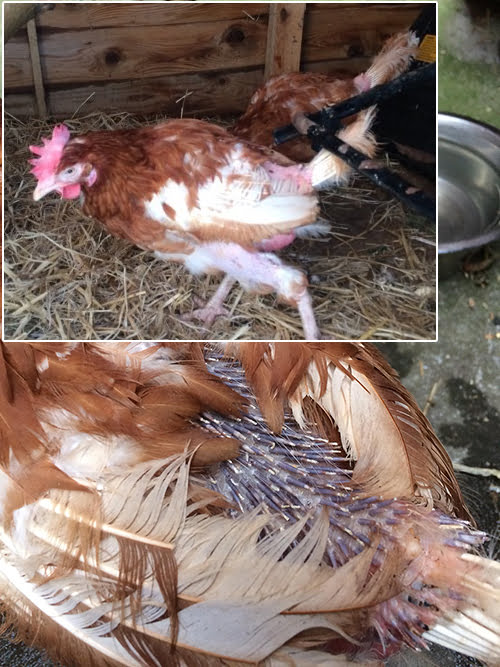
Feathers are now regrowing
As the chickens continue to settle into their new backyard home, the bare patches of skin they arrived with are already starting to fill in. Feather regrowth is often one of the first visible signs that rescue hens are feeling safer, calmer, and healthier.
Even after just a few days, the difference is noticeable. A combination of extra treats, gentle human interaction, and constant access to clean, fresh water has clearly helped. I’ve also been adding a small splash of apple cider vinegar for chickens, which can be a useful all-round supplement when used sensibly.
What does apple cider vinegar do for chickens?
Apple cider vinegar (ACV) is a simple, inexpensive product that’s widely available in supermarkets and pet stores. Like white vinegar, it can be used for cleaning. However, when you choose an unpasteurised apple cider vinegar that still contains the ‘mother’, it can also offer nutritional benefits for chickens.
Apple cider vinegar may help with:
- Reducing internal worms
- Acting as a mild antibacterial
- Supporting a healthy digestive system
- Boosting the immune system
- Helping deter mites
It’s a versatile staple that’s well worth keeping in the chicken cupboard. While standard ACV is still useful, unpasteurised apple cider vinegar for chickens is the better option for oral use.
The ‘mother’ contains natural enzymes, beneficial bacteria, and organic acids that can support gut health, aid digestion, and help the body flush out unwanted toxins — particularly helpful during periods of stress or transition, such as rehoming.
If you’re considering adopting rescue chickens, this post offers a realistic look at the first week of adjustment. For anyone building or improving their setup, you may also find my guide to creating a chicken-proof fence using reclaimed materials useful.
How much apple cider vinegar should I give my chickens?
A common guideline is around 5ml of apple cider vinegar per litre of drinking water, used up to five times per month. As with most supplements, moderation is key — too much of a good thing can do more harm than good.
Cleaning out the chickens
Keeping a clean coop is one of the simplest ways to support healthy backyard chickens. To clean out the chicken coop, I use a strong mix of white vinegar and hot water — roughly three parts vinegar to ten parts water.
After removing debris with a brush and spade, I wash the wooden floor thoroughly with the solution. This helps break down ammonia and reduces bacterial build-up. Although the coop smells vinegary at first, a bit of ventilation quickly leaves it smelling clean and fresh, ready for new bedding, food, and water.
I aim to do this at least once a week, and ideally twice. Chickens aren’t filthy animals, and they consistently thrive better in a clean, well-maintained environment.
White distilled vinegar
White distilled vinegar is particularly useful around chickens for:
- Cleaning the coop
- Scrubbing stone or concrete areas
- Neutralising ammonia smells
- Killing bacteria, including E. coli and salmonella
First egg from the now free-range chickens!
She’s a beauty.
Apollo laid her first egg here at the Backyard Farm, which was a brilliant moment and a clear sign that she’s settling in well. Seeing a first egg from rescue chickens is always reassuring, especially in the early days.
As expected, the egg was on the small side. First eggs often are, and they usually increase in size and shell strength as the laying cycle becomes more established.
After giving the chooks a few treats — including worms — a couple of days earlier, I was quietly hopeful. After cleaning out the coop and laying out a small feast of rocket and spinach, Apollo settled into one of the nesting areas.
She was making sounds I hadn’t heard before and clearly attempting to nest. I kept my distance and got on with my chores, checking in occasionally.
Once she hopped down for breakfast, I took the chance to inspect the nest.
Finally — an egg.
Cooking my first egg
Feeling suitably chuffed, the original plan was eggs and soldiers. However, given the egg’s size, I decided instead to add it to a plate of homemade baked beans and chips.
There wasn’t much egg white, but the yolk was a great size. Again, this is typical of early eggs, and I expect they’ll even out over the coming weeks.
How did it taste?
Excellent. The yolk was a deep golden yellow with a rich flavour and smooth texture. I’m already looking forward to the next ones — these ladies should soon be producing regularly.
Escaped chicken – I thought one had been eaten by a fox!
This was a near miss and a tense moment. As dusk settled and the chickens normally would have gone to roost, I realised I hadn’t seen them for over an hour.
Grabbing a torch, I checked the coop and could only see one chicken. After searching the garden, coop, and front area, I feared the worst — either a fox had been in, or one had wandered into a neighbour’s garden.
Hoping for the best, I let the dog out and started to wind down for the evening.
Found by my dog
I have some freshly felled pine logs stacked near the back door. When my dog paused there unusually long, I began to suspect something was up.
Sure enough, tucked in behind the logs was Giblets — the elusive escapee. Considering she’d barely been outside before, I never expected to find her settling down for the night so far from the coop.
Back in the chicken coop
I gently picked her up and returned her to the coop. Apollo had already claimed one side, possibly preparing another egg, while Giblets settled in on the other. Hopefully, she’ll be feeling confident enough to start laying before long.
Foods they have been eating
During their first week, I’ve been offering Giblets and Apollo a varied diet while they build confidence outdoors. In time, I expect most of their food will come from natural foraging — bugs, larvae, and greenery. Until then, a few carefully chosen treats help support nutrition and trust.
Do chickens like worms?
Absolutely. Wet, muddy conditions are perfect for worms, and during some gardening work I uncovered a few. They didn’t last more than a couple of seconds once Apollo and Giblets spotted them.
Fresh garden worms are clearly a firm favourite and a great natural protein source.
Do chickens like salads?
I had some leftover salad that was on its way out. Normally it would have gone straight into the compost, but I decided to see what the chickens thought.
After a few confused pecks, they quickly got the idea and set about tearing the leaves apart — leafy greens are a useful supplement in moderation.
Do chickens like bananas?
Bananas are a good source of vitamins for chickens, particularly when they’re slightly overripe. A few slices mixed into their feed were quickly gobbled up.
Interestingly, the skins are often even more nutritious. When boiled or steamed and finely chopped, banana skins can make a great occasional treat — something I’ll be experimenting with and covering in a future article.
Did you know?
In some parts of the world, food traditions are taken very seriously. In Gainesville, Florida, fried chicken is traditionally eaten with your hands — using cutlery is considered improper.