In practice, this solar system sizing calculator is designed for real‑world setups such as:
- Off‑grid cabins
- Campervans and van conversions
- Garden offices
- Small workshops or sheds
- Emergency backup power


Home » Solar Calculator – Solar Panel & Off‑Grid System Size Tool
Planning a small solar setup can feel confusing at first. However, once you understand the basics, it becomes much easier to estimate the right equipment.
Whether you’re powering a garden office, campervan, shed workshop, or off‑grid cabin, the same question usually comes up:
How big does the solar system need to be?
In practice, this solar system sizing calculator is designed for real‑world setups such as:
This solar calculator helps estimate the solar panel size, battery capacity, and inverter requirements needed to run your setup. Instead of trying to manually calculate watts and storage capacity, the tool quickly estimates your system based on the appliances you plan to run.
Simply add the appliances you want to run, adjust the daily usage hours, and the solar calculator will estimate how much solar generation and battery storage you need.
One of the most common questions people ask when planning a solar setup is:
“How many solar panels do I need?”
The answer depends on how much electricity your appliances use each day. Solar panels generate electricity during daylight hours, and that energy must cover everything you want to run — from lighting and laptops to fridges or power tools.
A good starting point is to estimate daily energy consumption, which is measured in watt‑hours (Wh).
For example:
When you add together all appliances, you get your total daily electricity demand.
At this point, the solar panel calculator estimates the solar panel capacity required to generate that energy during typical sunlight hours.
Typical small systems might look like this:
| System Size | Typical Panel Count |
|---|---|
| Small off‑grid setup | 2–4 panels |
| Garden office system | 4–6 panels |
| Small home system | 8–12 panels |
Most modern residential solar panels produce roughly 350–450 watts each, although output varies depending on panel quality, orientation, and sunlight levels.
The calculator automatically estimates how many panels are required based on your daily energy usage and typical solar generation.
A solar system sizing calculator works by estimating how much electricity your setup will use each day. It then calculates how much solar generation is needed to cover that demand.
The process follows a few simple steps.
First, the tool looks at appliance power usage, which is measured in watts (W). Every electrical device consumes a certain amount of power when it is running.
Next, it considers daily usage time. Naturally, running a device for longer increases the total energy consumed.
Using these two values, the calculator determines your daily energy demand, measured in watt‑hours (Wh).
For example:
60W laptop × 6 hours = 360Wh per day
Once the total daily energy requirement is known, the tool estimates:
Because solar panels only generate electricity during daylight hours, most systems also require battery storage. Batteries store excess energy during the day so that appliances can run overnight or during cloudy periods.
This solar power calculator uses conservative assumptions suitable for typical UK sunlight conditions, helping avoid undersized systems.
This off‑grid solar calculator is designed primarily for small independent power systems rather than full residential installations.
In particular, it works well for situations where grid electricity is unavailable, inconvenient, or simply not worth installing.
Common uses include:
Although these systems often power only a small number of appliances, accurate sizing still matters.
If the system is too small, the battery will drain quickly. On the other hand, an oversized system may increase costs unnecessarily.
Using a solar calculator helps you estimate a balanced solar system size before purchasing equipment.
Before sizing a solar system, it helps to understand a few basic concepts.
Watts measure instant power usage, while watt‑hours measure total energy used over time.
For example:
Because of this, solar systems are sized based on daily watt‑hour demand, not just the watt rating of individual appliances.
Solar panels convert sunlight into electricity. Panel size is usually described by the maximum watt output under ideal conditions.
| Panel type | Typical output |
| Small portable panel | ~100W |
| Standard residential panel | 350–450W |
Larger systems simply combine multiple panels to increase total generation.
Solar batteries store excess electricity generated during the day so it can be used later.
Two common battery types are:
| Battery type | Typical use |
| AGM / Lead Acid | Budget systems |
| Lithium (LiFePO4) | Modern off‑grid systems |
Lithium batteries are typically more efficient and longer‑lasting. However, lead‑acid batteries can still work well for simple off‑grid setups.
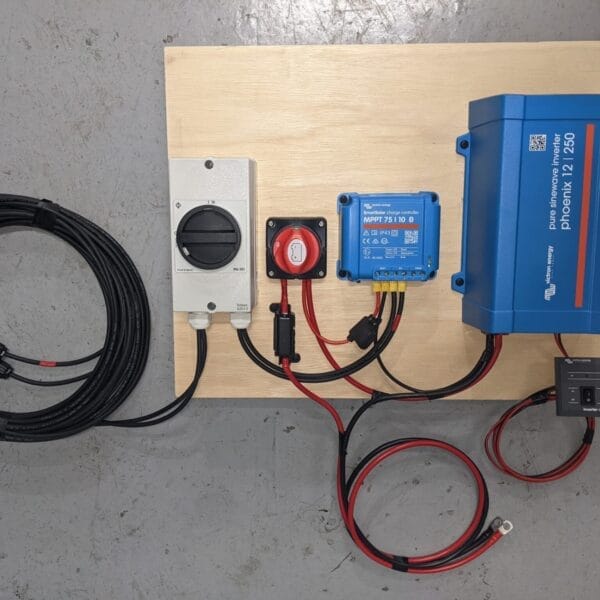
An inverter converts battery DC power into AC power, which most household appliances require.
Therefore, the inverter must be sized to handle the maximum power draw of your devices.
For example, if several appliances may run at the same time, the inverter must support the combined load.
Accurate solar system sizing is important because mistakes can quickly cause problems.
If the system is too small:
On the other hand, if the system is too large:
A well‑balanced solar system helps ensure:
Using a solar calculator removes much of the guesswork and provides a practical starting point when planning a solar setup.
Using the solar calculator is straightforward and usually takes only a few minutes.
The tool then estimates the solar panel size, battery capacity, and inverter requirements needed to power your setup.
This provides a helpful overview of what equipment may be required before buying solar components.
A simple garden office usually runs only a few devices each day.
| Appliance | Watts | Hours | Wh/day |
| Laptop | 60W | 6 | 360 |
| LED lights | 10W | 4 | 40 |
Estimated system:
In many cases, this is enough to power a basic workspace during the day.
Campervans often require slightly larger battery storage because appliances may run overnight.
| Appliance | Watts | Hours |
| Fridge | 50W | 24 |
| Lights | 8W | 5 |
Estimated system:
Of course, real‑world systems vary depending on travel habits, weather conditions, and energy usage.
The number of panels depends on your total daily energy usage. Small off‑grid systems may only require two to four panels, while larger systems require more.
Battery capacity should usually store one to two days of energy usage, allowing the system to run overnight or during cloudy weather.
Most systems require both a battery and an inverter. Solar panels alone cannot reliably power appliances when sunlight levels change.
Yes. The calculator uses conservative assumptions designed for typical UK sunlight levels.
Small cabins often require 300W–800W of solar panels with around 1–3kWh of battery storage, depending on appliance usage.