
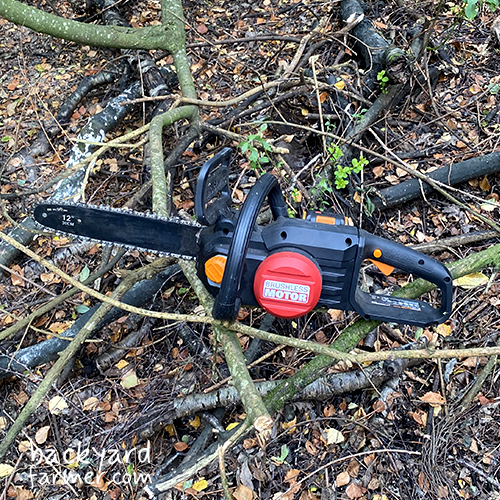
For most occasional chainsaw users, a manual filing guide is all that’s needed to keep a chain sharp. Electric sharpeners are more useful when maintaining several chains regularly, but they’re not necessarily better.
This guide compares five chainsaw sharpening tools available in the UK, covering manual files, guided sharpeners and electric grinders to help you choose the right equipment.
Which Chainsaw Sharpener Do You Need?
The best chainsaw sharpener depends on how often you use your saw and how comfortable you are maintaining the chain.
| Your situation | Recommended type | Why? |
|---|---|---|
| Occasional garden maintenance | Manual filing kit | Portable and straightforward |
| Want easier, guided sharpening | 2-in-1 filing guide | Maintains cutters and depth gauges together |
| Prefer adjustable filing guidance | Bar-mounted filing guide | More control over filing position |
| Regularly sharpen several chains | Electric bench grinder | Convenient for workshop maintenance |
For occasional garden work, a correctly matched manual filing guide is usually the most practical choice.
Best Chainsaw Sharpeners UK: Quick Comparison
These five chainsaw sharpening tools cover different needs, from basic maintenance to regular workshop sharpening.
| Chainsaw sharpener | Type | Best for |
|---|---|---|
| STIHL 2-in-1 EasyFile | Guided manual | Convenient routine sharpening |
| PFERD CHAIN SHARP CS-X | Guided manual | Alternative 2-in-1 system |
| Oregon Premium 601981 | Complete manual kit | Chainsaw maintenance equipment |
| Sealey CS02 | Bar-mounted guide | Adjustable manual filing |
| Oregon 410-230 | Electric grinder | Regular workshop sharpening |
Before buying: Chainsaw files and filing guides must match your exact chain specification. Check the manufacturer’s recommended file diameter and sharpening angle rather than choosing by chainsaw brand or bar length alone.
STIHL 2-in-1 EasyFile
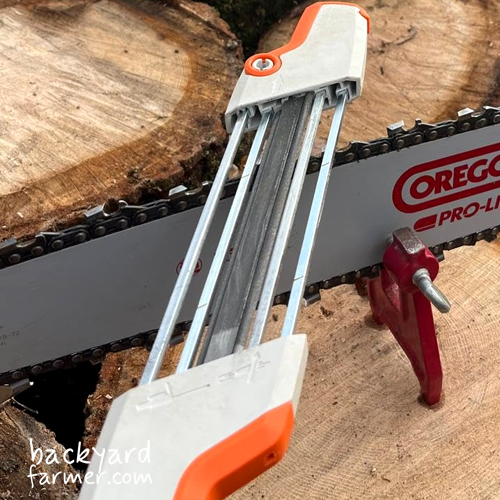
The STIHL 2-in-1 EasyFile is a convenient option for chainsaw owners who want guided sharpening without the expense or setup of an electric machine.
It combines two round files for sharpening the cutting teeth with a flat file for maintaining the depth gauges during the same filing operation.
Specifications
| Feature | Details |
|---|---|
| Model | STIHL 5605 750 4303 |
| Sharpening method | Guided manual filing |
| File diameter | 4.0 mm |
| Chain type | Compatible ⅜-inch Picco chains |
| Depth-gauge maintenance | Integrated |
| Replacement files | Available |
| Power required | None |
Best for
Occasional users who want straightforward, guided chain maintenance.
Pros
- Maintains cutters and depth gauges together
- Compact and portable
- Replaceable files
Cons
- Costs more than conventional files
- Requires the correct chain-specific version
- Still needs careful filing technique
What Makes It Useful
The EasyFile’s main advantage is convenience. Instead of sharpening the cutters and checking the depth gauges with separate tools, both operations are combined.
This makes it particularly appealing to beginners who find conventional chainsaw filing awkward.
The guide helps maintain the intended filing position, although consistent pressure and correct technique are still important.
The 5605 750 4303 version uses 4.0 mm round files and is intended for compatible ⅜-inch Picco chains. STIHL also produces other versions for different chain specifications, so selecting the correct model is essential.
The files can be replaced when worn, extending the useful life of the guide.
In UK chainsaw discussions, owners regularly recommend the STIHL 2-in-1 for its convenience, particularly when maintaining chains without a bench grinder.
For someone using a chainsaw occasionally around a garden or smallholding, the EasyFile offers a practical balance between guidance, portability and simplicity.
PFERD CHAIN SHARP CS-X

The PFERD CHAIN SHARP CS-X is another guided manual sharpener that maintains cutting teeth and depth gauges together.
It performs much the same job as the STIHL EasyFile, making it a useful alternative rather than an entirely different sharpening method.
Specifications
| Feature | Details |
|---|---|
| Model | PFERD 11098040 |
| Sharpening method | Guided manual filing |
| File diameter | 4.0 mm |
| Chain type | Compatible ⅜-inch low-profile chains |
| Filing angle | 30° |
| Depth-gauge maintenance | Integrated |
| Replacement files | Available |
Best for
Buyers comparing branded 2-in-1 filing systems.
Pros
- Guided 30° filing angle
- Maintains cutters and depth gauges together
- Replaceable filing components
Cons
- Similar functionality to the STIHL system
- Requires the correct chain-specific version
- Fixed filing angle won’t suit every chain
How It Compares With STIHL
The CS-X uses two round files and a depth-gauge file within an ergonomic guide.
PFERD’s design allows the tool to be turned over when moving between left- and right-facing cutting teeth without reconfiguring the filing assembly.
The 11098040 model uses 4.0 mm files and is designed for compatible ⅜-inch low-profile chains.
This makes it comparable to the selected 4.0 mm STIHL EasyFile, although buyers must still check the exact chain specifications before assuming either tool will fit.
Both sharpeners perform similar functions. Their main appeal is simplifying routine maintenance by combining cutter and depth-gauge filing.
There isn’t enough independent comparative evidence to suggest that either consistently produces better results.
For most buyers, compatibility, handling, replacement-file availability and price are likely to be the deciding factors.
The PFERD is worth considering alongside STIHL, particularly if it’s more readily available or offers better value for your chain type.
Oregon Premium 601981 Chainsaw Sharpening Kit

The Oregon Premium 601981 is a comprehensive manual sharpening and maintenance kit supplied in a hard case.
Unlike the STIHL and PFERD guides, it provides separate filing tools alongside other equipment used for maintaining chainsaw chains and guide bars.
Specifications
| Feature | Details |
|---|---|
| Model | Oregon 601981 |
| Sharpening method | Manual filing |
| Round files | 4.0, 4.8 and 5.5 mm |
| Depth-gauge maintenance | Separate flat file and gauge |
| Additional equipment | Stump vice, measuring tool, wedge and accessories |
| Storage | Hard carrying case |
| Power required | None |
Best for
Chainsaw owners wanting a complete collection of manual sharpening and maintenance equipment.
Pros
- Multiple file sizes included
- Comprehensive selection of maintenance tools
- Organised hard case
Cons
- More equipment than occasional users may need
- Requires conventional filing technique
- Included files won’t suit every chain specification
What’s Included and Who Needs It?
The Oregon 601981 includes round files in three common sizes, a flat file, depth-gauge tool and filing guide.
It also contains file handles, a stump vice, measuring equipment, a combination chainsaw wrench, screwdriver and other maintenance accessories.
The stump vice can help secure a suitable chainsaw bar during maintenance away from a workshop, provided it is used correctly.
Everything is stored in a hard case with separate compartments, making the equipment easier to organise and transport.
The main attraction is having a selection of tools available rather than buying each component separately.
This could be particularly useful for someone maintaining more than one chainsaw or wanting to learn conventional sharpening techniques.
However, the kit doesn’t automatically make sharpening easier.
Maintaining the correct filing angle, cutter length and pressure still takes practice. The depth gauges must also be checked separately using the appropriate tools.
It’s also important to check the file sizes. Although the kit includes several common diameters, not every chainsaw chain can be sharpened correctly using the supplied files.
For someone maintaining a single chain occasionally, a smaller chain-specific filing kit may be more economical.
The Oregon Premium kit makes more sense when you want a broader collection of equipment for ongoing chainsaw maintenance.
Sealey CS02 Bar-Mounted Chainsaw Sharpening Guide
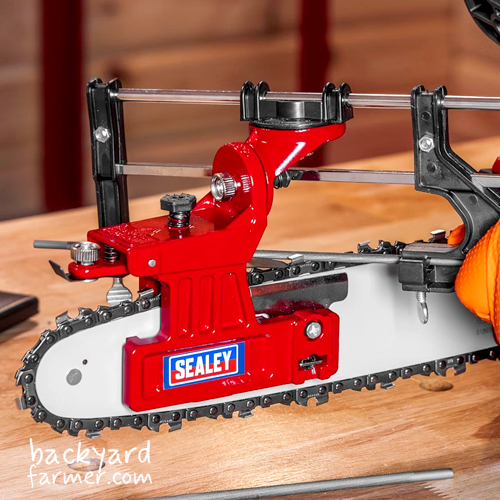
The Sealey CS02 provides adjustable manual sharpening without relying entirely on the operator to maintain a consistent filing position.
Rather than being held in the hand, the guide attaches to the chainsaw bar and supports the file during sharpening.
Specifications
| Feature | Details |
|---|---|
| Model | Sealey CS02 |
| Sharpening method | Bar-mounted manual filing |
| Mounting | Adjustable bar clamp |
| Adjustments | Two lockable axes |
| Supplied files | Two 4.8 mm files |
| Alternative files | 4.0 mm available separately |
| Power required | None |
Best for
Users wanting adjustable, repeatable filing guidance.
Pros
- Adjustable filing position
- Lockable settings
- Controlled filing depth
Cons
- More setup than handheld guides
- Less convenient for quick touch-ups
- Depth gauges require separate maintenance
Is a Bar-Mounted Guide Worth It?
The CS02 clamps to the guide bar and allows the filing position to be adjusted according to the chain requirements.
Once correctly positioned, its lockable adjustments help maintain a consistent filing angle between cutting teeth.
This may appeal to users who struggle with conventional hand filing or prefer a more controlled setup.
However, the additional adjustments also make it less convenient for quick sharpening.
A handheld guide can be removed from a toolbox and used with relatively little preparation, while the Sealey requires careful mounting and adjustment.
The CS02 includes two 4.8 mm files. Sealey also offers 4.0 mm replacement files separately, but buyers must check that the available file sizes suit their chain.
Depth gauges require a separate tool and must be maintained according to the chain manufacturer’s specifications.
The CS02 fills the gap between basic hand filing and electric workshop sharpening.
It’s most appealing to users who value adjustable filing guidance over speed and portability.
Oregon 410-230 Electric Chainsaw Sharpener
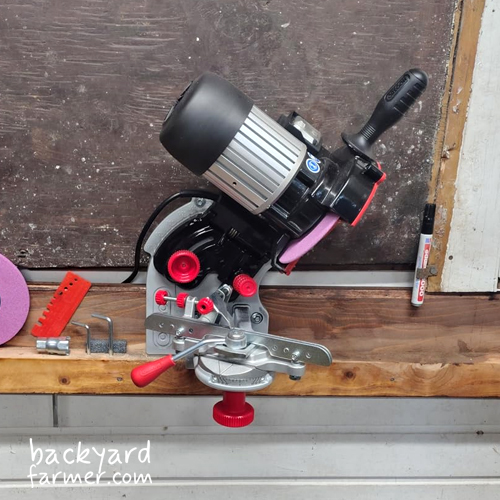
The Oregon 410-230 is a compact bench-mounted electric chain grinder designed for more regular sharpening.
Unlike the manual tools above, it uses a rotating grinding wheel to restore the cutting edges.
Specifications
| Feature | Details |
|---|---|
| Model | Oregon 410-230 |
| Sharpening method | Electric grinding |
| Power supply | 230 V mains |
| Mounting | Bench or wall |
| Chain holding | Manual clamping vice |
| Grinding wheels | 3.2 mm and 4.7 mm included |
| Depth-gauge equipment | 6 mm flat-profile disc included |
Best for
Users regularly maintaining several chains in a workshop.
Pros
- Adjustable powered sharpening
- Suitable for multiple chain specifications
- Bench or wall mounting
Cons
- More expensive than manual equipment
- Requires electricity and setup
- Incorrect grinding can damage cutting edges
When an Electric Grinder Makes Sense
The Oregon 410-230 is intended for situations where chains are sharpened regularly.
It mounts to a bench or wall and uses a manually operated clamping vice to position the chain beneath the grinding wheel.
Adjustable settings allow the operator to establish the correct grinding position for the chain being sharpened.
The grinder includes two sharpening wheels and a separate flat-profile disc for depth-gauge maintenance.
For someone maintaining several chains, a workshop grinder can be more convenient than working through each chain entirely by hand.
However, powered sharpening isn’t automatically easier.
The grinding wheel must suit the chain specification, the angles must be adjusted correctly and material removal needs careful control.
Excessive grinding can shorten the chain’s service life, while overheating may damage the cutting edges.
Replacement grinding wheels, storage space and electrical requirements are further considerations.
The 410-230 also uses manual chain clamping rather than the hydraulic-assisted arrangement found on some higher-end Oregon grinders.
For occasional garden use, these additional requirements may outweigh the benefits of powered sharpening.
The 410-230 makes more sense for someone regularly maintaining several chains who is prepared to learn the correct setup and operation.
How to Choose the Right Chainsaw Sharpener
Before buying a chainsaw sharpening tool, identify your chain and check the manufacturer’s sharpening specifications.
An expensive sharpener won’t produce good results if the file diameter or filing geometry is wrong.
Check Your Chainsaw Chain First
The important information includes:
- Chain pitch
- Chain make and model
- Recommended round-file diameter
- Sharpening angle
- Depth-gauge setting
Bar length alone doesn’t determine which sharpening equipment you need. Two chainsaws with identical bar lengths may use different chains.
Even chains with the same nominal pitch can require different file sizes.
For example, STIHL specifies the following round-file diameters for its chain types:
| STIHL chain type | Round-file diameter |
|---|---|
| ¼-inch Picco | 3.2 mm |
| ¼-inch | 4.0 mm |
| ⅜-inch Picco | 4.0 mm |
| .325-inch | 4.8 mm |
| Standard ⅜-inch | 5.2 mm |
| .404-inch | 5.5 mm |
These figures apply to the specified STIHL chain types and shouldn’t be treated as universal recommendations.
Other manufacturers may specify different diameters for particular chains.
Check the identification markings on your chain and refer to the manufacturer’s documentation before buying a file, filing guide or electric grinder.
Don’t Forget the Depth Gauges
Each cutting tooth has a depth gauge positioned in front of it.
The height difference between the cutting edge and depth gauge determines how deeply the tooth can engage with the wood.
As a cutter is sharpened and becomes shorter, that relationship changes.
If the depth gauge is too high, the chain may struggle to cut efficiently. If it’s too low, the chain can become overly aggressive and increase the risk of kickback.
This is why depth-gauge maintenance matters.
A compatible 2-in-1 filing guide maintains the cutters and depth gauges during the same filing operation. Conventional filing requires a separate depth-gauge tool and flat file.
Always follow the chain manufacturer’s specified settings rather than adjusting depth gauges by eye.
Check Replacement Files and Running Costs
Chainsaw files gradually wear out and eventually need replacing.
Before choosing a sharpening system, check whether compatible replacement files are available.
This is particularly relevant to guided sharpeners, where the files must fit the tool.
Electric grinders also require suitable replacement grinding wheels.
For occasional use, the initial purchase price is likely to be the main expense. Regular users should also consider consumables and maintenance costs.
Manual vs Electric Chainsaw Sharpeners: Which Is Better?
Both methods can maintain chains effectively when the correct equipment and technique are used.
| Consideration | Manual sharpener | Electric sharpener |
|---|---|---|
| Purchase cost | Generally lower | Generally higher |
| Portability | Excellent | Usually workshop-based |
| Electricity | Not required | Required |
| Setup | Usually straightforward | More involved |
| Occasional use | Well suited | Often unnecessary |
| Multiple chains | More hands-on work | Convenient for regular use |
| Material removal | Controlled by filing technique | Controlled by grinder setup |
When Manual Sharpening Makes Sense
Manual sharpening is well suited to chainsaws used occasionally around gardens, allotments and smallholdings.
The equipment is portable, requires no electricity and can be stored alongside the saw.
A conventional filing kit offers straightforward maintenance, while a guided system can make maintaining consistent angles easier.
For most occasional users, manual sharpening provides everything needed for routine chain maintenance.
For an example of a cordless chainsaw suited to occasional garden work, see my WORX WG350E chainsaw review.
When Electric Sharpening Makes Sense
Electric sharpeners are more useful when several chains need regular attention.
A workshop grinder provides adjustable positioning and powered material removal, potentially making repeated sharpening more convenient.
However, correct setup, wheel selection and grinding technique remain essential.
For a single chainsaw used occasionally, the additional cost and equipment may be difficult to justify.
When Should You Sharpen or Replace a Chainsaw Chain?
A blunt chainsaw chain reduces cutting efficiency and can increase the effort required to operate the saw.
Common warning signs include:
- Fine sawdust instead of normal wood chips
- Needing to force the saw through the cut
- Uneven cutting or pulling to one side
- Increased vibration or chatter
- Excessive heat or smoke
These symptoms can also indicate other problems, including incorrect chain tension or poor lubrication. Inspect the equipment rather than assuming sharpening alone will resolve the issue.
When Sharpening Is Enough
Routine sharpening is appropriate when the chain is otherwise in good condition and the cutters remain within the manufacturer’s wear limits.
Regular light maintenance is generally preferable to continuing to cut with a noticeably blunt chain.
Inspect the chain before use and sharpen it when necessary.
When the Chain Should Be Replaced
Sharpening cannot restore a chain that has reached its wear limits or suffered serious damage.
Replacement may be necessary when:
- Cutters have reached their wear markers
- Teeth are cracked, broken or missing
- Damage prevents the chain being safely restored
- Other chain components show excessive wear
If you’re unsure whether a damaged chain can be reused, have it inspected by a competent chainsaw servicing professional.
Is Sharpening Your Own Chain Worthwhile?
Sharpening equipment can reduce the cost of repeated professional servicing, particularly if you use a chainsaw regularly.
However, savings depend on how often the chain needs attention, the initial equipment cost and replacement consumables.
For occasional users, professional sharpening remains a reasonable alternative.
Keeping a suitable spare chain can also be useful, allowing maintenance to be completed later rather than interrupting work.
Chainsaw Sharpening Safety
Before sharpening, switch the chainsaw off and prevent accidental starting.
Remove the battery from cordless models, unplug mains-powered saws and follow the manufacturer’s isolation instructions for petrol models.
Wear suitable cut-resistant gloves when handling the chain and eye protection when filing or grinding. Secure the saw and guide bar appropriately and inspect the chain for damage before maintenance.
Follow the manufacturer’s sharpening instructions and check chain condition and tension before returning the saw to service.
The Health and Safety Executive identifies correct chain maintenance as an important part of safe chainsaw operation. Chainsaw use at work also carries specific training and competence requirements.
Frequently Asked Questions
A correctly matched 2-in-1 filing guide is often a sensible option. Systems such as the STIHL EasyFile and PFERD CS-X provide guided sharpening while maintaining the depth gauges. They’re convenient, although correct filing technique is still important.
Not necessarily. Manual files are portable, affordable and suitable for routine maintenance. Electric grinders can be useful for regularly sharpening several chains but require more setup and care. For occasional garden use, manual equipment is usually sufficient.
It can be worthwhile if you want to sharpen cutters and maintain depth gauges with one guided tool. Its main advantages are convenience and replaceable files. However, conventional files can achieve good results at a lower initial cost.
The correct file diameter depends on your exact chain specification. Chain pitch is important, but it doesn’t always determine file size on its own. Check the chain manufacturer’s recommendations before purchasing.
Yes. Many manual files and filing guides are designed to sharpen the chain while it’s fitted to the bar. The chainsaw must be safely isolated and secured according to the manufacturer’s instructions. Bench-mounted electric grinders generally require chain removal.
There’s no universal interval. Sharpening frequency depends on cutting conditions, chain design and how often the saw is used. Inspect the chain regularly and sharpen it when cutting performance begins to deteriorate.
Yes, if used incorrectly. Excessive grinding can remove unnecessary material, while incorrect wheel selection or overheating may damage the cutting edges. Follow the manufacturer’s settings and avoid removing more material than necessary.
Sharpening an otherwise serviceable chain is generally cheaper than replacing it whenever it becomes blunt. However, equipment and consumables have costs. Chains that have reached their wear limits or suffered serious damage should be replaced rather than repeatedly sharpened.