The Ryobi cordless leaf blower is a capable garden tool for clearing leaves, grass clippings and loose debris without dragging a cable around. I’ve used an earlier Ryobi 36V blower for everyday garden maintenance, and what stands out is the combination of strong airflow and the ability to control where everything ends up.
It’s particularly useful for clearing patios, paths, driveways and lawns. Damp leaves can be more stubborn, and battery consumption becomes noticeable when working at higher power settings, but for regular garden clearing, it’s a convenient alternative to sweeping and raking everything by hand.
The 36V MAX POWER range is especially worth considering if you already own compatible Ryobi batteries. If you’re starting from scratch, the additional battery and charger costs are an important consideration.
My hands-on experience is with an earlier Ryobi 36V blower. Ryobi has since updated its standard 36V model, so the specifications below reflect the current version rather than the exact machine I tested.
Ryobi Cordless Leaf Blower Specifications
The current standard Ryobi 36V MAX POWER blower has improved airspeed and a lighter design compared with the earlier version.
| Specification | Current 36V MAX POWER model |
|---|---|
| Model | RY36BLB-0 |
| Battery system | Ryobi 36V MAX POWER |
| Motor | Brushed |
| Maximum airspeed | 193 km/h |
| Maximum airflow | 15.6 m³/min |
| Weight without battery | 2.65 kg |
| Speed control | Variable-speed trigger |
| Nozzle | Removable |
| Runtime | Up to 14 minutes with a 4Ah battery at maximum speed |
| Sound pressure | 79.1 dB(A) at operator position |
| Battery and charger | Not included with bare tool |
| Warranty | 2 years, extendable to 3 years with eligible registration |
Specifications and runtime figures are supplied by Ryobi, not measured during my own testing.
Best For
- Small to medium UK gardens
- Clearing leaves and loose garden debris
- Patios, driveways, paths and lawns
- Gardeners already using Ryobi 36V MAX POWER batteries
Pros
- Strong airflow for everyday garden clearing
- Adjustable power makes directing leaves easier
- Cordless design offers good freedom of movement
- Useful battery compatibility across the 36V range
Cons
- High-power operation uses battery capacity quickly
- Larger batteries add noticeable working weight
- Wet leaves stuck in grass may still need raking
- Battery and charger cost extra with the bare tool
What Is the Ryobi Cordless Leaf Blower Like to Use?
Clearing Power
From my experience with an earlier Ryobi 36V blower, there’s plenty of airflow for everyday garden maintenance. It’s particularly useful for moving dry leaves and loose debris from patios, paths and driveways, gathering everything into manageable piles rather than sweeping large areas by hand.
On lawns, loose surface leaves are relatively straightforward to clear. Damp leaves that have settled into the grass can be more stubborn, especially after prolonged wet weather.
More airflow helps shift heavier debris, but leaves that are firmly stuck down may still need loosening with a rake. A leaf blower makes the collection process easier, although it doesn’t completely replace manual clearing.
For routine garden work, I find controlled airflow more useful than simply running at maximum power. Being able to direct leaves where you want them saves time and avoids scattering debris unnecessarily.
Weight & Handling
Ryobi’s 36V blowers are fairly substantial handheld garden tools, particularly once a larger battery is fitted.
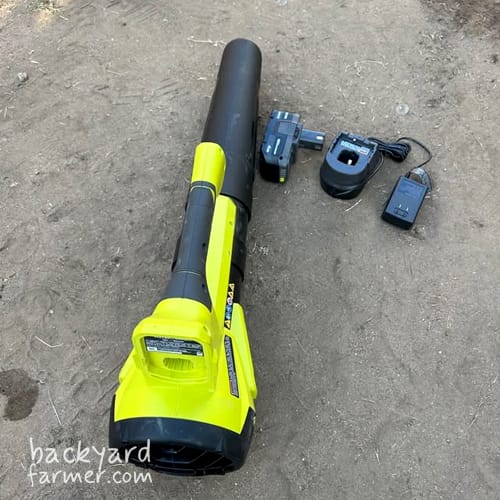
I found the earlier blower reasonably well balanced for shorter clearing sessions, although the additional battery weight becomes more noticeable when working continuously around a larger garden.
The newer standard model has a lighter bare-tool design at 2.65 kg, along with an overmoulded grip. Those are promising improvements on paper, although I haven’t tested the updated machine to compare its balance directly.
For most short garden-clearing jobs, the convenience of cordless operation is a significant advantage. For prolonged use, however, the working weight is worth considering.
Airflow Control
One of the most useful aspects of a cordless leaf blower is being able to adjust the airflow to suit the job.
Lower power is handy for moving loose debris around patios and paths, particularly near planted borders or gravel where excessive airflow can scatter material you want to leave in place.
Higher power becomes more useful when clearing larger piles of leaves or heavier debris.
The earlier Ryobi blower I used included a dedicated turbo button. The current standard model instead uses a variable-speed trigger, allowing airflow to be adjusted without a separate turbo control.
In practice, I prefer using only as much power as the job needs. It’s easier to keep leaves moving in the right direction and avoids wasting battery capacity.
Noise
Cordless doesn’t mean silent. The Ryobi produces noticeable fan noise, especially when operating at higher speeds.
Reducing the airflow can make it less intrusive, although hearing protection remains important during use.
Ryobi specifies an operator sound-pressure level of 79.1 dB(A) for the current standard 36V blower. That’s a manufacturer measurement rather than a reading from my own testing.
It’s also worth distinguishing this standard model from Ryobi’s separate Brushless Whisper range, which uses additional noise-reduction technology.
Battery Life & Ryobi 36V MAX POWER
Battery life is one of the main considerations with any powerful cordless leaf blower, particularly when clearing large areas.
In everyday use, where you’re moving between different parts of the garden and adjusting the airflow, battery consumption is easier to manage. Continuous operation at maximum power will reduce the available working time.
For the current standard 36V blower, Ryobi advertises up to 14 minutes with a 4Ah battery at maximum speed. Actual runtime will vary with battery capacity and how the tool is operated.
If you’re regularly tackling substantial autumn leaf fall, having a second charged battery could be useful.
The advantage of the Ryobi system is that its 36V MAX POWER batteries can be shared with compatible lawn mowers, hedge trimmers and other garden equipment.
However, Ryobi’s 18V ONE+ batteries are not interchangeable with its 36V range.
If you already own compatible batteries and a charger, purchasing the bare blower makes considerably more financial sense. Otherwise, factor the cost of a suitable battery and charger into your decision.
For a smaller, lighter alternative, see my Worx WG543E cordless leaf blower review.
FAQs
Ryobi’s 36V blowers offer useful power and flexibility for everyday garden clearing. In my experience with an earlier model, they’re particularly effective for moving loose leaves and debris across lawns and hard surfaces. Battery life and working weight are the main compromises to consider.
Yes, although performance depends on how wet and compacted the leaves are. Loose damp leaves are easier to move than material stuck firmly to grass, which may still need loosening with a rake.
It depends on the model, battery capacity and power setting. Ryobi advertises up to 14 minutes at maximum speed with a 4Ah battery for its current standard 36V blower. Lighter, intermittent use may provide longer working time.
Not always. Ryobi sells bare tools without batteries or chargers, alongside selected kit versions. Check the package contents carefully before purchasing.
Yes, provided they’re from the compatible battery system. The 36V MAX POWER blowers require Ryobi 36V batteries and cannot use the smaller 18V ONE+ batteries.
It can handle larger areas, although extended clearing sessions make battery runtime and working weight more important. For substantial leaf fall, a spare battery or one of Ryobi’s higher-performance blower models may be more practical.