

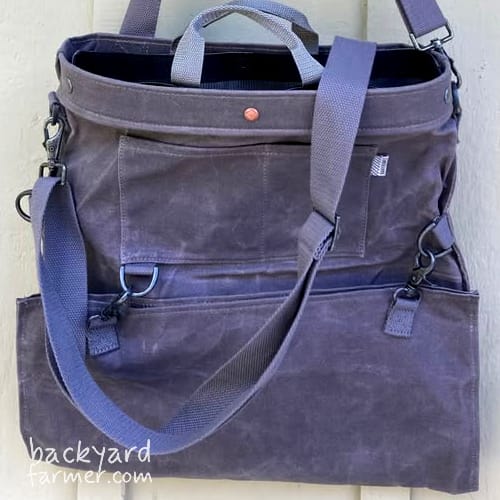
The Barebones Harvesting & Gathering Bag is a hands-free harvesting bag designed for collecting fruit, vegetables and garden produce as you move around the plot.
Its main advantage over a traditional trug is the complete harvesting setup: wear it while picking, use the removable watertight liner for muddy or damp crops, then open the bottom to transfer the harvest into a crate or storage container.
Specifications
| Specification | Details |
|---|---|
| Product | Barebones Harvesting & Gathering Bag |
| Main use | Harvesting and carrying garden produce |
| Outer material | Paraffin-waxed canvas |
| Liner | Removable, watertight liner |
| Dimensions | Approx. 43 × 41 × 7.6 cm |
| Empty weight | Approx. 0.9 kg |
| Carrying | Convertible multi-way straps; carry across the chest or back |
| Unloading | Drop-bottom opening |
| Outer protection | Water-resistant |
| Best suited to | Fruit, vegetables, cut flowers and general garden harvesting |
Barebones doesn’t publish a litre capacity or maximum carrying weight. In practice, the more useful question is what you intend to harvest and how much weight you’re comfortable carrying.
Best For
- Larger fruit and vegetable harvests
- Allotment and kitchen-garden use
- Hands-free picking
Pros
- Keeps both hands free while harvesting
- Drop-bottom makes unloading easy
- Removable watertight liner
- Substantial waxed-canvas construction
Cons
- Weighs around 0.9 kg empty
- Premium price
- Not ideal for very delicate produce
BYF verdict: A clever harvesting bag for productive gardens and allotments, with genuinely useful features rather than design for design’s sake.
What Makes the Barebones Harvesting Bag Different?
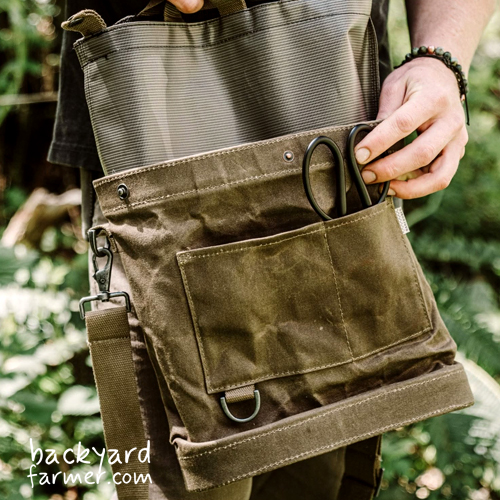
The Barebones isn’t simply a canvas garden tote. Its main advantage is that the bag becomes part of the harvesting process: wear it while picking, keep both hands free, then unload the contents through the bottom opening.
Add the removable watertight liner and it offers a noticeably different workflow from carrying a traditional trug, particularly when you’re moving around an allotment, kitchen garden or orchard rather than harvesting from one fixed spot.
How Well Does It Work for Harvesting?
The hands-free design is where the Barebones makes the most sense.
Instead of carrying a basket in one hand or repeatedly setting a trug down as you move along a row, the bag stays with you while you pick. That can be particularly useful for climbing beans, tomatoes, courgettes or fruit from trees.
It also suits sturdier crops such as apples, pears, potatoes and onions where you’re likely to bring in a reasonable quantity at once.
The open top gives you somewhere obvious to place each item as you work, although the type of crop still matters. Robust vegetables can go straight in; ripe tomatoes, soft fruit and other easily bruised crops need more care.
Best use: Harvesting sturdy fruit and vegetables where being able to pick with both hands and unload quickly genuinely saves time.
The Drop-Bottom Unloading System
One of the most useful parts of the design is the opening at the bottom of the bag.
Rather than lifting a full harvesting bag and turning it upside down, you can position it over a crate, storage box or sorting area and release the contents from underneath.
That makes particular sense for sturdy crops such as potatoes, onions and apples, especially as the bag becomes heavier. Delicate produce still needs to be transferred carefully rather than dropped from height.
Removable Watertight Liner
The other notable feature is the removable liner.
It’s important to distinguish between the two layers: the waxed-canvas outer is water-resistant, while the removable liner is watertight.
The liner is particularly useful for freshly lifted potatoes, carrots, beetroot and other muddy or damp crops because soil and moisture stay away from the main canvas body. It can then be removed separately for cleaning.
For dry, clean produce, you may prefer to take the liner out and reclaim some of the internal space.
Build Quality and Carrying Comfort
The paraffin-waxed canvas, metal hardware and substantial straps give the Barebones a noticeably heavier-duty construction than a lightweight picking apron or simple fabric harvesting bag.
That extra material comes with an obvious trade-off: the bag weighs around 0.9 kg before you’ve harvested anything.
The convertible straps allow the bag to be carried across the chest or back, letting it move with you while you work. That is one of its biggest strengths for lighter loads.
As the harvest becomes heavier, though, comfort becomes the limiting factor.
Apples, potatoes, onions and root vegetables can add several kilograms surprisingly quickly, turning a comfortable harvesting bag into a bulky load.
Barebones doesn’t publish a litre capacity or maximum load, but that isn’t necessarily the main limitation anyway. For bulk harvesting, crates or a wheelbarrow still make more sense.
I see the Barebones primarily as a harvesting and transfer bag: collect produce as you move around the plot, then transfer it into a larger container rather than carrying a completely full bag over a long distance.
Drawbacks to Know Before Buying
- Heavier than simpler alternatives: At around 0.9 kg empty, the bag already carries more weight than a lightweight picking apron or basic fabric tote.
- Heavy crops soon add up: Apples, potatoes and roots can make carrying uncomfortable when the bag is full.
- Not ideal for delicate produce: Soft berries, mushrooms and easily bruised fruit are generally better suited to a rigid shallow container.
- Premium price: Its value depends on whether you’ll actually use the hands-free design, liner and bottom release.
Barebones Harvesting Bag vs a Traditional Garden Trug
| Feature | Barebones Harvesting Bag | Traditional Trug |
|---|---|---|
| Hands-free picking | Yes | No |
| Drop-bottom unloading | Yes | No |
| Removable liner | Yes | Usually no |
| Easy to set down | Good | Excellent |
| Delicate produce | Good with care | Often better |
| Carrying larger harvests | Good | Depends on size |
| Weight | Approx. 0.9 kg empty | Usually lighter |
The Barebones makes most sense when you’ll actually use the hands-free harvesting and quick-unloading system.
For a quick trip outside to pick a few courgettes or tomatoes, a traditional garden trug is simpler. For moving along allotment rows, harvesting from trees or collecting produce across a larger growing area, the Barebones becomes much easier to justify.
Is the Barebones Harvesting & Gathering Bag Worth It?
For occasional harvesting, a simple garden trug or basket will usually do the job for considerably less money.
The Barebones starts to make more sense for a productive allotment, kitchen garden or small orchard where you’re regularly moving around while harvesting.
You’re paying extra for more than waxed canvas and good-looking hardware. The hands-free carrying system, removable liner and drop-bottom opening all have practical uses.
If you’ll use those features regularly, it’s a useful upgrade over a standard harvesting bag. If not, a good trug remains the simpler and cheaper option.
FAQs
The removable inner liner is watertight. The waxed-canvas outer should be considered water-resistant rather than fully waterproof.
The bag measures approximately 43 × 41 × 7.6 cm and weighs around 0.9 kg empty.
Barebones doesn’t publish a litre capacity or maximum load, so with heavier crops the practical limit is likely to be what you’re comfortable carrying rather than the physical space available.
The waxed-canvas outer should not be machine washed or dry cleaned.
Barebones recommends brushing away loose dirt, rinsing with cold water, gently brushing the canvas and allowing it to air dry. Stubborn marks can be treated with mild bar soap or saddle soap, and the canvas may need rewaxing afterwards.
The removable liner makes cleaning after muddy or damp harvests considerably easier.
Yes. Apples are one of the clearer use cases because the bag lets you keep both hands free while picking. Just remember that the weight builds quickly, so there is little benefit in overfilling it.
Yes. Potatoes, carrots, beetroot and other robust root crops suit the design particularly well. The removable liner helps contain soil, while the bottom opening makes transferring the harvest into a crate or washing area easier.
It depends on how you harvest. The Barebones is better suited to hands-free picking and moving around while you work, while a traditional trug is lighter, simpler and often better for small or delicate harvests.