
Introduction
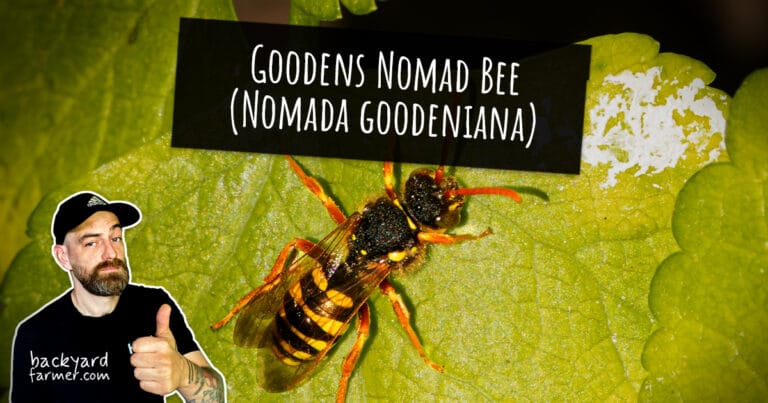
The Gooden’s Nomad Bee (Nomada goodeniana) is a striking and unusual solitary bee found in parts of the UK. Rather than collecting pollen or building its own nest, it lives as a cuckoo bee, laying its eggs in the nests of other solitary bees.
This species is most often encountered in gardens, hedgerows, woodland edges, and flower-rich countryside where its host bees are present. With its wasp-like appearance and bold markings, it is frequently mistaken for a wasp at first glance.
Because cuckoo bees depend entirely on healthy populations of their host species, the presence of the Gooden’s Nomad Bee is a sign of a functioning pollinator ecosystem. In this guide, you’ll learn how to identify Nomada goodeniana, recognise similar species, and understand why parasitic bees still play an important ecological role.
Identification & Key Facts
| Attribute | Details |
|---|---|
| Common Name | Gooden’s Nomad Bee |
| Latin Name | Nomada goodeniana |
| Size | ~8–11 mm |
| Location | England and Wales (localised) |
| Active Months | April to June |
| Habitat | Gardens, hedgerows, woodland edges |
| Nesting Behaviour | Parasitic – lays eggs in host bee nests |
| Social Behaviour | Solitary (cuckoo bee) |
| Flora | Buttercup, dandelion, spring flowers |
| UK Status | Locally common |
How to Identify the Gooden’s Nomad Bee
The Gooden’s Nomad Bee has a slender, wasp-like body with bold red, black, and yellow markings. Unlike pollen-collecting bees, it lacks obvious pollen baskets or dense body hair.
In the UK, it is most often seen flying close to the ground or visiting spring flowers in areas where its host mining bees are nesting. Its quick, darting movements and bright colours are helpful identification clues.
Physical Characteristics
- Female – Slightly larger, with vivid red and yellow markings and a smooth, shiny body.
- Male – Similar in appearance but often slimmer, with longer antennae and lighter facial hair.
Similar Species
The Gooden’s Nomad Bee is commonly confused with other nomad bees and wasp-like insects:
- Other Nomada species – Often very similar in colour; separation usually depends on pattern details and location.
- Wasps – Wasps lack body hair and typically show different flight behaviour.
- Small hoverflies – Hoverflies have large eyes and do not show the same sharp abdominal markings.
If you’re unsure which bee you’ve spotted, our Bee Identification guide can help you narrow down UK species by size, colour, and behaviour.
Why the Gooden’s Nomad Bee Matters
The Gooden’s Nomad Bee plays an indirect but important role in pollinator ecosystems. As a cuckoo bee, it helps regulate host populations and is entirely dependent on the presence of healthy solitary bees.
Although it does not gather pollen itself, it still contributes to biodiversity and acts as an indicator species for well-functioning habitats that support a wide range of insects.
FAQs
No. This species is not aggressive and is unlikely to sting unless handled.
It is mainly active in spring, typically from April to June.
It is locally common in suitable habitats but has a patchy distribution.
Females can sting, but stings are rare and usually only occur if the bee is trapped.
How You Can Help
Supporting the Gooden’s Nomad Bee means supporting its host species and their habitats:
🌿 Plant Bee-Friendly Flowers
- Dandelion, buttercup, spring wildflowers
🚫 Avoid Harmful Pesticides
- Avoid insecticides that harm solitary bees and contaminate nectar
🏡 Provide Nesting Spaces
- Leave bare or lightly vegetated soil to support ground-nesting host bees
By encouraging diverse, flower-rich habitats and avoiding chemical use, you help support the Gooden’s Nomad Bee and the solitary bees it depends on.