
Introduction
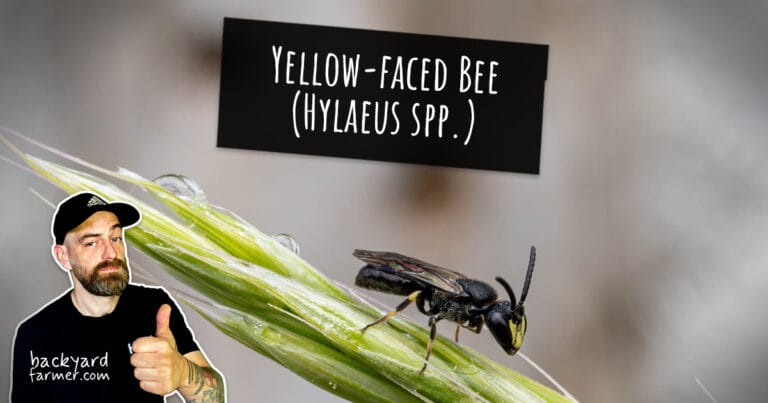
Yellow-faced Bees (Hylaeus species) are a group of small, slender solitary bees found throughout much of the UK. They are named for the distinctive yellow or pale facial markings seen on many species, particularly the males. Because they lack obvious pollen-carrying hairs, they are often mistaken for small wasps or flies.
These bees are commonly found in gardens, hedgerows, woodland edges, and open countryside, especially where flowers and suitable nesting sites are available. Rather than carrying pollen externally, Yellow-faced Bees transport pollen internally, making their behaviour and appearance quite different from most other bees.
Although many Hylaeus species are still common, they are sensitive to habitat loss, over-tidying, and pesticide use. In this guide, you’ll learn how to recognise Yellow-faced Bees as a group, understand their unusual biology, and avoid confusion with similar insects.
Identification & Key Facts
| Attribute | Details |
|---|---|
| Common Name | Yellow-faced Bees |
| Latin Name | Hylaeus spp. |
| Size | ~4–8 mm (varies by species) |
| Location | Widespread across the UK (species-dependent) |
| Active Months | April to September |
| Habitat | Gardens, hedgerows, woodland edges, grassland |
| Nesting Behaviour | Nests in hollow stems, beetle holes, cavities |
| Social Behaviour | Solitary |
| Flora | Umbellifers, ivy, bramble, small flowers |
| UK Status | Varies by species (common to scarce) |
How to Identify Yellow-faced Bees
Yellow-faced Bees are small, smooth-bodied bees with a narrow waist and very little visible hair. Their black bodies are often marked with yellow or cream patches on the face, legs, or thorax, giving them a wasp-like appearance.
In the UK, they are most often seen resting on leaves or flowers, or flying quickly between plants. Because they do not carry pollen on their legs or abdomen, they can easily be overlooked as bees.
Physical Characteristics
- Female – Usually darker overall, with fewer or smaller facial markings.
- Male – Often has bright yellow facial markings, making identification easier.
Similar Species
Yellow-faced Bees are commonly confused with other small insects:
- Small wasps – Wasps tend to be more aggressive and lack the subtle bee-like body shape.
- Small Carpenter Bee (Ceratina cyanea) – Metallic sheen and different nesting behaviour.
- Hoverflies – Have large eyes and typically hover in place.
If you’re unsure which bee you’ve spotted, our Bee Identification guide can help you narrow down UK species by size, colour, and behaviour.
Why Yellow-faced Bees Matter
Although small and often overlooked, Yellow-faced Bees play an important role in pollinating a wide range of wildflowers. Their internal pollen transport allows them to exploit flowers that other bees may ignore.
They also add diversity to pollinator communities and highlight the importance of hollow stems, dead wood, and undisturbed vegetation in supporting insect life.
FAQs
No. They are very gentle and rarely sting.
Most species are active from spring through late summer, roughly April to September.
Some species are common, while others are scarce or localised.
Females can sting, but stings are extremely rare and usually only occur if the bee is handled.
How You Can Help
Supporting Yellow-faced Bees is simple and well suited to wildlife-friendly gardens:
🌿 Plant Bee-Friendly Flowers
- Umbellifers, ivy, bramble, small wildflowers
🚫 Avoid Harmful Pesticides
- Avoid insecticides that contaminate nectar and pollen
🏡 Provide Nesting Spaces
- Leave hollow plant stems, dead wood, and natural cavities undisturbed
By leaving stems standing and allowing wild plants to flower, you help support Yellow-faced Bees and many other overlooked pollinators.