
Introduction
The Yellow-legged Mining Bee (Andrena flavipes) is a medium-sized solitary bee that is widespread and increasingly familiar across much of the UK. It is particularly noticeable in spring and early summer, when it can sometimes be seen nesting in large numbers in lawns, paths, and bare ground.
This species is highly adaptable and thrives in gardens, parks, urban green spaces, and farmland. Its tendency to form nesting aggregations means it often attracts attention, especially when dozens of bees are seen flying close to the ground in the same area.
Despite being common, the Yellow-legged Mining Bee is still affected by habitat disturbance, pesticide use, and the loss of wildflowers. In this guide, you’ll learn how to identify Andrena flavipes, distinguish it from similar mining bees, and understand why this conspicuous species plays an important role in pollination.
Identification & Key Facts
| Attribute | Details |
|---|---|
| Common Name | Yellow-legged Mining Bee |
| Latin Name | Andrena flavipes |
| Size | Females: ~11–13 mm, Males: ~9–11 mm |
| Location | Widespread across the UK |
| Active Months | March to July |
| Habitat | Gardens, parks, lawns, farmland, urban areas |
| Nesting Behaviour | Ground-nesting, often in large aggregations |
| Social Behaviour | Solitary (nesting in aggregations) |
| Flora | Willow, fruit blossom, dandelion, hawthorn |
| UK Status | Common |
How to Identify the Yellow-legged Mining Bee
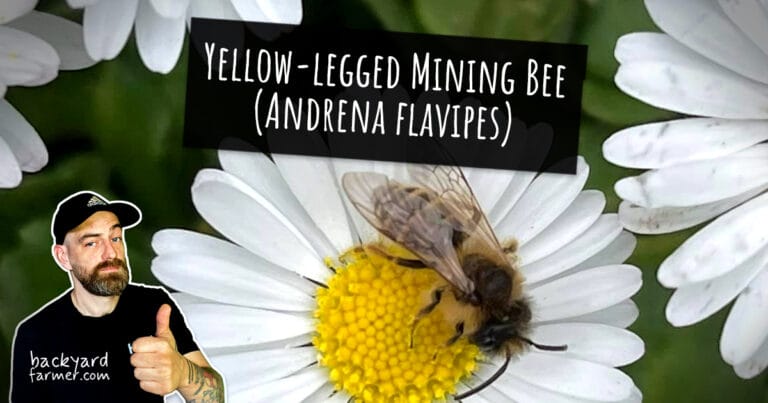
The Yellow-legged Mining Bee is a fairly robust mining bee with a dark body and distinctive yellowish or orange pollen-carrying hairs on the hind legs, which give the species its common name.
In the UK, it is most often seen flying low over short grass or bare soil near its nesting sites. Large nesting aggregations are one of the strongest identification clues, particularly in spring.
Physical Characteristics
- Female – Stocky build with dark body colouring and clearly yellow pollen brushes on the hind legs.
- Male – Smaller and slimmer, usually darker overall with longer antennae and less obvious leg colouring.
Similar Species
The Yellow-legged Mining Bee may be confused with other common Andrena species:
- Buffish Mining Bee (Andrena nigroaenea) – More variable colouring and lacks the distinctive yellow leg hairs.
- Early Mining Bee (Andrena haemorrhoa) – Females show a reddish-brown abdomen rather than yellow legs.
- Tawny Mining Bee (Andrena fulva) – Much brighter orange-red overall, especially on the thorax.
If you’re unsure which bee you’ve spotted, our Bee Identification guide can help you narrow down UK species by size, colour, and behaviour.
Why the Yellow-legged Mining Bee Matters
The Yellow-legged Mining Bee is an important early to mid-season pollinator, visiting a wide range of trees and wildflowers. Its activity helps support fruit production and the reproduction of spring-flowering plants.
Because it is tolerant of urban environments, this species plays a valuable role in pollination within towns and cities, where other pollinators may be less abundant.
FAQs
No. Despite nesting in large numbers, this species is gentle and rarely stings.
It is usually active from early spring through to mid-summer, roughly March to July.
No. It is a common and widespread species.
Females can sting, but stings are uncommon and usually only occur if the bee is handled or trapped.
How You Can Help
Supporting the Yellow-legged Mining Bee is straightforward:
🌿 Plant Bee-Friendly Flowers
- Willow, fruit trees, dandelion, hawthorn, spring wildflowers
🚫 Avoid Harmful Pesticides
- Avoid insecticides, particularly in spring when bees are nesting
🏡 Provide Nesting Spaces
- Leave patches of bare or lightly vegetated ground undisturbed
By tolerating nesting aggregations and allowing early flowers to bloom, you help support the Yellow-legged Mining Bee and many other solitary pollinators.