

Introduction
If you’re searching for a BioBizz autoflower schedule, you’re probably not looking for hype or another copy‑and‑paste feeding chart. Instead, you want a simple, reliable BioBizz feeding schedule for autoflowers — something that’s easy to follow, forgiving, and proven to work in real‑world container grows.
Why this guide exists
I came to BioBizz after running mineral feeds for a long time. While they do the job, they can be unforgiving. Small feeding mistakes build up quickly, especially in containers, and before long the whole process can feel like a constant balancing act.
Because of that, rather than chasing bigger yields, I started looking for a more organic, low‑stress alternative — a feeding approach that delivered:
- Healthier, more resilient plants
- Fewer corrections and emergency fixes
- A calmer, more forgiving autoflower feeding routine
That shift in priorities is what led me to BioBizz.
What this guide will give you
This article lays out a conservative, real‑world BioBizz autoflower feeding schedule based on practical use rather than theory. Instead of pushing plants, the focus stays on steady growth, avoiding nutrient burn, and letting plants develop naturally.
It’s written specifically for container gardeners using BioBizz soil, Light‑Mix, All‑Mix, or coco, who care about:
- Consistent growth from seed to harvest
- Better flavour and aroma
- Strong, balanced plant health
—not aggressive feeding or chasing numbers.
How to use this BioBizz autoflower schedule
Rather than blindly following an official feed chart, this guide explains:
- How a BioBizz autoflower schedule works in practice
- When lighter feeding produces better results
- Which common BioBizz autoflower mistakes to avoid
Along the way, you’ll also see how the approach changes slightly depending on whether you’re growing in:
- Standard soil
- BioBizz Light‑Mix
- Richer soil mixes or amended blends
Who this guide is for
- New to BioBizz? This guide helps you start with a simple, beginner‑friendly autoflower feeding schedule.
- Switching from mineral nutrients? It helps reset expectations and smooth the transition to organic feeding.
Either way, the goal stays the same:
An easy, forgiving BioBizz autoflower feeding schedule that lets the plant — and the soil — do most of the work.
Continue your autoflower & indoor growing journey
- Best LED grow lights for indoor gardens – Learn how lighting intensity and spectrum affect nutrient uptake and overall plant health
- LED grow light basics: spectrum, PAR & PPFD explained – Understand how light quality impacts feeding schedules and growth performance
- How to grow tomatoes indoors — complete guide – A practical indoor growing guide that overlaps strongly with autoflower feeding principles
What BioBizz Actually Is (and Why It’s Different)
BioBizz isn’t about forcing growth with fast‑acting mineral salts. Instead, at its core, it’s a range of organic liquid nutrients designed to work with the soil, rather than override it. Because of that, this difference plays a central role in how a BioBizz autoflower feeding schedule behaves in real‑world container grows.
Rather than pushing nutrients straight into the plant at high concentrations, BioBizz supports two things at the same time:
- The plant itself
- The microbial life in the growing medium
As a result, feeding feels calmer and more predictable. This matters in containers, where it’s otherwise easy to overfeed and trigger nutrient lockout.
Organic inputs, explained simply
Most BioBizz products are made from plant extracts, natural sugars, seaweed derivatives, and other biologically active ingredients. In practical terms, this changes how nutrients behave once they’re in the soil.
First of all, nutrients are released more gradually. Because of that, the growing medium helps buffer small feeding mistakes. As a result, plants tend to show stress more slowly, which gives you time to adjust instead of firefighting problems.
That doesn’t make BioBizz weak. Instead, it makes it forgiving, especially when compared to mineral‑based feeding schedules.
Feeding the soil as well as the plant
With organic feeding, the soil (or coco blend) plays an active role. Microbes break down organic inputs and make nutrients available as the plant actually needs them.
In container grows, this usually leads to:
- More stable and predictable growth
- Fewer sudden deficiencies caused by overfeeding
- Less need for constant correction
However, it also means results depend just as much on watering habits, soil choice, and substrate health as they do on the nutrients themselves.
Why this suits autoflowers particularly well
Fast‑cycling plants leave very little room for error. Once something goes wrong, recovery time is limited.
Because of that, a gentler, soil‑focused feeding approach tends to work better:
- Small mistakes don’t compound as quickly
- Growth stays steady instead of spiking
- Plants can focus energy on development rather than stress response
For this reason, a conservative BioBizz autoflower schedule often delivers better real‑world results than aggressive, chart‑driven feeding routines.
What BioBizz is not
To set expectations clearly, BioBizz is not:
- A “feed more, get more” nutrient system
- Instant‑response nutrition like mineral salts
- A shortcut for poor watering practices or weak substrates
Instead, it works best when you let the system breathe, stay patient, and resist the urge to push feed strength too far.
Key takeaway: BioBizz is about consistency and margin for error. When you approach it with a light hand, it rewards you with steady growth, healthier plants, and fewer problems — which is exactly what most people want from a reliable BioBizz autoflower feeding schedule.
The BioBizz Product Line — What Each Bottle Really Does
BioBizz has a fairly wide product range, and at first glance it can feel overwhelming. However, the key thing to understand is this: you don’t need every BioBizz product to run a successful BioBizz autoflower feeding schedule.
Instead, it’s more helpful to see the lineup as a set of tools you add over time. In other words, you start simple and only build things out if your plants actually need it. Below, I break down the BioBizz nutrient range in plain English — what each bottle does, when it’s typically used, and whether it’s essential or optional for a low-stress autoflower grow.
Base nutrients (the foundation of a BioBizz feeding schedule)
These bottles form the backbone of most BioBizz feeding routines. Therefore, if you’re aiming for a simple, beginner-friendly setup, this is where you start.
Bio·Grow
- What it’s for: steady vegetative growth and overall plant development
- What it does: provides organic nitrogen while supporting microbial activity in the soil
- When it’s used: early growth and, at reduced levels, into later stages
- Key note: easy to overdo in rich soils, so lighter feeding usually works better
Bio·Bloom
- What it’s for: flowering and fruiting support
- What it does: supplies phosphorus, potassium, and natural sugars to support flower development
- When it’s used: once plants clearly transition into flowering
- Key note: introduce gradually to avoid upsetting the balance during the transition phase
Fish·Mix
- What it’s for: an alternative organic nitrogen source
- What it does: promotes vegetative growth using fish-derived inputs
- When it’s used: early growth, particularly in lighter soils or depleted mixes
- Key note: very effective, although the smell isn’t for everyone
Additives & boosters (useful, but optional)
These products don’t replace the base nutrients. Instead, they fine-tune results. Because of that, many growers add them later, once they understand how their BioBizz autoflower schedule behaves in their specific setup.
Root·Juice
- What it’s for: root development and early establishment
- When it’s used: seedlings, transplants, and early growth only
- Key note: most beneficial at the start, with little value later on
Bio·Heaven
- What it’s for: nutrient uptake and metabolic support
- What it does: helps plants make better use of available nutrients
- When it’s used: throughout most of the grow
- Key note: subtle, but often noticeable over time
Alg·A·Mic
- What it’s for: stress relief and leaf health
- What it does: supports recovery from heat, watering, or environmental stress
- When it’s used: as needed
- Key note: best used reactively, not as a constant additive
Acti·Vera
- What it’s for: plant resilience and immune response
- What it does: supports enzyme activity and overall vitality
- When it’s used: early to mid growth
- Key note: focuses on resilience rather than rapid growth
Top·Max
- What it’s for: flowering quality and nutrient transport
- What it does: encourages sugar movement and nutrient availability during bloom
- When it’s used: flowering stage
- Key note: a strong product, so conservative dosing works best
Water and substrate support
These products only come into play in specific situations, rather than as default additions.
Cal·Mag
- What it’s for: calcium and magnesium supplementation
- When it’s used: when water quality or coco substrates genuinely require it
- Key note: not always needed in soil — only add when there’s a clear reason
Microbes
- What it’s for: boosting beneficial microbial life in soil
- When it’s used: soil building and ongoing maintenance
- Key note: most effective when paired with organic matter and sensible watering habits
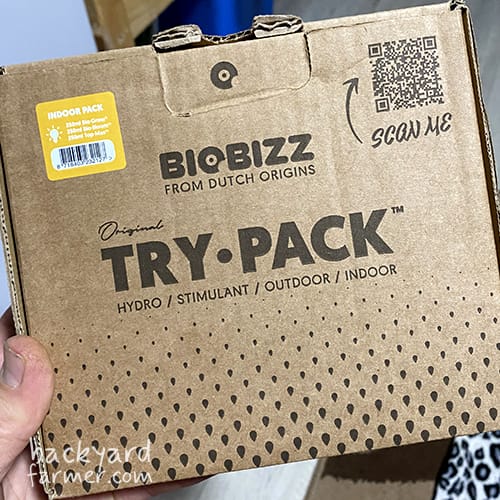
Starter kits (Try·Packs)
BioBizz Try·Packs bundle a small selection of nutrients together. As a result, they can be a convenient way to test a BioBizz autoflower feeding routine without committing to large bottles.
They’re useful if:
- you want to try BioBizz with minimal upfront cost
- you prefer a guided starting point
However, they’re less ideal if:
- you already know which BioBizz nutrients you need
- you’re intentionally keeping your setup as minimal as possible
The takeaway
For most container growers, Bio·Grow and Bio·Bloom are more than enough to get started with a reliable BioBizz autoflower schedule.
Everything else is optional — helpful in the right context, but never required. By starting simple, you’ll find it much easier to read your plants, avoid overfeeding, and build confidence before adding any extra bottles.
A Sensible, Beginner-Friendly Feeding Philosophy
Before getting into any numbers or charts, it helps to understand the mindset behind how a successful BioBizz autoflower feeding schedule actually works.
In practice, most feeding problems don’t come from choosing the wrong BioBizz product. Instead, they usually come from trying to do too much, too early — especially when switching from mineral nutrients to organic feeding.
Start light, not at the limit
Organic feeding systems reward restraint. With BioBizz, you’ll usually see better results if you:
- Start below the recommended feeding range
- Give the plant time to settle before increasing nutrients
- Make changes gradually and with intention
Rather than chasing instant visual responses, you’re building a steady, soil-led system that supports growth over time. As a result, patience almost always pays off when following a BioBizz autoflower schedule.
Feed rhythm matters more than exact numbers
When growing autoflowers in containers, how often you feed often matters just as much as what you feed.
In most setups, a simple, low-stress BioBizz feeding rhythm works best:
- Alternate nutrient feeds with plain water
- Avoid constant saturation of the growing medium
- Allow roots and microbes regular access to oxygen
Because of this approach, you’re far less likely to run into common problems such as soggy soil, slow growth, or nutrient confusion.
Let the soil (or coco blend) do its job
With BioBizz nutrients, the growing medium plays an active role in feeding autoflowers.
Healthy soil or coco blends help by:
- Buffering small feeding mistakes
- Releasing organic nutrients gradually
- Supporting more consistent, even growth
However, when the medium is overloaded with frequent or heavy feeds, its natural buffering ability drops. As a result, problems become far more likely.
Read the plant before adjusting the bottle
One of the biggest advantages of a gentler BioBizz feeding approach is time to observe.
Before increasing feed strength, it’s worth checking for:
- Sustained pale growth across the plant, not a single leaf
- Slowed development over several days
- A general loss of vigour, rather than isolated blemishes
More often than not, issues blamed on underfeeding are actually caused by overwatering, root stress, or environmental factors.
Why this philosophy suits autoflowers
Autoflowers run on a fixed timeline, which means there’s very little room for recovery if something goes wrong.
Because of that, a conservative BioBizz autoflower feeding strategy helps:
- Keep mistakes smaller and easier to manage
- Maintain steady growth instead of sharp spikes
- Allow plants to recover more easily from stress
For this reason, the schedule that follows is intentionally cautious rather than aggressive, prioritising consistency over force.
Key principle to remember:
BioBizz works best when you give autoflowers just enough support to thrive — and then resist the urge to push them harder than they need.
Taken together, this mindset makes a BioBizz autoflower feeding schedule easier to follow, easier to adjust, and far more forgiving in real-world container grows.
BioBizz Autoflower Schedule (Simple, Real-World Approach)
This BioBizz autoflower schedule is intentionally conservative, flexible, and hard to mess up. It’s designed for container gardeners who want steady progress, healthy plants, and a feeding routine that works in real-world conditions — without constantly chasing aggressive nutrient targets.
Rather than pushing maximum doses, the focus here is to support autoflowers consistently and let the soil or growing medium do part of the work. As a result, growth stays calmer, nutrient issues are easier to manage, and small mistakes don’t spiral into bigger problems.
Download the Backyard Farmer’s Biobizz Autoflower Feeding Schedule pdf
You can download the pdf version of the Biobizz Autoflowering Feeding Schedule here and keep it for referrence when feeding your plants:
How to read this BioBizz autoflower schedule
Before jumping into the schedule table, a few points help everything fall into place:
- This is a starting framework, not a rigid feeding chart
- In most cases, lighter feeding works better than heavier feeding
- Not every watering needs BioBizz nutrients
- Richer soils naturally require less input than lighter mixes
Because of this, if an autoflower looks slightly underfed but is otherwise healthy, it’s usually best to pause, observe, and wait, rather than reacting too quickly.
BioBizz autoflower feeding schedule overview
| Growth stage | Typical focus | Bio·Grow | Bio·Bloom | Top·Max | Notes |
|---|---|---|---|---|---|
| Seedling / early growth | Root establishment | – | – | – | Plain water only in most soils |
| Early vegetative growth | Leaf and structure | Light | – | – | Introduce gently if needed |
| Late vegetative / pre-flower | Preparing for flowering | Light | Very light | – | Avoid sudden increases |
| Early flowering | Flower formation | Reduced | Moderate | Light | Stability over strength |
| Peak flowering | Flower development | Minimal | Moderate | Moderate | Don’t push for speed |
| Final phase / ripening | Natural finish | – | – | – | Water only, allow natural fade |
This BioBizz autoflower feeding table shows relative strength rather than exact dilution numbers. Actual feed amounts depend on soil strength, container size, watering frequency, and overall plant response.
Soil strength matters
One of the most common reasons a BioBizz autoflower schedule runs into trouble is not accounting for the starting medium.
- All-Mix or rich soils: often need little to no feeding early on
- Light-Mix: allows earlier, lighter feeding
- Reused or depleted soil: may need support sooner, but still gently
Because of this, when in doubt, it’s usually safest to assume your soil is already doing more work than you think.
How often to feed BioBizz
For many container growers, a simple feeding rhythm works best:
- Feed BioBizz nutrients every other watering, not every time
- Use plain water in between to maintain oxygen and microbial balance
- Adjust feeding frequency before increasing nutrient strength
More often than not, feeding too frequently causes more problems than feeding too lightly.
Adjusting a BioBizz autoflower schedule without overcorrecting
If it feels like an autoflower needs more support:
- increase feeding frequency slightly before raising strength
- adjust one BioBizz product at a time
- give changes several days to show results before reassessing
In practice, many issues blamed on underfeeding are actually caused by overwatering, root stress, or environmental factors.
Why this BioBizz schedule stays conservative
Autoflowers follow a fixed timeline, which leaves very little room for recovery if something goes wrong.
Because of that, this conservative BioBizz autoflower feeding approach:
- reduces the impact of small errors
- keeps growth steady rather than spiky
- allows plants to finish more cleanly
The aim isn’t maximum force — it’s consistent momentum from start to finish.
Key reminder: If you’re unsure whether to increase feeding, wait. A calm, steady BioBizz autoflower feeding schedule almost always delivers better results than chasing numbers.
Soil vs Coco (What Actually Changes)
BioBizz works well in both soil and coco-based growing media. However, the way you approach a BioBizz autoflower feeding schedule does need to change slightly depending on which one you’re using. Most problems show up when coco is treated like soil — or when it’s assumed that both behave the same.
So, this section explains what actually changes, what stays consistent, and how to adjust your BioBizz autoflower schedule for soil or coco without overthinking it.
What stays the same
Regardless of whether you’re growing autoflowers in soil or coco, a few core feeding principles always apply:
- Start light and increase gradually
- Don’t feed at every watering
- Adjust feeding frequency before feed strength
- Watch the plant’s response, not the bottle
Because of this, BioBizz tends to work best when you focus on steady, consistent support rather than aggressive feeding, no matter the medium.
Growing autoflowers in soil (Light-Mix, All-Mix, or similar)
Soil provides natural buffering and biological activity, which makes a BioBizz soil feeding schedule especially forgiving.
What you’ll usually notice when using BioBizz in soil:
- Nutrients release more gradually
- Small overfeeds are less dramatic
- Plain water days help maintain oxygen and healthy microbial life
Practical soil feeding tips:
- Rich soils (such as BioBizz All-Mix) often need little to no feeding early on
- BioBizz Light-Mix allows earlier, lighter feeding
- Overwatering causes far more issues than underfeeding
As a result, if something looks slightly off in soil, it’s usually best to pause, observe, and wait before adding more nutrients.
Growing autoflowers in coco or coco blends
Coco behaves very differently from soil. It doesn’t hold nutrients in the same way and offers far less buffering, which means a BioBizz coco feeding schedule needs a bit more attention.
What changes when using BioBizz in coco:
- Nutrients become available more quickly
- Feeding mistakes show up faster
- Calcium and magnesium demand is often higher
Practical coco feeding adjustments:
- Keep BioBizz feed levels lighter than typical mineral-based coco routines
- Only add Cal·Mag when there’s a clear reason, such as water quality or visible deficiency
- Avoid letting coco dry out completely between waterings
Because coco reacts quickly, it’s especially important to make small, single adjustments, then give them time to show results before changing anything else.
Water quality and pH expectations
One advantage of using BioBizz nutrients in soil is that strict pH control is often unnecessary.
- Soil: minor pH swings are usually buffered naturally
- Coco: more sensitive, but still less rigid than mineral-based feeding systems
If autoflowers look healthy and growth remains steady, chasing exact pH numbers often causes more harm than good.
Choosing the right approach
If you’re looking for the lowest-stress BioBizz autoflower setup, soil is generally the more forgiving option.
Coco can still work well with BioBizz, but it:
- requires closer observation
- leaves less room for error
- rewards experience, restraint, and consistency
Key takeaway: BioBizz doesn’t need a completely different autoflower feeding schedule for soil and coco — it needs a different mindset. Soil gives you time and buffer, while coco demands attention and subtlety.
My Results After Switching from Canna to BioBizz
I didn’t switch to BioBizz expecting miracles. Canna A+B works, and it’s popular for good reason. However, the decision to change wasn’t about chasing bigger yields. Instead, it was about reducing friction and moving to a more intuitive, organic-style BioBizz autoflower feeding schedule that felt easier to manage day to day.
Rather than seeing instant results, the differences appeared gradually. Over time, though, they became consistent enough to stand out across the full grow cycle — especially when comparing a mineral nutrient approach with a more soil-led BioBizz autoflower feeding routine.
Plant health and resilience
One of the first noticeable changes was improved plant health and resilience.
- Plants recovered more calmly from minor stress
- Small feeding or watering mistakes didn’t escalate as quickly
- Growth stayed steadier, instead of spiking and crashing
With mineral nutrients, growing often felt like walking a tightrope. By contrast, BioBizz offered more margin for error, which matters in container grows where autoflowers can be less forgiving.
Ease of use and day-to-day confidence
As the grow progressed, feeding became less about exact measurements and more about observation and timing.
- Fewer urgent corrections were needed
- Second-guessing at each watering dropped noticeably
- Confidence improved by letting plants respond naturally
Instead of reacting to every slight colour change, I spent more time waiting, watching, and adjusting gently. As a result, that calmer approach delivered better outcomes more often than not.
Soil life and overall system balance
Another clear difference showed up in how the growing medium behaved week to week.
- Soil stayed healthier for longer
- Watering felt more forgiving
- The overall system remained more stable
Rather than constantly resetting the medium, a BioBizz-based autoflower feeding schedule supported a more balanced, living soil environment, which made the grow easier to manage.
Flavour, aroma, and finish
This is where the switch to BioBizz really justified itself.
- Aromas developed more cleanly and fully
- Flavour improved noticeably toward harvest
- Finishes felt more natural, rather than forced
Nothing felt rushed at the end of the grow. Allowing plants to ease off feeding gradually, instead of relying on heavy flushing, helped produce a smoother overall finish.
What didn’t change
To be clear, switching nutrients doesn’t solve everything.
- Poor watering habits still cause problems
- Weak lighting or environmental issues still limit results
- Plants still need observation, patience, and basic care
BioBizz didn’t remove the need to pay attention. Instead, it made that attention more effective, particularly when following a conservative BioBizz autoflower schedule.
The honest takeaway
For me, moving from Canna to BioBizz wasn’t about abandoning mineral nutrients altogether. Rather, it was about choosing a feeding system that better matched how I like to grow.
If you value:
- Consistency over aggressive feeding
- Flavour and plant health over pushing limits
- A calmer, more forgiving BioBizz autoflower feeding schedule
then BioBizz makes a lot of sense.
It didn’t make me a better grower overnight. However, it did make it easier to grow well, stay consistent, and enjoy the process.
Conclusion: Is BioBizz Right for You?
BioBizz isn’t about pushing plants to their limits. Instead, it focuses on steady progress, healthier systems, and fewer self-inflicted problems. Because of that, a BioBizz autoflower feeding schedule often appeals to growers who value consistency over constant correction.
So, if you’re the kind of grower who prefers:
- Consistency over chasing feed charts
- Observation over rigid numbers
- Flavour and plant health over aggressive feeding
then a conservative BioBizz autoflower schedule is likely to suit you very well.
Who BioBizz is best suited for
In practice, BioBizz works especially well for:
- Container growers using soil or soil-based mixes
- People new to organic feeding who want a forgiving autoflower feeding routine
- Growers switching from mineral nutrients who want less day-to-day stress
- Anyone who values flavour, aroma, and long-term plant resilience
As a result, BioBizz is often a strong fit for growers looking for a calmer, more predictable autoflower grow from start to finish.
Who it may not be ideal for
On the other hand, BioBizz may not be the best choice if you:
- Want instant, dramatic visual responses from feeding changes
- Prefer rigid, numbers-driven nutrient schedules
- Enjoy pushing plants hard with very little margin for error
There’s nothing wrong with those approaches. However, they’re simply different tools for different growing styles.
A simple way to get started
The good news is that you don’t need a shelf full of bottles to follow a successful BioBizz autoflower feeding schedule.
For most growers, a simple setup using Bio·Grow and Bio·Bloom is more than enough to get started. From there, additional BioBizz nutrients can be added gradually, once you understand how your plants and growing medium respond.
If you’d like to explore the products mentioned in this guide, you’ll find the current BioBizz range linked below.
(Product links are included for convenience and may earn a small commission at no extra cost to you.)
Where to go next
If you’d like to dig a little deeper, these related guides may help:
- How much BioBizz to use for autoflowers
- BioBizz vs Canna for autoflowers
- Choosing the right soil for BioBizz autoflowers
Each one builds on the same conservative, real-world BioBizz autoflower feeding approach outlined in this article.
Final thought: BioBizz doesn’t try to do everything for you. Instead, it gives you a stable foundation. When you work with it patiently and follow a sensible BioBizz autoflower schedule, it tends to reward you with calmer grows and more satisfying finishes. Learn more about Biobizz straight from the horses mouth at biobizz.com