
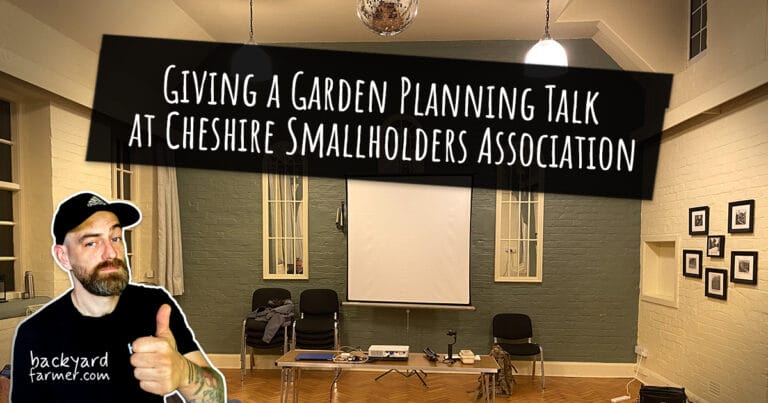
Why I Was Invited to Speak
Recently, I was invited to give a talk at the Cheshire Smallholders Association after being featured in the NAS (National Allotment Society) magazine.
The Chairman’s father — a previous chairman himself — had read the article, tried the allotment planner, and found it useful enough to reach out. As a result, they invited me to speak about the tool and the wider Backyard Farmer project.
Importantly, this is exactly the kind of organic connection I value — someone using something, finding value in it, and wanting to share it with others.
The Setting: A Local Hall in Cheshire
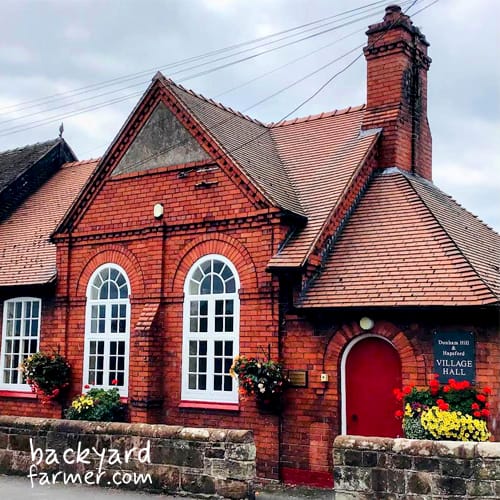
The talk was held in the town hall in Dunham-On-The-Hill, Cheshire — a proper local venue that felt grounded and familiar.
There were around 10 people in attendance, which, in reality, turned out to be ideal. Rather than a formal presentation, it quickly became a genuine conversation.
The group was made up of smallholders, mostly 50+, with a wide range of experience across different areas of growing and land use.
Notably, both Karl Colyer (honeybee farmer) and Mike Crawford (dog trainer and experienced speaker) were present — both of whom regularly do public speaking themselves. Karl also runs Bees in Our Community, which is well worth a look if you’re interested in bees and pollinators.
What I Covered in the Talk
I opened by sharing the background of the Backyard Farmer project — how it started during COVID and, more importantly, how the fragility of supply chains made food security feel very real, very quickly.
From there, I moved into a few key areas:
- The mistakes I made when starting out (overplanting, poor timing, unrealistic plans)
- Why planning matters more than most people think
- How slowing down and working with the seasons changes everything
- The balance between hands-on growing and useful digital tools
Rather than presenting polished theory, I kept it grounded in real experience — what worked, what didn’t, and why I built the tools in the first place.
The Planner: Where Things Opened Up
The allotment planner was where things really started to open up.
As soon as people could see how it worked — visually mapping beds, spacing, and companion planting — it immediately sparked ideas and discussion.
One experienced grower mentioned that she currently relies on multiple charts and handwritten notes to manage what the planner can show in seconds.
That moment, more than anything, summed up the purpose of the tool.
Other tools also came up naturally, including:
- The vegetable planting calendar
- The bee identification app (which Karl was particularly interested in)
Feedback from Experienced Growers
One of the most valuable parts of the evening was getting feedback from people who have been growing for decades.
As expected, the suggestions were practical and grounded:
- Clear vegetable quantities per square
- Soil type considerations
- More detailed companion planting distances
- Fallow year planning
- Green manure integration
- Integration with schemes like Kings Seeds
As a result, this kind of feedback is exactly what helps shape the next iteration of the tools.
Key Questions from the Night
A big part of the evening naturally turned into a practical Q&A. As a result, we ended up digging into real-world growing problems rather than theory — which is exactly where the value is.
Some of the most useful questions included:
- Is a fallow year necessary?
There were mixed views here. While some growers still follow the idea, others prefer to keep the soil active, feeding it properly and rotating crops instead of leaving it unused. - How long should crop rotation be?
Most agreed on a 3-year rotation (Brassicas, Alliums, Legumes). However, some extend this to 5 years where space allows. - Can the planner save layouts?
At the moment, it’s export-only. That said, there was clear interest in a feature that remembers layouts, so people can revisit and refine plans over time. - Do vegetables take up realistic space?
This came up quickly. For example, crops like courgettes often need more than a single square, so accuracy here matters. - Can the planner calculate total plant numbers?
This was a strong one. People want to know exactly how many plants (or seeds) they’ll need once a layout is complete. - How far do companion planting rules extend?
Not always straightforward. It depends on the crop, spacing, and growing conditions — so there’s no one-size-fits-all answer. - Does the planner show companion plants?
Yes — currently visible within the interface (bottom corner), which a few people hadn’t spotted yet. - What about soil types and pH?
This was flagged as a major factor. What works in one plot won’t always work in another, especially when soil conditions vary. - Is green manure included?
Raised as an important addition, particularly for improving soil health and structure between crops. - What can be grown in winter?
A common gap for many growers — and something people clearly want more guidance on. - Could there be a ‘plan my allotment’ feature?
This sparked interest. With current tools (and even AI), this feels like a realistic direction for the future. - How long do seeds last?
This linked directly to cost and waste, and it opened up a wider conversation around seed saving and sharing. - Seed schemes and cost-saving initiatives
The NAS Kings Seeds scheme was mentioned as a useful option, especially for those trying to keep costs down.
Overall, these questions highlighted something important.
While the idea of planning makes sense to most growers, the real challenge is handling the details — space, timing, soil, and cost — in a way that reflects real growing conditions, not just theory.
The Bigger Theme: Community
One thing that came up — and clearly resonated — was the idea of community.
Growing food has always been rooted in community:
- sharing seeds
- sharing knowledge
- learning from each other
However, in many places, that sense of community has faded.
People often grow in isolation now — even when they’re physically close to others.
And yet, when you visit a good allotment site, you can feel it immediately:
- conversations
- shared advice
- informal support
Clearly, there’s something there that people are missing.
Places like Hoylake, with initiatives like Incredible Edible Hoylake, show that this kind of community can still exist — and, importantly, thrive when given the chance.
What I Took Away from the Evening
For me, the biggest takeaway was simple:
People are ready to talk.
There was a real openness in the room — not just about growing, but also about bigger ideas like food security, independence, and how we live.
Especially after COVID, these aren’t abstract ideas anymore.
Instead, they’re practical — and shared.
Interested in a Similar Talk?
If you run a smallholding group, allotment association, or community project, and would be interested in a similar session, feel free to get in touch.
You can also find more details about the speaking and talks section here: https://backyard-farmer.com/about/
These talks work best as informal, discussion-led sessions, focused on:
- Planning and organisation
- Avoiding common mistakes
- Using simple tools to make better decisions
- Sharing real-world growing experience
Final Thoughts
This wasn’t about giving a presentation.
Instead, it was about having a conversation.
And in a small room, with the right people, that’s where the real value is.