
Introduction
The Common Furrow Bee (Lasioglossum calceatum) is one of the most widespread and frequently encountered small bees in the UK. Active for much of the year, it is often seen visiting low-growing flowers in gardens, parks, and grassy areas, though it is easily overlooked due to its small size and subtle colouring.
This species is particularly adaptable and thrives in both urban and rural environments, provided there is access to flowering plants and suitable ground for nesting. Unlike larger, more familiar bees, the Common Furrow Bee tends to fly low and fast, often close to lawns or flowerbeds.
Although currently common, it is still affected by pesticide use, soil disturbance, and the loss of wildflowers. In this guide, you’ll learn how to identify Lasioglossum calceatum, distinguish it from similar furrow bees, and understand its role as a reliable, long-season pollinator.
Identification & Key Facts
| Attribute | Details |
|---|---|
| Common Name | Common Furrow Bee |
| Latin Name | Lasioglossum calceatum |
| Size | Females: ~8–10 mm, Males: ~6–9 mm |
| Location | Widespread across the UK |
| Active Months | March to October |
| Habitat | Gardens, parks, grassland, hedgerows |
| Nesting Behaviour | Underground nests in bare or lightly vegetated soil |
| Social Behaviour | Solitary or weakly social |
| Flora | Dandelion, daisy, buttercup, clover, small wildflowers |
| UK Status | Common |
How to Identify the Common Furrow Bee
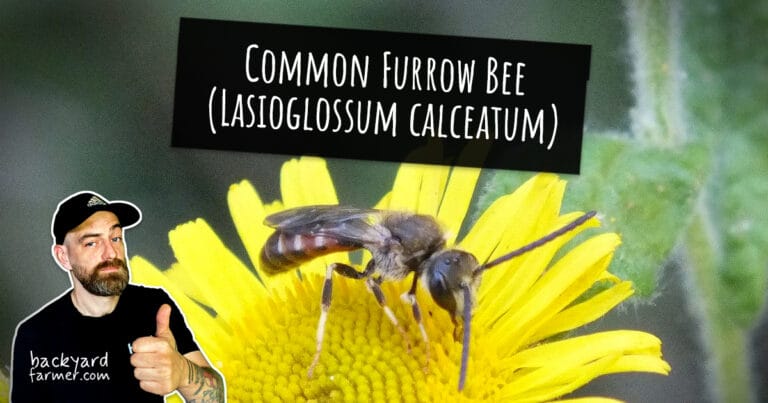
The Common Furrow Bee is a small, slender bee with a dark brown to black body and faint pale hair bands across the abdomen. In good light, it may show a subtle metallic sheen, though this is often difficult to see without close inspection.
In the UK, it is most often spotted flying low over grass or visiting small, open flowers. Its quick, darting flight and preference for low-growing blooms are useful clues when trying to identify it.
Physical Characteristics
- Female – Slightly larger, dark-bodied with faint hair bands and pollen carried on the hind legs.
- Worker – Not applicable, as this species does not produce true workers.
- Male (Drone) – Smaller and slimmer, with longer antennae and less obvious pollen-carrying hairs.
Image source: {source}
Similar Species
The Common Furrow Bee is frequently confused with other small ground-nesting bees:
- Smeathman’s Furrow Bee (Lasioglossum smeathmanellum) – Smaller overall and often appears more delicate.
- Sharp-collared Furrow Bee (Lasioglossum malachurum) – More robust and often found nesting in large aggregations.
- Small Sweat Bees (Halictus species) – Chunkier with stronger abdominal banding.
If you’re unsure which bee you’ve spotted, our Bee Identification guide can help you narrow down UK species by size, colour, and behaviour.
Why the Common Furrow Bee Matters
The Common Furrow Bee is an important pollinator of small wildflowers and garden plants. Its long active season means it provides pollination services from early spring through to autumn, supporting plant reproduction when other insects are scarce.
By visiting many flowers that larger bees may ignore, it helps maintain plant diversity and contributes to stable pollination networks across a wide range of habitats.
FAQs
No. This species is very gentle and avoids contact with people. Stings are extremely rare.
It is active for much of the year, typically from March to October.
No. It is one of the UK’s most common small bee species.
Females can sting, but stings are very uncommon and usually only occur if the bee is trapped.
How You Can Help
Supporting the Common Furrow Bee is simple and achievable in most gardens:
🌿 Plant Bee-Friendly Flowers
- Dandelion, daisy, buttercup, clover, lawn wildflowers
🚫 Avoid Harmful Pesticides
- Avoid insecticides that contaminate nectar and pollen
🏡 Provide Nesting Spaces
- Leave small areas of bare or lightly vegetated soil undisturbed
By allowing lawns to flower and leaving patches of natural ground, you help support the Common Furrow Bee and many other small solitary pollinators.