
Introduction
The Davies’ Colletes Bee (Colletes daviesanus) is a distinctive solitary bee most commonly associated with coastal habitats in the UK. It is best known for its strong preference for plants in the carrot family and its habit of nesting in sandy soils close to the sea.
This species is most often encountered along coastal paths, dunes, cliffs, and nearby grassland, though it can also appear inland where suitable plants and sandy ground are present. During its active period, it can sometimes be seen in noticeable numbers, particularly where favoured flowers are abundant.
Although not currently threatened, the Davies’ Colletes Bee depends on specific habitats and food plants, making it sensitive to coastal development, habitat disturbance, and changes in land management. In this guide, you’ll learn how to identify Colletes daviesanus, distinguish it from similar plasterer bees, and understand its role in supporting coastal biodiversity.
Identification & Key Facts
| Attribute | Details |
|---|---|
| Common Name | Davies’ Colletes Bee |
| Latin Name | Colletes daviesanus |
| Size | Females: ~10–13 mm, Males: ~9–12 mm |
| Location | Coastal areas of England and Wales; localised inland sites |
| Active Months | June to September |
| Habitat | Coastal dunes, cliffs, sandy grassland, paths |
| Nesting Behaviour | Ground-nesting in sandy soil; nests lined with waterproof secretion |
| Social Behaviour | Solitary (often nesting in aggregations) |
| Flora | Wild carrot, hogweed, fennel, other umbellifers |
| UK Status | Locally common |
How to Identify the Davies’ Colletes Bee
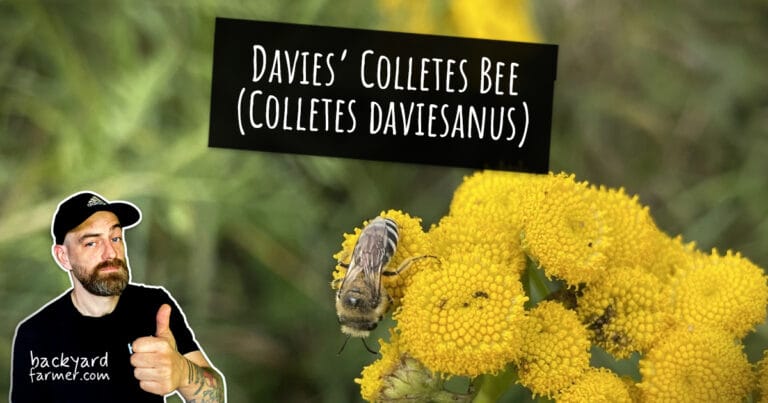
The Davies’ Colletes Bee is a medium-sized solitary bee with a robust body and pale hair bands across the abdomen. Its overall colouring is brownish-grey, giving it a slightly wasp-like appearance at a distance.
In the UK, it is most often seen visiting white or pale umbellifer flowers along coastal paths and dunes. Its steady, purposeful flight and strong association with sandy ground are useful identification clues.
Physical Characteristics
- Female – Sturdier overall, with clear pale hair bands on the abdomen and pollen carried on the hind legs.
- Male – Slightly slimmer, often with longer antennae and a lighter appearance.
Similar Species
The Davies’ Colletes Bee can be confused with other plasterer bees and similar solitary species:
- Ivy Mining Bee (Colletes hederae) – Active much later in the year and closely associated with ivy flowers.
- Heather Colletes Bee (Colletes succinctus) – Typically found on heathland and strongly associated with heather.
- Honey Bee (Apis mellifera) – More slender with different flight behaviour and smoother body appearance.
If you’re unsure which bee you’ve spotted, our Bee Identification guide can help you narrow down UK species by size, colour, and behaviour.
Why the Davies’ Colletes Bee Matters
The Davies’ Colletes Bee is an important pollinator of umbellifer flowers such as wild carrot and hogweed, which support a wide range of insects. By pollinating these plants, it helps maintain the diversity and resilience of coastal ecosystems.
Its reliance on sandy soils and coastal habitats also makes it a useful indicator species for the health of these increasingly pressured environments.
FAQs
No. This species is generally calm and focused on foraging. It is very unlikely to sting unless handled.
It is typically active from early summer through to early autumn, usually between June and September.
No. It is locally common in suitable coastal habitats but not widespread inland.
Females can sting, but stings are rare and usually occur only if the bee is trapped or mishandled.
How You Can Help
Supporting the Davies’ Colletes Bee is closely linked to protecting coastal habitats:
🌿 Plant Bee-Friendly Flowers
- Wild carrot, fennel, hogweed, other umbellifers
🚫 Avoid Harmful Pesticides
- Avoid pesticide use in coastal gardens and paths where bees forage
🏡 Provide Nesting Spaces
- Leave areas of sandy soil undisturbed, especially near the coast
By protecting sandy ground and allowing native wildflowers to thrive, you help support the Davies’ Colletes Bee and other specialist coastal pollinators.