
A propagation heat mat provides bottom warmth for germinating seeds in cooler UK growing conditions. They’re particularly useful for starting chillies, peppers, aubergines and other warmth-loving crops indoors before moving them into the greenhouse, garden or allotment.
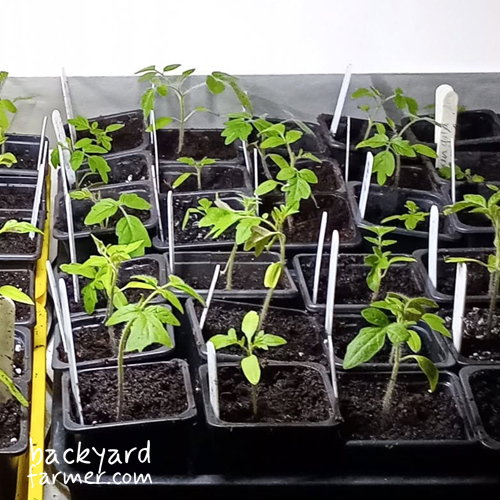
Choosing the right mat comes down to heating area, temperature control and the trays you already own. Some provide basic warmth, while others include thermostats to help maintain more consistent conditions.
Here are five propagation heat mats worth considering, based on UK specifications, availability, value and gardener experiences.
Quick Picks — Best Propagation Heat Mats UK
Best Overall — Root+ 30W Heat Mat Bundle
Best Budget — ROOT!T Hobby 11W
Best for Larger Batches — Root+ 60W
Quick Comparison of the Best Propagation Heat Mats
| Model | Best For | Size | Power | Temperature Control | UK Price |
|---|---|---|---|---|---|
| Root+ 30W Bundle | Best Overall | 40 × 60cm | 30W | Probe thermostat included | From £57.79 |
| ROOT!T Hobby 11W | Best Budget | 25 × 35cm | 11W | Separate | £17.99 |
| Root+ Large | Larger batches | 40 × 120cm | 60W | Separate | £33.99 |
| AC Infinity H3 | Compact controlled mat | 25.4 × 52.7cm | 20W | Digital controller included | £23.99 |
| Spider Farmer | Alternative | 25 × 53cm | Not confirmed | Adjustable controller included | £25.99 |
Prices checked on 20 October 2026 and may change. Prices are indicative and exclude delivery. Compare the full cost of mats, thermostats and insulation before buying. The AC Infinity H3 was on backorder and the Spider Farmer compact mat was sold out when checked.
For regular seed propagation, a mat with a separate-probe thermostat offers useful flexibility. For occasional sowing in a reasonably warm room, a smaller basic mat may be sufficient.
Best Overall Propagation Heat Mat — Root+ 30W Bundle
The Root+ 30W heat mat bundle is the strongest all-round option here for gardeners who regularly start seeds indoors.
Its 40 × 60cm mat provides a useful heating area, while the included insulating layer helps reduce heat loss through the surface underneath. The separate thermostat gives you more control over growing conditions than an uncontrolled mat.
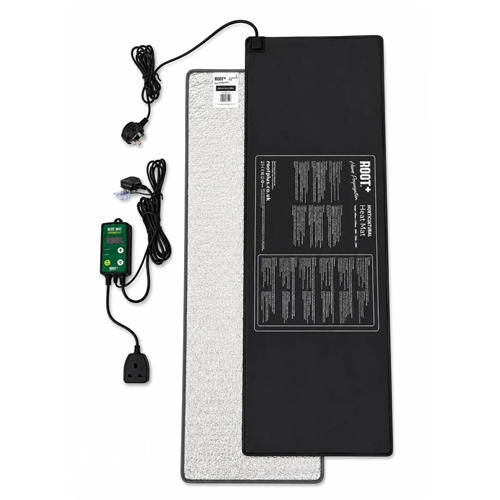
The included thermostat uses a separate temperature probe, allowing you to monitor conditions within the propagation setup. Follow the instructions supplied with the controller when positioning the probe.
At around £58 before delivery, this costs considerably more than a basic mat. However, buying the heating mat, insulation and controller together avoids having to source compatible components separately.
| Specification | Detail |
|---|---|
| Power | 30W |
| Dimensions | 40 × 60cm |
| Controller | Separate-probe thermostat included |
| Insulation | Included |
| UK connection | Three-pin plug |
| Warranty | One year |
Best For
- Regular seed propagation.
- Chillies, peppers and other warmth-loving crops.
- Medium-sized propagation benches.
- Gardeners wanting adjustable temperature control.
Pros
- Thermostat included.
- Useful heating area.
- Insulation included.
- Complete heating setup for existing trays.
Cons
- Higher initial cost.
- Trays and covers sold separately.
- Limited long-term owner feedback.
Our Verdict: The most practical all-round package for regular propagation. The included thermostat and insulation justify the extra cost for gardeners who will use it throughout the growing season.
Best Budget Propagation Heat Mat — ROOT!T Hobby 11W
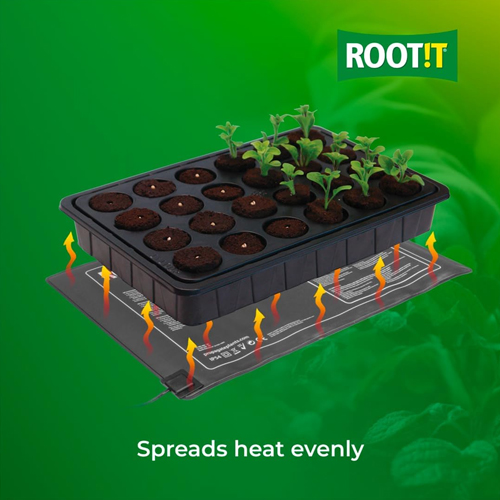
The ROOT!T Hobby 11W is a sensible choice if you only need to warm a small propagation tray.
Measuring 25 × 35cm, it fits neatly into a compact indoor growing setup. Its low initial price makes it attractive for occasional seed starting, particularly where the room is already reasonably warm.
ROOT!T also has some encouraging feedback from UK gardeners, although this doesn’t establish superior durability.
There is no included thermostat, so you’ll need to monitor the compost temperature. Adding a separate controller increases the total cost.
The Gro-Sure 17.5W mat is worth comparing before buying. At 25 × 50cm, it provides a larger heating area for only a little more money at some UK retailers, although it also lacks an adjustable thermostat.
| Specification | Detail |
|---|---|
| Power | 11W |
| Dimensions | 25 × 35cm |
| Controller | Not included |
| Format | Flexible heating mat |
| Intended use | Small propagation trays |
Best For
- Small indoor growing spaces.
- Occasional seed starting.
- One compact propagator.
- Budget-conscious gardeners.
Pros
- Affordable.
- Compact footprint.
- Established propagation brand.
- Low power consumption.
Cons
- No included thermostat.
- Limited heating area.
- Less suitable for very cold locations.
Our Verdict: A good inexpensive option for occasional propagation. If you need separate temperature control, compare the combined price with a complete bundle first.
Best Propagation Heat Mat for Larger Batches — Root+ 60W
The Root+ 60W propagation heat mat is designed for gardeners who need to warm several seed trays at once.
Its 40 × 120cm footprint makes it particularly useful on larger propagation benches, where trying to fit multiple trays onto a compact mat becomes impractical.
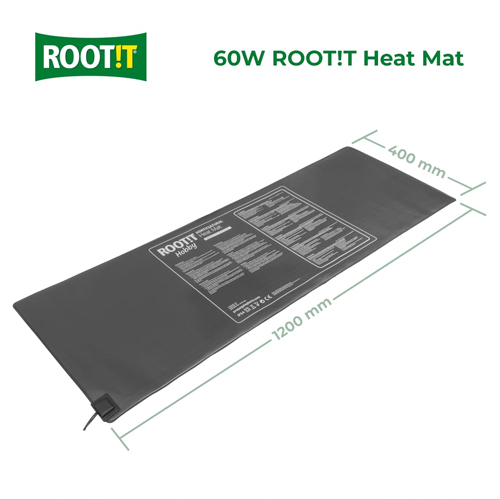
The 60W rating reflects its larger heating area rather than guaranteeing higher compost temperatures. Actual performance depends on the surrounding conditions, tray arrangement and temperature control.
Root+ supplies the mat with a UK plug and advertises IP67 protection for the mat itself. A matching thermostat and insulating layer are available separately.
Independent long-term feedback remains limited, but the specifications make it a worthwhile option for larger setups.
| Specification | Detail |
|---|---|
| Power | 60W |
| Dimensions | 40 × 120cm |
| Controller | Sold separately |
| UK connection | Three-pin plug |
| Water resistance | IP67 claimed for mat |
| Warranty | One year |
Best For
- Allotment growers.
- Several propagation trays.
- Larger growing shelves.
- Regular batch sowing.
Pros
- Generous heating area.
- UK plug supplied.
- Optional temperature control.
- Suitable for multiple trays.
Cons
- Requires more bench space.
- Thermostat costs extra.
- Limited long-term owner feedback.
Our Verdict: A sensible choice when heating area matters most. Measure your propagation bench and trays before ordering, and budget for a thermostat if you want adjustable control.
Best Compact Mat with Controller — AC Infinity SUNCORE H3
The AC Infinity SUNCORE H3 combines a compact heating mat with an adjustable digital controller.
At approximately 25 × 53cm, it suits a small indoor propagation shelf or existing seed tray setup. The controller displays the mat’s temperature, allowing you to adjust the heating without buying a separate thermostat.
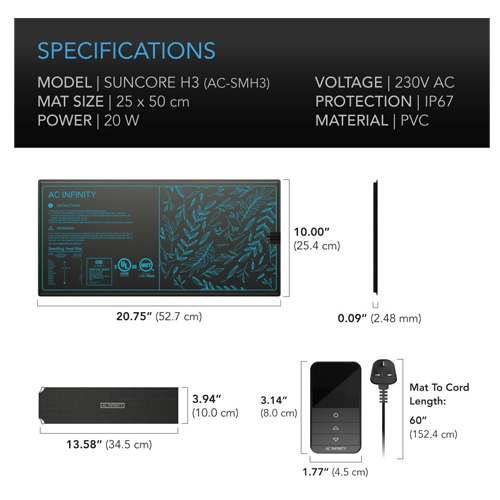
The limitation is that mat temperature isn’t necessarily the temperature around the seeds. A separate compost thermometer remains useful.
AC Infinity claims its heating film distributes warmth evenly, but independent evidence for this exact model is limited. Owner feedback is mixed, so we cannot confirm that it prevents hot spots or performs better than cheaper alternatives.
A UK retailer lists a 230V version, although it was on backorder when checked. Ensure the supplied mat itself is rated for UK mains electricity.
| Specification | Detail |
|---|---|
| Power | 20W |
| Dimensions | 25.4 × 52.7cm |
| Controller | Digital controller included |
| Temperature displayed | Mat temperature |
| UK retailer specification | 230V AC |
| Water resistance | IP67 claimed for mat |
Best For
- Compact indoor propagation.
- Existing seed trays.
- Gardeners wanting integrated controls.
- Small growing shelves.
Pros
- Digital controller included.
- Compact format.
- Flexible construction.
- Straightforward setup.
Cons
- Doesn’t directly measure compost temperature.
- Limited independent performance evidence.
- UK availability uncertain.
Our Verdict: A convenient compact option at a competitive listed price. Worth considering if the correct UK-rated version is available, although its heating performance isn’t proven superior to other mats.
Alternative Worth Considering — Spider Farmer Heat Mat
The Spider Farmer 10 × 20.75-inch heat mat offers adjustable bottom heat for a compact propagation setup.
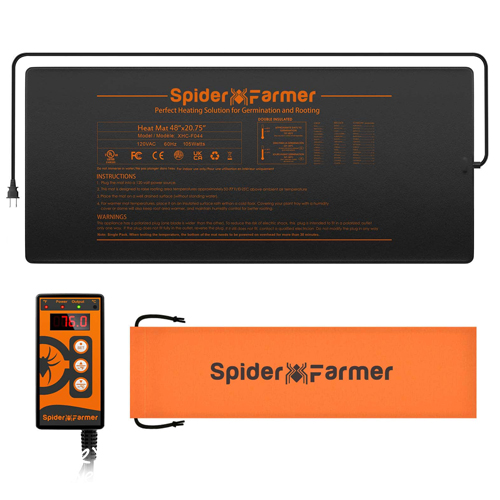
At approximately 25 × 53cm, it has a similar footprint to the AC Infinity H3 and can be used beneath existing suitable seed trays.
Its included controller is the main attraction. However, the sensing arrangement of the current compact UK model isn’t clearly documented, and there is limited independent evidence supporting its claims about even heating.
This makes it difficult to recommend Spider Farmer over similarly priced alternatives on heating performance alone.
| Specification | Detail |
|---|---|
| Dimensions | Approximately 25 × 53cm |
| Controller | Adjustable controller included |
| UK connection | Three-pin plug |
| Water resistance | IP67 claimed for mat |
| Intended use | Seed starting and propagation |
Best For
- Small propagation shelves.
- Gardeners with existing trays.
- Compact indoor setups.
Pros
- Controller included.
- Flexible design.
- Straightforward setup.
Cons
- Limited heating area.
- Controller sensing arrangement unclear.
- UK stock availability inconsistent.
Our Verdict: Worth considering when available at a competitive price. Its included controller makes it convenient, but there’s no strong evidence that it performs better than the AC Infinity.
For more detail, read our Spider Farmer Heat Mat Review.
How to Choose the Right Propagation Heat Mat
The best propagation heat mat is one that suits your trays and maintains suitable growing conditions without unnecessary expense.
For most UK gardeners, heating area and temperature control matter more than buying the highest-wattage model.
Quick Buying Guide
| Growing Situation | Best Type | Why |
|---|---|---|
| One small seed tray | Compact heat mat | Affordable and space-saving |
| Chillies and peppers | Thermostat-controlled mat | Helps maintain suitable germination warmth |
| Several propagation trays | Larger mat | More usable heating area |
| Cool potting shed | Controlled mat with insulation | Reduces heat loss |
| Warm indoor room | Mat may be unnecessary | Compost may already be warm enough |
Basic Heat Mats
The cheapest option for occasional propagation. They provide bottom warmth whenever powered, but require temperature monitoring to avoid overheating or drying the compost.
Mats with Digital Controllers
Convenient all-in-one systems with adjustable heating. Check whether the displayed temperature comes from the mat itself or a sensor within the growing medium.
Mats with External-Probe Thermostats
These allow temperature control based on a separate sensor positioned within the propagation setup. Follow the manufacturer’s instructions for probe placement, as requirements differ between controllers.
Practical Checks Before Buying
Tray fit: Measure the actual tray base, including any watering tray. Cell counts don’t reliably indicate overall dimensions.
Growing location: Small mats may struggle to maintain target temperatures in cold greenhouses or outbuildings. Suitable insulation can help reduce heat loss when used according to the manufacturer’s instructions.
UK electrical compatibility: Check the mat’s voltage rating. A travel adapter doesn’t convert voltage, and waterproof ratings don’t necessarily cover plugs or controllers.
Compost moisture: Bottom heat can dry compost beneath the surface. Check moisture and temperature at seed depth rather than relying on how warm the tray feels.
Once seeds germinate, adequate light becomes equally important. Our Best LED Grow Lights UK guide includes options suited to seedlings and compact growing setups.
How Much Does a Propagation Heat Mat Cost to Run?
Propagation heat mats generally have modest electricity requirements, although costs depend on wattage and running time.
The figures below use an illustrative electricity rate of 25p per kWh, assuming continuous full-power operation over 30 days.
| Mat Power | 12 Hours Daily | 24 Hours Daily |
|---|---|---|
| 11W | £0.99 | £1.98 |
| 20W | £1.80 | £3.60 |
| 30W | £2.70 | £5.40 |
| 60W | £5.40 | £10.80 |
These estimates exclude standing charges and additional controller consumption. Thermostatically controlled mats may use less electricity because the heating switches off when the measured temperature reaches its setting.
The most economical approach is only using additional heat when your seeds actually need it.
Frequently Asked Questions About Propagation Heat Mats
Yes, when they raise cool compost into a suitable germination-temperature range. They’re particularly useful for chillies, peppers and aubergines. Extra heat offers little benefit if the compost is already warm enough.
A thermostat is useful for controlling temperature and reducing the risk of overheating. Models with a separate probe allow you to monitor a chosen point in the propagation setup, depending on the manufacturer’s placement instructions.
It depends on the crop. Many warmth-loving vegetables germinate well with compost temperatures around 20–25°C, although some prefer warmer or cooler conditions. Follow crop-specific guidance and check the actual compost temperature.
Only if the product is suitable for those conditions. Small mats may struggle in very cold surroundings, and electrical equipment must be protected appropriately. An insulated, thermostat-controlled setup is generally more practical than an uncontrolled mat.
For many crops, bottom heat can be reduced or removed once seedlings emerge. Tender seedlings may still need warmth, particularly in cool rooms. Maintain suitable growing temperatures and provide adequate light.
A standalone mat is often better value if you already own suitable trays and covers. A complete heated propagator may be more convenient when starting from scratch, as it combines several components in one unit.