
Established free-standing apple trees are usually pruned while dormant, from roughly November to early March in the UK.
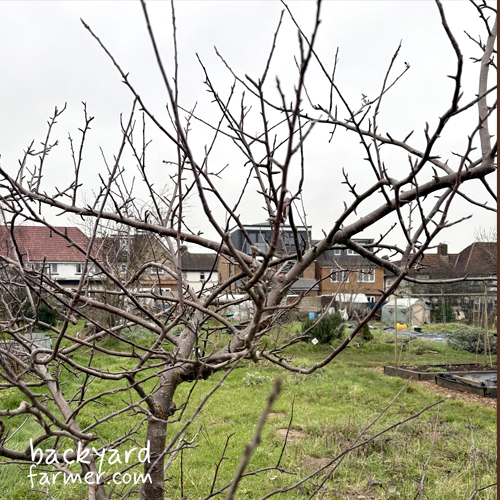
The aim is not to cut everything back. Winter pruning is mainly about removing badly placed wood, opening the crown and keeping the tree productive and manageable.
This guide is for established bush, half-standard and standard apple trees. Young trees need formative pruning, while espaliers, cordons and other trained forms are mainly managed with summer pruning.
For planting, feeding, pollination and general care, see our How to Grow Apple Trees in the UK guide.
Apple Tree Winter Pruning Quick Guide
| Question | Quick answer |
|---|---|
| When to prune? | November to early March, while dormant |
| Which trees? | Established free-standing apple trees |
| Main aim | Open the crown, remove problem wood and maintain structure |
| How much? | Around 10–20% of the canopy in a normal year |
| What first? | Dead, diseased, damaged, crossing and inward-growing branches |
| Young trees? | Need formative pruning rather than this maintenance method |
| Espaliers and cordons? | Mainly summer-pruned |
| Plums and cherries? | Do not use this winter-pruning method |
Which Apple Trees Should You Prune in Winter?
This method is for established free-standing apple trees.
Young trees need a different approach to build their framework, while espaliers, cordons, fans, stepovers and other trained apples are mainly pruned in summer.
If you have just bought a dormant tree, see our How to Plant Bare-Root Fruit in the UK guide first.
Plums, cherries and other stone fruit also need different seasonal pruning, so do not apply this method to them.
When to Prune Apple Trees in the UK
Prune established apple trees after leaf fall and before strong spring growth begins.
In the UK, that normally means November to early March.
There is no single perfect month. The important thing is that the tree is dormant and has not yet moved strongly into spring growth.
What Are You Trying to Achieve?
Winter pruning has three main jobs: remove unhealthy or badly positioned wood, allow more light and air through the crown, and keep the tree at a manageable size.
The finished tree should have a reasonably open structure rather than a dense tangle of branches.
You are thinning and shaping the tree, not giving it a haircut.
Stand back regularly as you work. The whole structure is much easier to judge from a few metres away than from inside the canopy.
How to Prune an Apple Tree in Winter
1. Remove the Obvious Problem Wood
Start with dead, diseased, damaged, crossing, rubbing and strongly inward-growing branches.
Remove badly placed vertical growth and low or downward-growing branches where they are causing a problem.
If two branches cross, keep the better-positioned one rather than simply shortening both.
This is also a good time to remove mummified fruit and look for obvious canker or damaged wood.
2. Stand Back
Once the obvious problem branches are gone, stop and look at the whole tree.
Ask whether you can see daylight through the crown, whether branches are still rubbing and whether one area is noticeably more congested than the rest.
Do not remove healthy wood simply because the tree does not perfectly match a diagram.
3. Thin the Centre Where Needed
Remove selected branches completely rather than trimming every branch tip.
The aim is to create a more open structure without leaving the tree bare.
4. Maintain the Main Framework
Where needed, shorten the previous season’s extension growth on the main framework branches by around one-quarter to one-third, cutting just above a suitable outward-facing bud.
5. Leave Useful Side-Shoots
Do not automatically shorten every young lateral.
Well-positioned side-shoots can develop fruit buds, so repeatedly cutting all of them back can reduce future cropping.
6. Stop and Reassess
Have a reason for every cut. Once the crown is noticeably more open and the main problems have been removed, there is usually little benefit in continuing simply because more branches could come off.
How Much Should You Prune?
For normal annual winter pruning, aim to remove roughly 10–20% of the canopy.
Heavy winter pruning can trigger vigorous regrowth, producing masses of upright watershoots and sometimes reducing fruiting.
You do not have to correct every problem in one session.
If the pruning pile is getting surprisingly large, stop. You can always take more out next winter.
Spur-Bearing and Tip-Bearing Apples
Apple varieties can fruit on short spurs, shoot tips or a mixture of both.
The basic winter-pruning approach is broadly similar, but avoid automatically shortening every young side-shoot. Tip-bearing varieties can lose useful fruiting wood if they are pruned too heavily.
If you do not know which type you have, selective thinning is safer than routinely shortening every lateral.
What to Do With Watershoots
Watershoots are strong, straight, upright shoots that often appear after hard pruning.
Remove those that are badly placed or crowding the crown. Occasionally, a well-positioned shoot can be retained if it is useful for replacing missing framework on an older tree.
If the tree produces a mass of watershoots every year, previous pruning may have been too severe. Cutting the tree even harder the following winter is unlikely to solve the problem.
Where excessive vigour is the main issue, summer pruning can sometimes be more useful.
Pruning an Old or Overgrown Apple Tree
Do not try to completely renovate a neglected apple tree in one winter.
Start with dead, dangerous, badly crossing and heavily congested wood, then spread larger structural changes over two or three winters.
Removing major limbs creates larger wounds and can provoke strong regrowth, so think carefully before making drastic cuts.
An old apple tree does not have to be fixed in one afternoon.
If the job involves removing major limbs or there are concerns about structural safety, get experienced help rather than treating it as routine annual pruning.
Tools for Winter Pruning
Sharp secateurs will handle smaller shoots, with loppers or a pruning saw for thicker branches. Use clean, sharp tools and suitable eye protection.
Do not struggle through thick wood with undersized secateurs.
Pruning paint or wound sealant is not normally needed on apple-tree cuts.
Common Apple Tree Pruning Mistakes
| Mistake | Why it causes problems |
|---|---|
| Cutting the tree like a hedge | Creates dense outer regrowth instead of opening the crown |
| Removing too much in one winter | Encourages watershoots and can reduce fruiting |
| Shortening every side-shoot | Can remove future fruiting wood |
| Ignoring crossing branches | Leads to rubbing and congestion |
| Never standing back | Makes it easy to over-prune one part of the tree |
| Renovating an old tree in one go | Creates large wounds and excessive regrowth |
| Winter-pruning trained apples like free-standing trees | Uses the wrong pruning method |
| Using this method on plums or cherries | Stone fruit needs different seasonal pruning |
FAQs
Yes. Established free-standing apple trees are normally pruned while dormant, usually from November to early March in the UK.
After leaf fall and before strong spring growth begins. There is no single perfect month; the dormant period is what matters.
For normal annual maintenance, aim to remove roughly 10–20% of the canopy. Harder pruning can trigger vigorous watershoots.
Not necessarily. Most badly positioned watershoots can go, but a well-placed shoot may occasionally be useful for replacing missing framework.
Routine pruning of espaliers, cordons and other trained apples is mainly carried out in summer. Winter work is generally more structural and should not follow the same method as a free-standing tree.