
Introduction: It’s not just you
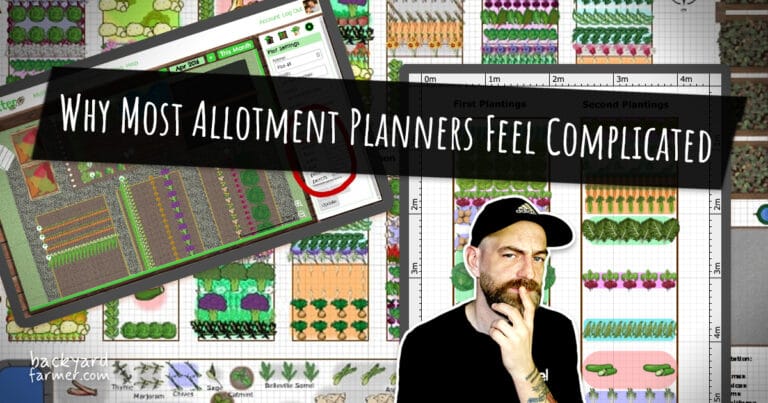
If you’ve ever opened an allotment planner and felt instantly overwhelmed, you’re definitely not alone.
Most gardeners — especially those new to allotments — expect an allotment planner or allotment planning software to make things clearer and easier. However, what they often find instead is:
- Dense menus filled with unfamiliar terms
- Long setup processes before anything genuinely useful happens
- The feeling they need to understand everything before they can even get started
Naturally, that frustration can knock your confidence. But importantly, it isn’t a sign you’re doing something wrong. More often than not, it simply means the allotment planning software you’re using wasn’t designed with beginners or casual growers in mind.
In reality, most allotment planners are built for very specific types of growers, including:
- People managing larger or multiple plots
- Growers planning several seasons ahead
- Educators teaching structured growing systems
- Gardeners refining methods they already know work
For those users, depth and detail are a real strength. On the other hand, if you’re still finding your feet, that same depth can quickly feel like unnecessary complexity — especially when you’re simply trying to plan your first allotment layout or understand what fits where.
This article isn’t about saying allotment planners are bad — many are excellent allotment planning tools when used at the right stage. Instead, it explains why so many allotment planners feel complicated, who they’re actually built for, and how to choose an allotment planner that fits your current stage of growing rather than working against it.
When planning tools match where you are, not where you think you should be, they stop feeling overwhelming. As a result, they start doing what they’re meant to do: helping you grow with confidence, clarity, and enjoyment.
Continue your reclaimed materials journey
- Free wood near you in the UK – Logs, timber, and offcuts you can legally source for DIY projects
- Reclaimed materials beyond pallets – Find free wood, bricks, and reusable building materials near you
- What to build once you’ve sourced pallets – A practical DIY guide to turning pallets into a sturdy wood store or shed
Why so many allotment planners feel the same
If you’ve tried a few different allotment planners, you’ve probably started to notice a pattern. Despite different branding, price points, or well‑known names attached to them, many allotment planning tools feel surprisingly similar once you actually begin using them.
That similarity isn’t because gardeners lack imagination — and it’s certainly not because developers are lazy. Instead, it largely comes down to how allotment planning software has evolved over time.
A legacy of early garden planning software
Many modern allotment planners are built on systems that were first designed years ago, back when:
- Desktop computers were the main way people worked online
- Gardening software targeted serious enthusiasts or professional growers
- Feature depth mattered far more than ease of entry
At the time, those early tools solved real problems — and they solved them well. However, as they were reused, expanded, and rebranded, the underlying structure rarely changed.
As a result, today’s allotment planners often inherit the same layouts, workflows, and assumptions, even when they look different on the surface.
Why white‑label allotment planning software is so common
Another major reason allotment planners feel the same is the widespread use of shared or white‑label allotment planning software.
These platforms allow educators, brands, and gardening websites to offer an allotment planner without building one from scratch. In many ways, this is a sensible approach because it keeps costs down, reduces ongoing maintenance, and relies on software that’s already proven to work.
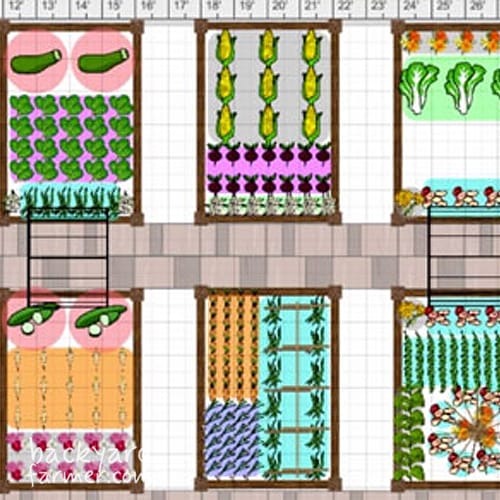
At the same time, it also means many planners:
- Run on the same core engine
- Share very similar interfaces and data structures
- Prioritise comprehensive features over flexibility
For experienced growers, that consistency can feel reassuring. On the other hand, for beginners or casual allotment holders, it often feels restrictive.
Depth versus simplicity in allotment planning tools
Most traditional allotment planning tools are designed around accuracy, completeness, and long‑term control. They assume users want to:
- Plan crop rotations several years in advance
- Track detailed crop, spacing, and variety information
- Follow clearly structured planning workflows
There’s nothing wrong with that approach. However, it does assume a level of confidence and commitment that many gardeners simply haven’t built yet.
When you’re still learning spacing, timing, or how much you can realistically grow, that level of structure can quickly become a barrier rather than a benefit.
A mismatch of expectations
This is often where frustration starts to creep in.
New or casual growers usually want to experiment, sketch ideas, and learn by doing. Traditional allotment planners, by contrast, tend to focus on optimising an approach you already understand.
So when an allotment planner feels complicated, it’s rarely because it’s poorly designed. More often, it’s because it was designed for a different stage of gardening.
Once you recognise that mismatch, choosing the right allotment planner becomes much easier. You can start looking for a planning tool that supports how you grow now — rather than one that makes you feel like you’re constantly catching up.
Who most traditional allotment planners are actually built for
To understand why many allotment planners feel demanding, it helps to step back and look at who this type of allotment planning software was originally designed to serve.
Most traditional allotment planning tools aren’t trying to work for everyone — and that’s intentional. Instead, they’re built for growers who already have a clear sense of how they like to garden and want an allotment planner to help refine, organise, and optimise that approach.
Experienced and long‑term growers
For gardeners who’ve been growing on an allotment for several seasons, planning naturally shifts. Over time, it becomes less about discovery and more about improvement and consistency.
These growers often want to:
- Manage crop rotations over multiple years
- Balance soil health with long‑term productivity
- Get more from a space they already understand well
In‑depth allotment planners suit this way of thinking. As a result, they reward consistency and tend to work best for growers who already understand spacing, timing, and how different crops behave.
Educators and system‑led growers
Many allotment planning tools are also designed with teaching and demonstration in mind.
Educators, authors, and course‑led growers often need an allotment planner that can:
- Support structured growing methods
- Demonstrate repeatable systems clearly
- Align closely with a particular gardening or growing philosophy
For this audience, clear rules and predefined workflows are a real strength. In practice, they make it easier to explain ideas, share plans, and guide others through a proven process.
Gardeners optimising an established method
Some allotment holders sit somewhere in the middle. They’re not beginners, but they’re not professionals either. They’ve found a way of growing that works and now want allotment planning software to help fine‑tune it.
These gardeners are often focused on:
- Improving efficiency
- Reducing waste
- Planning further ahead with more confidence
Traditional allotment planners support this mindset well. However, they still assume the foundations are already in place.
Why this matters
None of these use cases are wrong. In fact, they explain exactly why paid and in‑depth allotment planners continue to be valuable planning tools.
At the same time, they highlight an important truth: most allotment planners are built for people who already know what they’re doing.
So if you’re still learning how crops behave, experimenting with layouts, or working out how much time you can realistically commit, that same level of structure can feel intimidating rather than helpful.
The issue isn’t the quality of the allotment planning software. Rather, it’s whether the planner matches your current stage of growing.
Why beginners and casual growers often bounce
For new or casual allotment holders, the issue with many allotment planners isn’t a lack of interest — it’s the experience of getting started.
Most beginners arrive with fairly simple goals. They want to see what might fit, understand basic spacing, or sketch out an initial layout before committing anything to the ground. However, when an allotment planner or allotment planning software immediately asks them to make decisions they don’t yet feel ready for, confidence can drop very quickly.
Too many decisions, too early
Traditional allotment planning software often expects users to define a lot upfront, including:
- Exact bed sizes and allotment layouts
- Crop varieties, quantities, and spacing
- Rotations, dates, and planting schedules
For experienced growers, that structure makes sense. For beginners, though, it can feel like sitting an exam before the lesson has even started.
Commitment before understanding
Another common sticking point is commitment.
Many allotment planning tools require users to set up full plans, create accounts, or follow structured steps before they can experiment freely. As a result, there’s pressure to “get it right” straight away — even though gardening is something most people learn through trial and error.
When planning feels permanent, mistakes start to feel costly. And once that happens, people naturally hesitate to carry on using the planner.
Rigid systems versus real gardens
In reality, allotments and gardens are messy.
Weather changes, crops fail, time runs short, and plans shift. Because of this, beginners often discover quite quickly that real growing rarely follows a neat plan.
When an allotment planner doesn’t easily allow for change, it can feel as though the software is judging progress rather than supporting it. Over time, that rigidity can replace curiosity with frustration, leaving growers feeling like they’re constantly behind or doing something wrong.
The emotional side of learning
This part is easy to overlook, but it matters.
New growers aren’t just learning what to plant — they’re learning to trust their own judgement. Allotment planners that assume confidence can unintentionally undermine that process by highlighting gaps in knowledge instead of helping to fill them.
That’s why many beginners quietly stop using planning tools. Not because they don’t care, but because the allotment planner makes the learning process feel heavier than it needs to be.
Understanding this bounce isn’t about blaming users or software. Rather, it’s about recognising that learning-stage gardeners need room to explore, experiment, and adjust — not pressure to perform or perfect their plans.
Different types of allotment planners (and what they’re good at)
Once you step back from individual products, a clearer pattern starts to appear. Most allotment planners fall into a few broad categories, and each type of allotment planning tool is designed to solve a slightly different problem.
Importantly, none of these approaches are better or worse than the others. Instead, they suit different stages of growing and different ways people naturally think, plan, and learn.
In‑depth paid allotment planners
These are the most feature‑rich options and, in many cases, what people picture when they think of traditional allotment planning software.
They usually focus on:
- Multi‑year crop rotations
- Detailed crop and variety databases
- Precise scheduling, planning, and record keeping
Best suited for: experienced growers, long‑term planners, and anyone managing a large or more complex allotment.
For confident users, these allotment planners offer control and reassurance. However, for beginners or first‑year plot holders, that same depth can feel like more than they actually need at the start.
Calendar‑led allotment planners
Some allotment planning tools focus primarily on timing rather than layout or space.
These planners tend to emphasise:
- When to sow, plant, and harvest crops
- Seasonal reminders and growing prompts
- Month‑by‑month planting guidance
Best suited for: gardeners who already have a rough idea of where things will go, but want help staying organised and on track through the growing season.
Calendar‑led allotment planners can feel reassuring. That said, they’re often less helpful if you’re trying to visualise space, test layouts, or experiment with crop spacing.
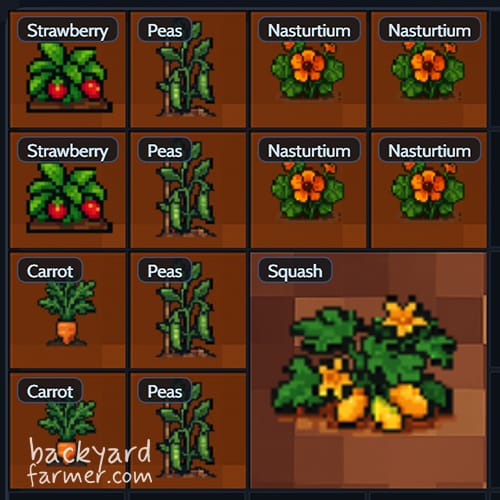
Visual layout planners
Visual layout planners focus on the physical space of the allotment itself.
They usually allow growers to:
- Map out beds, paths, and plot layouts
- Experiment with crop spacing and positioning
- See how different allotment layouts might work before anything is planted
Best suited for: growers who think visually, are still learning how much fits where, or want to explore ideas without committing too early.
Because this approach feels closer to sketching than data entry, it naturally supports experimentation, confidence‑building, and hands‑on learning.
Free and lightweight planners
Free or lightweight allotment planners strip planning back to the essentials.
As a result, they often prioritise:
- Low friction and fast setup
- Exploration without commitment
- Learning by doing rather than following a fixed system
Best suited for: new plot holders, casual growers, and anyone still figuring out how they like to garden.
These planners don’t try to do everything. Because of that, they can be especially effective early on, when confidence and understanding are still developing.
Why recognising these differences helps
Once you understand these categories, choosing an allotment planner becomes much simpler.
Rather than asking “Which allotment planner is best?”, a more useful question is:
“Which type of allotment planner fits where I am right now?”
When you frame the choice this way, allotment planning tools stop feeling overwhelming. Instead, they start to feel supportive, which makes it far easier to get started, experiment, and keep going.
When paid allotment planners make the most sense
Paid allotment planners tend to come into their own once a grower’s needs move beyond simple exploration and into optimisation.
After a few seasons on an allotment, clear patterns usually start to appear. You begin to see what grows well, where bottlenecks form, and how small changes affect results over time. At that point, depth stops feeling like friction and starts feeling genuinely useful.
You already know how you like to grow
Paid allotment planning tools work best when you’re no longer asking what might work, but how to improve what already does.
They’re particularly helpful if you:
- Have an established allotment layout that rarely changes
- Follow a fairly consistent growing method from year to year
- Want to fine‑tune spacing, timing, or crop rotations
With that foundation in place, structured allotment planners usually feel supportive rather than restrictive.
You’re planning across multiple seasons
One of the main strengths of in-depth allotment planning software is its ability to support long‑term planning.
Paid allotment planners often make sense when you want to:
- Track crop rotations over several growing seasons
- Balance soil health with ongoing productivity
- Plan ahead for succession planting and future harvests
In other words, if your focus has shifted toward sustainability, continuity, and long‑term results, the extra structure can start to pay off.
You’re managing complexity
As allotment plots get larger — or responsibilities increase — complexity naturally follows.
Paid allotment planners can be a good fit when you’re:
- Managing a larger allotment or multiple growing areas
- Coordinating shared or communal plots
- Keeping more detailed records to inform future growing decisions
In these situations, the time spent setting up an allotment planner is often repaid later through clarity, consistency, and fewer surprises.
Depth isn’t better — it’s more specialised
It’s worth being clear about one thing: paid allotment planners aren’t automatically better than simpler or free planning tools.
They’re more specialised.
When your confidence is high and your goals are clearly defined, that specialisation can be extremely useful. However, if you’re still learning, experimenting, or adapting your approach, it can easily feel like more structure than you actually need.
Choosing a paid allotment planner makes sense when you know what you want from it — and when the structure it provides genuinely matches how you already grow.
When simpler or free planners are the smarter choice
Simpler or free allotment planners tend to work best when curiosity is higher than certainty.
For many gardeners — especially in the early stages — the goal isn’t optimisation. Instead, it’s orientation. People want to understand their allotment space, test ideas, and build confidence without feeling locked into an allotment planning tool before they’re ready.
You’re in your first year on an allotment
The first season on an allotment is full of unknowns. Naturally, everything feels like a learning curve.
New plot holders are often working out:
- How their soil behaves across the plot
- Which areas get the most light during the season
- How much time they can realistically commit to growing
- What they actually enjoy growing on an allotment
At this stage, a lightweight allotment planner that allows quick experimentation is often far more helpful than a detailed allotment planning software system that assumes long-term certainty from day one.
You’re still learning spacing and crop behaviour
Books and guides can offer useful averages. However, real allotments and gardens rarely behave like examples on a page.
Simple allotment planners make it easier to:
- Try different crop spacings without consequence
- See what fits visually before planting anything out
- Adjust plans as crops succeed, struggle, or fail
Because of that flexibility, learning happens naturally in a way rigid allotment planning tools often struggle to support.
You want to experiment without pressure
Free allotment planners remove the sense of commitment that can make planning feel intimidating.
When there’s no cost barrier and no expectation of perfection, it becomes much easier to:
- Explore planting ideas freely
- Change allotment layouts mid-season
- Treat planning as a sketch, rather than a fixed contract
As a result, curiosity stays high — and that’s where most practical growing knowledge develops.
You’re planning around real life, not ideal conditions
Not every allotment season runs smoothly.
Work, family, weather, and energy levels all influence what’s possible. Because of this, lightweight allotment planning tools are often easier to adapt when plans need to change quickly or temporarily.
Rather than enforcing a fixed growing approach, they allow gardeners to respond to reality as it unfolds on the plot.
Simplicity as a strength
Choosing a simpler or free allotment planner isn’t a compromise. In many cases, it’s simply a better match for where you are right now as a grower.
When allotment planners lower the barrier to action, they help gardeners start, adjust, and keep growing without feeling judged or overwhelmed.
Over time, confidence builds and needs change. But early on, simplicity isn’t a limitation — it’s the foundation that makes everything else in allotment planning possible.
Free vs “Free” Allotment Planners — What to Watch Out For
At this point, it’s worth touching on something that often catches people out.
On the surface, many allotment planners are described as free. However, once you start using them, that definition can mean very different things.
In practice, a lot of “free” allotment planning tools are actually:
- Free to try, but require sign-up before you can do anything useful
- Limited unless you upgrade or unlock features
- Built around accounts, saving plans, or structured workflows from the start
For some growers, that approach works well — especially if you already know you want to commit to a system.
However, if you’re still exploring ideas, it can feel like another layer of friction. Instead of sketching out a few thoughts, you’re creating accounts, navigating menus, or trying to understand how the tool wants you to work.
By contrast, genuinely simple or free allotment planners tend to remove that barrier entirely.
They allow you to:
- Start immediately, without logging in
- Experiment freely without committing to a plan
- Adjust ideas quickly as your understanding grows
That difference might seem small at first. But when you’re learning, it has a big impact on how comfortable planning feels.
| Feature | Typical “Free” Planners | Simple Free Planners (Like Ours) |
|---|---|---|
| Requires sign-up | Yes | No |
| Instant access | Limited | Yes |
| Free to use | Partially | Fully |
| Built for beginners | Not always | Yes |
| Flexibility to experiment | Restricted | High |
| Pressure to “get it right” | Higher | Lower |
Ultimately, the right choice depends on how you prefer to plan.
If you’re looking for structure, long-term tracking, and detailed control, a more traditional allotment planner can be a great fit.
On the other hand, if you simply want to explore your space, test ideas, and build confidence as you go, a lightweight planner often makes that process feel far more natural.
That’s exactly why I built the Backyard Farmer planner the way I did — to give you a space to plan without friction, pressure, or the feeling you need to understand everything before you begin.
Planning as exploration, not optimisation
One of the biggest differences between allotment planners that feel supportive and those that feel overwhelming isn’t the number of features — it’s the mindset they encourage.
Many traditional allotment planning tools are built around optimisation: getting the most from the space, following precise rules, and refining an approach over time. That works well once you already understand how you grow and how your allotment behaves.
However, for many gardeners — especially beginners and early-stage allotment holders — a different mindset is far more helpful.
Gardening is not a fixed system
Unlike spreadsheets or schedules, allotments and gardens change all the time.
Weather shifts, pests turn up, crops behave unpredictably, and real life affects how much time and energy you can give. Even so, experienced growers still adjust their allotment plans mid-season.
When allotment planners assume everything will go to plan, that natural variability can start to feel like failure.
By contrast, an exploratory approach to allotment planning treats uncertainty as part of the growing process, rather than something to eliminate.
Learning happens through trying, not following
Most gardeners don’t learn spacing, timing, or crop behaviour by reading rules alone or following rigid allotment planning software.
Instead, they learn by:
- Trying different allotment layouts and seeing what actually works
- Making small mistakes and adjusting plans along the way
- Noticing patterns over time, season by season
Allotment planners that support experimentation make this learning visible. As a result, they give gardeners a safe space to test ideas before committing anything to the soil.
Visual thinking reduces pressure
When allotment planning feels more like drawing than data entry, it becomes much easier to engage with.
Visual allotment planners allow gardeners to:
- See consequences without locking anything in
- Compare planting options side by side
- Adjust allotment layouts quickly as understanding grows
Because of this, the emotional cost of being wrong drops — which is essential when you’re learning how to plan an allotment effectively.
Exploration builds confidence
Confidence doesn’t come from perfect allotment plans. Instead, it grows from seeing how decisions play out over time.
When allotment planning tools encourage exploration rather than perfection, gardeners are more likely to:
- Trust their own judgement
- Keep using the allotment planner without pressure
- Learn gradually, instead of all at once
That confidence is what eventually makes deeper allotment planning software genuinely useful.
Optimisation comes later
Optimisation absolutely has its place in allotment planning — but it works best once experience is already there.
By treating an allotment planner as a space to explore, rather than a system to master, gardeners give themselves permission to start imperfectly.
And in allotment growing, starting imperfectly is often the fastest — and most forgiving — way to learn.
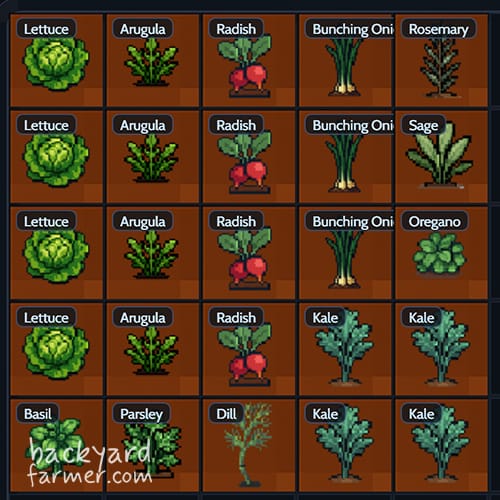
Try the Free Allotment Planner (No Sign-Up Needed)
If you just want to sketch out ideas, see what fits, and get a feel for your plot without committing to anything, you can jump straight in.
No accounts, no setup — just a simple way to plan your allotment and build confidence as you go.
Final thoughts: there’s no single “best” allotment planner
It’s easy to assume that choosing an allotment planner means finding the most complete, the most advanced, or the most talked‑about option.
However, in practice, the best allotment planner is simply the one that helps you move forward without feeling overwhelmed, restricted, or boxed in.
Different allotment planners exist because gardeners are at different stages. What feels supportive to one person can feel restrictive to another, depending on experience, confidence, and growing goals. That doesn’t make either choice right or wrong — it simply reflects how varied allotment growing journeys really are.
For some growers, in‑depth allotment planning software provides the structure, detail, and long‑term thinking they need. Meanwhile, for others — especially beginners or early‑stage growers — simpler or free allotment planners offer the freedom to experiment, learn, and build confidence without pressure.
What matters most isn’t how detailed your allotment plan looks. Instead, it’s whether the planning process itself encourages you to keep growing and stay engaged.
When allotment planning tools match where you are — rather than where you think you should be — planning becomes less about control and more about understanding. Over time, that understanding is what turns first attempts into steady habits and long‑term success.
So start with what feels manageable. Let your needs change as your confidence grows. Above all, remember that in allotment growing, progress comes from seasons of learning — not from perfect plans or the so‑called “best” allotment planner on paper.