
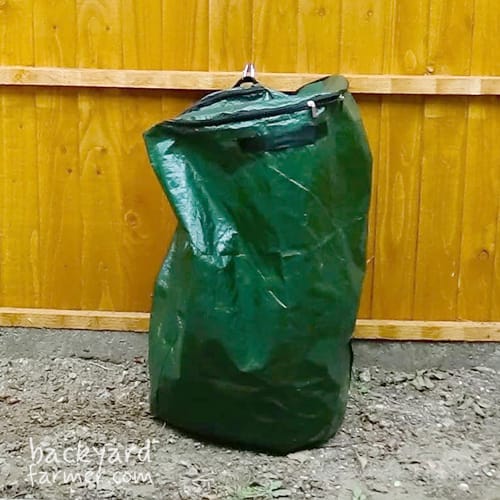
If you’re short on space but still want to compost kitchen and garden waste at home, this compact compost bin is a simple, lightweight alternative to a traditional plastic composter. Its flexible design makes it particularly useful for small gardens, patios and other areas where a full-sized compost bin would take up too much room.
| Specification | Detail |
|---|---|
| Capacity | 57 litres (small); 129 litres (large) |
| Material | Polyethylene (PE) |
| Dimensions | Small: 35 × 60 cm; Large: 45 × 80 cm |
| Shape | Cylindrical |
| Ventilation | Ventilation holes around the bag |
| Top Access | Zipped lid |
| Lower Access | Front Velcro flap |
| Handles | Two side carrying handles |
Best For
- Small gardens and patios
- Kitchen scraps and light garden waste
- Anyone needing a compact, movable compost bin
Pros
- Lightweight and easy to move
- Takes up very little space
- Simple top and lower access
- Can double as a grow bag
Cons
- Basic construction
- Zips and pull-tabs may wear over time
- Too small for larger amounts of garden waste
How It Performs in Practice
Capacity and Filling
The two sizes are enough for kitchen scraps and light garden waste, without taking up much room. The zipped top opens wide enough to make filling straightforward.
Aeration
Ventilation holes around the bag allow air to circulate through the compost. As with any compost bin, results still depend on getting a reasonable balance of green and brown material rather than the bin doing all the work.
Emptying
The lower Velcro flap gives access to material at the bottom without tipping everything out, which is handy once the compost starts breaking down.
Portability
Because the bin is lightweight and has side handles, it is easy to reposition when partly filled. That is one of its main advantages over a rigid compost bin.
Durability
The construction is fairly basic, so I would treat it as a light-duty composting option rather than a permanent garden fixture. The zip, pull-tabs and Velcro flap are the parts most likely to wear with repeated use.
What Owners Commonly Report
Recurring positives: Owners commonly praise the compact size, lightweight design and ease of moving the bin around, particularly in smaller gardens and patios.
Recurring drawbacks: The main concern is durability, with some users reporting wear or failure around the zip and pull-tabs.
Isolated complaints: A smaller number of buyers mention quality-control issues on arrival, including damaged zips or holes in the material.
My Experience
I use a couple of these compact compost bins in my own backyard for kitchen scraps and smaller amounts of garden waste. They’re lightweight, easy to move and useful where a full-sized compost bin would take up too much space.
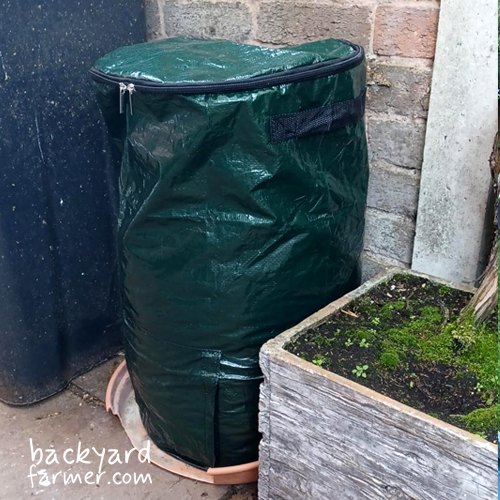
The zipped top makes filling simple, while the lower Velcro flap gives easier access to the compost. I’ve also repurposed one as a potato grow bag when it wasn’t needed for composting.
FAQs
Yes. Its compact footprint makes it particularly useful for small gardens, patios and other spaces where a rigid compost bin would take up too much room.
The smaller version holds around 57 litres, while the larger version holds around 129 litres.
There is a Velcro access flap near the bottom, allowing you to remove material without emptying the entire bin from the top.
Occasional turning or mixing can help introduce air and keep the contents breaking down evenly. As with any compost bin, maintaining a good balance of materials is more important than the bin itself.
There isn’t a fixed timescale. It depends on factors such as temperature, moisture, airflow and the materials being composted. I’d remove the old claim that it reliably produces compost in two to three months.
Yes. I’ve also used one as a large potato grow bag when it wasn’t needed for composting.