
The best grow tent fan setup usually combines an extractor with a separate circulation fan. The extractor removes warm, humid air and helps draw fresh air in through the tent’s intake vents, while the circulation fan moves air around the plants and reduces stagnant pockets. They perform different jobs, so choosing one does not remove the need for the other.
This guide compares extractor fans, circulation fans and complete ventilation kits, with options for different tent sizes, budgets and noise requirements. If you are unsure where to start, the Quick Picks below provide the shortest route to a suitable option.
Best Circulation Fan – Spider Farmer 6-Inch Clip Fan
Best Premium Smart Extractor – AC Infinity CLOUDLINE T6
Best Complete Ventilation Kit – Spider Farmer 6-Inch Kit
Quick Comparison of the Best Grow Tent Fans
These fans do different jobs, so start with the Type and Best For columns rather than simply comparing airflow figures.
| Model | Type | Fan Size | Speed Control | Best For | Main Drawback |
|---|---|---|---|---|---|
| Spider Farmer 6-Inch Clip Fan | Oscillating circulation fan | 6 in | 10 speeds | Canopy airflow | Costs more than basic clip fans |
| AC Infinity CLOUDLINE T6 | Smart inline extractor | 6 in | Variable | Quiet automated extraction | Premium price |
| Spider Farmer 6-Inch Ventilation Kit | Inline extractor + filter kit | 6 in | Variable/smart controller | Complete ventilation setup | More equipment than very small tents need |
| VIVOSUN AeroZesh G4 | EC inline extractor | 4 in | 10 speeds | Smaller tents and value | Lower maximum airflow than 6-inch models |
| Garden HighPro ProFan 15W | Fixed clip fan | 15 cm | 2 speeds | Budget/local airflow | Does not oscillate |
Maximum airflow and noise figures are omitted because manufacturer testing methods and product configurations can differ.
Best Circulation Fan – Spider Farmer 6-Inch Clip Fan
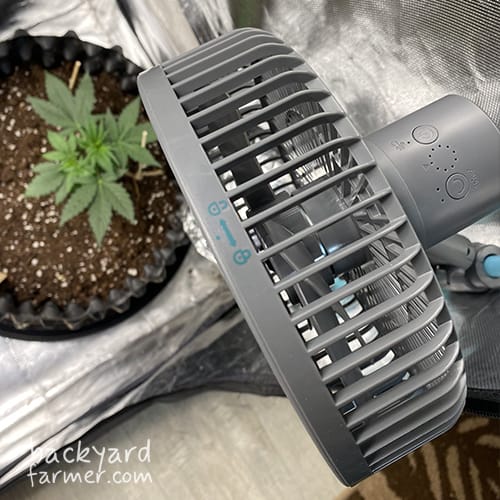
The Spider Farmer 6-Inch Clip Fan is the best general-purpose circulation fan in this guide. It moves air around the plants rather than extracting air from the tent, helping reduce stagnant areas within the canopy and encouraging gentle leaf movement.
Its main advantage over a basic fixed clip fan is the combination of oscillation and ten speed settings. The oscillating head spreads airflow across a wider area, while the lower settings help avoid excessive breeze around seedlings or smaller plants. As the canopy develops, the fan can be repositioned on a tent pole or adjusted to cover sheltered areas.
It is not an extractor and cannot replace one. For internal airflow in a small or medium tent, however, it offers a more flexible solution than a basic two-speed fan.
Specifications
| Specification | Detail |
|---|---|
| Fan type | Oscillating clip/circulation fan |
| Fan diameter | 6 inches |
| Motor | EC |
| Speed settings | 10 |
| Oscillation | Wide-angle, 10 levels |
| Maximum airflow | 300–315 CFM manufacturer rating |
| Power | 9W ±5% |
| Protection rating | IP54 |
| Max fan speed | 2,500 RPM |
Best For
- Small and medium grow tents
- Moving air across a plant canopy
- Growers wanting adjustable airflow
- Tents where a fixed clip fan leaves dead spots
Pros
- Wide oscillating airflow
- Ten speed settings
- Efficient EC motor
- Easy to reposition
- Compact enough for tent poles
Cons
- More expensive than basic AC clip fans
- Not a substitute for an extractor
- Larger tents may still need two circulation fans
Best Premium Smart Extractor – AC Infinity CLOUDLINE T6
The AC Infinity CLOUDLINE T6 is the premium extractor choice for growers who want ventilation linked to conditions inside the tent. Rather than simply running at one fixed speed, it can adjust airflow according to temperature, humidity and VPD settings through the supplied controller.
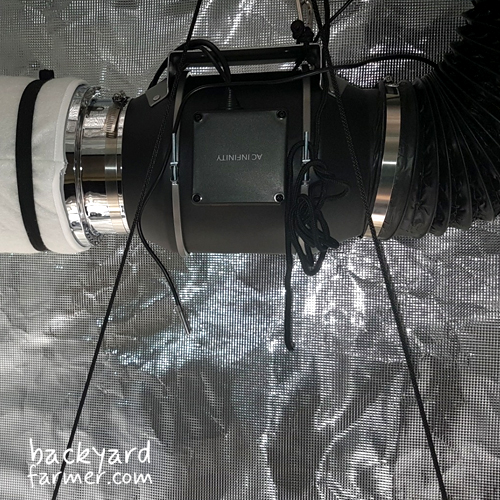
That makes it different from a basic speed-controlled inline fan. A simpler model may let you choose a speed manually, whereas the CLOUDLINE T6 is designed to respond automatically when conditions change. Its EC motor should also provide efficient, quieter operation at reduced speeds than many older AC-style extractors.
The main reason to choose it is the combination of controllability, low-speed refinement and environmental management. For a small tent with straightforward requirements, the extra cost may be difficult to justify.
Specifications
| Specification | Detail |
|---|---|
| Fan type | EC inline extractor |
| Duct size | 6 inches |
| Airflow | 425 CFM manufacturer rating |
| Speed control | Variable |
| Environmental control | Temperature, humidity and VPD |
| Average power usage | 38W average |
| Maximum power draw | 70W maximum |
| Controller | CONTROLLER 69 PRO |
| Protection rating | IP44 |
Best For
- Quiet indoor growing setups
- Medium and larger tents
- Automated temperature, humidity and VPD control
- Growers willing to pay more for refinement
Pros
- Quiet EC motor
- Fine airflow control
- Strong extraction capability
- Temperature, humidity and VPD control
- Mature accessory/controller ecosystem
Cons
- Expensive
- More complex than a basic inline fan
- Unnecessary for simple or very small tents
Best Complete Ventilation Kit – Spider Farmer 6-Inch Inline Fan + Carbon Filter Kit
The Spider Farmer 6-Inch Inline Fan and Carbon Filter Kit is the easiest recommendation for somebody starting a ventilation system from scratch. Instead of choosing an extractor, filter, ducting and fittings separately, the main components are supplied as a matched package.
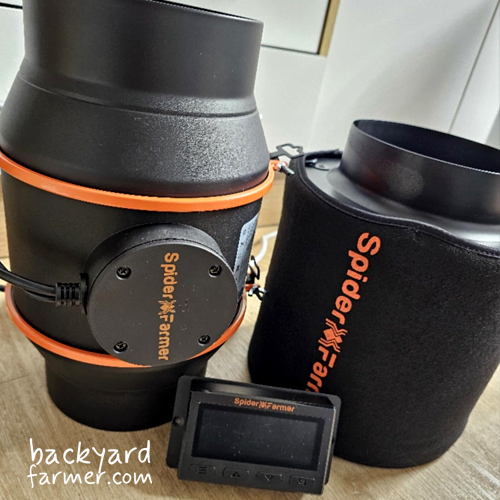
That is particularly useful when odour control is required. The carbon filter sits in the extraction path and helps remove odours before air leaves the growing area. It also adds resistance, so the extractor needs enough capacity to maintain useful airflow once the filter and ducting are installed.
The verified UK kit includes the GGS Controller, temperature/humidity sensor, carbon filter, ducting and associated connection hardware. Check the exact package before ordering if using a different retailer or listing, because controller options can differ between variants. The kit is more equipment than a very small tent may need, but it is convenient for medium-sized setups.
Specifications
| Specification | Detail |
|---|---|
| Fan type | EC inline extractor |
| Duct size | 6 inches / 15.2 cm |
| Maximum airflow | 402 CFM manufacturer rating |
| Power | 62W ±5% |
| Noise claim | 32 dBA |
| Fan speed | 3,000 RPM |
| Carbon filter | Included |
| Ducting | Included |
| Controller | GGS Controller included |
| Smart control | Yes – app-compatible GGS system |
Best For
- First complete grow-tent setup
- Growers needing carbon filtration
- Medium-sized grow tents
- Buyers who do not want to source components separately
Pros
- Complete package
- Powerful EC extractor
- Carbon filter included
- Straightforward component matching
- App-compatible smart control included
Cons
- More expensive than buying a basic fan alone
- Filter adds airflow resistance
- Smart ecosystem may be more than some growers need
Best Value Extractor – VIVOSUN AeroZesh G4
The VIVOSUN AeroZesh G4 is a sensible step up from cheap, fixed-speed inline extractors. Its four-inch format suits smaller grow tents, and the EC motor gives it more efficient and flexible operation than many basic alternatives.
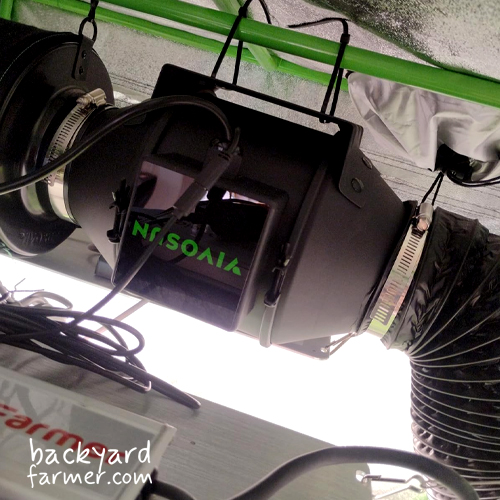
The ten-speed controller is useful because extraction requirements change throughout the grow. You may need more airflow when lights produce heat or humidity rises, while a lower setting can be preferable during cooler periods or when reducing noise. Its compact size also makes installation easier where a six-inch system would be unnecessarily bulky.
It should not be oversold for large tents. A four-inch extractor has less airflow capacity than a comparable six-inch model, and filters, long duct runs and tight bends can reduce real-world performance further.
Specifications
| Specification | Detail |
|---|---|
| Fan type | EC mixed-flow inline extractor |
| Duct size | 4 inches |
| Maximum airflow | 195 CFM |
| Power | 20W |
| Speed settings | 10 |
| Controller | E12 |
| Current UK noise claim | 39 dBA |
| Fan speed | 2,600 RPM |
| Protection rating | IP44 |
Best For
- Smaller grow tents
- Value-conscious buyers
- Growers wanting EC efficiency without premium pricing
- Basic extraction where a six-inch system is unnecessary
Pros
- EC motor
- Ten speed levels
- Compact four-inch format
- Good price-to-feature balance
Cons
- Lower airflow than six-inch systems
- Less suited to larger tents or restrictive ducting
- Manufacturer noise figures should not be directly compared with differently tested products
Best Budget Clip Fan – Garden HighPro ProFan 15W
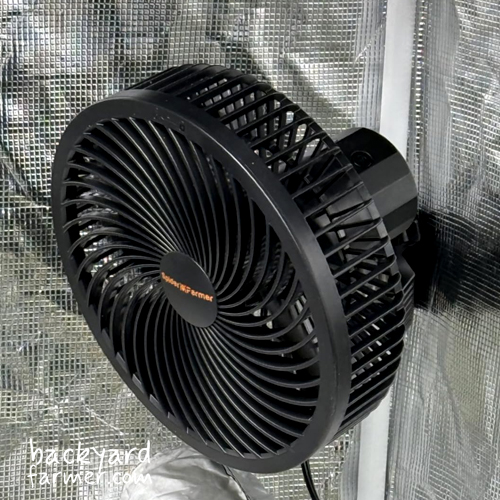
The Garden HighPro ProFan 15W is a simple, low-cost circulation fan for growers who need basic airflow without paying for an EC motor or oscillating mechanism. It can be clipped to a tent pole, shelf or nearby support and is useful below the canopy, around propagation areas or as a second fan.
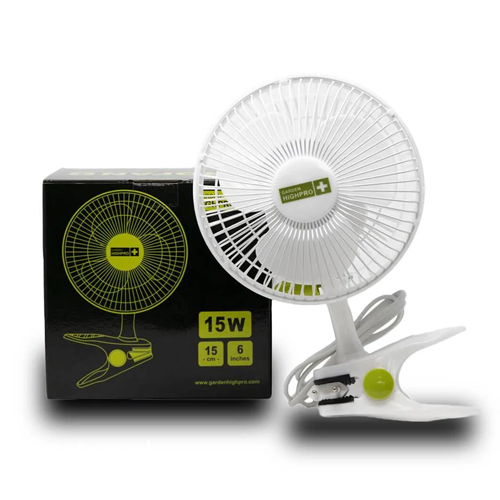
This model does not oscillate, so its airflow remains directed in one position. That is not necessarily a problem in a small setup, especially if the fan is used to remove a damp pocket beneath the foliage or supplement a larger circulation fan.
The two-speed control is basic but practical. It is best viewed as a secondary or budget circulation option rather than a complete airflow solution for a large or densely planted tent.
Specifications
| Specification | Detail |
|---|---|
| Fan type | Fixed clip fan |
| Diameter | 15 cm |
| Motor | AC, 100% copper |
| Power | 15W |
| Speed settings | 2 + stop |
| Airflow | 200 m³/h |
| Fan speed | 2,100 RPM |
| Oscillation | No |
| Mounting | Clip |
Best For
- Smaller tents
- Under-canopy airflow
- Propagation areas
- Buyers wanting the cheapest simple circulation option
Pros
- Inexpensive
- Compact
- Simple two-speed operation
- Strong clip
- Easy to add as a second fan
Cons
- Does not oscillate
- Limited reach
- Less efficient/refined than modern EC circulation fans
Which Grow Tent Fan Setup Do You Actually Need?
Think in terms of a ventilation system rather than expecting one fan to do everything. The extractor manages the exchange of warm and humid air, while circulation fans move air around the plants inside the tent.
| Setup | Extractor | Circulation | Suitable BYF Pick |
|---|---|---|---|
| Small tent | 4-inch inline extractor | One circulation fan | VIVOSUN AeroZesh G4 plus Garden HighPro or Spider Farmer clip fan |
| Medium tent | Properly sized 4- or 6-inch extractor | One oscillating fan; add a second if foliage becomes dense | Spider Farmer clip fan plus AC Infinity T6 or Spider Farmer six-inch kit |
| Larger or heavily equipped tent | 6-inch or larger extractor sized for actual airflow, heat and filter resistance | Multiple circulation points | AC Infinity T6 or Spider Farmer six-inch kit, subject to final sizing |
Do not choose solely by tent dimensions. Lighting heat, plant density, ambient room temperature, duct length, bends and filtration all affect the airflow required. If you are also choosing lighting, see our LED grow light guide for more on heat output and ventilation load.
How to Choose a Grow Tent Fan
What Size Extractor Fan Do You Need?
There is no single fan size that suits every tent. Start with the tent volume, then allow for heat, humidity and resistance from the rest of the ventilation system.
1. Calculate Tent Volume
Use:
Length × width × height = volume
For example, a tent measuring 1.2m long, 1.2m wide and 2m high has a volume of:
1.2 × 1.2 × 2 = 2.88m³
2. Establish Baseline Airflow
A useful starting point is to aim for roughly one complete air change per minute:
2.88m³ × 60 = 173m³/h
That is the approximate free-airflow target for the example tent before accounting for resistance. Because carbon filters, ducting, bends, heat and humidity reduce delivered airflow, choose an extractor with a higher published maximum and run it at a controlled speed rather than selecting a fan that only just reaches 173m³/h.
This is a starting point, not a universal engineering standard. Lighting heat, room temperature, plant density and the intended control strategy can all increase the required capacity.
3. Allow for Resistance
Required fan capacity increases when the system includes:
- Carbon filters
- Long duct runs
- Tight bends
- Warm lighting
- High ambient room temperatures
A fan that looks powerful on paper may deliver less airflow once connected to a filter and several metres of ducting. Buying useful headroom is generally preferable to running a marginal fan at maximum speed continuously.
Practical Fan Size Table
Use these as conservative starting points, then check the extractor’s published airflow against the calculated target and allow for system resistance.
| Tent Size | Approx. Volume | Baseline Airflow at One Air Change per Minute | Practical Extractor Starting Point |
|---|---|---|---|
| Small | Up to 2m³ | Up to 120m³/h | 4-inch inline extractor |
| Medium | 2–5m³ | 120–300m³/h | High-airflow 4-inch or 6-inch inline extractor |
| Large | Above 5m³ | Above 300m³/h | 6-inch or larger extractor, sized for heat and filter resistance |
EC vs AC Grow Tent Fans
| EC Fans | Basic AC Fans |
|---|---|
| More efficient | Cheaper |
| Better variable-speed control | Simple to operate |
| Often quieter at reduced speeds | Often adequate for secondary circulation |
| Higher purchase price | Less efficient and usually less controllable |
A £10–£15 Garden HighPro and a premium EC fan are not direct equivalents. The HighPro may be suitable for simple local airflow, while an EC fan is designed to offer more efficient operation, finer control and, in many cases, quieter performance.
Do You Need a Carbon Filter?
A carbon filter is not necessary simply to control temperature or humidity. It is used when odours need to be removed from air leaving the tent.
Filters restrict airflow, so the extractor needs enough capacity to maintain useful ventilation once the filter is installed. Match the filter diameter to the fan and check that the filter’s rated airflow is suitable for the extractor. A filter that is too restrictive or undersized can reduce performance and increase noise.
Frequently Asked Questions
Most small and medium grow tents need one appropriately sized extractor plus at least one circulation fan. Dense canopies or larger tents may benefit from a second circulation fan.
Circulation fans are commonly run continuously at a gentle speed. Extractor operation depends on heat, humidity and the ventilation setup, although many systems also run continuously at a reduced setting.
Often yes for small and medium tents, provided the intake openings are large enough and unrestricted. Larger or restrictive setups may need powered intake.
Negative pressure means the extractor removes slightly more air than enters through the intake, causing the tent walls to pull inward slightly. It can help ensure extracted air passes through the intended filtration system.
Place the extractor high in the tent, fresh-air intake low down and circulation fans around canopy height. Avoid directing a strong stream of air continuously at one plant.
Increase extraction where necessary, improve circulation through dense foliage, avoid overcrowding and make sure warm humid air is actually being exhausted from the growing space. A VPD calculator can also help you assess whether temperature and humidity are balanced for the plants’ growth stage.
If humidity remains high despite good ventilation, see our guide to reducing excessive grow tent humidity for further checks and practical fixes.
Yes. Excessive direct circulation can dry or damage leaves, while an oversized extractor running flat out can create unnecessary noise and excessive negative pressure. A larger variable-speed fan can still work well when turned down.
Modern EC inline fans generally provide better low-speed noise and efficiency than basic fixed-speed extractors, although installation, ducting and fan speed have a major effect on real-world noise.
Check them every few weeks in dusty environments and clean them whenever visible dust begins accumulating on blades, guards or intake surfaces.