
Choose an LED grow light by matching its practical coverage and intensity to the area occupied by your plants. Start by measuring the mature canopy, then consider the crop and whether the fixture will supplement daylight or provide all the light.
Do not rely on the model name, maximum centre reading or advertised footprint alone. Check the actual power draw, whole-area PPFD coverage, fixture layout, dimming, heat management and UK running cost.
The steps below explain how to assess each specification clearly. Once you know what your setup requires, compare suitable current models in our guide to the Best LED Grow Lights UK.
Measure the Area You Actually Need to Light
Measure the width and depth of the area your plants will occupy at maturity, not just the space taken up by young seedlings.
Do not automatically choose a light for the full dimensions of a room, cabinet or grow tent. A shelf, propagator or windowsill may need a much smaller fixture, even inside a larger enclosure. For example, a 120cm-wide tent containing a 60cm propagation shelf does not necessarily need a light designed for a complete 120×120cm canopy.
Also decide whether the fixture will provide all the plants’ light or supplement daylight from a window. Supplementary lighting may require less output than a sole-source setup.
Finally, check the available vertical clearance. The distance between the fixture and canopy affects both intensity and coverage.
Buy for the planted canopy, not the dimensions of the space around it.
Match the Light to What You Are Growing
Different plants need different amounts of light, so the right fixture depends on the crop as well as the canopy size.
| Plant category | Typical requirement | Fixture priorities |
| Seedlings and cuttings | Low-to-moderate intensity | Even tray coverage, dimming and adjustable height |
| Herbs and leafy greens | Moderate, uniform light | Efficient shelf coverage and low running cost |
| Supplementary-lit houseplants | Depends on existing daylight | Convenient mounting, a timer and suitable beam width |
| Compact fruiting crops | Higher intensity | Strong average coverage, dimming and heat control |
| Tomatoes, chillies and peppers through fruiting | High daily light requirement | Full-canopy coverage, adequate output and strong edge readings |
Seedlings and leafy crops usually need less intensity than mature fruiting plants, so a slim shelf light or lower-powered dimmable fixture may be sufficient. Tomatoes, chillies and peppers grown indoors through flowering and fruiting need stronger whole-canopy coverage and more output headroom.
Wattage alone cannot prove suitability because fixture efficiency, layout, hanging height and operating time also affect the light reaching the plants.
For detailed crop requirements and indoor-growing guidance, see Growing Vegetables Under Artificial Light.
Check the Actual Power Draw
Grow-light model names such as 1000, 2000 or 3000 do not necessarily show the fixture’s wattage. These numbers may refer to a product range or an older “equivalent wattage” comparison, so always check the stated input power or actual wall draw.
Actual wattage tells you how much electricity the fixture consumes and provides the basis for calculating running costs. It does not show how much plant-usable light is produced or how evenly that output reaches the canopy. Two fixtures drawing the same wattage can differ substantially in efficiency, practical coverage and edge intensity.
Treat equivalent-wattage claims cautiously unless the comparison is clearly explained. Dimming normally reduces consumption, but a dial set to 50% should not automatically be assumed to use exactly half the full wall draw.
Do not buy from the model number alone. Check the current power specification for the exact revision being sold.
PPF, PPFD, DLI and Efficacy Explained
Grow-light specifications use several similar measurements. Each describes a different part of performance, so no single figure should be judged in isolation.
| Term | What it means | What it does not prove |
| PPF | Total plant-usable photon output from the fixture, measured in µmol/s | Where the light lands |
| PPFD | Light intensity reaching a square metre at a particular point, measured in µmol/m²/s | Whole-canopy uniformity from one reading |
| DLI | Total light received over a day, measured in mol/m²/day | Whether the distribution is even |
| Photon efficacy | Photon output produced per watt of electricity, measured in µmol/J | Coverage, reliability or build quality |
PPF is useful for comparing total fixture output, but it does not show how evenly that output reaches the plants.
DLI combines PPFD with operating time, showing the total light plants receive over a day.
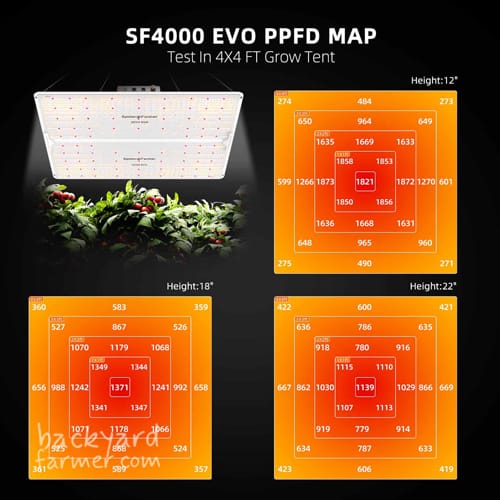
PPFD measures intensity at the canopy. A full grid of centre, edge and corner readings is therefore more useful than one high reading directly beneath the fixture.
Photon efficacy shows how efficiently a fixture converts electricity into plant-usable photons. A higher figure means more output per watt, but it does not guarantee even coverage or reliable construction.
Only compare PPFD maps when the test area, hanging height, power setting and enclosure conditions are similar.
Understand Practical Coverage
Advertised coverage often describes the largest area a fixture can illuminate, not the area over which it provides useful intensity for a particular crop. A vegetative footprint should not automatically be treated as suitable for tomatoes, chillies or peppers grown through fruiting, which usually need stronger and more consistent light.
A high centre PPFD reading can also hide weak edges and corners. Fixture width, diode spacing, optics and hanging height all affect distribution. Raising the light usually widens the footprint but reduces intensity, while lowering it increases central intensity and narrows the useful area.
Reflective tent walls can alter test results, so enclosed PPFD maps should not be compared directly with open-room tests.
A useful PPFD map should show:
- Exact fixture and revision
- Power or dimmer setting
- Test-area dimensions
- Hanging height
- Centre, edge and corner readings
- Grid spacing
- Whether reflective walls were used
Check that the map matches the exact wattage and revision currently being sold.
Practical coverage is the area over which a fixture maintains useful intensity for the intended crop—not the largest footprint printed in the product description.
For higher-output options, see Best LED Grow Lights for a 4×4 Tent UK.
Choose the Right Fixture Layout
The shape of a grow light affects how light and heat are distributed across the canopy. Each layout suits a different type of setup.
| Fixture type | Best suited to | Main advantage | Main limitation |
| Board light | Compact, value-focused setups | Strong output per pound | More concentrated centre intensity and heat |
| Bar light | Larger complete canopies | More even edge distribution | Wider and usually more expensive |
| Strip or shelf light | Propagation trays, herbs and shelving | Slim and easy to position | Limited output for deep, mature canopies |
| Bulb-style light | One plant or supplementary lighting | Simple and inexpensive | Narrow, uneven coverage |
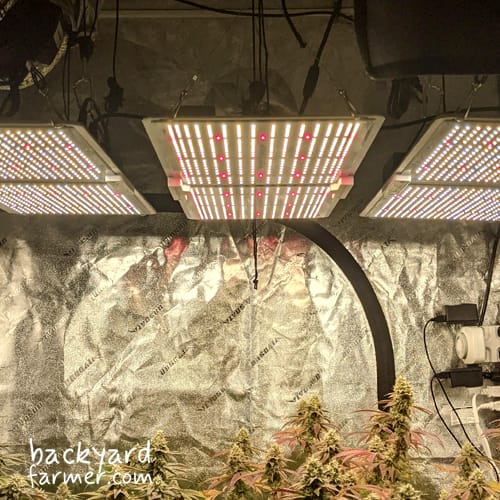
Choose a board-style fixture when price matters most, the growing area is compact and a stronger central zone is acceptable. These lights often provide good value but may leave weaker intensity around the perimeter.
A bar fixture is better suited to larger canopies where edge coverage matters. Its wider diode layout usually produces more even distribution, although the fixture will normally cost more and take up more space.
Strip lights work well over shallow shelves and propagation trays, while bulb-style lights are best suited to individual plants or supplementary lighting.
Layout alone does not determine quality. Output, diode spacing, driver design, tested distribution and price still need to be assessed individually.
Does Grow-Light Spectrum Matter?
Spectrum affects plant development, but the idea that blue light is only for leaves and red light is only for flowers is too simplistic. Blue, green and red wavelengths all contribute to photosynthesis and growth, with their effects varying by crop, intensity and wavelength balance.
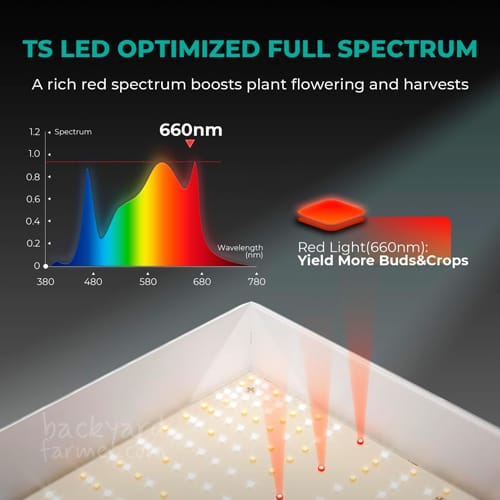
The term full spectrum also has no consistent meaning in grow-light marketing. It may describe broad white light, a mixture of white and red diodes or simply a fixture intended for the full growing cycle. A published spectral graph is more useful than the phrase alone.
Most home growers do not need independently adjustable red and blue channels. A well-designed fixed broad-spectrum fixture can support seedlings, herbs, leafy vegetables and fruiting crops when it provides sufficient intensity and coverage.
Far-red and UV may have specialised uses but are not essential for ordinary home growing. Diode brand alone also does not prove coverage, driver quality or long-term reliability.
For most buyers, suitable intensity and even coverage matter more than adjustable spectrum channels.
Dimming, Timers and Smart Controls
The most useful controls are usually the simplest.
Most useful:
- Manual dimmer: Reduces output for young plants, a partly filled canopy or when heat and running costs need to be lowered.
- Plug-in timer: Maintains a consistent lighting schedule without manual switching.
- Daisy-chain control: Lets several compatible fixtures be adjusted together.
Optional conveniences:
- Wi-Fi or Bluetooth apps
- Sunrise and sunset simulation
- Environmental controller integration
- Remote monitoring
- Automated dimming schedules
These features can make a larger setup easier to manage, but they are not essential for most home growers and may add extra cost or compatibility requirements.
Smart controls cannot compensate for an undersized fixture, weak edge coverage or poor heat management. Prioritise suitable output, whole-canopy coverage and reliability before paying extra for app-based features.
For setup, timer use and maintenance guidance, see How to Install and Maintain LED Grow Lights.
Heat, Driver Position and Airflow
LED grow lights still produce heat. Describing them as low heat is only meaningful when comparing them with another system delivering a similar amount of usable plant light. A powerful fixture can still raise temperatures inside a cabinet, room or grow tent.
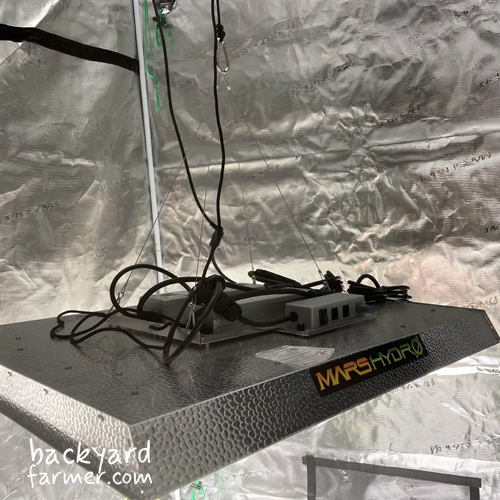
Fanless operation simply means the light uses passive cooling rather than an internal fan. The LED board or bars, heat sink and driver still contribute to the overall heat load.
A detachable driver can often be positioned outside the immediate growing area, moving some heat away from the canopy. This can be useful in compact or enclosed setups, but it does not prove that the whole fixture will run cooler or last longer. The LEDs and fixture body still need adequate airflow.
Higher-powered lights may require extraction or active air movement to prevent heat building up around the plants. Before buying, check the required clearance, operating-temperature range, permitted driver position and ventilation guidance.
For hanging heights, electrical setup, fans and maintenance, see How to Install and Maintain LED Grow Lights.
Calculate the UK Running Cost
Use the fixture’s actual power draw, not its model name or advertised equivalent wattage.
Power in kW × daily operating hours × electricity rate × number of days
The estimates below use 26.11p per kWh, applicable from 1 July to 30 September 2026, and assume 30 days of operation.
| Power | 12 hours/day | 16 hours/day |
| 33W | £3.10 | £4.14 |
| 100W | £9.40 | £12.53 |
| 200W | £18.80 | £25.07 |
| 300W | £28.20 | £37.60 |
| 480W | £45.12 | £60.16 |
| 640W | £60.16 | £80.21 |
These figures assume full stated power. Dimming or using a shorter lighting schedule will reduce consumption, although the dimmer setting may not match the exact percentage of wall draw.
The household standing charge is excluded, along with fans, heating, humidifiers and other supporting equipment. Actual costs will vary with your tariff.
For current fixture prices and model-specific running costs, see Best LED Grow Lights UK.
Check the Warranty, Seller and Exact Revision
Grow-light models can change while keeping the same or a very similar name. Manufacturers may update the diodes, driver, controls, fixture layout or actual power draw, meaning an older review or PPFD test may not accurately represent the version currently on sale.
Before ordering, match the exact model and revision against the retailer’s current specifications. Check the:
- Actual power draw
- Diode type
- Driver arrangement
- Dimming and control system
- Fixture dimensions and layout
Warranty length is only part of the picture. Read the written terms and confirm whether they cover:
- The complete fixture
- The driver
- Fans, apps and control equipment
- Return shipping
- Repair labour or replacement
A manufacturer’s warranty is separate from your statutory rights against the retailer. Buying from a dependable UK seller generally provides a clearer route for returns, faulty-goods claims and replacement support than relying entirely on an overseas manufacturer.
Save a copy or screenshot of the product listing, specifications and warranty terms when you order. This can help if the listing changes or a revised model later replaces the one you bought.
Revision check: Only rely on reviews and PPFD tests that match the wattage, diode specification, fixture layout and control system of the version being sold.
LED Grow Light Buying Checklist
Before ordering, make sure you have:
- Measured the mature planted canopy
- Decided whether the light will supplement daylight or provide all the light
- Matched the fixture output to the crop category
- Confirmed the actual power draw at the wall
- Checked the full PPFD map and stated test height
- Compared centre, edge and corner coverage
- Chosen a suitable board, bar, strip or bulb layout
- Checked for useful dimming and timer compatibility
- Planned for heat, airflow and driver placement
- Calculated the likely monthly running cost
- Confirmed the exact model revision and UK warranty terms
A light that fits the canopy and provides useful coverage across the whole growing area is usually a better purchase than a more powerful fixture with a stronger model name or a higher centre reading.
Frequently Asked Questions
Wattage depends on the planted canopy, crop demand and fixture design. Use actual wattage to compare power consumption and likely output, but do not treat it as proof of suitable coverage.
PPFD is more useful for showing how much light reaches the canopy. However, one centre reading is not enough. Check a full PPFD map at a stated hanging height and compare the centre, edges and corners.
Most home growers are well served by a fixed broad-spectrum fixture. However, full spectrum has no consistent meaning in retail marketing and does not prove suitable output, coverage or build quality. Check the spectral graph and practical performance instead.
Bar lights generally provide more even distribution across larger canopies. Board lights are usually more compact and may offer better value. Neither layout is automatically superior, so compare output, diode spacing, driver design, tested coverage and price.
At 26.11p per kWh, a 200W fixture costs approximately £18.80 per month at 12 hours per day or £25.07 at 16 hours per day. A 480W fixture costs approximately £45.12 or £60.16 under the same schedules.
These estimates assume 30 days at full power and exclude the household standing charge. See the UK running-cost table above for more examples.
Compare Current LED Grow Lights
Once you know the canopy size, required output and preferred fixture layout, you can compare suitable models in our current UK buying guides.
Our main roundup covers compact and medium-powered grow lights for seedlings, shelves and smaller indoor setups. The dedicated 4×4ft guide focuses on higher-output fixtures designed to cover a larger, complete canopy.