Carrot fly is a common UK garden pest that can ruin otherwise healthy-looking carrots. Its larvae tunnel through the roots, leaving rusty-brown damage that often goes unnoticed until harvest.
The most reliable prevention is to protect crops with fine insect mesh before adult flies can lay their eggs. Understanding when carrot flies are active can also help you avoid repeated infestations.
Carrot Fly at a Glance
| Pest | Carrot fly (Chamaepsila rosae, also known as Psila rosae) |
| Affected crops | Carrots, parsnips, celery, celeriac and parsley |
| Main symptoms | Rusty-brown root tunnels, sometimes with discoloured foliage |
| Active season | Generally April–October, depending on conditions |
| Best prevention | Fine insect-proof mesh, fitted before egg-laying |
| Other measures | Crop rotation, less susceptible varieties and careful thinning |
| Existing damage | Cannot be reversed |
| Overwintering | Larvae or pupae survive in the soil |
How to Prevent Carrot Fly
The most effective way to prevent carrot fly is to stop adult flies reaching the soil around your carrots.
Female carrot flies lay eggs near suitable host plants. Once the larvae hatch, they feed on the roots, causing damage that may remain hidden until harvest.
Fine insect-proof mesh provides the most dependable protection. Crop rotation, less susceptible varieties and careful thinning can help reduce the risk further.
Protect Carrots with Fine Insect Mesh
Covering carrots from sowing with suitable insect-proof mesh is one of the most reliable ways to prevent carrot fly.
Standard insect mesh with openings around 1.3–1.4 mm is suitable for excluding carrot flies. Finer 0.8 mm mesh also works, although the smaller openings are not necessary for this particular pest.
For effective protection:
- Cover the bed from sowing. Install mesh before adult flies can reach the developing crop.
- Cover the entire growing area. Use hoops or supports where needed, leaving enough room for the foliage.
- Secure the edges. Bury or weigh down the sides to prevent flies entering underneath.
- Check for gaps. Inspect the cover after strong winds and whenever you work around the bed.
- Replace it promptly. After weeding, thinning or harvesting, secure the mesh again if crops remain.
The important detail is stopping female flies from reaching the soil to lay eggs, not simply keeping insects away from the leaves.
Mesh can remain in place throughout the growing season, provided the plants have sufficient space and can be maintained properly.
Important: If a bed previously held infested carrots, adult flies may emerge from overwintered pupae beneath a new cover. In this situation, mesh can trap insects inside rather than exclude them.
Combining protective mesh with crop rotation helps avoid this problem.
Rotate Carrot Crops
Carrot fly can survive winter in the soil, allowing adults to emerge near the following season’s crops.
Moving carrots away from previously infested beds reduces the risk of flies emerging directly beneath newly installed mesh.
Avoid following heavily affected carrots with another susceptible crop in exactly the same position. Parsnips, celery and celeriac can also support carrot fly.
Rotation alone will not eliminate the problem because adults can arrive from neighbouring beds and gardens. It works best alongside physical protection.
Planning a new growing position? Use our free Allotment Planner to organise your crops and avoid repeating carrots in previously affected beds.
Choose Less Susceptible Carrot Varieties
Some carrot varieties are less susceptible to carrot fly and can be useful where infestations are common.
‘Flyaway’ F1, ‘Resistafly’ F1, ‘Maestro’ F1 and ‘Sytan’ are examples of varieties with improved resistance.
However, none is completely immune. Even less susceptible carrots can suffer damage where pest populations are high.
These varieties provide an additional precaution rather than a replacement for insect mesh.
Reduce Disturbance When Thinning
Carrot flies use chemical signals from host plants when locating suitable places to lay eggs. Damaged or disturbed foliage can release odours that attract females.
Sowing thinly reduces the need to disturb seedlings later.
Where thinning is necessary, remove unwanted plants carefully, take discarded foliage away from the growing area and replace protective mesh promptly.
Thinning at particular times of day or in windy conditions is sometimes recommended, but these measures should not be relied upon instead of physical protection.
When Is Carrot Fly Season in the UK?
Carrot flies are generally active from spring into autumn, producing two main generations and sometimes a third when conditions are favourable.
The timing depends on temperature, location and weather. Activity can begin earlier in warmer southern areas than in cooler parts of the UK.
| Period | Typical carrot fly activity |
|---|---|
| April–June | First-generation emergence and egg-laying |
| July–August | Second-generation activity and further egg-laying |
| September–October | Continued activity and possible third generation |
| November–March | Adult activity is generally low, although larvae or pupae may remain in the soil |
These periods are approximate. Generations can overlap, and emergence dates vary between regions and seasons.
When Do Carrot Flies Start and Stop Flying?
The first carrot flies may emerge during April, although activity often starts later in cooler areas.
Further generations develop during summer, with additional egg-laying possible into autumn.
Research from the University of Warwick demonstrates how emergence dates vary across the UK. Its 2026 forecasts indicated third-generation activity beginning in September at some warmer sites, with emergence extending into October elsewhere.
There is therefore no single date when carrot flies start or stop flying nationwide.
The most reliable approach is to protect vulnerable crops throughout the relevant growing period rather than relying on fixed calendar dates.
When Can You Remove Carrot Fly Netting?
If carrot fly is a recurring problem, the safest option is to leave protective mesh in place until your carrots are harvested.
Removing it in midsummer can expose crops to later generations, while removing it too early in autumn may allow further egg-laying.
If you harvest the entire crop, the mesh is no longer needed. For carrots remaining in the ground, continued protection is sensible while adult flies may still be active.
Adult activity normally declines as temperatures fall, so protection against new egg-laying becomes less important during colder winter conditions.
However, larvae already feeding inside roots can remain a problem after adult flights have ended. Leaving the mesh in place will not reverse existing damage.
Where infestations are common, keeping the cover in place until the final harvest is generally the simplest approach.
How to Identify Carrot Fly Damage
Carrot fly damage is easiest to identify by examining the roots rather than the foliage.
The adult fly is small and rarely noticed. Most damage is caused underground by pale larvae feeding on developing carrots.
Signs Above Ground
Affected carrots may show:
- Yellowing or reddish foliage.
- Reduced growth or weak-looking plants.
- Wilting in more severely affected crops.
- Little obvious warning before harvest.
These symptoms are not specific to carrot fly. Drought, nutrient problems and other root damage can produce similar changes.
Some affected carrots show no visible symptoms above ground.
If you suspect an infestation, carefully lift a carrot and inspect the root.
Signs on the Roots
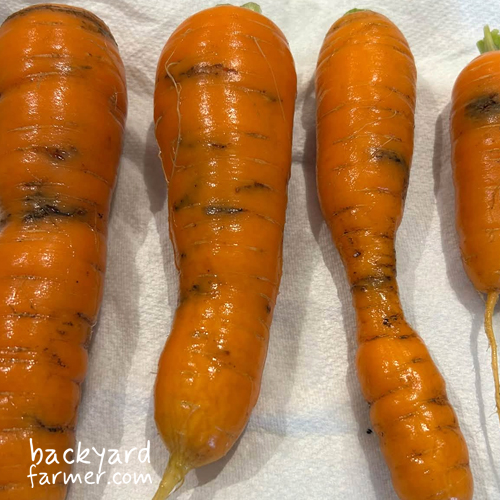
The most recognisable symptom is rusty-brown tunnelling within or just beneath the carrot’s surface.
Other signs include:
- Dark feeding scars or narrow channels.
- Small holes leading into damaged tissue.
- Slender, creamy-yellow larvae within the tunnels.
- Softening or secondary rot in badly affected roots.
Carrot fly larvae are legless maggots that can reach approximately 9 mm long.
Cutting a damaged carrot lengthways can reveal tunnels that are not obvious from the outside.
Characteristic root tunnelling is a much stronger indication of carrot fly than foliage discolouration alone.
What to Do If Your Carrots Have Carrot Fly
Once carrot fly larvae have damaged a root, the affected tissue cannot recover.
There is no practical treatment that repairs the tunnels or reliably removes larvae already feeding inside carrots.
Start by lifting a few carrots to assess how widespread the damage is.
If most roots remain sound, you may still obtain a useful harvest. Remove badly affected or rotting carrots and avoid placing damaged roots into storage alongside healthy ones.
Where damage is widespread or roots are deteriorating, harvesting usable carrots sooner may be preferable to leaving them in the ground.
Can You Eat Carrots Damaged by Carrot Fly?
Minor carrot fly damage does not automatically make an entire carrot unusable.
If the root remains firm and otherwise healthy, it may be possible to cut away localised damaged tissue and use the sound portions.
Inspect carefully because feeding tunnels can extend further beneath the surface than they initially appear.
Damage can also affect flavour. Garden Organic reports that tissue surrounding the feeding tunnels may develop a bitter taste.
Discard carrots with extensive tunnelling, soft or rotten tissue, mould or other signs of spoilage.
Lightly damaged carrots that are otherwise sound are best used promptly rather than placed into long-term storage.
Can You Save the Remaining Crop?
Installing mesh after an infestation may prevent additional adult flies reaching the crop, but it cannot remove larvae already feeding inside the roots.
It may also trap emerging adults if pupae are already present beneath the cover.
Where carrot fly is established, concentrate on inspecting the remaining crop, harvesting usable roots and preventing damage to future sowings.
For the next crop, choose a different growing position where possible and install insect mesh from the beginning.
What Causes Carrot Fly?
Carrot fly (Chamaepsila rosae, also commonly known as Psila rosae) is a small, dark-bodied insect whose larvae feed on carrots and related plants.
Adults cause little direct damage. The problem begins when females lay eggs in the soil close to suitable host plants.
The Carrot Fly Life Cycle
Carrot fly develops through four stages:
- Adults: Flies emerge from pupae in the soil and locate suitable host plants.
- Eggs: Females lay eggs in soil near the base of those plants.
- Larvae: Pale maggots hatch and feed on fine roots before tunnelling into developing taproots.
- Pupae: Mature larvae pupate, usually in the soil, before another generation emerges.
Two generations are common during the UK growing season, with a third possible in suitable conditions.
Carrot fly can overwinter as larvae or pupae, allowing infestations to reappear the following year.
Understanding this life cycle explains why preventing egg-laying is generally more effective than attempting to treat damaged roots.
Which Crops Does Carrot Fly Attack?
Carrots are the best-known host, but other susceptible plants include:
- Parsnips
- Celery
- Celeriac
- Parsley
- Other related plants in the carrot family
These crops belong to the Apiaceae family and can support carrot fly larvae.
When planning crop rotation or protective covers, consider related host crops rather than focusing entirely on carrots.
Do Companion Plants and Natural Deterrents Work Against Carrot Fly?
Several traditional methods claim to prevent carrot fly by confusing, discouraging or physically obstructing adult insects.
Some can reduce damage under particular conditions, but they are generally less dependable than covering the entire crop with suitable insect mesh.
Do Onions and Garlic Repel Carrot Fly?
Growing onions beside carrots is a familiar companion planting recommendation.
The theory is that strong-smelling plants interfere with the signals carrot flies use to locate their hosts.
However, research has produced inconsistent results.
Garden Organic found that ordinary carrot-and-onion companion planting does not provide reliable protection. Its research suggests that at least four rows of onions for every row of carrots may reduce damage, but even this arrangement does not eliminate infestation.
There is insufficient evidence to recommend ordinary garlic companion planting as a dependable alternative.
Growing onions or garlic beside carrots is fine where it suits your garden, but it should not replace mesh protection.
Do Vertical Barriers Stop Carrot Fly?
Carrot flies often travel close to the ground, leading to recommendations for surrounding beds with barriers around 50–60 cm high.
However, the claim that carrot flies cannot fly above a particular height is misleading.
Research shows that vertical barriers can reduce infestations without completely excluding the pest.
Taller, well-designed barriers may be useful in smaller growing areas, but gaps, wind conditions and the surrounding environment can affect their performance.
Growing carrots in raised containers may also reduce exposure, although height alone does not guarantee protection.
Complete insect-mesh coverage remains the more dependable option.
Are Carrot Fly Sprays or Biological Controls Effective?
Spraying carrot foliage will not repair existing root damage or reliably reach larvae already feeding inside carrots.
There are no chemical pesticide treatments approved specifically for carrot fly control by amateur gardeners in the UK.
Biological controls containing beneficial nematodes are available. Certain species can attack young carrot fly larvae in the soil when applied under suitable conditions.
However, timing, soil moisture and temperature are important, and nematode treatments are not guaranteed to eliminate an infestation. Some products can also affect other soil-dwelling insects.
For most allotment holders, preventing egg-laying with insect mesh and using sensible crop rotation remains the more straightforward approach.
Frequently Asked Questions About Carrot Fly
Carrot flies often travel close to the ground, but they are not restricted to a fixed height of 50 or 60 cm. Vertical barriers can reduce infestations without guaranteeing protection. Complete insect-mesh coverage is more reliable.
Adult activity generally declines during autumn, but timing varies with temperature and location. A third generation can emerge in September or October in some years. Where infestations are common, keeping carrots protected until harvest is the safest approach.
Yes. Some gardens experience little carrot fly damage, while others suffer repeated infestations. Crop rotation, less susceptible varieties and careful thinning may reduce the risk, but none guarantees protection. Mesh is particularly worthwhile where carrot fly has caused problems previously.
Yes. Carrot fly can attack parsnips, celery, celeriac, parsley and other related plants. Consider these crops when planning rotation and use suitable insect mesh where infestations are common.
Ordinary companion planting with onions does not reliably prevent carrot fly. Dense onion planting may reduce damage in some circumstances, but it does not provide complete protection. Fine insect mesh is more dependable.
It can. Larvae or pupae survive winter in the soil, and adult flies may emerge the following spring. Flies can also arrive from neighbouring growing areas. Rotating susceptible crops and installing protective mesh early can substantially reduce the risk of another infestation.