Cabbage white caterpillars can cause serious damage to UK brassicas, feeding on cabbage, kale, broccoli, cauliflower and Brussels sprouts. Both large and small white butterflies lay eggs on these crops, and their caterpillars can strip leaves or damage developing heads.
The most reliable protection is to prevent butterflies reaching the plants with properly fitted netting. Where eggs or caterpillars are already present, regular inspection and hand removal can help prevent further damage.
Cabbage Whites at a Glance
| What you’re seeing | What to do |
|---|---|
| Clusters of yellow eggs on brassica leaves | Remove the eggs before they hatch |
| Individual pale yellow eggs | Check for small white butterfly eggs |
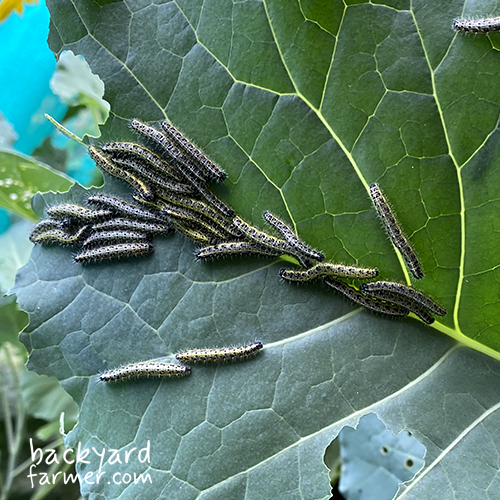
| Groups of yellow-and-black caterpillars | Remove large white caterpillars |
| Green caterpillars feeding alone | Check for small whites or other brassica pests |
| Brassicas without caterpillar damage | Protect with properly fitted insect netting |
| Caterpillars beneath existing netting | Remove them and inspect the cage for gaps or leaf contact |
| Leaves badly eaten | Check whether the growing point is intact before removing the plant |
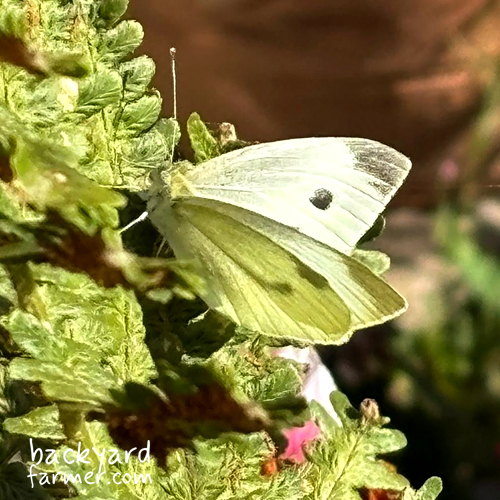
Large white butterfly (Pieris brassicae)
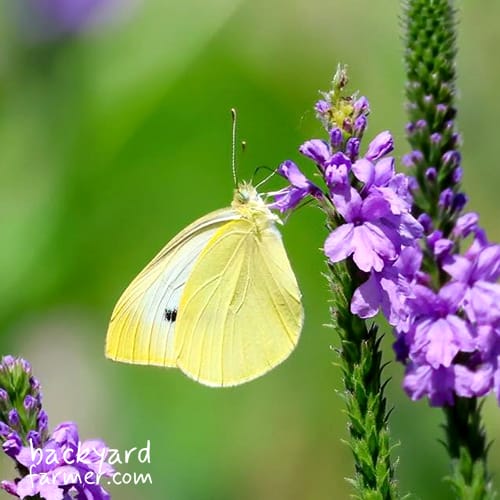
Small white butterfly (Pieris rapae)
How to Identify Cabbage White Eggs and Caterpillars
Two closely related butterflies cause much of the cabbage white caterpillar damage in UK vegetable gardens: the large white (Pieris brassicae) and small white (Pieris rapae).
Although the adults look similar, their eggs and caterpillars are easier to distinguish.
| Feature | Large white | Small white |
|---|---|---|
| Eggs | Yellow, usually laid in clusters | Pale yellow, laid individually |
| Egg location | Upper or lower leaf surfaces | Usually leaf undersides |
| Caterpillars | Yellow-green with black spots and markings | Velvety green with faint yellow markings |
| Feeding behaviour | Often feed together in groups | Usually feed individually |
| Main damage | Heavy feeding on exposed leaves | Less obvious damage, sometimes inside developing cabbage heads |
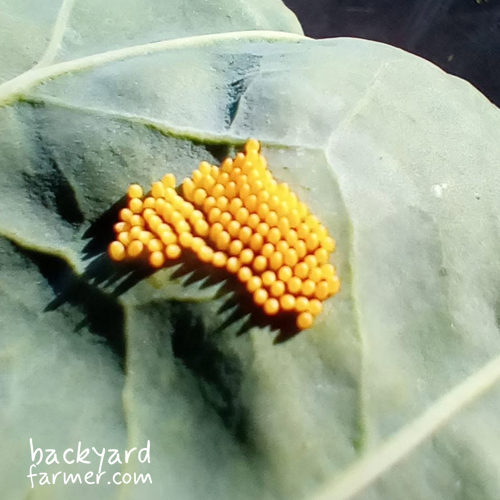
Large whites typically lay batches of eggs on brassica leaves. Once hatched, the caterpillars initially feed together, sometimes removing large areas of foliage.
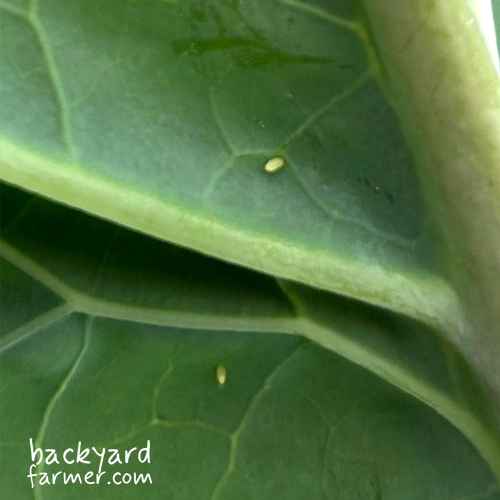
Small whites lay their eggs individually. Their green caterpillars are well camouflaged and may remain unnoticed until feeding damage appears.
Large whites often cause obvious damage to exposed leaves, while small white caterpillars can be harder to spot and may feed inside developing cabbage heads.
Very young caterpillars can be harder to distinguish because their appearance changes as they develop.
Both species feed on cultivated brassicas and certain wild plants in the cabbage family.
Signs of Cabbage White Caterpillar Damage
The most obvious symptom is irregular holes appearing in brassica leaves. Damage can become extensive when several caterpillars feed on the same plant.
Common signs include:
- Irregular holes through cabbage, kale or broccoli leaves.
- Large sections of foliage missing.
- Leaves stripped back towards their veins.
- Small green or dark caterpillar droppings.
- Caterpillars concealed beneath leaves.
- Feeding damage inside developing cabbage or cauliflower heads.
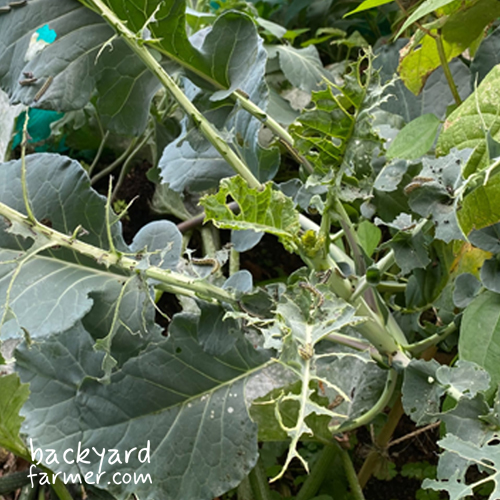
Young plants are particularly vulnerable because substantial leaf loss or damage to their growing points can restrict further development.
However, holes in brassica leaves aren’t always caused by cabbage whites.
Flea beetles typically produce numerous small holes, while slugs and other moth caterpillars can cause larger, irregular damage.
For smaller holes affecting young brassicas, see our guide to identifying and controlling flea beetles.
How to Remove Cabbage White Eggs and Caterpillars
If caterpillars are already feeding on your brassicas, removing them promptly can prevent further damage.
This is particularly effective before the insects become numerous or move into tightly developing vegetable heads.
Check Leaves for Eggs and Caterpillars
Inspect both sides of brassica leaves for eggs.
Large whites lay conspicuous clusters of yellow eggs on either surface, while small whites usually lay individual yellow eggs underneath leaves.
Pay particular attention to:
- Upper and lower surfaces of outer leaves.
- Leaves surrounding the central growing point.
- Areas along prominent leaf veins.
- Curled or overlapping foliage.
- Developing cabbage heads and broccoli florets.
Caterpillar droppings can also help reveal where feeding is taking place.
Check plants regularly during periods of butterfly activity, especially where brassicas are growing without protective netting.
Remove Eggs and Caterpillars by Hand
Visible eggs can be gently rubbed or scraped from leaves, taking care not to damage the plant. Where necessary, a small, heavily infested section of leaf can be removed.
Caterpillars can be collected by hand and removed from the crop.
If you prefer to preserve them, they can be moved onto suitable host plants, such as nasturtiums grown for wildlife, away from protected crops. They will continue feeding, so don’t transfer them onto somebody else’s vegetables.
Inspect plants again over the following days, as individual eggs and small caterpillars are easily missed.
Hand removal reduces an existing infestation but won’t stop butterflies returning to lay more eggs.
For longer-term protection, the crop needs a suitable physical barrier.
How to Protect Brassicas with Netting
Preventing cabbage white butterflies from reaching brassica leaves is generally more dependable than relying on deterrents after egg laying has begun.
A properly fitted brassica cage provides a physical barrier between the butterflies and the crop.
However, simply covering plants with netting doesn’t guarantee protection. The material, cage dimensions, installation and maintenance all matter.
Choose Suitable Insect Netting
Several types of netting can protect brassicas, but their openings vary considerably.
| Netting type | Typical opening size | Practical use |
|---|---|---|
| Butterfly netting | Around 4–7 mm | Excludes cabbage whites when kept clear of foliage |
| Standard insect-proof mesh | Around 1.3–1.4 mm | Excludes butterflies and several smaller pests |
| Fine insect-proof mesh | Around 0.8 mm | Can also protect against smaller pests, including flea beetles |
| Scaffolders’ debris netting | Varies by product | Check opening size and suitability before use |
Standard insect mesh is sufficient for excluding cabbage white butterflies when properly fitted, but finer mesh may be needed where flea beetles or aphids are also a concern.
Finer coverings can increase humidity and reduce airflow, so continue checking for slugs and signs of disease beneath them.
Butterfly netting allows good airflow and rainfall through the covering, provided it is correctly installed.
Scaffolders’ debris netting is popular with some allotment growers because it can cover large areas, but products vary. Check the actual openings rather than assuming all green debris netting provides the same protection.
Avoid stretching mesh excessively, as this can enlarge its openings.
For most brassica cages, the essential requirements are suitable mesh, secure edges and enough space to keep foliage away from the covering.
Loose or poorly secured netting can also entangle wildlife, so make sure the material remains properly supported.
Make the Cage Large Enough for Mature Brassicas
One common mistake is building a cage around the size of newly planted brassicas rather than their eventual mature dimensions.
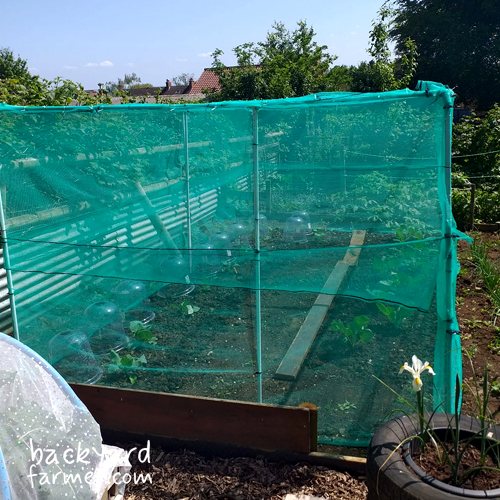
Cabbages spread outwards, kale can become tall and wide, and Brussels sprouts may grow considerably higher than expected.
As plants develop, their leaves can press against the sides or roof of a cage that initially appeared spacious.
This can allow butterflies to lay eggs through openings in the netting where foliage is within reach.
The cage should be large enough that fully grown leaves remain clear of the mesh.
Allow additional space around the planting area and use a strong frame to prevent the material sagging onto the plants.
Hoops, timber frames and suitable lengths of water pipe can all support netting effectively when installed securely.
Exact dimensions depend on the crop and variety, but always plan for mature growth, including leaves moving in the wind.
From our allotment: We’ve used relatively tight green scaffolders’ netting to protect brassicas but still experienced cabbage white caterpillar problems. We suspect butterflies may have laid eggs where the foliage touched the mesh, although we couldn’t confirm the exact cause. Our experience is that giving mature plants generous clearance is essential.
Secure the Edges and Maintain Access
Even a well-sized cage can fail if butterflies find a way underneath the netting.
Secure the perimeter without leaving loose edges or gaps around the base.
Ensure the covering remains firmly attached during windy weather and check occasionally for tears or displaced sections.
Design the cage with an accessible or removable side so you can inspect plants, weed and harvest without dismantling the entire structure.
A cage that’s difficult to open can discourage regular inspections, allowing existing caterpillars to go unnoticed.
Check plants for eggs before covering them, then inspect beneath the netting periodically throughout the season.
When should brassicas be covered?
Ideally, protect plants from planting out, before butterflies have an opportunity to lay eggs.
In the UK, cabbage whites are commonly active from spring into autumn, with later generations often causing substantial damage during summer and early autumn.
Avoid removing protection simply because the first wave of butterflies has passed.
Keep covers in place while butterflies remain active and the crop is vulnerable.
Why Are Caterpillars Getting Under My Netting?
Finding caterpillars inside a covered brassica bed can be frustrating, especially when the plants appeared well protected.
However, their presence doesn’t necessarily mean butterflies passed directly through the mesh.
Several factors can explain how an infestation developed.
| Possible cause | What to check |
|---|---|
| Eggs were already present | Inspect plants before installing the cover |
| Leaves are touching the netting | Increase clearance around mature plants |
| Gaps around the edges | Secure the perimeter and check corners |
| Damaged or unsuitable mesh | Look for tears, holes or oversized openings |
| Butterflies entered during access | Close the cage promptly after working inside |
| Small larvae were overlooked | Examine leaf undersides and developing heads |
If caterpillars are discovered, remove those you can find before checking the cage.
Inspect the plants again over the following days to catch any remaining larvae.
Where foliage is pressing against the covering, adjust the frame or reposition the netting to restore clearance.
If infestations continue, reassess the cage dimensions, material and access points.
A well-designed cage greatly reduces the risk of infestation, but regular monitoring remains worthwhile.
Can Caterpillar-Damaged Brassicas Recover?
A cabbage or kale plant with heavily eaten leaves isn’t necessarily beyond saving.
Before removing a damaged brassica, inspect the centre of the plant. If the growing point remains intact and healthy new leaves are developing, recovery may still be possible.
The first steps are to remove any remaining caterpillars, check the growing point for damage, look for healthy new growth and consider how much growing season remains.
The outcome depends on the crop and severity of feeding.
| Condition | Likely outlook |
|---|---|
| Outer leaves damaged, growing point intact | Recovery is often possible |
| Kale producing healthy new leaves | Further harvesting may be possible |
| Cabbage heart badly damaged | Head formation may be compromised |
| Broccoli florets containing caterpillars | Harvest quality may be difficult to recover |
| Plant severely stripped late in the season | Too little time may remain for a useful harvest |
Leafy brassicas such as kale can often replace damaged foliage, although the next harvest may be delayed.
Heading crops such as cabbage and cauliflower are less forgiving when their developing centres are badly damaged. A cabbage with an intact growing point may still form a head, but a destroyed centre can seriously affect development.
Broccoli and cauliflower heads should also be checked carefully for hidden caterpillars and droppings.
Sound produce can be washed, but badly damaged or heavily contaminated portions may be unsuitable for harvesting.
Avoid pulling up a plant solely because its outer leaves look untidy.
If healthy new growth is appearing and sufficient growing time remains, keeping the plant may still provide a worthwhile harvest.
For further crop advice, see our guides to growing cabbage and growing kale.
Natural Enemies of Cabbage White Caterpillars
Cabbage white caterpillars are part of the garden food web and are eaten or parasitised by various natural enemies.
Birds, predatory insects and parasitoid wasps can all help reduce their numbers.
One particularly interesting species is Cotesia glomerata, a small parasitoid wasp associated with large white caterpillars.
The wasp lays eggs inside a caterpillar, where its larvae develop.
After developing inside the caterpillar, the larvae emerge and spin clusters of small yellow cocoons nearby. Adult wasps later emerge from these cocoons.
These clusters are sometimes mistaken for butterfly eggs, but they are the cocoons of the parasitoids.
Natural enemies can help regulate cabbage white populations, particularly in gardens with suitable habitats.
However, a parasitised caterpillar may continue feeding for some time before dying.
Supporting beneficial wildlife remains worthwhile, but natural control alone cannot always prevent immediate crop damage.
For vulnerable food crops, physical exclusion is generally the more dependable protection.
Do Nasturtiums and Companion Plants Stop Cabbage Whites?
Companion planting and sacrificial crops are frequently recommended for protecting brassicas from cabbage white butterflies.
However, their effectiveness is often overstated.
Nasturtiums are suitable host plants for cabbage whites, and butterflies may lay eggs on their leaves.
They can therefore provide alternative host plants in parts of the garden where caterpillar feeding can be tolerated.
But growing nasturtiums beside cabbages doesn’t guarantee that butterflies will choose them instead of the crop.
A similar issue applies to claims that garlic, mint, marigolds or other strongly scented plants reliably deter cabbage whites.
These plants may provide other garden benefits, but their presence alone isn’t an established method of preventing egg laying.
From our experience: Companion planting and sacrificial crops haven’t reliably protected our brassicas without netting. Nasturtiums can provide alternative host plants, but we wouldn’t depend on them to keep caterpillars away from cabbages.
Nasturtiums can be grown outside a protected brassica cage as alternative host plants, but they shouldn’t be relied upon to divert butterflies from the crop.
Properly fitted netting remains the main protection.
Common Cabbage White Control Mistakes
Many cabbage white problems result from small gaps in protection or relying on methods that aren’t dependable on their own.
| Common mistake | Why it matters |
|---|---|
| Draping netting directly over brassicas | Butterflies may lay eggs where leaves touch the mesh |
| Building cages too small | Mature plants can outgrow the protected area |
| Covering plants without checking for eggs | Existing eggs can hatch underneath |
| Leaving gaps around the edges | Butterflies may gain access |
| Removing netting too early | Later generations may still lay eggs |
| Relying on nasturtiums alone | Alternative host plants don’t guarantee crop protection |
| Assuming every green caterpillar is a small white | Other brassica pests can look similar |
| Removing every badly eaten plant | Some crops recover when growing points remain intact |
| Using unverified homemade sprays | Effectiveness and plant safety may be uncertain |
Artificial butterflies, eggshells and other supposed deterrents are sometimes recommended, but they shouldn’t be relied upon to prevent egg laying.
For most UK vegetable growers, suitable netting, regular inspection and prompt physical removal provide a more dependable approach than repeated homemade treatments.
Frequently Asked Questions
Cabbage white caterpillars aren’t generally considered poisonous to people through normal handling. However, they shouldn’t be deliberately eaten, and vegetables containing caterpillars or droppings should be inspected and washed thoroughly before use.
Yes. Brussels sprouts are brassicas and can be attacked by both large and small white caterpillars. Inspect leaves and growing tips regularly, particularly during summer and early autumn. Suitable netting can prevent butterflies laying eggs on the plants.
Keep netting in place while cabbage white butterflies remain active and crops are vulnerable. In the UK, butterflies may continue flying into autumn during suitable weather. Avoid removing covers simply because the first summer generation has passed.
They may be able to reach leaves through openings where foliage touches the mesh. Choosing suitable netting and leaving enough clearance around mature plants helps prevent this. Eggs already present before covering can also explain caterpillars appearing inside a cage.
Cabbages may recover if their central growing point remains intact and sufficient growing time remains. Plants with badly damaged developing heads are less likely to produce a good harvest. Remove remaining caterpillars and check for healthy new growth before replacing the crop.
Homemade washing-up-liquid sprays aren’t a dependable or automatically safe treatment. Detergents can damage foliage and affect other organisms. Removing eggs and caterpillars by hand, followed by properly fitted netting, is a better starting point.