Flea beetles are tiny jumping beetles that leave small, rounded holes in vegetable leaves, particularly brassicas, rocket and pak choi. They can seriously damage young seedlings, especially in spring and summer.
Established plants can often tolerate a few holes without affecting the harvest. Knowing when to intervene and how to protect vulnerable crops with the right insect mesh can prevent unnecessary losses.
Flea Beetles at a Glance
| Problem | What to do |
|---|---|
| Tiny rounded holes in brassica leaves | Look for small beetles that jump when disturbed |
| Established plants with a few holes | Usually monitor rather than intervene |
| Young seedlings losing leaf tissue | Check for active beetles and remove them where practical before fitting fine insect mesh. Monitor for further damage. |
| Rocket or pak choi leaves badly damaged | Check new growth and consider another sowing |
| Beetles appearing beneath netting | Check for trapped insects, incorrect mesh size and gaps |
| Preparing another sowing | Use 0.8 mm or finer insect-proof mesh from the start |
How to Identify Flea Beetles and Their Damage
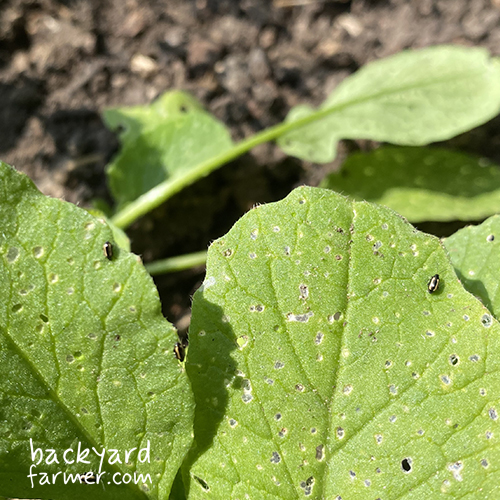
Flea beetles are small leaf beetles, usually around 2–3 mm long. Depending on the species, they may be black, metallic blue-green or marked with yellow stripes.
Despite their name, they aren’t fleas. Their powerful hind legs allow them to jump rapidly when disturbed.
The most recognisable sign of feeding is numerous small, rounded holes scattered across vegetable leaves. Some begin as pale feeding pits before the damaged tissue dries and breaks away.
Common signs include:
- Small, rounded holes or pale feeding marks.
- Damage concentrated on young leaves and seedlings.
- Tiny dark or striped beetles on the foliage.
- Beetles jumping away when disturbed.
- Increasing leaf damage during periods of active feeding.
To check for flea beetles, inspect the leaves closely and gently disturb the plant. The adults often jump away before they can be examined properly.
The RHS guide to flea beetles covers the common species affecting UK brassicas and related vegetables.
Flea Beetle Damage vs Other Leaf Pests
Small holes aren’t always caused by flea beetles. Several garden pests can produce similar damage.
| Possible cause | What to look for |
|---|---|
| Flea beetles | Numerous small holes or pits; tiny jumping beetles |
| Slugs and snails | Larger irregular holes, sometimes with slime trails |
| Caterpillars | Irregular feeding damage, often with caterpillars or droppings |
| Leaf miners | Pale tunnels or blotches within the leaf tissue |
| Physical damage | Tears or holes without obvious signs of feeding insects |
Small rounded holes suggest flea beetles, but seeing the jumping adults provides stronger evidence.
More than one pest may also be feeding on the same crop.
When Should You Worry About Flea Beetle Damage?
Not every flea beetle infestation requires intervention.
Healthy, established brassicas can often tolerate minor feeding, particularly when damaged outer leaves aren’t part of the harvest.
Young seedlings are much more vulnerable. Heavy feeding can remove enough leaf tissue to slow growth or prevent plants from establishing.
Leafy crops such as rocket, mizuna and pak choi are different because the damaged leaves are the part being harvested.
| Crop situation | Risk | Practical response |
|---|---|---|
| Newly emerged brassica seedlings | High | Protect promptly from further feeding |
| Rocket, pak choi and mizuna | High for leaf quality | Protect developing leaves |
| Young swedes and turnips | High during establishment | Monitor closely and protect |
| Established cabbage and broccoli | Usually lower | Tolerate minor holes if growth is healthy |
| Established radishes grown for roots | Often lower | Check whether plants are developing normally |
A few holes in an established cabbage are unlikely to affect the eventual harvest. The same damage on newly emerged swede seedlings could cause serious losses.
For rocket and other salad leaves, even relatively minor damage may reduce harvest quality, although the leaves can remain edible.
If plants are growing strongly and damage remains limited, monitoring may be all that’s necessary.
The aim is to protect productive growth, not eliminate every beetle from the garden.
How to Protect Vegetables from Flea Beetles
The most dependable approach is to protect vulnerable crops before serious damage develops.
Fine insect-proof mesh provides a physical barrier against adult beetles, while good growing conditions help seedlings establish and tolerate minor feeding.
Use Fine Insect-Proof Mesh
Fine insect mesh is one of the most effective non-chemical ways to protect susceptible vegetables.
However, not all garden netting will stop flea beetles.
Ordinary butterfly netting has openings that are too large, while some products sold as insect mesh are still too coarse to exclude these tiny beetles.
| Covering | Flea beetle protection |
|---|---|
| Butterfly netting, 4–7 mm | Too coarse |
| Standard insect mesh, 1.3–1.4 mm | Unreliable |
| Fine insect mesh, 0.8 mm | Suitable |
| Ultrafine insect mesh, 0.3–0.6 mm | Suitable; monitor conditions beneath it |
The RHS recommends 0.8 mm fine insect mesh for excluding flea beetles. Ultrafine mesh also provides protection, although smaller openings can increase warmth and humidity beneath the covering.
To install mesh effectively:
- Cover susceptible crops before beetles arrive, where possible.
- Use hoops or supports to keep mesh clear of the foliage.
- Secure the perimeter, ideally burying edges beneath at least 5 cm of soil.
- Leave enough slack for plants to grow without stretching the mesh.
- Check regularly for tears and loose edges.
- Reseal the covering carefully after weeding, thinning or harvesting.
Keeping mesh away from foliage also helps prevent beetles feeding through the covering where leaves touch it.
Good-quality mesh can be reused over several growing seasons when properly maintained.
For detailed specifications, see the RHS guide to insect-proof mesh.
What if Flea Beetles Are Already Feeding?
Mesh prevents beetles entering a protected area, but it won’t eliminate insects already present.
The best response depends on how badly the crop has been affected.
Minor damage on established plants: Leave healthy plants growing and monitor new leaves. Some feeding is usually tolerable.
Active feeding on vulnerable seedlings: Inspect plants for beetles and remove those found where practical. Protect remaining growth with correctly fitted fine mesh, checking that insects aren’t trapped beneath it.
Severely damaged seedlings: If plants have lost most of their foliage and stopped developing, another sowing may be more productive. Protect the replacement crop from the beginning.
Existing holes won’t disappear, but protecting new growth can still result in a worthwhile harvest.
Help Seedlings Establish Strongly
Young, slow-growing seedlings are particularly vulnerable to flea beetle feeding.
Maintaining appropriate moisture, spacing and growing conditions helps plants establish and recover from limited damage.
For crops that transplant well, raising seedlings in modules before planting outdoors can reduce the time they spend exposed at their smallest stage.
However, not every vegetable benefits from transplanting. Radishes and other crops normally grown from direct sowing may be better protected with fine mesh from germination.
During dry weather, water appropriately to prevent young plants from becoming stressed.
Watering supports healthy crop growth but shouldn’t be presented as a reliable way of killing or repelling flea beetles.
Tolerate Minor Damage and Encourage Natural Predators
Flea beetles are part of the wider garden ecosystem.
Birds, frogs and predatory ground beetles can feed on flea beetles or their larvae, contributing to natural population regulation.
Maintaining a diverse garden with suitable habitats supports these natural enemies.
However, predators aren’t a guaranteed solution to an active infestation.
Where established vegetables remain healthy and damage is mostly cosmetic, allowing some feeding is often the most practical approach.
Why Flea Beetles Still Get Through Netting
UK growers frequently report finding flea beetles on vegetables that are supposedly protected by netting.
This doesn’t necessarily mean fine insect mesh is ineffective. The problem may involve the covering itself, insects already inside or gaps created during maintenance.
| What you’re seeing | What to check |
|---|---|
| Beetles present immediately after covering | They may already have been on the plants or beneath the covering |
| Beetles repeatedly appearing inside | Check mesh aperture, unsecured edges and damaged sections |
| New holes where foliage touches mesh | Beetles may be feeding through the covering |
| Damage appearing after harvesting or weeding | Beetles may have entered while the cover was open |
| Mesh becoming stretched or torn | Openings may have enlarged or the barrier may be damaged |
| Damage continuing despite intact mesh | Check for beetles already inside or emerging from the soil |
Flea beetles may already be feeding on plants before a cover is installed. Adults can also emerge from soil beneath a covering where suitable species and life stages are present.
Once beetles are trapped inside, the covering may prevent further entry without stopping the existing damage.
Fine mesh also changes the growing environment. Very fine coverings can increase temperature and humidity, potentially encouraging other problems such as fungal diseases and slugs.
Check crops regularly and maintain suitable growing conditions beneath the covering.
A properly fitted 0.8 mm mesh is a useful barrier, but correct installation and ongoing checks are essential.
When Are Flea Beetles Active in the UK?
Flea beetles are mainly active during spring and summer, although timing varies with species, local weather and temperature.
Adult brassica flea beetles commonly overwinter in sheltered vegetation and leaf litter.
As temperatures rise in spring, they emerge and begin feeding on young brassicas and other suitable host plants.
Adults lay eggs near host plants, and larvae develop in the soil. For the common flea beetles affecting garden brassicas, larval root feeding generally causes little significant damage compared with adult feeding on leaves.
Further adult activity can occur through summer. Movement from agricultural brassica crops, particularly oilseed rape, can sometimes increase flea beetle numbers in nearby gardens during late summer.
This means flea beetles aren’t exclusively an early spring problem.
How to Reduce Damage in Future Sowings
If flea beetles repeatedly damage the same crops, adjusting your growing routine may help.
Practical options include:
- Protecting seedlings with fine mesh from the beginning.
- Raising suitable crops in modules before planting out.
- Considering later sowings where the crop and season allow.
- Maintaining steady growth during dry conditions.
- Checking susceptible crops regularly during spring and summer.
Some gardeners find that later sowings of rocket, pak choi and other leafy brassicas suffer less damage.
However, changing sowing dates doesn’t guarantee protection. Flea beetles can remain active later in the season, particularly when local populations are high.
For regularly affected crops, early protection is more dependable than relying on a particular sowing date.
Flea Beetle Control Methods That Don’t Reliably Work
Various homemade remedies and alternative treatments are promoted for flea beetles, but many lack reliable evidence for controlling infestations in UK vegetable gardens.
| Method | Evidence-based assessment |
|---|---|
| Garlic or washing-up liquid sprays | Not established as dependable control; homemade pesticide mixtures may pose risks |
| Marigolds as companion plants | No reliable protection against flea beetles established |
| Sacrificial radishes or nasturtiums | Trap-cropping ideas exist, but ordinary garden results are uncertain |
| Sticky traps | May catch individual beetles without reliably controlling an infestation |
| Nematode products | Targeting soil-dwelling larvae doesn’t necessarily prevent adult leaf feeding |
| Diatomaceous earth | Insufficient evidence for dependable routine control |
Trap cropping has been investigated in commercial brassica production, including oilseed rape. However, agricultural trial results don’t automatically translate into reliable protection for an allotment bed.
Likewise, some biological products target flea beetle larvae in the soil. This doesn’t necessarily resolve the immediate problem of adult beetles feeding on vegetable leaves.
Homemade sprays also deserve caution. A substance having insecticidal properties doesn’t establish that a homemade mixture is effective, safe for edible crops or lawful for its intended use.
The Health and Safety Executive’s guidance on garden pesticides explains the requirements for authorised products.
For most UK gardeners, fine insect mesh, healthy crop establishment and tolerating minor feeding provide a more practical starting point.
Frequently Asked Questions
Yes. Small feeding holes don’t automatically make otherwise healthy vegetable leaves unsafe to eat. Wash harvested leaves as normal and discard any that are decaying or unsuitable. The main concern is usually harvest quality.
Heavy feeding can kill young seedlings or prevent establishment. Larger, healthy vegetables usually tolerate some damage, particularly when the affected leaves aren’t the part being harvested.
The openings may be too large, the covering may have gaps, or beetles may already be inside. Use 0.8 mm or finer insect-proof mesh, making sure the edges are secured and the covering remains undamaged.
Not necessarily. Activity varies between species and seasons, with further feeding possible later in summer. Beetles may also move into gardens from nearby agricultural crops.
Changing sowing dates can sometimes reduce exposure during heavy feeding periods, but it doesn’t guarantee protection. Fine mesh remains useful whenever vulnerable crops are growing.
The common plant-feeding flea beetles found on UK brassicas aren’t considered a biting hazard to people. Despite their name and jumping behaviour, they’re leaf beetles rather than fleas.