Clubroot is a persistent soil-borne disease affecting cabbages, cauliflower, broccoli, kale and other brassicas. It causes swollen, distorted roots that struggle to absorb water and nutrients, leading to wilting and poor growth.
Although the pathogen can survive in soil for many years, affected ground isn’t necessarily unusable. Managing soil conditions and choosing suitable crops can help you continue growing successfully.
Clubroot at a Glance
| Disease | Clubroot (club root) |
| Cause | Plasmodiophora brassicae, a soil-borne protist |
| Affected crops | Cabbage, broccoli, cauliflower, kale, Brussels sprouts, swede and other brassicas |
| Main symptoms | Swollen, distorted roots, wilting and stunted growth |
| Favourable conditions | Acidic, wet soil and suitable temperatures |
| Best management | Measured pH adjustment, drainage, crop rotation and resistant varieties |
| Existing damage | Damaged roots cannot recover |
| Soil persistence | Resting spores can survive for up to 15–20 years |
| Other crops | Non-brassicas can generally still be grown |
How to Identify Clubroot in Brassicas
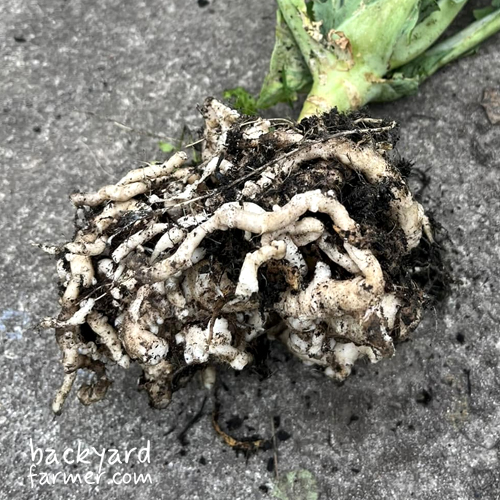
The clearest sign of Clubroot is abnormal swelling and distortion of brassica roots.
Above ground, affected plants may resemble crops struggling with drought or poor soil conditions. The problem is below ground, where swollen roots become less effective at taking up water and nutrients.
Clubroot Symptoms Above Ground
Affected brassicas may show:
- Wilting during warm weather, sometimes recovering overnight.
- Stunted or uneven growth.
- Yellowing or purple-tinged foliage.
- Poorly developed heads, leaves or stems.
- Declining growth despite adequate soil moisture.
These symptoms are not unique to Clubroot. Drought, waterlogging, compaction and other root problems can produce similar changes.
Don’t diagnose Clubroot from foliage alone. Inspect the roots before making long-term changes to the soil.
What Clubroot Looks Like on the Roots
Infected roots develop irregular swellings or club-shaped growths known as galls.
Early infections may cause small lumps, while severe cases can leave much of the root system distorted. Fine feeder roots may also be reduced.
To check a suspicious plant:
- Select a badly affected brassica.
- Carefully lift it, keeping the root system as intact as possible.
- Examine the roots for abnormal swelling.
- Avoid transferring potentially contaminated soil to other beds.
- Investigate further if symptoms remain unclear.
As infected roots deteriorate, they release resting spores into the soil.
If Clubroot is confirmed, record the affected growing position to help plan future crops.
A normal soil pH test cannot diagnose Clubroot. It measures acidity or alkalinity, not the presence of the pathogen.
How to Get Rid of Clubroot in Soil
There is no reliable home-garden treatment that eliminates Clubroot from contaminated soil. However, managing soil pH, improving drainage, rotating crops and preventing the movement of contaminated soil can reduce its impact.
These methods have different purposes and work best as part of a long-term management approach.
| Situation | Recommended action |
|---|---|
| Clubroot suspected but unconfirmed | Inspect affected brassica roots |
| Confirmed Clubroot in acidic soil | Test pH and consider measured liming |
| Wet or compacted ground | Improve drainage and soil structure |
| Repeated severe brassica infections | Extend rotation or use alternative growing areas |
| Risk of soil contamination spreading | Clean equipment and avoid moving infected soil |
Test Soil pH Before Adding Lime
Clubroot generally becomes more severe in acidic soil.
Raising pH towards neutral or slightly alkaline conditions can reduce disease severity, although the effect depends on soil conditions and pathogen pressure.
Commercial brassica production guidance sometimes recommends maintaining pH above 7 in affected fields. However, this is not a universal target for mixed-crop allotments.
A high soil pH can reduce Clubroot severity, but heavily contaminated ground may still produce infected plants, particularly where drainage is poor.
Before applying lime:
- Test the soil pH. Establish whether the soil is acidic, neutral or already alkaline.
- Decide whether adjustment is appropriate. Avoid automatically liming soil that is already sufficiently alkaline.
- Choose a suitable material. Ordinary garden lime is generally more appropriate for routine soil adjustment than builders’ or hydrated lime.
- Apply a measured quantity. Follow guidance based on the soil type, starting pH and liming material.
- Retest periodically. Avoid repeated applications without measuring the result.
Heavy clay soils can require different lime quantities from lighter soils because their buffering capacity differs.
Excessive liming can reduce the availability of certain nutrients, including iron and manganese.
Important: Liming may suppress Clubroot symptoms, but it does not reliably destroy the resting spores already present in contaminated soil.
Improve Drainage and Soil Structure
Clubroot infection is encouraged by wet soil conditions because the pathogen produces mobile stages that move through water films around soil particles.
Prolonged saturation and poor drainage can therefore favour infection, particularly when soil temperatures are suitable.
To improve conditions:
- Avoid working or repeatedly walking on saturated soil.
- Reduce compaction where practical.
- Maintain soil structure with suitable organic matter.
- Improve drainage in persistently wet areas.
- Consider raised beds where they genuinely improve drainage.
Better drainage reduces favourable conditions but does not eliminate the pathogen.
An ordinary raised bed filled with contaminated soil remains contaminated.
For more guidance on improving difficult growing conditions, see our Waterlogged Soil guide.
Rotate Brassicas Away from Affected Beds
Crop rotation reduces opportunities for Clubroot to multiply, although the pathogen can survive much longer than a typical rotation.
UK agricultural guidance recommends a break of at least four years between susceptible brassica crops on affected land. Longer breaks may be particularly valuable where previous infections were severe or growing conditions repeatedly favour the disease.
However, no short rotation guarantees that the soil becomes disease-free.
Rotation must include the wider brassica family, not just cabbage.
Broccoli, cauliflower, kale, Brussels sprouts, swede, turnip, radish, pak choi and mustard greens can all be susceptible.
Susceptible brassica weeds, including shepherd’s purse and charlock, may also maintain the pathogen even when no cultivated brassicas are growing.
Where infections are severe, consider using affected beds for non-brassica crops over an extended period.
Planning your next crop rotation? Use our free Allotment Planner to organise growing positions and avoid repeatedly planting brassicas in affected beds.
Stop Contaminated Soil Spreading
Clubroot can be carried between growing areas in contaminated soil, infected rootballs and water.
On allotments, shared tools, footwear and plants can contribute to its spread.
To reduce the risk:
- Clean visible soil from boots, tools and wheelbarrows.
- Avoid moving soil from affected beds into clean growing areas.
- Don’t share plants with potentially contaminated rootballs.
- Use clean compost and containers for new brassica seedlings.
- Keep infected roots out of communal compost.
- Avoid moving contaminated material to neighbouring plots.
Where possible, work clean areas before entering infected beds.
Even where Clubroot is already widespread, preventing further movement of contaminated soil remains worthwhile.
Can You Save Brassicas Affected by Clubroot?
Clubroot-damaged roots cannot recover, but an infected plant is not always a complete loss.
Some brassicas continue developing useful heads, leaves or stems despite infection. Others become severely stunted because their damaged root systems cannot support further growth.
The decision depends on the condition of the plant and how much useful harvest remains.
| Plant condition | Recommended action |
|---|---|
| Young plant, severely stunted | Unlikely to produce a worthwhile harvest |
| Mature cabbage forming a head | May be worth keeping if development continues |
| Kale producing healthy leaves | Continue harvesting while growth remains useful |
| Swede or turnip with distorted edible root | Inspect individually for usable tissue |
| Extensive root deterioration | Remove carefully and contain contaminated material |
Adequate watering may help an affected plant tolerate stress, but it cannot repair swollen roots.
Adding lime or fertiliser after severe root damage has developed will not reverse the infection.
If the plant remains productive, continuing to harvest may be reasonable. Once cropping finishes, remove infected roots carefully rather than leaving them to deteriorate in the bed.
Can You Eat Cabbage Affected by Clubroot?
Clubroot mainly damages the roots and does not automatically make an otherwise sound cabbage head unsuitable to eat.
Healthy leaves, heads or stems may still provide a useful harvest.
Inspect edible portions and discard material showing rot, mould or other deterioration.
For root brassicas such as swedes and turnips, the edible portion may itself be swollen or distorted.
A distorted root is not necessarily spoiled, but discard roots with extensive decay, soft or mouldy tissue, or other signs of deterioration.
What Can You Grow in Soil with Clubroot?
Clubroot-affected soil can still support many productive crops. The pathogen primarily infects members of the brassica family rather than every vegetable grown on an allotment.
Choosing non-host crops allows the ground to remain useful while reducing opportunities for further Clubroot multiplication.
| Crop group | Examples | Clubroot risk |
|---|---|---|
| Brassicas | Cabbage, broccoli, cauliflower, kale | Susceptible |
| Root brassicas | Swede, turnip, radish | Susceptible |
| Asian brassicas | Pak choi, mizuna, mustard greens | Susceptible |
| Potatoes | Early and maincrop potatoes | Not Clubroot hosts |
| Legumes | Runner beans, French beans, peas | Not Clubroot hosts |
| Other root crops | Carrots, parsnips, beetroot | Not Clubroot hosts |
| Alliums | Onions, garlic, leeks | Not Clubroot hosts |
| Other vegetables | Lettuce, tomatoes, courgettes | Not Clubroot hosts |
Non-host crops may still experience unrelated pests, diseases or unsuitable soil conditions, but they are not affected by the Clubroot pathogen.
Can You Grow Potatoes and Runner Beans in Clubroot Soil?
Yes. Potatoes and runner beans are not Clubroot hosts and can be grown in affected soil where other growing conditions are suitable.
However, they do not remove the pathogen.
Resting spores may remain present while non-host crops are growing.
The benefit of growing these crops is that Clubroot cannot reproduce through them, reducing opportunities for further multiplication.
Which Green Manures Are Suitable for Clubroot Soil?
Green manures can improve soil structure and protect bare ground, but the species matters.
Mustard and forage radish belong to the brassica family. Susceptible varieties may maintain Clubroot and should generally be avoided on infected land.
Some specialist agricultural radish varieties have Clubroot resistance, but this does not mean they reliably remove the pathogen from contaminated soil.
For allotment growing, suitable non-brassica alternatives include certain grasses and legumes, such as cereal rye or appropriate leguminous green manures.
These crops can provide ground cover without acting as susceptible brassica hosts.
However, they do not reliably eliminate resting spores.
Also control brassica weeds during the rotation, as susceptible weeds can maintain infection even when cultivated brassicas are absent.
How to Grow Brassicas in Clubroot-Affected Soil
Despite contaminated ground, some UK allotment holders still achieve worthwhile brassica harvests.
The most useful approach combines stronger transplants, less susceptible varieties and appropriate soil management.
Success depends on disease pressure and growing conditions, so no individual technique guarantees a crop.
Raise Healthy Transplants in Clean Compost
Raising brassicas in uncontaminated compost allows them to develop healthy roots before exposure to infected soil.
The RHS recommends using pots of at least approximately 9 cm diameter for this approach.
To establish stronger plants:
- Raise seedlings in clean growing media.
- Use clean pots or trays.
- Allow a healthy root system to develop before planting out.
- Avoid leaving plants until they become badly root-bound.
- Handle rootballs carefully when transplanting.
Well-established plants may tolerate subsequent infection better than small seedlings.
However, larger transplants are not resistant simply because they were grown in pots.
Choose Clubroot-Resistant Brassica Varieties
Some brassica varieties have improved resistance to particular Clubroot strains.
Examples include:
| Crop | Example variety |
|---|---|
| Cabbage | ‘Kilaton’ F1 |
| Cauliflower | ‘Clapton’ F1 |
| Brussels sprouts | ‘Crispus’ F1 |
| Swede | ‘Gowrie’ |
Resistance can substantially reduce damage, but it does not guarantee immunity.
Different pathogen strains occur in the UK, and some can overcome particular resistance genes.
Use resistant varieties alongside crop rotation and appropriate soil management rather than relying on resistance alone.
Consider Containers or Separate Clean Growing Areas
Where repeated Clubroot infections make brassica growing impractical, containers or separate clean growing areas may provide an alternative.
Use uncontaminated growing media and ensure containers offer sufficient root space for mature plants.
Large cabbages, cauliflowers and Brussels sprouts require substantial growing volume, so small pots may not be suitable for a full crop.
Raised beds can improve drainage, but open-bottomed beds are not necessarily isolated from contaminated soil beneath them.
If you want to avoid exposure to contaminated ground, a container with a solid base and drainage holes, filled with clean growing media, provides a more reliably separated root zone. Keep the drainage holes and container base away from contaminated soil.
For many gardeners, reserving clean growing areas for selected brassicas and using affected beds for other vegetables is more practical than replacing large quantities of soil.
What Causes Clubroot and How Long Does It Survive?
Clubroot is caused by Plasmodiophora brassicae, a microscopic soil-borne protist rather than a true fungus.
It infects susceptible roots, causing abnormal growth and the swollen galls characteristic of the disease.
The pathogen survives through long-lived resting spores.
- Resting spores remain in contaminated soil.
- Germination occurs when suitable conditions and susceptible roots are present.
- Infection begins as mobile stages move through water films and enter root tissues.
- Root swelling develops as infected cells enlarge and divide.
- New resting spores are produced and released as infected roots deteriorate.
Wet conditions can favour movement of the pathogen’s mobile stages, while acidic soil can increase disease severity.
However, acidic soil does not create Clubroot. The pathogen must already be present.
How Long Does Clubroot Stay in the Soil?
Clubroot resting spores may remain viable for up to 15–20 years, according to UK horticultural and agricultural guidance.
This does not mean an affected bed remains equally infectious throughout that period.
Disease pressure may decline as spores lose viability, particularly when susceptible hosts are absent.
However, persistence explains why even a lengthy rotation cannot guarantee complete eradication.
Can You Compost Clubroot-Infected Plants?
Clubroot-infected roots and attached soil should not be placed in ordinary home compost.
The pathogen’s resting spores are highly persistent, and typical home compost systems cannot be relied upon to destroy them.
Infected material could spread Clubroot if contaminated compost is later applied to other beds.
If you find infected roots:
- Lift them carefully to avoid transferring contaminated soil.
- Keep infected roots and attached soil out of home and communal compost.
- Contain the material for appropriate disposal.
- Follow your local authority’s rules for disposing of diseased plants.
- Avoid burying infected roots elsewhere on the plot.
Composting Clubroot-infected roots presents a different risk from composting some common foliar diseases, such as powdery mildew, where complete decomposition may make infected foliage suitable.
Common Clubroot Remedies That Don’t Reliably Work
Traditional gardening advice often includes treatments that are difficult to verify or are incorrectly presented as cures.
| Suggested remedy | What the evidence indicates |
|---|---|
| A handful of lime in each planting hole | Results vary; measured soil pH management is more dependable |
| Builders’ lime | Not interchangeable with garden lime; greater handling risks |
| Crushed eggshells | Not a dependable replacement for measured liming |
| Rhubarb pieces in planting holes | No reliable evidence of Clubroot control |
| Aspirin solutions | Not an established treatment |
| Four-year rotation as a cure | Misleading; resting spores can persist much longer |
Some growers report good harvests after using traditional methods, but when transplant size, variety, liming and growing conditions change together, it is difficult to establish which factor was responsible.
Prioritise measured soil management and practices supported by repeatable evidence over untested remedies.
Frequently Asked Questions About Clubroot
No. Runner beans are legumes, not brassicas, and are not hosts of Plasmodiophora brassicae. They can be grown in Clubroot-affected soil where other conditions are suitable, although they will not eliminate the pathogen.
Yes. Potatoes are not Clubroot hosts and can be grown in affected soil. However, resting spores may remain present, so growing potatoes does not sterilise the ground.
Yes. Spring greens belong to the brassica family and can become infected. Include them when planning brassica rotations, even though they are primarily harvested for their leaves.
No. Raising the pH of acidic soil can reduce disease severity but does not reliably destroy resting spores. Test the soil before liming and avoid repeated unmeasured applications.
A break of at least four years is recommended in some UK agricultural guidance for affected land, with longer rotations often preferable where previous infections were severe. However, the pathogen can survive far longer, so rotation reduces opportunities for multiplication rather than guaranteeing eradication.
Yes. Compost containing infected roots or contaminated soil can spread Clubroot if resting spores remain viable. Keep infected root systems out of ordinary home compost and follow local disposal guidance.