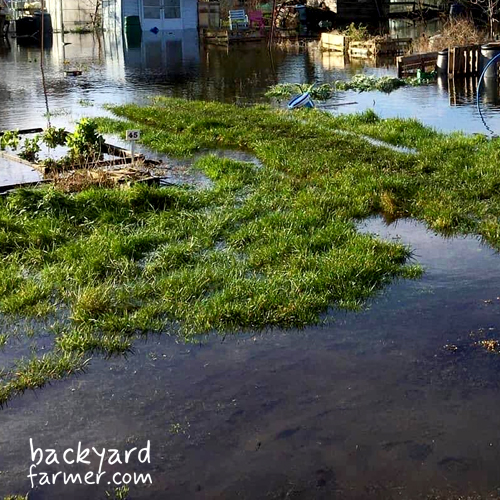
Waterlogged soil is a common problem in UK gardens and allotments, particularly during autumn and winter. When soil remains saturated, oxygen cannot reach plant roots effectively, leading to poor growth, yellowing leaves and potentially root damage.
Before attempting to improve drainage, it’s important to understand why the water is collecting. Seasonal rainfall, compacted soil and a high water table can all cause waterlogging, but they require different solutions.
Waterlogged Soil at a Glance
| Problem | What to do |
|---|---|
| Soil saturated after heavy rain | Allow time to drain and avoid walking on wet beds |
| Heavy or compacted soil | Improve structure gradually with organic matter and reduced foot traffic |
| Water remains long after rainfall | Investigate soil drainage, groundwater and possible runoff |
| Plants yellowing or wilting | Check soil moisture and root health before adding fertiliser |
| Growing areas flood repeatedly | Consider raised beds or mounds while investigating the cause |
Important: Ordinary rainwater saturation is different from flooding involving potentially contaminated water. The Food Standards Agency advises discarding any fruit or vegetables that have come into contact with floodwater. See its food safety guidance after flooding.
Find the Right Solution for Your Soil
Not every waterlogged garden needs a drainage system. Sometimes the best approach is to improve soil structure, while persistently wet ground may require raised growing areas or further drainage investigation.
The right starting point depends on how long the soil remains saturated, where water collects and what is preventing it from draining.
These solutions can overlap. If you’re unsure what’s causing the problem, start by checking your soil drainage before choosing a method.
Why Does Soil Become Waterlogged?
Waterlogging occurs when water fills the spaces between soil particles faster than it can drain away.
Healthy soil contains both water-filled and air-filled pores. These allow roots to absorb moisture while receiving the oxygen needed for respiration.
When soil remains saturated, oxygen becomes depleted and plant growth can suffer.
Common Causes of Waterlogged Soil
Several conditions can contribute to waterlogging:
- Prolonged rainfall: Heavy or repeated rain saturates soil faster than excess water can escape.
- Compaction: Walking or working on wet ground compresses soil pores and restricts water movement.
- Heavy clay: Fine particles can slow drainage, especially where the soil has poor structure.
- Impermeable layers: Dense subsoil, compacted layers or underlying rock may prevent water moving downwards.
- High water table: Groundwater close to the surface can keep the root zone saturated.
- Surface runoff: Water from paths, buildings or higher ground may collect in lower areas.
Clay soil isn’t necessarily unhealthy. Well-structured clay can be fertile and productive, retaining both nutrients and useful moisture.
The important factor is whether water can move through the soil while leaving enough air available for roots.
What Happens to Plant Roots and Soil Biology?
Plant roots need oxygen for respiration, which releases the energy required for growth and nutrient uptake.
When soil remains saturated, oxygen becomes scarce. Root activity slows, nutrient absorption becomes less efficient and prolonged waterlogging can damage or kill roots.
This explains why a waterlogged plant may wilt despite standing in wet soil. Its damaged roots can no longer supply water effectively.
Waterlogging also changes the activity of soil microorganisms. Oxygen-poor conditions can encourage processes such as denitrification, where microorganisms convert nitrates into gaseous forms of nitrogen that escape from the soil.
Heavy rainfall may also wash soluble nutrients beyond the root zone.
These changes can produce symptoms resembling nutrient deficiencies, even when sufficient nutrients are present.
AHDB’s guidance on soil texture and water status and the functions of soil biology explains the relationship between water, soil structure, microorganisms and nutrient cycling.
Adding fertiliser therefore isn’t necessarily the answer to yellowing leaves. The underlying problem may be the condition of the roots rather than a shortage of nutrients.
Signs Waterlogging Is Affecting Your Crops
| Symptom | Possible explanation |
|---|---|
| Yellowing leaves | Root stress or reduced nutrient uptake |
| Wilting despite wet soil | Damaged roots unable to supply enough water |
| Slow or stunted growth | Restricted root respiration |
| Soft, dark or decaying roots | Oxygen damage or associated root disease |
| Rotting bulbs or underground stems | Prolonged saturation or infection |
| Persistent surface puddles | Poor infiltration, runoff or groundwater |
These symptoms aren’t exclusive to waterlogging, so check soil conditions before drawing conclusions.
Garlic, onions and shallots are worth monitoring during wet winters because prolonged saturation can encourage bulb and root deterioration.
Overwintered broad beans may also struggle to establish in saturated ground. Where conditions are unsuitable, delaying planting or starting suitable crops in modules can be more sensible than planting directly into wet soil.
Established winter brassicas may tolerate temporary saturation, but prolonged waterlogging can still damage their roots.
How to Check Your Soil Drainage
Before choosing a solution, establish whether the waterlogging is temporary or caused by a persistent drainage restriction.
Check How Long the Water Remains
Observe the garden after several periods of rainfall.
Does the soil become saturated during wet weather but recover as conditions improve? Or does water remain standing long after the rain has stopped?
Look for patterns across the growing area.
Puddles forming mainly along paths may indicate compaction, while water collecting in a low corner could be arriving from higher ground.
Repeated saturation across an entire plot may suggest deeper drainage limitations or groundwater close to the surface.
The most useful observation is often whether the same areas remain wet year after year.
Use a Simple Soil-Pit Test
The RHS recommends a soil-pit investigation to help distinguish poor drainage from groundwater problems.
When the ground is stable and conditions are suitable:
- Dig a straight-sided inspection pit approximately 60 cm deep in the affected area.
- Examine the exposed soil layers for compaction, dense material or restricted root growth.
- Cover the pit securely to prevent rainfall entering and leave it overnight.
- Check whether water has collected naturally.
- If the pit remains dry, fill it with water, cover it again and check after approximately 24 hours.
Water entering an empty, covered pit suggests groundwater or water trapped above a restrictive soil layer may be contributing to the problem.
If the pit remains dry initially but added water drains away very slowly, restricted infiltration or drainage is more likely.
Neither observation provides a complete diagnosis on its own. Recent rainfall, soil layers and seasonal groundwater levels can all influence the results.
If you’re uncertain, repeat observations under different weather conditions before undertaking major drainage work.
Safety: Check for underground services before digging. Avoid excavation during active flooding or unstable ground conditions, and never leave an open pit accessible to children, animals or other plot holders.
What Do the Results Mean?
| Observation | What it may suggest |
|---|---|
| Soil drains as rainfall subsides | Seasonal saturation |
| Water moves slowly through the soil | Compaction or restricted drainage |
| Water enters an empty, covered pit | Groundwater or water perched above a restrictive layer |
| Low-lying areas remain saturated | Runoff, groundwater or landscape position |
| Water arrives from elsewhere | External runoff or existing drainage problems |
These observations help narrow down the likely cause and identify the most useful next step.
Four Practical Ways to Manage Waterlogged Soil
There is no single treatment that works for every waterlogged garden.
The right approach depends on how long the soil stays saturated, where the water comes from, and whether it has somewhere to drain.
Solution 1: Let Seasonal Waterlogging Drain Naturally
Best for: Gardens and allotments that become saturated during wet weather but drain as conditions improve.
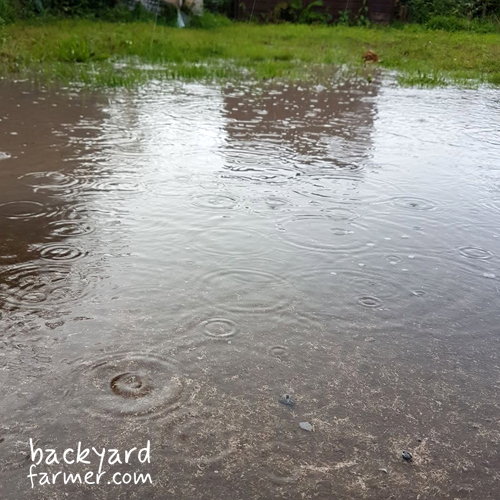
Temporary winter saturation doesn’t automatically mean your soil needs fixing.
Cold conditions generally reduce the oxygen demands of dormant plants and soil microorganisms, although actively growing crops can still suffer if saturation continues.
If standing water gradually disappears and crops remain healthy, the best immediate approach may be to leave the ground alone.
Avoid walking across wet growing beds, digging sticky clay or rotavating saturated soil.
Working wet ground can compress and smear soil particles together, destroying pore spaces and making drainage worse.
Wait until the soil becomes workable. A handful should begin to crumble when gently broken apart rather than remain a sticky, mouldable mass.
Use established paths to access growing areas without trampling the beds.
What this won’t solve: Persistent groundwater problems, contaminated flooding or water that remains long after rainfall has stopped.
Solution 2: Improve Compacted Soil and Poor Structure
Best for: Soil where compaction, poor aggregation or restricted infiltration is slowing drainage.
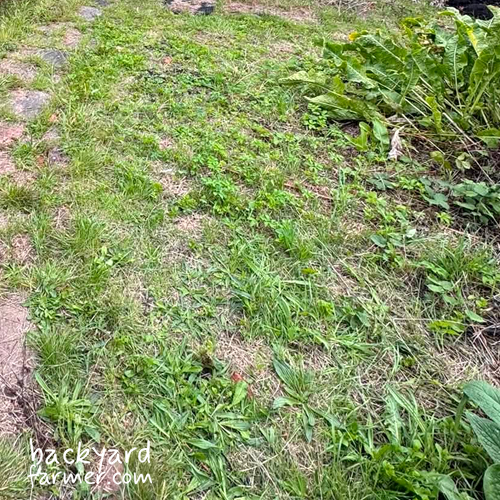
Healthy soil structure depends on particles forming stable aggregates with connected spaces between them.
These spaces allow water to infiltrate, oxygen to circulate and roots to develop.
Improving soil structure takes time, but it can make a substantial difference to growing conditions.
Start by protecting the soil from further compaction. Establish permanent growing beds and defined paths so the beds aren’t repeatedly walked on.
Apply mature compost or well-rotted organic matter when conditions are suitable. Organic matter supports soil organisms and helps encourage stable aggregates over time.
No-dig management can be particularly useful. Applying compost to the surface while avoiding unnecessary cultivation helps preserve existing structure and biological activity.
Earthworms contribute by creating channels through the soil, incorporating organic material and improving water movement.
Living roots also help maintain soil structure, so suitable green manures and cover crops can be worthwhile between vegetable crops.
However, no-dig isn’t a universal cure.
Where a genuinely compacted layer prevents root penetration and drainage, targeted loosening may be necessary once the ground is sufficiently dry and workable.
What this won’t solve: High groundwater, external runoff or impermeable underlying layers that soil improvement cannot overcome.
Solution 3: Raise the Growing Area
Best for: Persistently wet growing ground where lifting the root zone above the surrounding soil would improve growing conditions.
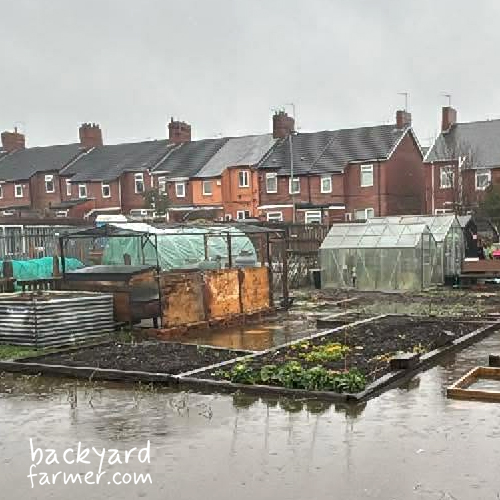
Raised beds can provide a more reliable growing environment when the natural ground remains wet for extended periods.
By lifting the root zone, plants may establish in soil less affected by shallow surface saturation.
You don’t necessarily need expensive timber frames.
Simple growing mounds made from suitable soil and organic matter may provide enough additional height for certain crops.
More permanent framed raised beds can maintain a defined depth of workable soil while keeping foot traffic away from growing areas.
Avoid creating a sealed base that traps water, and consider how water will move through the bed and underlying ground.
Raised beds are especially useful where improving drainage across an entire allotment is impractical.
For materials, construction and filling, see our guide to long-lasting raised beds.
What this won’t solve: Raised beds don’t remove water from surrounding paths or resolve a high water table. They can also become saturated if water rises into the growing area or cannot escape.
Solution 4: Investigate Persistent Drainage Problems
Best for: Ground affected by high groundwater, incoming runoff, blocked drainage or restrictions that soil improvement alone cannot resolve.
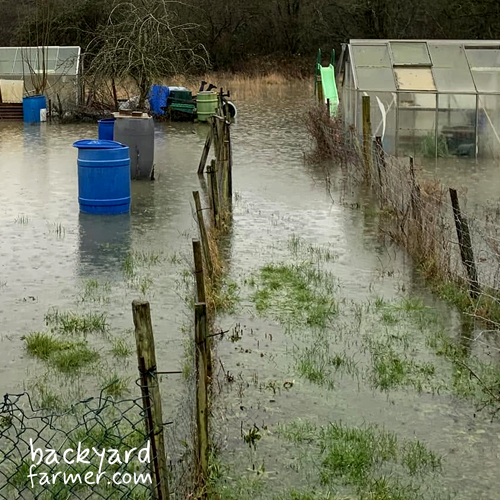
If waterlogging persists long after rainfall, the problem may extend below the topsoil or involve water entering from elsewhere.
Start by identifying the source.
Check whether the affected ground lies below surrounding areas, receives runoff from buildings or paths, or is close to existing drains and ditches.
Where drainage systems already exist, inspect accessible outlets for blockages or damage.
A French drain or drainage trench may help in some situations, but only where collected water has a suitable place to discharge.
Simply digging a trench and filling it with gravel won’t reliably solve waterlogging if the water cannot escape.
Similarly, a soakaway is unlikely to function effectively where the surrounding ground has poor infiltration or groundwater is already high.
Before undertaking drainage work, establish the likely water source, ground conditions and available outlets.
On allotments, check with site management before making alterations that could affect paths, neighbouring plots or shared drainage systems.
The RHS guide to installing garden drainage explains the importance of suitable outlets and the restrictions that may apply to discharging water into drains or sewers.
What this won’t solve: A drainage installation cannot compensate for poor design or an unsuitable outlet. It may simply relocate the problem.
How to Prevent Waterlogging Long-Term
Good soil management can reduce the risk of waterlogging caused by compaction and poor structure.
Once drainage problems have been identified, focus on maintaining the conditions that allow water, air and roots to move through the soil.
- Keep unnecessary foot traffic off growing beds, particularly during winter.
- Maintain organic matter through appropriate compost applications.
- Keep living roots in the soil where practical.
- Avoid unnecessary cultivation, especially when the ground is wet.
- Maintain existing drainage channels and outlets.
- Monitor recurring wet areas to identify changes over time.
The aim isn’t to make soil dry. Healthy growing soil should retain useful moisture while maintaining enough air-filled spaces for roots and biological activity.
These habits help protect soil structure, although persistent groundwater or external flooding may still require separate management.
Our UK Winter Growing Guide also covers managing outdoor crops during the colder months.
Common Waterlogging Mistakes to Avoid
Some popular drainage remedies are ineffective because they don’t address the underlying cause.
| Common advice | Why it can be problematic |
|---|---|
| Digging wet clay to loosen it | Can smear soil and create further compaction |
| Adding a little sand or gravel | Usually insufficient to improve drainage in heavy clay |
| Filling isolated holes with gravel | Water may simply collect in the holes |
| Applying gypsum automatically | Only appropriate for certain soil conditions |
| Installing drainage without an outlet | Water may have nowhere suitable to escape |
| Adding fertiliser to yellowing plants | Damaged roots may be unable to absorb nutrients |
| Assuming no-dig fixes every drainage problem | Cannot necessarily overcome high groundwater or impermeable subsoil |
A recurring lesson from UK allotment growers is that improving soil structure and removing excess water are two different tasks.
Compost may gradually improve poorly structured clay, but it cannot necessarily stop groundwater entering a plot.
Equally, expensive drainage work may be unnecessary where soil becomes saturated during prolonged winter rain and recovers naturally afterwards.
The most reliable approach is to identify the cause before choosing a treatment.
Frequently Asked Questions
Temporarily waterlogged soil will often recover as rainfall decreases and excess water drains away. Roots and soil biology may also recover, depending on the duration of saturation. Persistent groundwater or severe drainage restrictions may require further action.
Avoid digging saturated soil, particularly heavy clay. Working wet ground can damage its structure and create compaction. Wait until the soil is sufficiently dry and workable before undertaking necessary cultivation.
Mature compost can improve soil structure over time by supporting aggregation and biological activity. This helps maintain spaces for air and water movement, but it won’t independently resolve a high water table or impermeable underlying layer.
No-dig can help preserve soil structure by reducing disturbance and maintaining organic matter. Earthworms, roots and microorganisms also contribute to natural drainage channels. However, no-dig alone cannot solve every persistent drainage problem.
Raised beds can improve conditions around plant roots by lifting the growing area above wet ground. They don’t necessarily remove water from the surrounding soil, and severe groundwater or drainage problems may still need attention.
It’s generally better to wait until saturated soil has drained and become workable. Planting into waterlogged ground can restrict root development and damage soil structure. For suitable crops, starting plants in modules or using an adequately drained raised growing area may be a practical alternative.