Powdery mildew is a common fungal disease that causes white, powdery patches on plant leaves and stems. It frequently affects courgettes, squash, cucumbers, peas and other crops grown in UK gardens and allotments.
A little mildew doesn’t necessarily mean your crop is lost. Identifying the problem early, reducing plant stress and managing badly affected foliage can help keep plants productive.
Powdery Mildew at a Glance
| Problem | Powdery mildew |
| Cause | Several related species of fungi |
| Main symptoms | White or grey powdery patches on leaves and sometimes stems |
| Common crops | Courgettes, squash, cucumbers, peas, grapes and fruit crops |
| Typical season | Spring to autumn, particularly summer and early autumn |
| Favourable conditions | Suitable temperatures, humid air and susceptible plants; drought stress can increase vulnerability |
| Immediate action | Assess severity, correct water stress and selectively remove badly affected foliage |
| Prevention | Adequate watering, good spacing, ventilation and less susceptible varieties |
| Recovery | Mildly affected plants may continue growing and cropping |
How to Identify Powdery Mildew
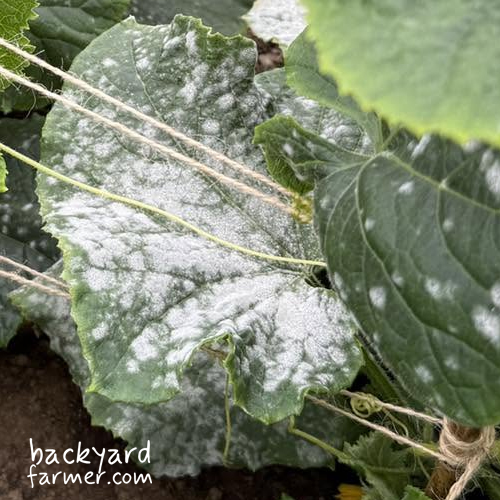
Powdery mildew usually appears as small, white or greyish patches on leaves, resembling a dusting of flour.
The patches gradually expand and may join together, eventually covering large areas of foliage. Infected leaves can turn yellow, curl, dry out or die prematurely.
Most powdery mildew fungi produce visible growth on the leaf surface, although some also affect stems, shoots, flowers or developing fruit.
The white coating is fungal growth rather than a natural change in leaf colour.
Powdery Mildew or Natural White Leaf Markings?
Not every white patch on a courgette, pumpkin or squash leaf is powdery mildew.
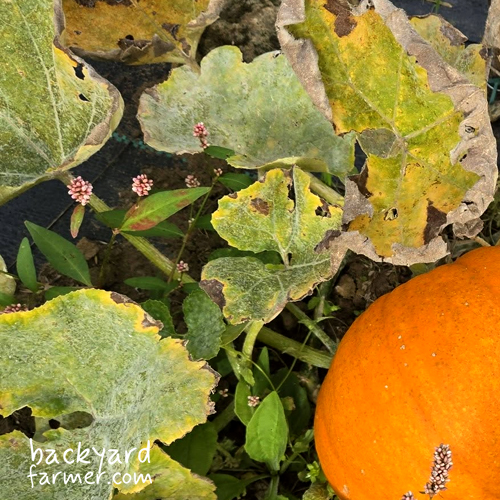
Some varieties naturally develop pale or silver markings, often following the veins. These markings are part of the leaf tissue rather than fungal growth on its surface.
Natural silvering usually forms a consistent pattern, while mildew produces irregular patches that develop and spread.
For a detailed visual comparison, see our guide to Why Courgette, Pumpkin & Squash Leaves Turn White.
Powdery Mildew vs Downy Mildew
Despite their similar names, these are different diseases.
Powdery mildew produces conspicuous white or grey fungal growth on leaf surfaces.
Downy mildew more commonly causes yellow or brown patches, sometimes angular and restricted by leaf veins. Greyish or purplish growth may develop on the undersides of leaves during humid conditions.
Downy mildew is caused by fungus-like organisms called oomycetes, rather than the fungi responsible for powdery mildew.
Correct identification matters because the conditions favouring each disease and their management can differ.
How to Get Rid of Powdery Mildew
There is no guaranteed way to eliminate an established powdery mildew infection, but early action can help protect healthy growth and limit further damage.
If only a few leaves are affected, you usually don’t need to remove the entire plant.
The priority is to assess the infection, correct avoidable plant stress and preserve enough healthy foliage for continued growth and cropping.
What to Do When Powdery Mildew Appears
- Confirm the infection. Make sure the white patches are fungal growth rather than natural leaf markings.
- Assess the severity. A few patches on older leaves are less concerning than widespread infection and dying foliage.
- Check soil moisture. If the root zone is drying excessively, water thoroughly and maintain more consistent moisture.
- Improve airflow. Reduce unnecessary crowding and ventilate greenhouses or polytunnels where practical.
- Remove badly affected foliage selectively. Prioritise yellowing, dying or heavily infected leaves.
- Monitor the plant. Check whether new growth remains healthy and whether the crop continues producing.
Improving growing conditions helps plants tolerate infection and may reduce conditions favourable to further disease development. However, these changes do not reliably remove fungal colonies already established on leaves.
For many mature courgette and squash plants, sensible ongoing care is more useful than trying to eliminate every visible white patch.
Should You Remove Leaves with Powdery Mildew?
Removing heavily affected foliage can reduce the amount of infected material on a plant, but excessive pruning may do more harm than good.
Leaves are responsible for photosynthesis, providing the energy needed for growth and fruit development.
Use the condition of the foliage to guide your decision:
| Leaf condition | Recommended action |
|---|---|
| A few white patches, mostly green | Usually retain and monitor |
| Widespread mildew, leaf still functioning | Consider selective removal, but preserve healthy foliage |
| Yellowing, dying or badly deteriorated | Remove where practical |
| Most of the plant affected | Avoid stripping it bare; assess remaining productivity |
Use clean secateurs or a sharp knife, cutting affected leaves at the stalk without damaging healthy stems.
Remove cut foliage from around the plant rather than leaving it beneath susceptible crops.
Selective removal may reduce local spore production, but it cannot guarantee that the disease will stop spreading.
Can Plants Recover from Powdery Mildew?
A plant can continue growing and cropping after powdery mildew appears, even if the infected leaves never return to their original condition.
The important question is whether enough healthy foliage remains to support new growth and developing fruit.
A mature courgette developing mild mildew in September may still provide a useful final harvest. The same infection appearing on a young plant in June deserves more attention because much of the growing season remains.
For pumpkins and winter squash, maintaining healthy foliage is particularly important while fruit is still developing.
If most leaves have died, new growth is weak and the plant is no longer producing, removal may be more sensible than continued intervention.
Can You Still Eat Produce from an Infected Plant?
Powdery mildew on foliage does not automatically make otherwise healthy fruit unsuitable to eat.
Courgettes, pumpkins, squash and cucumbers can often still be harvested from affected plants, provided the produce is sound and shows no signs of spoilage.
Inspect each harvest individually.
Discard produce showing mould, soft rot or other deterioration. Washing or cooking should not be relied upon to make visibly spoiled produce safe.
Where the edible leaves themselves are infected, as with herbs, avoid harvesting visibly affected tissue.
How to Prevent Powdery Mildew
Powdery mildew is difficult to prevent entirely because spores can arrive from other susceptible plants.
However, good growing conditions can reduce the risk of severe infection and help crops remain productive.
Keep Plants Watered During Dry Weather
Unlike many fungal diseases, powdery mildew generally does not need free water sitting on leaves to infect them.
Warm, relatively dry weather can favour some powdery mildew fungi, while drought stress may increase a plant’s susceptibility.
This is particularly important for thirsty crops such as courgettes, pumpkins and squash.
To maintain healthier growing conditions:
- Water thoroughly around the roots when the soil needs it.
- Avoid repeated periods of severe drying.
- Mulch where appropriate to help conserve soil moisture.
- Check container-grown plants regularly, as their compost can dry quickly.
Watering the root zone is a practical way to maintain consistent moisture without unnecessarily wetting foliage.
However, water touching leaves is not automatically the cause of powdery mildew.
Improve Spacing and Airflow
Crowded foliage can create sheltered conditions that favour disease development.
Allow enough room for plants at their mature size, particularly courgettes and squash, which can produce much larger leaves than expected.
In greenhouses and polytunnels, ventilate when conditions allow to reduce stagnant, humid air.
For established plants, remove dead or heavily crowded foliage selectively rather than attempting to correct poor spacing through extensive pruning.
Avoid Excessive Nitrogen Feeding
Excess nitrogen can encourage rapid, lush growth that may be more susceptible to some powdery mildew infections.
Maintain balanced feeding appropriate to the crop and its stage of development.
Extra fertiliser is not a treatment for powdery mildew.
Choose Less Susceptible Varieties
Some crop varieties offer improved resistance to particular powdery mildew fungi.
This is worth considering where the same crop develops severe mildew year after year.
Check variety descriptions when selecting seeds, particularly for cucumbers, courgettes and squash.
Resistance is specific to the crop and pathogen involved and does not guarantee immunity.
Powdery Mildew on Different Crops
Different powdery mildew fungi affect different plants, so the consequences and most useful management measures can vary.
Courgettes, Squash and Pumpkins
Powdery mildew commonly appears on mature foliage during late summer and autumn.
A plant with mild infection may continue producing healthy fruit, particularly towards the end of its growing season.
Severe early infection is more concerning because it reduces the leaf area available to support continued growth.
For pumpkins and winter squash, retain as much functional foliage as practical while fruit is developing and maturing.
Cucumbers
Powdery mildew can affect outdoor cucumbers and those grown under cover.
Severe infection reduces the healthy foliage available to support continuous fruit production.
Maintain appropriate greenhouse ventilation and avoid removing excessive amounts of green foliage.
Where mildew is a recurring problem, varieties with documented resistance may be worthwhile.
Peas
Powdery mildew often appears as pea plants approach maturity.
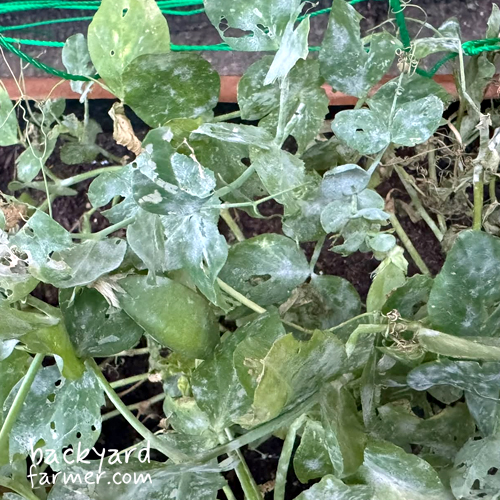
A little infection near the end of harvest may have limited practical impact, but severe infection earlier in the season can reduce growth and pod production.
Remove spent plants once cropping finishes, rather than leaving heavily affected material around the growing area.
Fruit Bushes, Apples and Grapes
Powdery mildew also affects perennial crops, including gooseberries, apples and grapevines.
Some species can infect buds, young shoots or fruit and survive between seasons on the host plant.
Managing affected shoots and maintaining an open plant structure may therefore be more important than it is for annual vegetables.
Follow crop-specific advice, as these diseases do not all behave identically.
What Causes Powdery Mildew and Does It Spread?
Powdery mildew is caused by several related fungal species that infect living plant tissues.
The visible white coating consists of fungal growth and spores, which can spread through the air to susceptible plants.
Most powdery mildew fungi grow mainly on plant surfaces, using specialised feeding structures to obtain nutrients from living cells.
Temperature, atmospheric humidity, plant susceptibility and growing conditions influence how quickly infection develops.
Because free water on leaves is generally unnecessary for infection, powdery mildew can spread during relatively dry weather.
Some species survive between growing seasons on infected plant material, within persistent structures or on perennial hosts.
Can Powdery Mildew Spread to Other Plants?
Yes, but most powdery mildew fungi have particular host ranges.
For example, an infection affecting courgettes may also threaten other susceptible cucurbits.
However, it does not automatically mean nearby peas, apples or unrelated vegetables will develop the same infection.
Different crops often have similar-looking symptoms caused by different powdery mildew fungi.
Good spacing, monitoring and garden hygiene can help limit disease development, although airborne spores cannot be excluded completely outdoors.
Can You Compost Plants with Powdery Mildew?
Powdery mildew-affected foliage can sometimes be added to home compost, provided the material decomposes completely.
The RHS explains that many common foliar diseases, including powdery mildew, generally cannot survive for long once infected material has fully broken down.
However, home compost heaps do not always reach consistently high temperatures, and some powdery mildew fungi produce persistent survival structures.
Complete decomposition matters more than simply assuming the heap becomes hot enough to destroy every pathogen.
For practical composting:
- Add affected foliage to an actively decomposing heap where it can break down thoroughly.
- Avoid leaving intact infected leaves around susceptible plants.
- Do not spread incompletely decomposed diseased material around vulnerable crops.
- Consider council green-waste collection where permitted if thorough decomposition is uncertain.
Composting infected foliage is an option, not a requirement. Where material will remain intact for an extended period, an alternative disposal method may be preferable.
For further advice on composting garden waste, see our composting guides.
Do Milk, Bicarbonate and Other Natural Treatments Work?
Homemade sprays are frequently recommended for powdery mildew, but controlled research should not be confused with untested household recipes.
Does Milk Spray Work Against Powdery Mildew?
Milk-based sprays have reduced powdery mildew in some controlled studies involving courgettes and pumpkins.
However, effectiveness depended on the crop, concentration, application frequency and growing conditions.
These results do not establish milk as a universally effective treatment or justify recommending one homemade recipe for every plant.
Claims that milk works simply because it becomes acidic also oversimplify the research.
Does Baking Soda Kill Powdery Mildew?
Some formulated bicarbonate treatments have demonstrated activity against powdery mildew.
However, tested potassium bicarbonate formulations are not interchangeable with improvised mixtures containing ordinary kitchen baking soda.
Concentration and formulation affect both effectiveness and the risk of damaging foliage.
What About Oils and Washing-Up Liquid?
Certain formulated horticultural oils can suppress powdery mildew, but this does not mean ordinary cooking oils or household detergents are safe substitutes.
Homemade mixtures can damage foliage, and their effects on beneficial organisms may be poorly understood.
The RHS advises against using unregulated homemade fungicide preparations.
For most UK allotment crops, suitable watering, airflow, less susceptible varieties and selective removal of badly affected foliage provide a more dependable starting point.
Frequently Asked Questions About Powdery Mildew
Not reliably from an outdoor garden. Spores can arrive from other susceptible plants, and some species survive between seasons. Improving growing conditions, removing badly affected material and choosing resistant varieties can reduce recurring problems without guaranteeing permanent eradication.
It can spread between susceptible plants, but most powdery mildew fungi have particular host ranges. Courgettes, squash and some cucumbers may share pathogens, while unrelated crops are often affected by different species.
Avoid eating leaves visibly covered with powdery mildew. Washing cannot be relied upon to remove all fungal material. Healthy, unaffected growth elsewhere on the plant may still be usable if it is sound and shows no signs of disease or spoilage.
No. Remove badly affected, yellowing or dying foliage selectively, but retain enough healthy leaves for photosynthesis and continued growth. Removing every leaf with a small white patch can weaken the plant.
Some species survive in persistent structures on plant debris or within infected buds and shoots of perennial hosts. Others depend on surviving host plants or new spores arriving the following season. Survival depends on the pathogen and crop.
Most powdery mildew fungi do not need free water on leaves to cause infection. Suitable humidity and temperatures can support disease development during dry weather, while drought-stressed plants may be more susceptible. Maintaining adequate soil moisture can help protect plant health.