
You can grow mushrooms indoors in an ordinary UK home without specialist equipment. For beginners, a ready-colonised grey oyster mushroom kit is one of the easiest places to start.
You don’t need a garden or greenhouse. The main things to get right are moisture, fresh air, indirect light and a temperature suited to the mushroom you’re growing.
A kit probably won’t beat supermarket mushrooms on price, but that’s not really the point. You get exceptionally fresh mushrooms, can try varieties that aren’t always easy to find in shops, and learn how fungi grow in the process.
What Are the Easiest Mushrooms to Grow at Home?
Not all gourmet mushrooms like the same conditions, so choosing a suitable species makes your first attempt much easier.
| Mushroom | Difficulty | Best suited to |
|---|---|---|
| Grey oyster | Easy | Best first choice |
| Blue oyster | Easy | Cooler indoor conditions |
| Pink oyster | Easy–moderate | Warmer rooms |
| Lion’s mane | Moderate | Something unusual after oysters |
| Shiitake | Moderate | Growers ready for a slower crop |
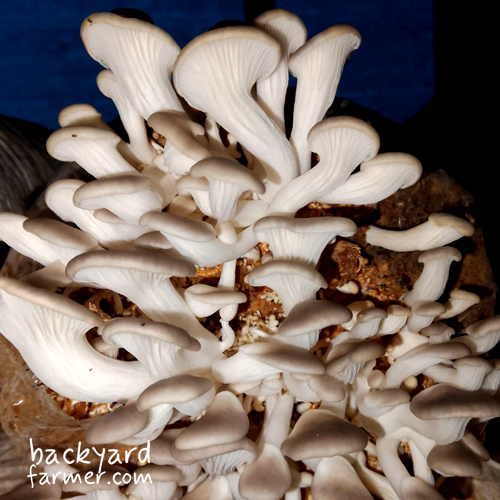
For most UK beginners, I would start with grey oyster mushrooms. They’re quick to fruit, relatively forgiving and well suited to cooler indoor conditions.
The Easiest Way to Start: Use a Mushroom Growing Kit
Growing mushrooms from scratch means preparing a substrate, introducing a culture and controlling contamination. A beginner doesn’t need to start there.
A mushroom growing kit has already done most of that work for you. The substrate is colonised with living mycelium and is essentially waiting for the right conditions to begin fruiting.
If you’d like to grow your own mushrooms, a ready-colonised fruiting block is the simplest place to begin.
Once a live kit arrives, don’t leave it sitting around indefinitely. Start it within the timeframe recommended by the supplier.
Where Should You Put a Mushroom Kit?
A bright room with indirect daylight is usually better than a dark cupboard.
Look for somewhere that is:
- Out of strong direct sunlight
- Away from radiators and dry heat
- Reasonably well ventilated
- Easy to check each day
- Within the temperature range recommended for the species
Mushrooms don’t photosynthesise like plants, but that doesn’t mean they need complete darkness.
Temperature also varies by species. Grey and blue oysters are generally better suited to cooler UK homes than warm-loving mushrooms such as pink oysters.
How to Grow Mushrooms From a Kit
Different manufacturers use slightly different fruiting methods, so always read the instructions before cutting or opening the packaging.
Most ready-to-fruit kits follow the same basic process.
1. Open the Kit as Directed
Some kits tell you to cut a cross or slit in the bag, while others expose the growing block differently.
Follow the supplier’s method rather than making a larger opening because you think the mushrooms need more room.
2. Put It in Indirect Light
Move the block somewhere bright but out of direct sunshine.
A normal room is usually more suitable than an airing cupboard. You don’t need to recreate a cave.
3. Keep the Fruiting Area Moist
Mushrooms need humidity to develop properly, but that doesn’t mean soaking the block.
Follow the misting instructions supplied with the kit and aim to stop the exposed fruiting area from drying out.
The key is:
Humid, not waterlogged.
If water is pooling around the bottom of the block or sitting permanently in a tray, reduce it.
4. Give the Mushrooms Fresh Air
Fresh-air exchange is particularly important with oyster mushrooms.
If an oyster kit is kept somewhere too enclosed, you may end up with mushrooms that develop long stems and disproportionately small caps.
You don’t need powerful fans or specialist ventilation for a simple home kit. Just avoid sealing the block inside a stagnant container and allow normal air movement around it.
5. Watch for Pins and Check the Kit Daily
The first tiny mushrooms are often called pins.
Once these appear, growth can accelerate surprisingly quickly. Check oyster mushrooms daily from this point because a cluster can go from small to harvest-ready in a short space of time.
6. Harvest at the Right Stage
Don’t wait for the mushrooms to become as large as physically possible. Oyster mushrooms are best harvested before the caps become strongly upturned and over-mature.
How Often Should You Mist a Mushroom Kit?
There isn’t one perfect misting schedule for every UK home.
A mushroom block in a centrally heated room may dry faster than one growing somewhere naturally cooler and more humid. Different kit designs also expose different amounts of substrate.
Follow the supplier’s guidance and pay attention to the growing conditions rather than automatically spraying a fixed number of times each day.
If the fruiting area keeps drying out, it may need more moisture. If the block is permanently dripping wet or standing in water, reduce it.
And if oyster mushrooms develop long stalks with small caps, fresh air is one of the first things to check rather than simply adding more water.
How Long Do Mushrooms Take to Grow?
A ready-colonised oyster mushroom kit can often produce a crop within roughly one to two weeks once fruiting begins, although the exact timing depends on the strain, temperature and conditions in your home.
Starting mushroom cultivation from spores or culture is a different process and takes considerably longer because the growing medium first has to be colonised.
For a beginner who mainly wants to experience growing and harvesting mushrooms, a ready-to-fruit block is much quicker and simpler.
How to Tell if Your Mushroom Kit Is Healthy
Most first-time problems come back to moisture, airflow or unsuitable conditions.
| What you see | Possible cause | What to do |
|---|---|---|
| Long stems with small caps | Not enough fresh air | Increase ventilation around the kit |
| Caps drying or cracking | Conditions too dry | Increase humidity or misting as directed |
| Water collecting around the block | Too much moisture | Drain excess water and reduce spraying |
| White growth on the block | Often normal mycelium | Don’t automatically assume it’s mould |
| No pins appearing | Kit may need more time or conditions may be unsuitable | Check expected timing, temperature, moisture and instructions |
| Green, black or unusual coloured growth | Possible contamination | Check the supplier’s guidance before continuing |
| Strong unpleasant smell | Possible contamination | Stop treating it as a normal healthy grow and contact the supplier |
White fungal growth can look unusual if you’ve never grown mushrooms before, but remember that the block is supposed to contain living fungal mycelium.
Unusual colours or strong unpleasant smells are more reason for caution.
When Should You Harvest Oyster Mushrooms?
A good time to harvest oyster mushrooms is when the caps have expanded and are beginning to flatten while the outer edges are still slightly turned down.
Don’t wait until the edges are strongly curled upwards.
Once a cluster reaches this stage, check it regularly. Oyster mushrooms can become over-mature surprisingly quickly, and harvesting before that point also limits heavy spore release indoors.
To harvest them, hold the cluster close to the base and gently twist it away from the block. You can also use a clean knife to cut the cluster close to the substrate.
Avoid digging chunks out of the growing block, especially if you hope to get another crop.
Can a Mushroom Kit Grow More Than One Crop?
Each mushroom crop is known as a flush.
A healthy oyster block may produce a second and occasionally third flush, although later crops are usually smaller.
After harvesting, follow the supplier’s instructions for resting or rehydrating the block rather than throwing it away immediately.
Treat additional flushes as a bonus rather than a guarantee.
How to Store Homegrown Mushrooms
Fresh mushrooms are best eaten fairly quickly.
Brush off loose growing material and refrigerate them in a paper bag or breathable container. Avoid soaking them in water before storage because excess moisture can shorten their useful life.
For the best texture, harvest them at the right stage and use them within a few days.
A UK Note on Mushroom Species and the Garden
There is one important UK-specific point that is easy to miss when reading generic mushroom-growing advice.
Not every gourmet mushroom culture sold commercially should be released outdoors.
Some cultivated fungi are non-native, so you shouldn’t automatically assume that a spent fruiting block belongs on the compost heap or buried under a tree.
Grey oyster mushrooms occur naturally in Britain, which is another reason they make a sensible first choice.
More care is needed with exotic cultivated species. Golden oyster mushrooms are one example of a commercially grown species that should not simply be established outdoors in the UK.
Before putting a spent mushroom block on the compost heap, check which species you’ve grown.
Indoor mushroom growing and deliberately establishing a fungus outdoors are two different things.
Are Mushroom Growing Kits Worth It?
If you’re simply trying to buy the greatest weight of mushrooms for the least money, probably not. Supermarket mushrooms will usually be cheaper.
A kit makes more sense for the experience, freshness and chance to grow varieties that can be harder to find in shops.
It’s also a very easy introduction to humidity, fresh-air exchange and fruiting before deciding whether you want to try more advanced mushroom cultivation.
Mushroom Growing FAQs
Yes. Ready-colonised mushroom kits are particularly well suited to indoor growing because the difficult colonisation stage has already been completed.
Grey oyster is one of the easiest choices for UK beginners because it grows quickly and tolerates relatively cool indoor conditions.
Mushrooms don’t photosynthesise like plants, but many gourmet mushrooms fruit well with indirect daylight. Avoid strong direct sunlight.
A ready-to-fruit oyster kit can often produce a harvest within around one to two weeks once fruiting begins, although conditions and individual kits vary.
Many can. A healthy block may produce a second and occasionally third flush, although later crops are normally smaller.
Yes, but used coffee grounds can be prone to contamination. For a first attempt, a prepared mushroom kit is considerably simpler and more reliable.
Not automatically. Check which mushroom species is in the kit first, particularly if you’ve grown a non-native commercial species.