

A greenhouse thermometer helps you monitor overnight lows and daytime highs, making it easier to protect tender plants from frost and prevent overheating during warmer weather.
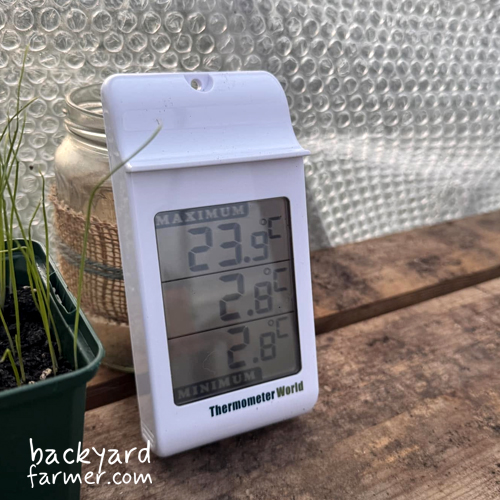
For most UK gardeners, a digital maximum/minimum thermometer is all that’s needed. It records the highest and lowest temperatures between visits, giving you a clearer picture of growing conditions than the current reading alone.
We’ve compared five greenhouse thermometers, from inexpensive digital models to weather-resistant sensors with smartphone monitoring, using manufacturer specifications, UK prices and gardener experiences.
Quick Picks — Best Greenhouse Thermometers UK
Brannan Weatherproof Digital Max/Min
Thermometer World IN-024
SwitchBot Outdoor Meter
Quick Comparison of the Best Greenhouse Thermometers
| Model | Best For | Temperature Recording | Humidity | Weather Resistance | UK Price |
|---|---|---|---|---|---|
| Brannan Weatherproof Digital | Best Overall | Max/min | No | IP65 | From £14.35 |
| Thermometer World IN-024 | Budget | Max/min | No | Keep sheltered | £9.95 |
| Brannan Gilt Dial | Analogue | Max/min | Yes | Keep sheltered | £12.54 |
| Brannan Jumbo Max/Min | External probe | Max/min | Yes | Keep sheltered | From £20.42 |
| SwitchBot Outdoor Meter | Smart monitoring | App history | Yes | IP65 | £19.99 |
Indicative UK prices checked in October 2026. Prices and availability may change. SwitchBot requires an additional hub for remote monitoring.
For everyday greenhouse monitoring, the Brannan Weatherproof Digital Max/Min offers the best combination of useful readings, weather resistance and value. Gardeners wanting temperature history or remote alerts should consider SwitchBot.
Best Overall Greenhouse Thermometer — Brannan Weatherproof Digital Max/Min
The Brannan Weatherproof Digital Max/Min is our best all-round choice for UK greenhouse temperature monitoring.
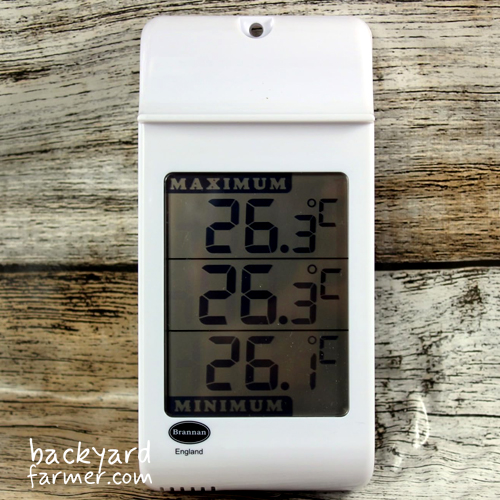
Its clear display shows current, maximum and minimum temperatures, allowing you to check how cold the greenhouse became overnight or how hot it reached during the day.
The main advantage over cheaper digital thermometers is its IP65-rated housing, which provides documented protection against dust and water jets. This makes it better suited to damp greenhouse conditions than models requiring a sheltered position.
It’s straightforward to hang and operate, although it doesn’t measure humidity or provide automatic temperature alerts.
| Specification | Detail |
|---|---|
| Temperature range | −20 to 50°C |
| Advertised accuracy | ±1°C from 0–50°C |
| Weather resistance | IP65 |
| Recording | Current, maximum and minimum |
| Sampling interval | Every 10 seconds |
| Battery | 1 × AAA |
Best For
- Everyday greenhouse monitoring.
- Damp or unheated greenhouses.
- Checking overnight temperature extremes.
Pros
- IP65 weather resistance.
- Clear max/min display.
- Simple operation.
- Affordable.
Cons
- No humidity measurement.
- No wireless monitoring.
- No automatic frost alerts.
Our Verdict: The best everyday choice for UK gardeners who want straightforward temperature monitoring without unnecessary extras. Its IP65 protection makes it worth the small premium over basic indoor thermometers.
Best Budget Greenhouse Thermometer — Thermometer World IN-024
The Thermometer World IN-024 provides the essential maximum/minimum functions for under £10.
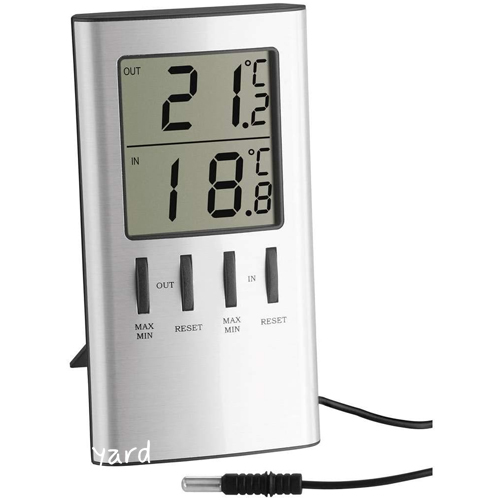
Its large digital display shows the current temperature alongside the highest and lowest readings since the last reset. This makes it useful for checking greenhouse conditions between visits without spending much money.
The main limitation is weather protection. Although marketed for greenhouse use, the IN-024 has no confirmed waterproof rating and must be sheltered from moisture.
At around £4.40 less than the Brannan Weatherproof, it’s an inexpensive option for a protected position, but the saving is relatively small.
| Specification | Detail |
|---|---|
| Temperature range | −10 to 50°C |
| Advertised accuracy | ±1°C |
| Recording | Current, maximum and minimum |
| Sampling interval | Every 10 seconds |
| Battery | 1 × AA, supplied |
| Weather resistance | No confirmed IP rating |
Best For
- Budget-conscious gardeners.
- Sheltered greenhouses.
- Occasional temperature checks.
Pros
- Inexpensive.
- Large, readable display.
- Simple manual reset.
- Battery included.
Cons
- No confirmed waterproof rating.
- Requires shelter from moisture.
- No humidity measurement.
Our Verdict: The cheapest straightforward option on our list. It does the essential job well on paper, provided you can keep it dry. For a consistently damp greenhouse, we’d spend the extra on Brannan’s IP65 model.
Best Analogue Greenhouse Thermometer — Brannan Gilt Dial Max/Min
The Brannan Gilt Dial Max/Min is a traditional alternative for gardeners who prefer mechanical instruments.
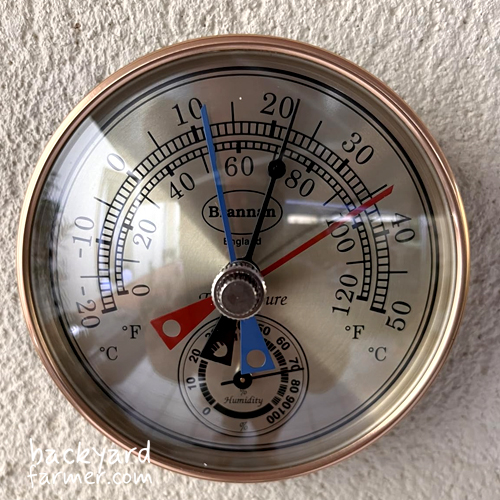
It measures temperature and relative humidity without batteries, using coloured pointers to record the highest and lowest temperatures since the last reset.
The analogue design is simple, although the pointers can make precise readings less convenient than a digital display. UK owner feedback on readability is mixed.
The dial also needs a sheltered position away from direct sunlight and rain.
| Specification | Detail |
|---|---|
| Temperature range | −20 to 50°C |
| Humidity range | 0–100% RH |
| Advertised temperature accuracy | ±1°C from 0–30°C |
| Maximum/minimum | Mechanical pointers |
| Power | No batteries required |
| Mounting | Hanging hook |
Best For
- Traditional greenhouse setups.
- Gardeners avoiding batteries.
- Basic temperature and humidity checks.
Pros
- No batteries required.
- Records temperature extremes.
- Humidity measurement included.
- Simple mechanical design.
Cons
- Less convenient to read precisely.
- Pointers need resetting.
- Must be sheltered from rain.
Our Verdict: A good battery-free choice for gardeners who prefer traditional equipment. It provides useful temperature and humidity readings, although digital models are generally easier to read at a glance.
Best Greenhouse Thermometer with External Probe — Brannan Jumbo Max/Min
The Brannan Jumbo Max/Min Thermometer & Hygrometer combines a large digital display with a 2m wired temperature probe.
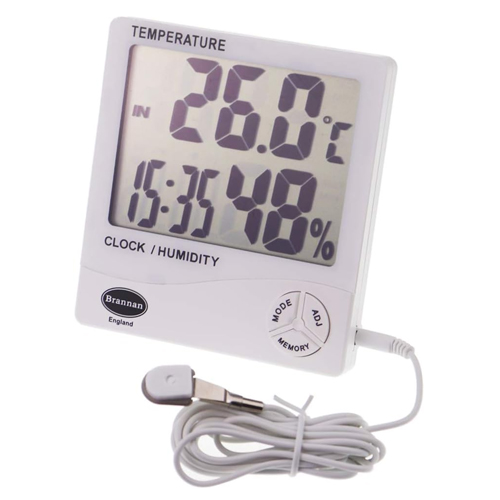
The probe allows you to measure temperature at a separate position from the main unit, such as near vulnerable plants or inside a propagating area. The display can then be placed somewhere easier to read.
It also measures relative humidity, but the humidity sensor is in the main display, not the external probe. To measure greenhouse humidity, the main unit must remain inside the greenhouse.
There is no confirmed IP rating for the housing, so the display needs a position protected from condensation and water.
| Specification | Detail |
|---|---|
| Main unit temperature range | −10 to 50°C |
| External probe range | −50 to 70°C |
| External probe cable | 2m |
| Humidity range | 20–90% RH |
| Recording | Maximum and minimum |
| Weather resistance | No confirmed IP rating |
Best For
- Measuring temperature at a separate position.
- Gardeners wanting a large display.
- Temperature and humidity monitoring.
- Sheltered growing areas.
Pros
- Large digital display.
- 2m external temperature probe.
- Humidity measurement included.
- Max/min recording.
Cons
- Main unit needs shelter.
- Probe doesn’t measure humidity.
- No wireless monitoring.
Our Verdict: The best option here if you need to measure temperature away from the display. The external probe is its main advantage, while the humidity reading provides useful additional information in a sheltered greenhouse.
Best Smart Greenhouse Thermometer — SwitchBot Outdoor Meter
The SwitchBot Indoor/Outdoor Thermo-Hygrometer records greenhouse temperature and humidity through a smartphone app.
Its IP65-rated housing makes it suitable for damp greenhouse conditions. It can measure temperatures down to −20°C, although SwitchBot recommends regular operation between −10°C and 60°C to help preserve the device’s lifespan.
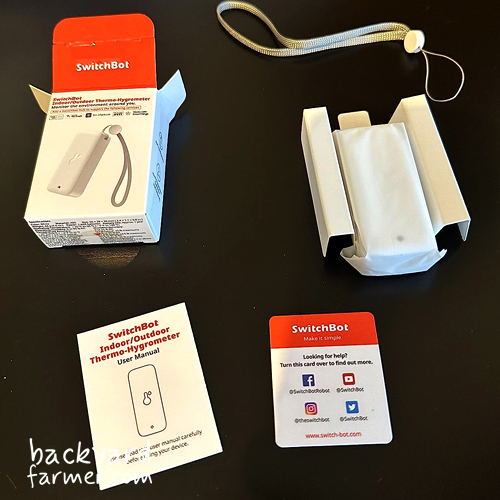
The sensor stores up to 68 days of readings locally, allowing you to review temperature changes rather than simply checking current conditions.
Bluetooth works without a hub, although your phone must be within connection range to retrieve readings. For remote access and frost notifications while away from home, you’ll need a compatible SwitchBot hub with an internet connection.
There is no built-in display, and the hub increases the overall cost.
| Specification | Detail |
|---|---|
| Temperature range | −20 to 60°C with supplied batteries |
| Recommended regular operating range | −10 to 60°C |
| Humidity measurement | Yes |
| Weather resistance | IP65 |
| Connectivity | Bluetooth |
| Local storage | Up to 68 days |
| Remote alerts | Compatible hub required |
| Built-in display | No |
Best For
- Gardeners wanting temperature history.
- Greenhouse humidity monitoring.
- Comparing conditions across growing areas.
- Optional remote frost alerts.
Pros
- IP65 weather resistance.
- Temperature and humidity history.
- Bluetooth works without a hub.
- Remote monitoring upgrade available.
Cons
- No built-in display.
- Hub costs extra.
- Remote alerts depend on connectivity.
- App required to view readings.
Our Verdict: Worth considering if you want recorded temperature trends or notifications while away. For gardeners who visit their greenhouse regularly, a basic max/min thermometer remains better value.
How to Choose the Right Greenhouse Thermometer
For most UK gardeners, a thermometer that records temperature extremes is more useful than one packed with additional features.
The best choice depends on your greenhouse conditions, how often you visit and whether you need readings beyond temperature alone.
Quick Buying Guide
| Growing Situation | Best Type | Why |
|---|---|---|
| General greenhouse growing | Digital max/min | Records temperature extremes |
| Sheltered budget setup | Basic digital max/min | Affordable monitoring |
| Battery-free preference | Analogue thermometer | Mechanical readings |
| Separate measuring position | External-probe thermometer | Measures away from the display |
| Remote monitoring | Smart sensor with hub | Phone access and alerts |
| Damp, unheated greenhouse | IP-rated thermometer | Better moisture protection |
Digital Max/Min Thermometers
The most practical everyday option. They record the highest and lowest temperatures between resets, helping you understand conditions when you’re not in the greenhouse.
Analogue & Humidity Thermometers
Analogue instruments avoid batteries, while thermo-hygrometers provide additional humidity readings. Both can be useful, although mechanical pointers may be harder to read and some digital displays require shelter.
Wireless & Smart Monitors
Smart sensors can record temperature history and, with compatible equipment, provide remote alerts.
Bluetooth allows local communication, but checking conditions from anywhere generally requires a connected gateway and internet access.
Practical Checks Before Buying
Weather resistance: Greenhouses can be damp, particularly in winter. Look for a documented IP rating rather than assuming a thermometer is waterproof. IP65 offers protection against dust and water jets, but not immersion.
Accuracy: Many inexpensive digital models advertise accuracy around ±1°C, although this varies by model and temperature range. Small differences between instruments are normal. Near freezing, don’t treat a single reading as an exact frost threshold.
Maximum/minimum memory: Check whether recorded extremes reset manually or automatically. A manual reset lets you choose the monitoring period.
Connectivity: If you want alerts while away, confirm the complete setup supports remote notifications. This matters particularly for allotments without Wi-Fi.
Where Should You Put a Greenhouse Thermometer?
Position your thermometer around plant height, preferably somewhere representative of the greenhouse’s growing conditions.
Avoid direct sunlight, heaters and vents, which can distort readings. Non-weatherproof instruments also need protection from condensation and water.
Check the recorded minimum after cold nights and the maximum during warmer weather. Reset the memory as needed so you know which period the readings cover.
A thermometer shows what happened in your greenhouse, while our UK Frost Risk Map can help you prepare for forecast overnight frost. Actual temperatures will depend on local conditions.
Frequently Asked Questions About Greenhouse Thermometers
A digital maximum/minimum thermometer is the most practical choice for most UK gardeners. It records overnight lows and daytime highs, helping you identify frost and overheating risks between visits.
Not necessarily, but moisture resistance is useful in damp greenhouses. IP-rated models offer documented protection against dust and water exposure within their rating. Ordinary indoor thermometers should be sheltered.
Many inexpensive models advertise accuracy around ±1°C, depending on their measuring range. Proper positioning is important, as direct sunlight or nearby heat sources can produce misleading readings.
It can be useful for propagation and managing ventilation, particularly where condensation is a problem. However, temperature monitoring is generally the first priority for preventing frost damage.
Yes, with a compatible smart monitoring system. Bluetooth devices generally require a nearby phone, while internet-connected hubs can provide remote readings and notifications when the sensor and gateway remain connected.
A basic max/min thermometer records how cold the greenhouse became but doesn’t alert you automatically. Some smart systems can send notifications when temperatures approach a chosen threshold, provided the necessary connectivity is working.