
Introduction
The Ashy Mining Bee (Andrena cineraria) is one of the easiest solitary bees to recognise in the UK, especially when you spot a female in spring.
She is a smart little black and grey bee with bold pale bands across the thorax. Once you know that pattern, she stands out well from most other spring bees.
You’ll often see Ashy Mining Bees in gardens, lawns, footpaths, parks, allotments and sunny bare patches of soil from March to June. In most gardens, it is the lawn nests that make people stop and wonder what is going on.
At first, a group of Ashy Mining Bees can look a bit worrying. You may notice several bees flying low over the grass, with tiny holes and small soil mounds appearing in the ground. However, this is not a swarm, and it is not a wasp nest.
Ashy Mining Bees are solitary ground-nesting bees. Each female digs and uses her own small burrow, even when lots of females nest close together in the same sunny patch.
In this guide, you’ll learn how to identify the Ashy Mining Bee, how to tell males and females apart, where they nest, what flowers they visit, and what to do if they appear in your garden.
How to Identify the Ashy Mining Bee
Ashy Mining Bee identification mostly comes down to colour, pattern, season and behaviour.
The female is the one most people notice. She has a glossy black abdomen and two ash-grey or whitish bands of hair across the thorax. In good light, this gives her a crisp black-and-grey look that stands out well from most other spring bees.
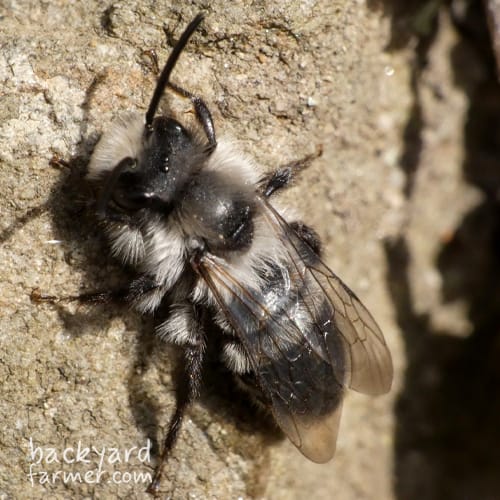
You are also more likely to spot her around the nest site. Look for bees flying low over sunny soil, short grass, path edges or little holes in the lawn.
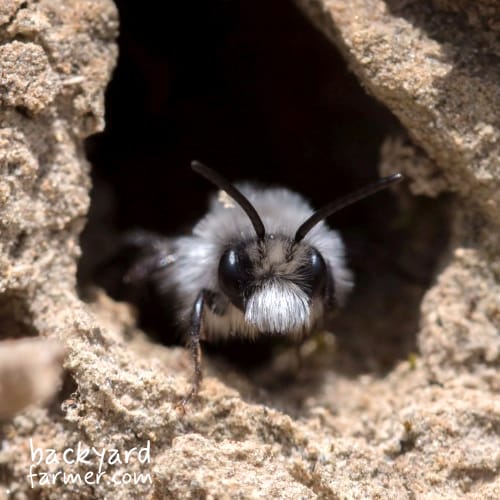
The male is smaller, slimmer and harder to pin down. He often looks greyer and hairier, with longer antennae and a pale facial tuft. Because of that, males are much easier to confuse with other spring mining bees, especially from quick phone photos.
So, if you are new to bee identification, start with the females. They are the clearer field sign and the best route into recognising this species.
Quick ID checklist
| Feature | What to look for |
|---|---|
| Colour | Black bee with ash-grey or whitish markings |
| Best ID feature | Female has two pale bands across the thorax |
| Abdomen | Glossy black, sometimes with a blue-black sheen |
| Size | Around honeybee-sized, up to roughly 15mm |
| Season | Mostly March to June, especially April and May |
| Habitat | Lawns, paths, banks, bare soil, gardens and parks |
| Nesting sign | Small holes with tiny piles of loose soil |
| Behaviour | Flies low over sunny ground and nest entrances |
| Beginner tip | Females are much easier to identify than males |
The easiest field clue is simple:
A black spring bee with two clear pale bands across the thorax is likely to be a female Ashy Mining Bee.
Female Ashy Mining Bee
Female Ashy Mining Bees are usually the easiest ones to identify, especially from garden photos.
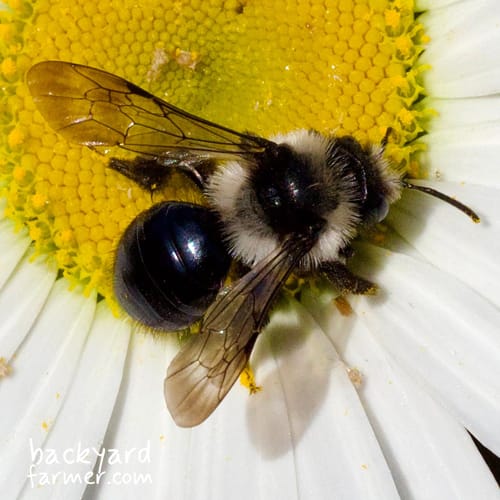
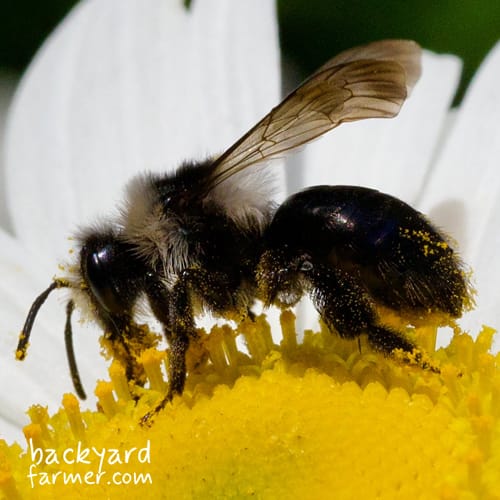
The female has a dark, glossy abdomen and a black thorax broken by two pale grey or whitish bands of hair. One band sits near the front of the thorax, while the other sits nearer the rear. Between them, you should see a clear dark gap.
That dark gap is useful. It gives the female Ashy Mining Bee her classic sharp, black-and-grey look, rather than a general fuzzy grey appearance.
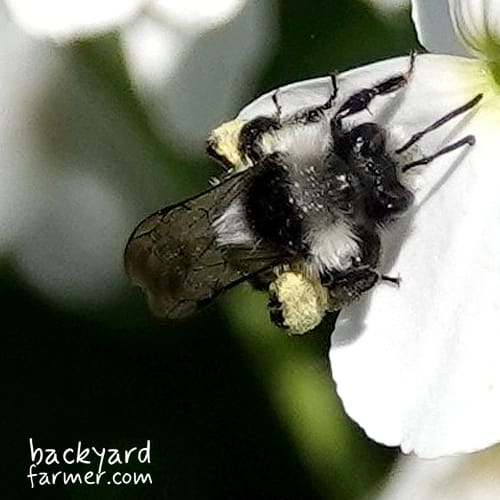
She also has pale hairs on the face and dark pollen-collecting hairs on the legs. These leg hairs are not always obvious in quick photos, but you may notice them when she is resting, feeding or carrying pollen.
Fresh females look especially crisp, with strong contrast between the black body and pale thorax bands. However, older bees can look a bit scruffier as their hairs wear away. Even then, the glossy black abdomen and pale thorax bands usually remain the best clues.
Female features
| Feature | Female Ashy Mining Bee |
|---|---|
| Size | Around 10–15mm |
| Body shape | Compact mining-bee shape |
| Thorax | Black with two bold ash-grey or whitish bands |
| Abdomen | Glossy black or blue-black |
| Face | Pale grey or whitish facial hair |
| Legs | Dark pollen brushes on hind legs |
| Behaviour | Digs and provisions underground nest burrows |
Male Ashy Mining Bee
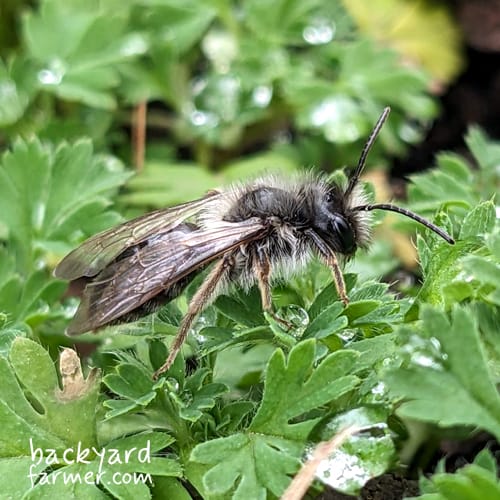
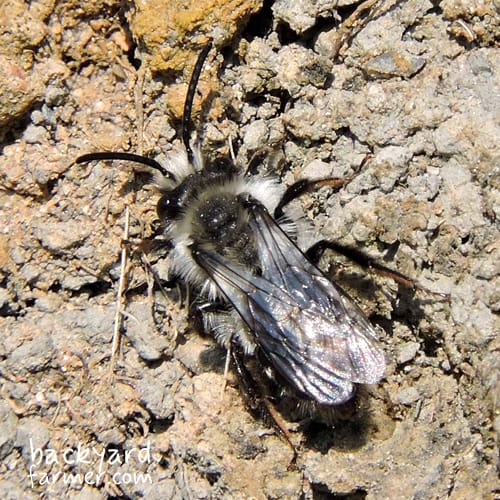
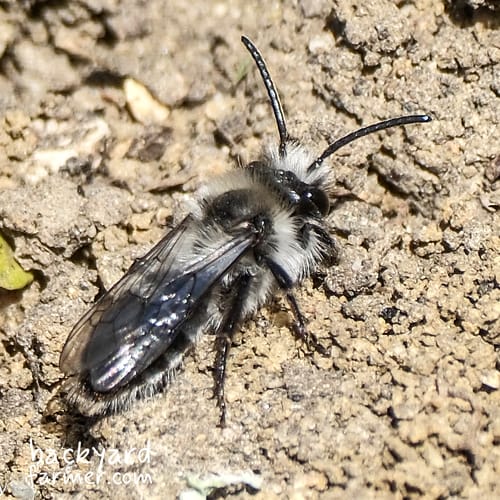
Male Ashy Mining Bees are smaller and slimmer than females. They usually appear slightly earlier in spring, then patrol nesting areas while looking for newly emerged females.
They do not show the same bold, clean banding as the females. Instead, males often look greyer, hairier and less sharply marked, with longer antennae and a pale tuft of hair on the face.
That makes them trickier in real life. A male seen quickly in flight, or caught in a slightly blurry phone photo, may just look like a small grey spring bee.
So it is worth being honest here: female Ashy Mining Bees are a good beginner species, but males need more care. Unless the photo is clear, it is better to record them as a likely mining bee rather than forcing a confident ID.
Male features
| Feature | Male Ashy Mining Bee |
|---|---|
| Size | Smaller than the female |
| Body shape | Slimmer and lighter-looking |
| Thorax | More generally grey-haired and less sharply banded |
| Face | Pale facial tuft |
| Antennae | Longer than the female |
| Behaviour | Patrols nest areas and searches for females |
| Beginner note | Easy to confuse with other spring mining bees |
Male vs Female Ashy Mining Bee
Female Ashy Mining Bees are much easier to identify than males. If you are trying to confirm this species from a garden photo, the female’s bold black-and-grey pattern is usually your best clue.
| Feature | Female | Male |
|---|---|---|
| Ease of ID | Easier to identify | Harder to identify |
| Size | Larger | Smaller and slimmer |
| Main colour | Bold black and ash-grey | Greyer and hairier overall |
| Thorax | Two clear pale bands with a dark gap between them | Less cleanly banded |
| Abdomen | Glossy black | Dark, often with more pale hair |
| Face | Pale facial hair | Stronger pale facial tuft |
| Antennae | Shorter | Longer |
| Behaviour | Digs and stocks the nest burrow | Patrols nesting areas looking for females |
| Best beginner clue | Bold black-and-white female | Often not safe to ID from poor photos |
As a simple rule, female Ashy Mining Bees are good beginner bees to recognise. Males need a clearer view and a bit more caution.
Identification & Key Facts
Here are the main Ashy Mining Bee facts at a glance. This is the quick-reference section if you are trying to match a bee in your garden with the right species.
| Attribute | Details |
|---|---|
| Common name | Ashy Mining Bee / Grey Mining Bee |
| Latin name | Andrena cineraria |
| Bee family | Andrenidae |
| Bee type | Solitary ground-nesting mining bee |
| UK status | Native and widespread |
| Active months | Usually March to June |
| Peak activity | April and May |
| Size | Up to around 15mm |
| Main habitat | Gardens, lawns, parks, paths, banks, bare soil and open sunny ground |
| Nest type | Individual underground burrows |
| Social behaviour | Solitary, but often nests close together in aggregations |
| Food plants | Spring blossom, willow, dandelion, buttercup, gorse, fruit trees and other spring flowers |
| Main ID feature | Female has two ash-grey or whitish bands across a black thorax |
| Garden risk | Very low; non-aggressive and useful for pollination |
The most useful thing to remember is this: Ashy Mining Bees may nest in groups, but they are still solitary bees. There is no queen, no hive, and no big colony to defend.
When to See Ashy Mining Bees in the UK
Ashy Mining Bees are very much spring bees.
In most UK gardens, you are most likely to see them between March and June, with the busiest period usually falling in April and May. That is when they often appear around lawns, path edges and sunny bare soil.
In southern England, males can appear from March, especially after a mild spell. Females usually follow as the weather warms and nesting conditions improve.
Further north, and in cooler parts of the UK, activity often starts later and may run into early summer. So, if you are in northern England, Scotland, Wales or a colder inland spot, do not be surprised if your main sightings are later than someone’s in the south.
Most Ashy Mining Bees have one main generation per year. However, late records do happen, and some sources suggest there may occasionally be a second brood. For most gardeners, though, this is mainly a spring species.
For normal garden identification, use this simple rule:
A black-and-grey mining bee seen around lawns, paths or sunny bare soil in April or May is a strong Ashy Mining Bee candidate.
Where Ashy Mining Bees Live
Ashy Mining Bees like open, sunny places with bare or lightly vegetated soil.
That is why they often turn up in ordinary gardens, not just wildflower meadows or nature reserves. A quiet patch of lawn edge, a warm bank, or a bit of bare soil beside a path can be enough.
You may find them in:
- lawns
- garden borders
- allotments
- footpaths
- sunny banks
- parks
- school grounds
- old quarries
- open woodland edges
- grassland
- coastal habitats
- disturbed ground
- areas of short turf
Gardens can be excellent Ashy Mining Bee habitat, especially when there are spring flowers nearby and a few sunny nesting patches left alone.
Bare soil is often treated as something to cover, mulch, pave or tidy up. However, for many solitary bees, bare sunny ground is valuable nesting habitat.
That is a useful thing to remember in wildlife gardening. It is not always about making every inch lush and full. Sometimes a small, scruffy-looking patch of open soil is doing more good than it gets credit for.
Ashy Mining Bee Nesting Behaviour
Ashy Mining Bees are ground-nesting solitary bees.
A female digs a narrow tunnel into the soil, then creates small brood cells below ground. She stocks each cell with pollen and nectar, lays an egg, and seals it. The larva then feeds on that stored food and develops safely underground.
The nest entrance often looks like a tiny hole with a small mound of loose soil around it. In a lawn, these can look like little soil volcanoes. They are usually small, but once you notice them, you start seeing them everywhere.
Several females may choose the same sunny patch, so you can end up with lots of nest holes close together. This is called a nesting aggregation.
That can sound like a colony, but it is not. Each female is working for herself. There is no queen, no worker force and no shared hive to defend.
Why do lots appear in one place?
Ashy Mining Bees gather where the conditions are right.
They like suitable soil, warmth, sun and nearby flowers. So, if one patch of lawn, path edge or bank offers all of that, many females may nest there at once.
This can look dramatic for a few weeks in spring. However, it usually settles down naturally once the main nesting period passes.
Do they reuse the same nest sites?
Ashy Mining Bees can return to suitable nesting areas year after year, especially if the soil stays open, sunny and fairly undisturbed.
That does not mean the same individual bee is living there for years. It means the site keeps offering the right conditions for new bees emerging from the ground.
Do they close the nest entrance?
Yes, nest entrances may be closed or less visible at times. Females can seal or cover entrances during poor weather, after disturbance, or when they are not actively coming and going.
So, if you see holes one day and fewer the next, it does not always mean the bees have gone. The entrance may simply be covered over for a while.
Are Ashy Mining Bees Dangerous?
Ashy Mining Bees are not dangerous in normal garden situations.
They are solitary bees, not social wasps or honeybees. They do not have a large colony, honey store or queen to defend, so they have no reason to come after you in the garden.
Females can sting, but they are not aggressive and are very unlikely to sting unless they are trapped, squeezed or handled roughly. Males cannot sting at all.
If Ashy Mining Bees are nesting in your lawn, path edge or flower bed, the best response is usually simple: leave them alone and let the nesting season pass.
Avoid:
- pouring water into the holes
- using insecticide
- digging up the nest area
- covering the area with plastic
- compacting the soil heavily
In most gardens, the busy nesting activity only lasts for a short spell in spring. It can look intense while it is happening, but it usually settles down on its own.
Will Ashy Mining Bees damage my lawn?
Ashy Mining Bees may leave small soil mounds, but they do not usually cause serious lawn damage.
The soil piles are tiny compared with molehills, ant nests or heavy wear from feet and pets. Once nesting activity ends, normal grass growth and weather usually soften the area again.
If the nest site is somewhere you need to use, try to work around it for a few weeks rather than destroying it. In most cases, a bit of patience is all that is needed.
What Flowers Do Ashy Mining Bees Visit?
Ashy Mining Bees are generalist spring foragers. That means they visit a range of flowers rather than relying on one single plant.
This is good news for gardeners. If your garden has spring blossom, lawn flowers, shrubs or early wildflowers, there is a fair chance Ashy Mining Bees will find something useful.
They may visit:
- apple blossom
- pear blossom
- cherry blossom
- plum blossom
- blackthorn
- hawthorn
- willow
- dandelion
- buttercup
- gorse
- bramble
- spring wildflowers
- brassicas and related crops
- early garden flowers
Their timing lines up especially well with fruit blossom. So, if you grow apples, pears, cherries or plums, Ashy Mining Bees may be part of the early pollinator mix helping those flowers set fruit.
This is one reason not to panic when you see mining bees in spring. They are not a garden problem. They are part of the quiet background work that makes productive, wildlife-friendly gardens tick.
Similar Species
Female Ashy Mining Bees are quite distinctive, but a few spring bees and bee-like insects can still cause confusion.
This is especially true when you only get a quick look, a blurry phone photo, or a bee moving fast between flowers. Use the table below as a practical field comparison.
| Species | Why it may confuse people | Key difference | Simple field clue |
|---|---|---|---|
| Grey-backed Mining Bee (Andrena vaga) | Also black and grey | Greyer across the thorax, without the same clear dark gap between pale bands | Ashy Mining Bee has a sharper black-and-white banded look |
| Hairy-footed Flower Bee (Anthophora plumipes) | Dark spring female, often seen in gardens | Fuzzier, faster and more bumblebee-like; females often have orange hind-leg hairs | Flower bees dart around flowers and walls; Ashy Mining Bees often fly low near soil |
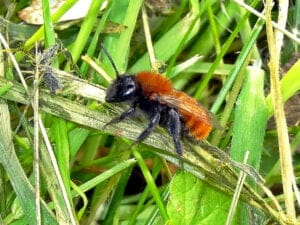
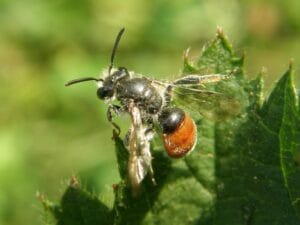
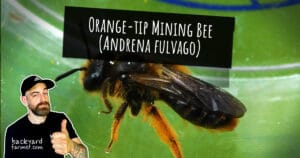
| Tawny Mining Bee (Andrena fulva) | Similar spring lawn-nesting habit | Female is bright ginger-orange, not black and grey | Ginger mining bee usually means Tawny Mining Bee |
| Honeybee (Apis mellifera) | Similar size at a glance | Warmer brown or golden banding, not glossy black with pale thorax bands | Honeybees look browner and less sharply monochrome |
| Large Bee-fly (Bombylius major) | Furry spring insect often seen near mining bee nests | It is a fly, with a long straight proboscis and hovering flight | Looks like a tiny furry dart hovering in front of flowers |
| Small dark bumblebees | Dark, hairy and active in spring | Bulkier body and no individual soil volcano nest entrances | Check body shape, flight style and nesting behaviour |
Ashy Mining Bee vs Grey-backed Mining Bee
The Grey-backed Mining Bee (Andrena vaga) is one of the closer lookalikes, although most garden sightings are still more likely to be Ashy Mining Bee.
Both species can look black and grey, so the thorax pattern is the useful thing to check.
A female Ashy Mining Bee usually has two pale bands with a clear dark band between them. This gives her that sharp black-and-white look. Grey-backed Mining Bee tends to look greyer across the thorax overall, without the same strong dark gap.
For casual garden ID, this is probably not the first confusion to worry about. However, if you are recording bees more seriously, or you live in an area where Grey-backed Mining Bee is known, it is worth checking this one carefully.
Ashy Mining Bee vs Hairy-footed Flower Bee
Female Hairy-footed Flower Bees can look dark and also appear in spring, so this is a common beginner mix-up.
Behaviour is often the giveaway.
Hairy-footed Flower Bees are fast, loud and darting. They often zip between flowers, walls and early garden plants such as lungwort. Females are dark and furry, and they often show orange or rusty hairs on the hind legs.
Ashy Mining Bees behave differently. You are more likely to see them flying low over sunny ground, entering small soil holes, or resting near bare patches in lawns and paths.
So, if the insect is hovering and darting around flowers like a tiny black bumblebee, think Hairy-footed Flower Bee. If it is black and grey and linked to small holes in soil, think Ashy Mining Bee.
Ashy Mining Bee vs Tawny Mining Bee
This is one of the easier spring bee comparisons.
Both species are mining bees. Both can nest in lawns and gardens, and both may seem to appear suddenly when the weather warms up. So, the behaviour can feel similar at first.
However, the females look very different.
Female Tawny Mining Bees are rich orange, ginger or fox-red. Female Ashy Mining Bees are black with pale grey or whitish bands across the thorax.
A simple rule works well here:
Ginger mining bee = Tawny Mining Bee. Black-and-white mining bee = possible Ashy Mining Bee.
Why the Ashy Mining Bee Matters
The Ashy Mining Bee is an important early-season pollinator.
It flies when many fruit trees, shrubs and spring wildflowers are in bloom. That makes it useful in gardens, orchards, allotments and wider countryside habitats, especially during the busy spring blossom window.
If you grow apples, pears, plums or cherries, this is exactly the sort of bee you want moving around the garden early in the year. It may not get the same attention as honeybees or bumblebees, but it still plays a useful role.
Ashy Mining Bees also support other wildlife.
Some cuckoo bees and bee-flies use mining bee nests as part of their life cycles. You may see bee-flies hovering near nest entrances or nomad bees investigating the nesting area.
At first, that can look like trouble. However, it is natural. Parasites and predators are part of a healthy ecosystem, even if the word “parasite” makes it sound like something has gone wrong.
A garden with Ashy Mining Bees, bee-flies, spring flowers and bare nesting ground is not messy. It is functioning.
How to Help Ashy Mining Bees in Your Garden
You do not need a perfect wildlife garden to help Ashy Mining Bees.
In fact, the best things are often simple: a bit of sunny bare soil, plenty of spring flowers, and less tidying where the bees are nesting. That is very doable in a normal garden or allotment.
1. Leave some sunny bare soil
Many solitary bees need bare ground for nesting, including Ashy Mining Bees.
Leave small sunny patches along path edges, near beds, beside walls or in quiet corners. Try not to cover every inch with membrane, gravel, paving or dense mulch.
A small open patch may look unfinished to us, but to a mining bee it can be prime nesting space.
2. Avoid pesticides
Avoid insecticides where possible, especially in spring when bees are active.
Even products aimed at other insects can affect pollinators if they are used carelessly. If your garden has nesting solitary bees, it is better to step back and avoid spraying around that area.
3. Grow spring flowers
Spring flowers give Ashy Mining Bees food when they first emerge and start nesting.
Useful plants include:
- lungwort
- primrose
- hellebore
- grape hyacinth
- flowering currant
- willow
- blackthorn
- hawthorn
- fruit trees
- comfrey later in spring
You can also let a few dandelions flower before cutting the lawn. They may not win any lawn-pride competitions, but bees make good use of them.
4. Keep fruit blossom bee-friendly
If you grow apple, pear, plum or cherry trees, avoid spraying them while they are in flower.
Spring blossom is valuable food for Ashy Mining Bees and many other pollinators. It is also the point where pollinators are doing real work for your harvest, so it makes sense to keep that window as bee-friendly as possible.
5. Do not panic about lawn nests
If you find small soil mounds in your lawn in spring, watch before acting.
If black-and-grey bees are coming and going, they may be Ashy Mining Bees. Leave the patch alone if you can. The busy period is temporary, and the bees are usually gone before long.
6. Mow with care
If Ashy Mining Bees are nesting in the lawn, avoid mowing the exact patch while activity is high.
If you must mow nearby, choose a cooler part of the day when bees are less active, raise the mower height, and avoid scalping or crushing the nest area. A little care for a few weeks is usually enough.
FAQ
No. Ashy Mining Bees are solitary, non-aggressive bees. They do not defend a large colony like wasps or honeybees, so they are not something you usually need to worry about in the garden.
Females can sting, but they are very unlikely to do so unless they are handled, trapped or squeezed. Males cannot sting.
Your lawn probably has a warm, sunny patch of suitable nesting soil. Many females may nest close together, but each bee has her own burrow. It is busy, but it is not a shared hive.
No. It may look like a swarm at first, especially when several bees are flying low over the grass. However, it is usually a nesting aggregation of solitary bees.
Ashy Mining Bees may create small soil mounds, but they rarely cause serious lawn damage. The activity is temporary and usually linked to spring nesting.
Usually, no. The best approach is to leave them alone, avoid insecticides, and let the nesting period pass naturally. In most gardens, they will settle down on their own.
Adults feed on nectar, while females collect pollen and nectar for their larvae. They visit many spring flowers, including fruit blossom, willow, dandelion and buttercup.
They are mostly active from March to June, with peak activity in April and May. In cooler northern areas, activity may run a little later.
Female Ashy Mining Bees are black with pale grey or whitish bands. Female Tawny Mining Bees are bright orange, ginger or fox-red.
Large Bee-flies can parasitise mining bee nests. That may sound alarming, but it is a natural part of the ecosystem and does not mean the nest site is failing.
Final Thoughts
The Ashy Mining Bee is one of the best solitary bees for beginners to learn.
It is distinctive, useful, gentle and often found in ordinary gardens. Once you recognise the black body and pale ash-grey thorax bands, you may start noticing it every spring.
If Ashy Mining Bees appear in your lawn, path or border, try not to see them as a problem. In most cases, they are a good sign. Your garden still has something many pollinators need: sunny soil, spring flowers and a little bit of wildness.
That is worth protecting.