
Introduction
The Tawny Mining Bee (Andrena fulva) is one of the easiest solitary bees to spot in the UK, especially in spring. Fresh females have a bright fox-orange coat across the top of the body, with a much darker head, underside and legs.
You will often notice them before you know what they are. They fly low over lawns, borders, allotment beds and sunny bare soil, and the females can leave tiny volcano-like soil mounds where they dig their nests.
Those little mounds can look a bit suspicious at first. Most gardeners would pause if a patch of lawn suddenly had bee holes in it. However, Tawny Mining Bees are harmless solitary bees, not wasps or a lawn pest. They do not form a hive, and each female works her own burrow, even when several nests are close together.
For a garden, that is usually good news. Tawny Mining Bees are useful early-season pollinators, visiting spring flowers, fruit blossom and wild plants while the rest of the garden is just waking up.
In this guide, we’ll cover how to identify female and male Tawny Mining Bees, why they make soil mounds in lawns, whether they sting, what flowers they visit, and how to help them without overcomplicating things.
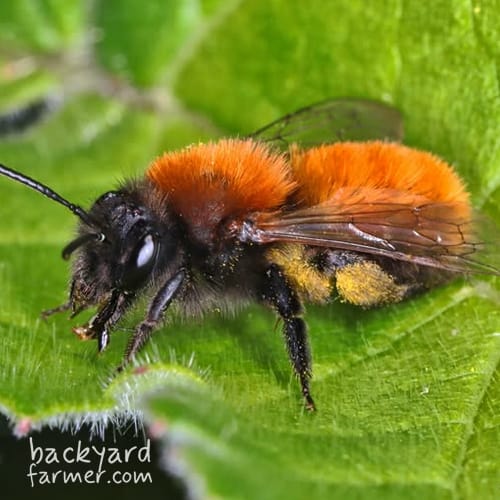
Female Tawny Mining Bee — the bright fox-orange fur makes this one of the easiest UK solitary bees to recognise.
Quick Answer Box
Quick answer: The Tawny Mining Bee is a harmless solitary bee seen in UK gardens in spring. Fresh females are bright fox-orange on top, with a darker underside and legs.
If you find small bee holes or tiny volcano-like soil mounds in a sunny lawn, they may be Tawny Mining Bee nests. It is not a hive or an infestation. Each female has her own burrow, and in most cases, the best thing to do is simply leave the patch alone.
How to Identify the Tawny Mining Bee
Tawny Mining Bee identification is easiest in spring, especially when you see a fresh female. Look for a small, furry bee with a bright fox-orange upper body and a darker head, underside and legs.
The setting helps as much as the colour. Tawny Mining Bees are ground-nesting solitary bees, so they are often seen flying low over lawns, short grass, sunny borders, bare soil, banks and allotment beds. If you can also see tiny volcano-like soil mounds nearby, that is a strong clue.
Compared with a honey bee, a female Tawny Mining Bee usually looks rounder, fluffier and brighter. Bumblebees are normally bulkier and more clearly banded, while wasps look much smoother and less hairy.
Quick ID checklist:
| Feature | What to look for |
|---|---|
| Colour | Bright fox-orange or tawny fur across the upper body |
| Underside | Darker/black head, underside and legs |
| Size | Small to medium bee, roughly honey-bee sized |
| Shape | Furry, rounded and compact |
| Behaviour | Flying low over lawns, borders, banks or bare soil |
| Nest clue | Tiny soil mounds or bee holes in sunny, well-drained ground |
| Season | Mainly spring, usually March/April to May |
Male Tawny Mining Bees are trickier. They are slimmer, browner and less vivid than females, so they can easily be confused with other spring mining bees.
Quick ID note: A bright fox-orange female near tiny soil mounds in spring is a strong Tawny Mining Bee clue. A slimmer brown male is much less certain unless you have a clear photo.
Female Tawny Mining Bee
The female Tawny Mining Bee is the one most gardeners notice first. She is the bright fox-orange bee that gives this species its name, and she is much easier to identify than the male.
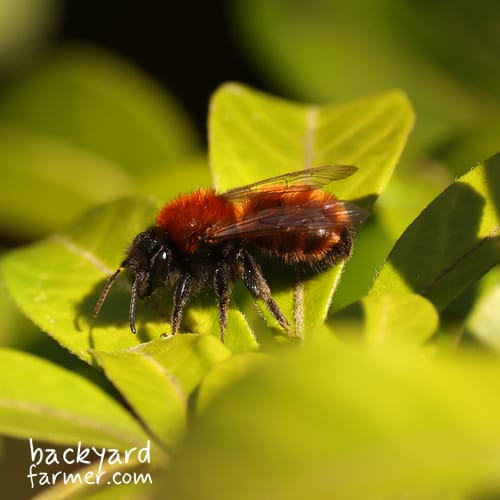
Fresh females have dense tawny-orange fur across the thorax and abdomen. From above, they can look almost fully orange, but the head, underside and legs are much darker. That contrast is one of the best identification clues.
Females are usually around 10–12mm long, so they are roughly honey-bee sized. However, they often look rounder, fluffier and brighter, especially when moving low over grass or bare soil.
Around nest sites, you may see a female land beside a small soil mound and disappear into a narrow hole. This behaviour is a really useful clue because Tawny Mining Bees are ground-nesting solitary bees.
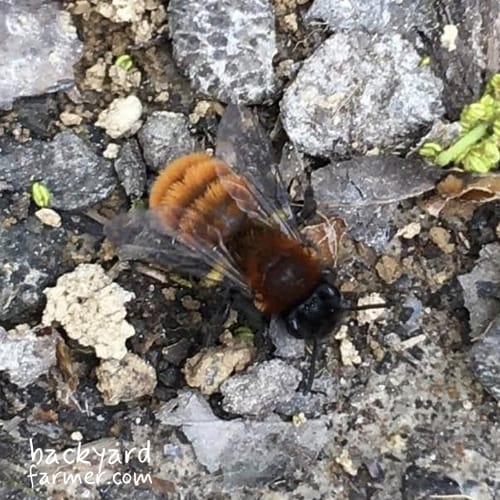
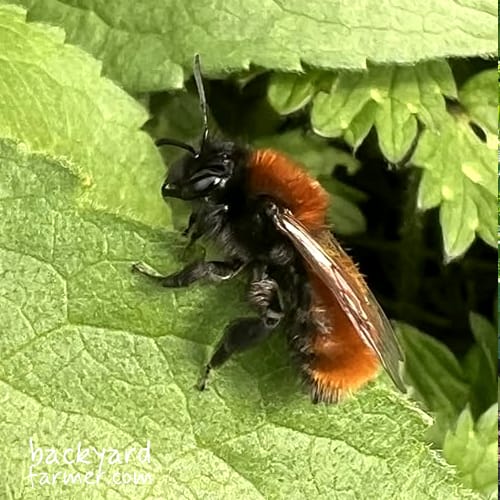
Each female digs her own burrow and stocks separate brood cells with pollen and nectar. So, even if several females nest close together, they are not sharing a hive.
Female Tawny Mining Bee ID features:
| Feature | What to look for |
|---|---|
| Upper body | Thick fox-orange or tawny fur across the thorax and abdomen |
| Head and underside | Darker/black, creating strong contrast |
| Size | Around 10–12mm, roughly honey-bee sized |
| Shape | Compact, rounded and furry-looking |
| Behaviour | Flying low, landing near soil mounds, or entering ground burrows |
| Pollen carrying | Females may carry pollen on the hind legs |
A fresh female is usually the safest Tawny Mining Bee ID. Older females can look duller, so use the nesting clues as well as the colour.
Female Tawny Mining Bee — the fox-orange upper body and darker underside are the key features to look for.
Male Tawny Mining Bee
The male Tawny Mining Bee is smaller, slimmer and less colourful than the female. Instead of that bold fox-orange coat, he usually looks browner, paler and a bit more delicate.
Males often appear before females in early spring. You may see them patrolling low over sunny lawns, banks and borders, looking for newly emerged females. They can move quickly, so they are not always easy to photograph or identify from a quick glance.
In close photos, males may show long pale facial hairs. Some people describe this as a small moustache-like tuft, although it is not always obvious in the field.
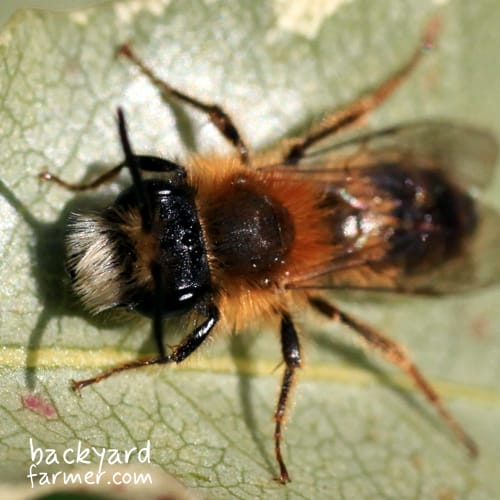
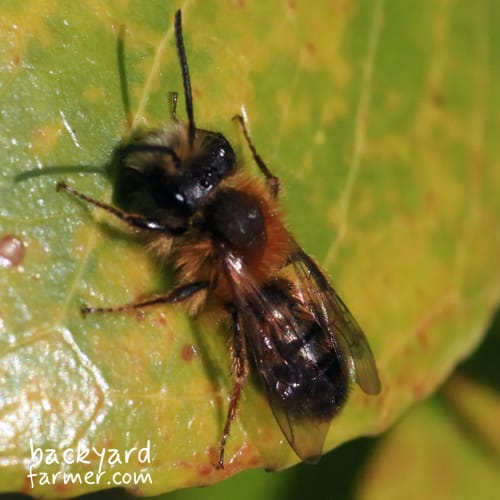
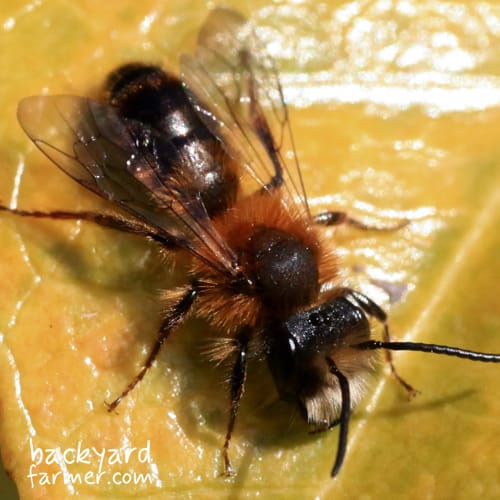
For most gardeners, male Tawny Mining Bee identification needs a bit of caution. Many male Andrena mining bees are small, brownish and active in spring, so colour alone is not enough.
Male Tawny Mining Bee ID features:
| Feature | What to look for |
|---|---|
| Size | Usually smaller and slimmer than the female |
| Colour | Browner, paler and less vividly orange |
| Shape | More delicate and less rounded than the female |
| Face | May show long pale or whitish facial hairs in close photos |
| Behaviour | Often patrols low around nesting areas looking for females |
| Season | Often appears before females in early spring |
| ID difficulty | Much harder to confirm than a bright female Tawny Mining Bee |
ID tip: For a confident garden-level ID, look for the female or the nest clues. A bright fox-orange female near tiny soil mounds is much more reliable than a fast-moving brown male.
Male Tawny Mining Bees are slimmer, less brightly coloured, and harder to identify than females.
Identification & Key Facts
If you are trying to identify a small orange bee in your lawn or garden, do not rely on colour alone. The strongest clues are the bright female, the spring timing, and the tiny soil mounds made by nesting females.
| Attribute | Details |
|---|---|
| Common name | Tawny Mining Bee |
| Latin name | Andrena fulva |
| Bee type | Solitary mining bee / ground-nesting bee |
| Size | Females around 10–12mm; males smaller and slimmer |
| UK status | Common across much of lowland England and Wales; less common in Scotland |
| Active months | Usually March/April to May, sometimes into early June |
| Flight period | One main spring flight period each year; males often appear first |
| Habitat | Lawns, borders, allotments, orchards, parks, woodland edges, short grass and sunny bare soil |
| Nesting behaviour | Females dig individual burrows, often leaving small volcano-like soil mounds |
| Nesting style | Solitary, but several females may nest close together |
| Key ID features | Bright fox-orange female, darker underside, spring activity, ground nesting and tiny soil mounds |
| Sting risk | Very low; solitary and non-aggressive |
| Lawn damage | Usually none beyond temporary soil mounds |
| Useful flowers | Fruit blossom, dandelion, willow, hawthorn, dead-nettle, buttercup, comfrey and lungwort |
| Bee hotels? | Not usually; Tawny Mining Bees need ground-nesting habitat |
A Tawny Mining Bee is not a honey bee, bumblebee or wasp. It is a solitary ground-nesting bee, so each female works alone even when several nests appear in the same patch of lawn or soil.
For a quick garden-level ID, look for:
- Spring activity, especially March/April to May.
- Bright fox-orange females with a darker underside.
- Low flight over lawns, borders or bare soil.
- Tiny volcano-like soil mounds marking nest entrances.
- Calm, non-aggressive behaviour around the nesting area.
If you see those signs together, Tawny Mining Bee is a strong possibility. If the bee is brown, fast-moving or not clearly linked with a nest mound, it is worth being more cautious with the ID.
Why Are There Tiny Soil Mounds in My Lawn?
If you find tiny soil mounds in your lawn during spring, they may be Tawny Mining Bee nests. The females make these little mounds as they dig underground burrows for their young.
They often look like miniature volcanoes, with a small hole in the middle and loose soil around the entrance. You might see them in short grass, sunny lawn edges, bare soil, borders, banks or allotment beds.
At first glance, they are easy to mistake for ants, wasps or some kind of lawn problem. However, Tawny Mining Bee mounds are usually harmless. In fact, they are a decent sign that your garden has a warm, well-drained patch of soil that solitary bees can use.
Each mound normally belongs to one female. So, even if several mounds appear close together, it is not a hive or an infestation. Tawny Mining Bees are solitary, and each female digs and provisions her own nest.
The mounds can look a bit untidy on a neat lawn, but they are temporary. The loose soil usually settles back in, washes in with rain, or disappears once the short nesting period has passed.
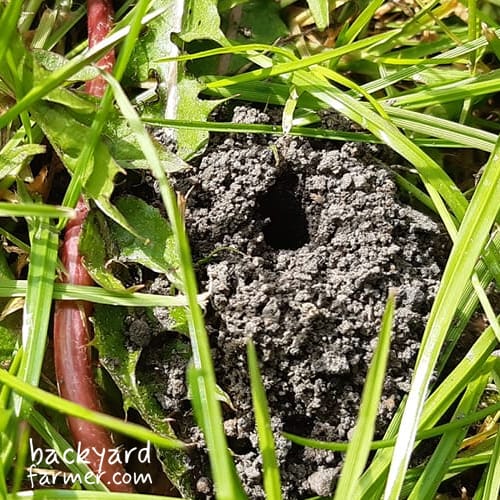
Tiny mounds in your lawn?
These are often nest entrances made by female Tawny Mining Bees. Several mounds together still does not mean there is a hive underground.
Do I need to do anything?
Usually, no. Leave the patch alone if you can, avoid digging or compacting it, and let the bees finish their spring nesting season.
If the nests are in an awkward spot, mark the patch with a cane, plant label or temporary border for a few weeks. There is no need to flood the holes, spray the area or block the entrances.
Tawny Mining Bee nests often look like tiny volcano-like soil mounds in short grass or bare soil.
Are Tawny Mining Bees Dangerous?
Tawny Mining Bees are not dangerous in a normal garden setting. They are solitary bees, so there is no large hive or colony for them to defend.
Most of the activity you see around a lawn or border is just nesting or mating behaviour. Males may zip low over the ground looking for females, while females return to their own burrows with pollen.
They are not aggressive like social wasps. If you leave them alone, they usually ignore people and get on with their short spring nesting season.
Do Tawny Mining Bees sting?
Female Tawny Mining Bees can technically sting, but they are very unlikely to do so unless trapped, squeezed or handled roughly. Males cannot sting at all.
If you have children or pets, the sensible approach is simple: give the nest patch a bit of space. Stop children poking sticks into the holes, and keep dogs away if they are likely to dig, roll or snap at insects.
For gardeners: treat an active nest patch as a temporary wildlife area. Avoid digging it up, trampling it heavily, or compacting the soil for a few weeks.
In most gardens, Tawny Mining Bees are better seen as a welcome sign of spring than a pest problem. They are gentle, seasonal and useful pollinators.
Tawny Mining Bee Nests in Lawns and Soil
A Tawny Mining Bee nest is a small underground burrow made by a single female. She digs into the soil, creates brood cells below the surface, then stocks each cell with pollen and nectar before laying an egg.
In gardens, nests often turn up in lawns, sunny banks, short grass, bare soil, borders and allotment beds. Warm, well-drained soil is ideal because it is easier to dig and less likely to sit wet around the burrow.
The giveaway is the little mound of loose soil around the entrance. Several nests may appear close together if the patch is right, but it is still not a hive. Each female has her own burrow and works alone.
What a Tawny Mining Bee nest looks like:
| Nest feature | What you may notice |
|---|---|
| Entrance | A small hole in short grass or bare soil |
| Soil mound | Loose soil around the hole, often like a tiny volcano |
| Location | Sunny lawn edges, banks, borders, allotment beds or open soil |
| Activity | Females entering and leaving the hole during spring |
| Grouping | Several nests close together where the habitat is suitable |
| Damage | Usually no serious lawn or garden damage |
A single female may make more than one nest, and good nesting patches can be used again in future years. So, if the same sunny corner attracts mining bees each spring, it is usually because the conditions suit them.
Are Tawny Mining Bee nests a problem?
No. The nests are temporary, harmless and useful for pollination. The small soil mounds usually disappear naturally, and there is no need to fill the holes, flatten the mounds, pour water into the nests or use insecticide.
If the nests are in a lawn, avoid heavy foot traffic and close mowing over the active patch for a few weeks if you can. Marking the area with a cane or plant label is usually enough.
Behaviour and Habitat
Tawny Mining Bees are spring bees. In the UK, you will usually see them from March or April into May, sometimes into early June if the season runs cool or late.
Males often appear first. They patrol low over sunny grass, banks and borders, looking for females. This can look busy when you first notice it, but it is normal mating behaviour rather than aggression.
Females spend more time around the nest sites. They dig, collect pollen, and return to their burrows with food for the brood cells. If you watch quietly, you may see the same female leave a hole, visit nearby flowers, then come back to the same entrance.
In gardens and allotments, Tawny Mining Bees favour warm, sunny and well-drained ground. Short grass, lawn edges, bare soil, open borders, sunny banks and orchard ground can all suit them.
They are not only garden bees, though. You can also find them in parks, orchards, grassland, field edges and open woodland edges, as long as there is suitable nesting soil and spring forage nearby.
Common Tawny Mining Bee habitats:
| Habitat | Why it suits them |
|---|---|
| Lawns and short grass | Easy access to soil in sunny, well-drained patches |
| Bare soil and borders | Open ground gives females places to dig |
| Allotments | Loose soil, crops and spring flowers can all help |
| Orchards | Fruit blossom provides useful spring forage |
| Sunny banks | Warm, drained soil can be ideal for nesting |
| Parks and green spaces | Short grass and flowers can support nesting groups |
| Woodland edges | Sheltered edges can provide warmth, blossom and nesting ground |
Tawny Mining Bees are solitary, but several may nest close together where the conditions are right. That is why one lawn might have lots of small mounds while another nearby lawn has none.
For gardeners, the takeaway is simple: useful habitat does not need to look dramatic. A sunny patch of bare soil, short grass, a few dandelions and some early blossom can support solitary bees without turning the whole garden wild.
Similar Species
Female Tawny Mining Bees are fairly distinctive when they are fresh and bright. However, not every orange or ginger bee in spring is a Tawny Mining Bee. Males, faded females and fast-moving bees can be much harder to pin down.
Use the full picture: colour, body shape, behaviour and nesting place. A bright fox-orange female entering a soil mound in a lawn is a strong Tawny Mining Bee clue. An orange bee using a bee hotel, wall hole or hollow stem is more likely to be something else, such as a Red Mason Bee.
Similar bees to check:
| Similar species | How to separate it from Tawny Mining Bee |
|---|---|
| Red Mason Bee | Also orange-brown, but nests in cavities, bee hotels, walls and hollow stems rather than soil mounds in lawns. Females carry pollen under the abdomen. |
| Buffish Mining Bee | Similar spring mining bee, but usually less vivid fox-orange. Close views may be needed for confident ID. |
| Chocolate Mining Bee | Warm brown spring mining bee, but usually lacks the vivid orange upper body of a fresh female Tawny Mining Bee. |
| Ashy Mining Bee | Ground-nesting spring bee, but females are black and grey rather than fox-orange. |
| Early Bumblebee | Bulkier, with yellow bands and an orange-red tail. It is a social bumblebee, not a solitary mining bee. |
| Tree Bumblebee | Ginger thorax, black abdomen and white tail. Often nests in bird boxes or cavities, not individual soil burrows. |
| Honey Bee | Slimmer, less fluffy and more striped. Usually seen visiting flowers rather than entering soil burrows. |
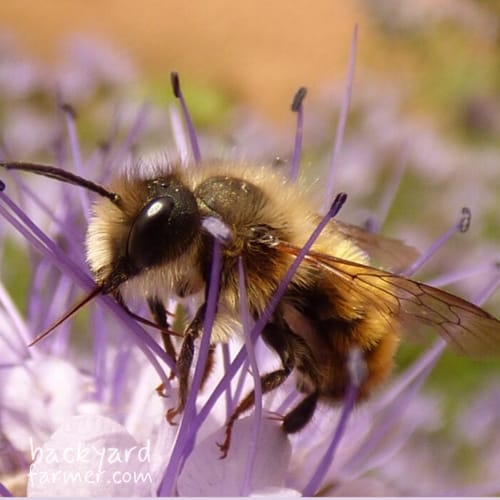
Red Mason Bee vs Tawny Mining Bee
The Red Mason Bee is one of the main confusion species because it can also look orange-brown in spring. The easiest garden clue is where it nests.
Tawny Mining Bees nest in the ground and leave small soil mounds. Red Mason Bees usually nest in cavities, including bee hotels, hollow stems, wall holes and gaps in brickwork.
Other Spring Mining Bees
Other Andrena species, including Buffish Mining Bee and Chocolate Mining Bee, can look warm brown or orange-toned. Some need close details, such as leg hairs or facial features, before you can identify them confidently.
So, if the bee is not a clear bright female Tawny Mining Bee, it is better to call it a possible mining bee rather than force the ID.
Bumblebees and Honey Bees
Bumblebees are usually bulkier and more clearly banded. Honey bees are slimmer, less fluffy and more striped.
Behaviour helps here. Tawny Mining Bees often fly low over lawns or enter individual soil burrows. Honey bees are more often seen visiting flowers before returning to a colony elsewhere.
Simple comparison tip: If the bee is bright fox-orange, active in spring, and linked with tiny soil mounds in a sunny lawn or border, Tawny Mining Bee is a strong possibility. If it is using a bee hotel or wall cavity, check Red Mason Bee instead.
Flowers Tawny Mining Bees Visit
Tawny Mining Bees are useful early-season pollinators because they are active while many spring flowers, shrubs and fruit trees are coming into bloom.
They visit a range of plants for nectar and pollen. Adults feed on nectar for energy, while females collect pollen to stock their underground brood cells.
For gardeners and allotment growers, fruit blossom is the big one. Apple, pear, cherry and plum blossom can all overlap with the Tawny Mining Bee’s spring flight season. So, if these bees are nesting nearby, they may also be helping with early fruit pollination.
They also use common spring wildflowers and lawn flowers. Dandelions, dead-nettle and buttercups might not look fancy, but they can be valuable food sources before summer borders really get going.
Useful flowers and plants for Tawny Mining Bees:
| Plant type | Useful examples |
|---|---|
| Fruit blossom | Apple, pear, cherry, plum |
| Spring trees and shrubs | Willow, hawthorn, blackthorn |
| Lawn and wild plants | Dandelion, buttercup, dead-nettle |
| Garden plants | Lungwort, comfrey, rosemary, early herbs, spring bulbs |
For a wildlife-friendly garden, aim for a steady run of flowers from late winter into spring. You do not need a perfect meadow or a specialist planting scheme. A few early flowers, some fruit blossom and a less aggressive approach to lawn weeds can make a real difference.
Dandelions are worth leaving in a few quiet areas if you can. They are often treated as weeds, but for early bees they provide food at exactly the right time of year.
This is where productive gardening and wildlife gardening overlap nicely. The same bee visiting a dandelion or comfrey may also visit fruit blossom nearby, helping both the garden and the wider pollinator network.
Why the Tawny Mining Bee Matters
The Tawny Mining Bee matters because it is active early in the year, when fruit blossom, spring shrubs and wildflowers are coming into bloom. At that stage, gardens and allotments often have fewer pollinators around than they do in summer.
Females visit flowers for nectar and collect pollen for their nest cells. As they move between flowers, they also help with pollination, especially around spring blossom.
For gardeners, that can be useful around apple, pear, cherry and plum trees. These often flower while the weather is still changeable, so a mix of early pollinators gives the blossom more chances to be visited.
Tawny Mining Bees also remind us that not all useful bees live in hives or bee hotels. Many important solitary bees need small patches of sunny, well-drained soil that might otherwise be mulched, paved or tidied away.
Why they are useful in gardens:
| Benefit | Why it matters |
|---|---|
| Early pollination | They are active while spring flowers and fruit blossom are open |
| Garden biodiversity | They add to the mix of solitary bees, bumblebees, hoverflies and other pollinators |
| Fruit blossom support | They may visit apple, pear, cherry and plum blossom during spring |
| Soil habitat indicator | Nesting can show that a garden has suitable sunny, well-drained ground |
| Wildlife value | Their nests can be part of a wider spring food web involving bee-flies and nomad bees |
A nesting patch can also attract other spring insects, including bee-flies and nomad bees. These can look a bit odd if you are not used to them, but they are part of the natural ecology around solitary bee nests.
Garden wildlife note: If Tawny Mining Bees settle in your garden, you may also notice bee-flies or nomad bees nearby. These are part of the same spring nesting ecology, not usually a problem to fix.
In most cases, seeing Tawny Mining Bees is a positive sign. They are gentle, seasonal pollinators that only need a bit of sunny soil, a few early flowers, and a garden that is not too aggressively tidied or sprayed.
How You Can Help Tawny Mining Bees
Helping Tawny Mining Bees is mostly about doing less in the right places. They are ground-nesting bees, so they need sunny soil, early flowers and low-disturbance nesting spots more than they need a bee hotel.
Leave Some Bare Soil
Females need access to soil so they can dig their nest burrows. If every border is paved, mulched, covered with membrane or packed with dense planting, there may be fewer places for them to nest.
You do not need to clear a big area. A sunny patch of lightly disturbed soil, a lawn edge, a bank, or a quiet allotment bed edge can be enough.
Good nesting conditions include:
| Helpful feature | Why it helps |
|---|---|
| Sunny soil | Warmer ground helps spring nesting activity |
| Short grass | Gives bees easier access to the soil surface |
| Bare patches | Allows females to dig |
| Well-drained ground | Helps nest burrows stay stable |
| Undisturbed edges | Gives nests time to complete their spring cycle |
Go Easy on Active Lawn Nest Patches
If Tawny Mining Bees are nesting in your lawn, treat that spot as a temporary wildlife patch. Avoid digging, raking, rolling, flattening or heavily compacting the active nests.
If possible, leave the small patch unmown for a few weeks. If you need to mow nearby, raise the blades and avoid running the wheels over the nest entrances. A cane, plant label or bit of twine can help mark the area.
Avoid Pesticides
Avoid insecticides where possible, especially on flowering plants, lawns, fruit trees and borders. This matters most in spring, when females are collecting pollen for their nests.
If you have a pest issue, start with gentler options first: hand removal, netting, companion planting, better plant health, or simply tolerating a small amount of damage.
Plant Spring Flowers
Tawny Mining Bees need nectar and pollen early in the year, before many summer flowers are available.
| Plant group | Examples |
|---|---|
| Fruit blossom | Apple, pear, cherry, plum |
| Spring trees and shrubs | Willow, hawthorn, blackthorn |
| Lawn and wild flowers | Dandelion, dead-nettle, buttercup, primrose |
| Garden flowers and herbs | Lungwort, comfrey, crocus, rosemary, early herbs |
Leaving a few dandelions in quiet areas can be useful. They flower at exactly the time many early bees need food, even if they are not everyone’s idea of a perfect lawn.
Do Not Rely on Bee Hotels
Bee hotels help cavity-nesting bees such as Red Mason Bees. Tawny Mining Bees nest in the ground, so they are unlikely to use bamboo tubes, drilled blocks or wall-mounted bee hotels.
For this species, focus on ground habitat: sunny bare soil, short turf, quiet lawn edges and undisturbed nesting patches.
Simple rule: For Tawny Mining Bees, think ground first. Early flowers feed them, but sunny soil gives them somewhere to nest.
FAQs
These quick answers cover the main questions people have when they find Tawny Mining Bees, small bee holes, or tiny soil mounds in a lawn.
No. Tawny Mining Bees are gentle solitary bees. They do not have a hive to defend and are very unlikely to bother people if left alone.
Female Tawny Mining Bees can technically sting, but they are very unlikely to do so unless trapped or handled roughly. Males cannot sting.
No serious damage is usually caused. The small soil mounds can look messy for a short time, but they are temporary and normally settle back in after the nesting season.
Your garden probably has suitable sunny, well-drained soil. Several females may nest close together, but each one has her own burrow. It can look busy, but it is not a hive.
No. Tawny Mining Bees are solitary mining bees. Even when several nests appear close together, there is no queen, worker caste, or shared colony underground.
They are mainly seen in spring, usually from March or April into May. In some years, especially cool or late seasons, activity may continue into early June.
Often, yes. Males commonly emerge first and patrol nesting areas looking for newly emerged females.
Adults feed on nectar, while females collect pollen and nectar for their nest cells. Useful plants include fruit blossom, dandelion, willow, hawthorn, dead-nettle, buttercup, lungwort, comfrey and rosemary.
Usually, no. The nests are temporary, harmless and beneficial. Avoid flooding holes, spraying insecticide, blocking entrances or digging up the patch.
If possible, leave the active patch unmown for a few weeks. If you need to mow nearby, raise the blades and avoid running mower wheels over the nest entrances.
Not usually. Tawny Mining Bees nest in the ground, so they need sunny bare soil, short turf and quiet lawn edges rather than bamboo tubes or drilled blocks.
No. Red Mason Bees are also orange-brown spring bees, but they usually nest in cavities, bee hotels and wall holes. Tawny Mining Bees nest in the ground and often leave small soil mounds.
If it appears in spring, has a bright fox-orange upper body, and is flying around tiny soil mounds or holes in short grass, it may be a female Tawny Mining Bee.
Yes. They are useful early-season pollinators and visit spring flowers, fruit blossom, shrubs and garden plants.
Visible nesting activity is usually short-lived and mainly happens in spring. The soil mounds should become less noticeable once the active nesting period ends.
In most cases, no. Stop children poking the holes, and keep pets away if they are likely to dig or snap at insects. Treat the area as a small temporary wildlife patch rather than a danger zone.
Building a bug hotel is another great way to support solitary bees like the Tawny Mining Bee in your garden. Learn more in our guide on how to make a bug hotel.