
Introduction
The Ivy Bee (Colletes hederae) is one of those bees people tend to notice properly once summer is winding down. In the UK, it usually shows up in September and October, just as flowering ivy starts buzzing with life.
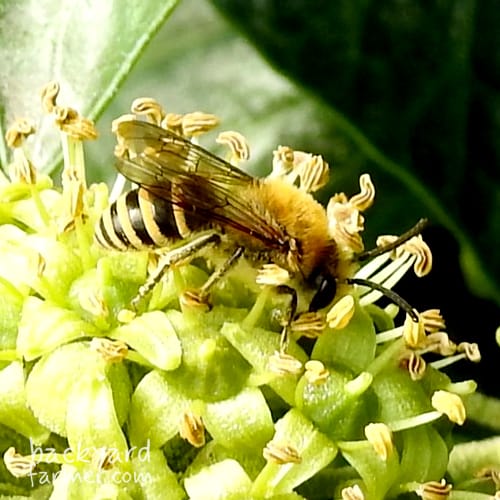
Most people spot it in one of two ways:
- Working busily over flowering ivy
- Appearing around bare, sunny ground where it nests
That second part can throw people a bit. When several bees are using the same patch, it can look more like a nest or a colony at first glance. In reality, the Ivy Bee is a solitary bee, even if a good nesting spot gets busy.
What this guide will help with
- The main field marks to look for
- How female and male Ivy Bees differ
- The seasonal and nesting clues that make the ID easier
- The most likely lookalikes to compare it with
Quick ID
If you are trying to identify an Ivy Bee quickly, start with the big clues. With this species, that usually works better than obsessing over one tiny feature.
What to look for
- Season: mainly September and October
- Flowers: strongly linked to flowering ivy
- Thorax: warm ginger-orange to orange-brown
- Abdomen: dark with clear pale bands
- Habitat clue: often near sunny bare ground where it nests
Why these clues are so useful
- Timing rules out a lot of spring and summer bees straight away
- Ivy association is one of the strongest supporting clues
- The colour pattern gives the bee its neat, recognisable look
- Nearby nesting ground can make the ID feel much more convincing
If you have an autumn bee on flowering ivy with that orange-brown thorax and pale-banded abdomen, you are already in the right area. It is usually that overall combination that points you toward an Ivy Bee, not one tiny detail on its own.
How to Identify the Ivy Bee
When trying to identify an Ivy Bee, the best approach is to use a combination of clues rather than hanging everything on one detail. That matters here, because some other mining bees can look broadly similar, especially in photos.
The strongest field clues
- Season: mainly early autumn, especially September and October
- Flower choice: strongly linked to flowering ivy
- Thorax colour: usually warm orange-brown, ginger, or tawny
- Abdomen pattern: darker with clear pale bands across the segments
- Overall shape: neat, tidy mining bee shape rather than the rounder look of a bumblebee
- Nesting context: often near sunny bare ground, banks, path edges, or short turf
A simple way to judge it
Ask yourself:
- Is it early autumn?
- Is it visiting flowering ivy?
- Does it show the orange-brown thorax and pale-banded dark abdomen?
- Is it near a likely nesting area?
If most of those clues line up, you are probably in the right area for Colletes hederae.
A useful reality check
- Some other mining bees can look broadly similar
- A quick or distant sighting may only get you to a likely ID rather than a guaranteed one
- For most readers, season + ivy + overall pattern is far more useful than trying to judge tiny structural details
In other words, it is usually the overall feel of the bee that helps most. If it looks right, fits the season, and is using flowering ivy or nearby nesting ground, that is often more valuable than getting hung up on one tiny mark.
Female Ivy Bee
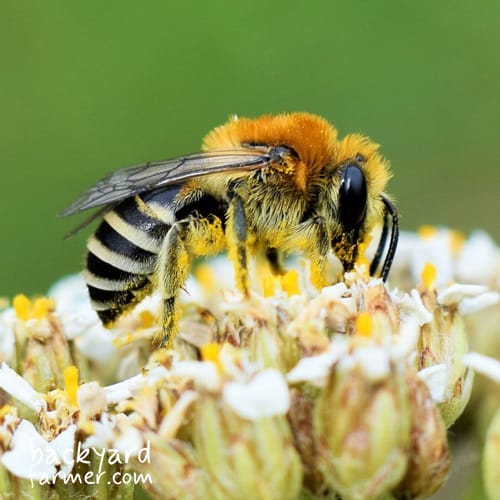
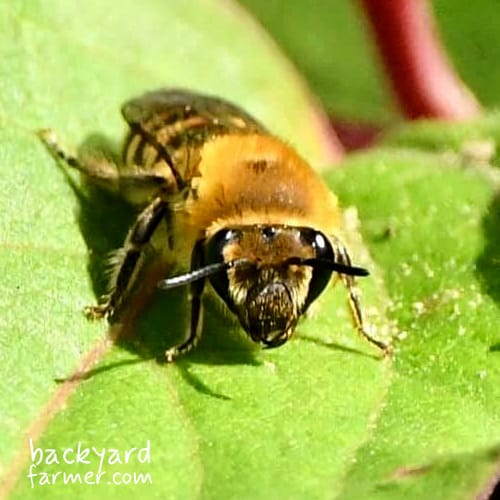
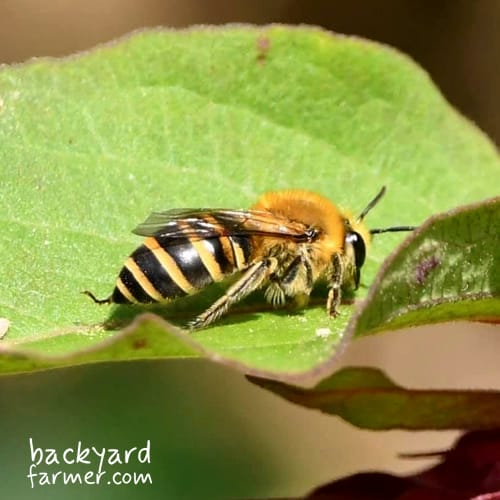
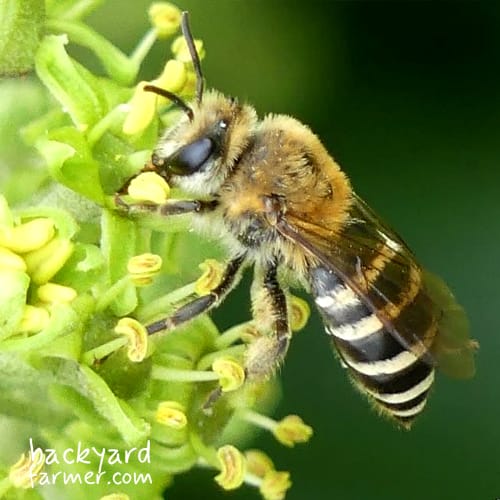
The female Ivy Bee is the one most people are likely to get a proper look at, because she is often seen collecting pollen on ivy flowers and then heading back toward a nest site.
What usually stands out
- Size and build: larger and chunkier than the male
- Thorax: warm ginger-orange to orange-brown
- Abdomen: darker with pale bands across the segments
- Behaviour: often works steadily over ivy flowers collecting pollen
- Nest clue: may drop to bare soil, short turf, a sunny bank, or a path edge
Why the female is easier to notice
- She often looks more solid and purposeful in the field
- Pollen-collecting behaviour is easier to spot than quick patrolling flights
- If you find a likely nesting patch nearby, females may be seen disappearing into small nest holes
Best way to recognise a female
Focus on the main clues together:
- Early autumn timing
- Ivy flowers
- Pollen-collecting behaviour
- Orange-brown thorax
- Dark abdomen with pale bands
That combination is usually far more useful than chasing tiny technical details. If the bee looks busy, fits the season, and is working flowering ivy with purpose, you are often looking at a female Ivy Bee.
Male Ivy Bee
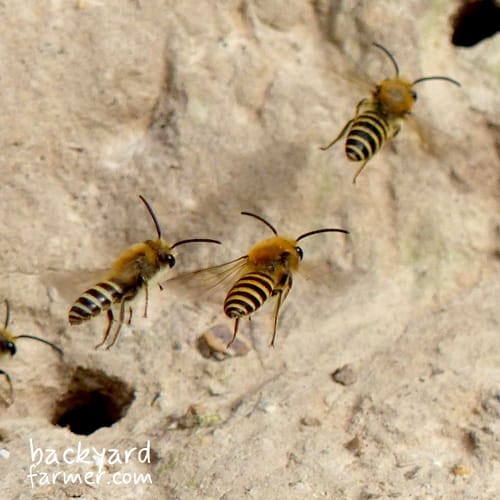
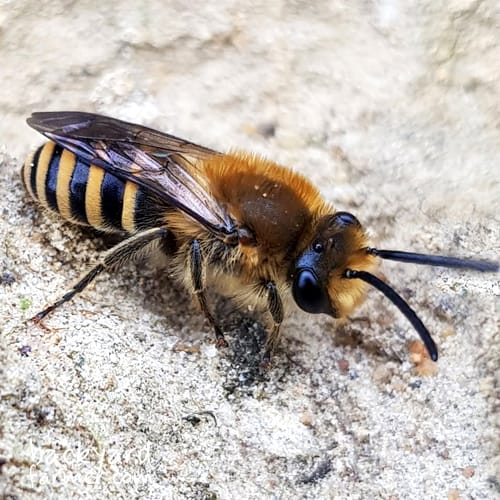
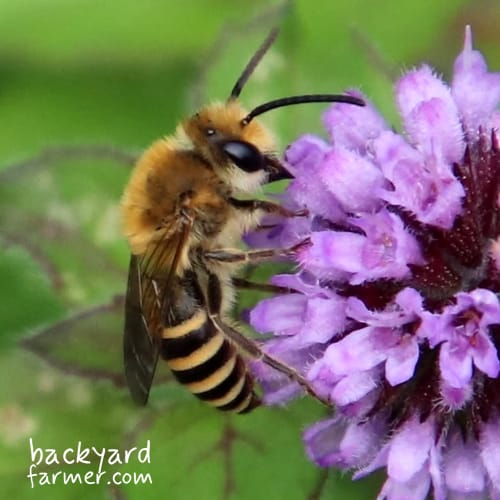
The male Ivy Bee is usually smaller and slimmer than the female, and in the field it often looks a bit lighter and neater overall.
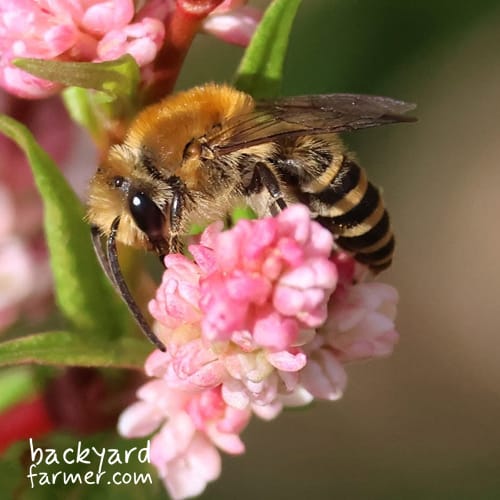
What usually stands out
- Size and build: smaller and less chunky than the female
- Thorax: warm orange-brown
- Abdomen: darker with pale bands
- Behaviour: often seen feeding on ivy or patrolling near nest sites
- Season clue: males usually appear before the females
- Pollen clue: males do not collect pollen
Why males can be trickier
- They are smaller and more active in the field
- Quick views can make them harder to separate from other similar mining bees
- They are often noticed while flying or patrolling rather than settling for long
Best way to recognise a male
Focus on the main clues together:
- Autumn timing
- Ivy association
- Smaller, slimmer shape
- Orange-brown thorax
- Dark abdomen with pale bands
- Restless patrolling behaviour
For most readers, the male is best judged by the overall combination rather than one tiny feature on its own. If the bee is zipping about ivy in early autumn, looks slimmer than the females, and is not carrying pollen, a male Ivy Bee is a good fit.
You Are Probably Looking at an Ivy Bee If…
You are probably looking at an Ivy Bee if several of the main clues line up at once. With this species, that overall fit is usually more useful than trying to force a decision from one tiny mark.
Strong signs to look for
- It is September or October and the bee is active in early autumn
- It is feeding on flowering ivy or moving around ivy-rich areas
- It has a warm ginger-orange or orange-brown thorax
- It has a darker abdomen with clear pale bands
- It is near sunny bare ground, short turf, a bank, or a path edge where bees may be nesting
Why this approach works
- One clue on its own is not always enough
- Several matching clues together make the ID much stronger
- A bee on ivy in autumn with the right overall pattern is already giving you a very good starting point
Useful filters
- If you see a similar-looking bee in spring or early summer, it is much less likely to be an Ivy Bee
- If the setting points more strongly toward heather or coastal sea aster, another Colletes species may be a better fit
In other words, do not just ask whether the bee is brownish or banded. Ask whether the season, flower choice, pattern, and habitat all make sense together. If they do, Ivy Bee becomes a much more convincing call.
Identification & Key Facts
If you want the quick-reference version, these are the main things worth checking.
| Feature | Ivy Bee details |
|---|---|
| Common name | Ivy Bee |
| Scientific name | Colletes hederae |
| Bee type | Solitary mining bee |
| Main flight period | Early autumn, mainly September and October |
| Peak sightings | Usually September and October |
| Main flower link | Strongly associated with flowering ivy |
| Thorax | Warm ginger-orange to orange-brown |
| Abdomen | Dark with clear pale bands |
| Female | Larger, chunkier, often seen collecting pollen |
| Male | Smaller, slimmer, often seen patrolling or feeding on ivy |
| Nesting habit | Solitary, but often nests in dense aggregations |
| Typical nesting places | Sunny bare ground, banks, path edges, short turf, light or sparsely vegetated soil |
| Best field clues | Autumn timing, ivy association, orange-brown thorax, pale-banded abdomen, nearby nesting habitat |
The bits that matter most in the field
- Timing matters more than many people expect
- Flowering ivy is one of the strongest supporting clues
- Nearby nesting ground can help confirm what you are seeing
- The best ID usually comes from the whole combination, not colour on its own
If you strip it right back, the strongest fit is usually an autumn bee on ivy with the right pattern and suitable nesting habitat nearby.
Similar Species
The Ivy Bee is not usually confused with every insect on ivy. The more realistic lookalikes are other mining bees in the genus Colletes, especially ones with a similar banded abdomen and the same general shape.
Most likely confusion species
| Similar species | How to tell it apart |
|---|---|
| Heather Colletes / Common Colletes | One of the most realistic confusion species. It fits heather habitats much better, so if the bee is around heathland rather than flowering ivy, this becomes a stronger possibility. |
| Sea Aster Mining Bee | Another close lookalike, but much more closely tied to coastal habitats and sea aster, not the sort of inland ivy-covered garden or hedge where many people notice Ivy Bees. |
| Honeybee | Often feeds on ivy too, but it has the more familiar honeybee shape and usually does not show the same neat orange-brown thorax and pale-banded mining bee look. |
| Common Carder Bumblebee | Can look warm brown at a glance, but it is usually rounder, fuzzier, and much more obviously bumblebee-shaped. |
| Wasps and hoverflies | Common on ivy and often noticed at the same time, but they are usually less hairy and have a very different body shape once you look properly. |
Best way to separate them in the field
Ask yourself:
- Is the bee on flowering ivy in autumn?
- Is it near sunny bare ground or a nesting area?
- Does it have the tidy, pale-banded mining bee look?
- Does the setting point more toward ivy, heather, or coastal flowers?
That last point matters more than people sometimes expect. A banded mining bee on flowering ivy in autumn, especially near sunny bare ground, is already giving you a much stronger Ivy Bee feel than a similar-looking insect seen in a completely different setting.
A realistic note on certainty
- Some photos and quick sightings will only get you to a likely Ivy Bee rather than a guaranteed one
- Distant images can make fine differences hard to judge
- In tricky cases, season, habitat, and flower choice can be just as useful as close-up pattern details
So, try not to force certainty where it is not there. In real life, the best IDs often come from the whole picture rather than one perfect close-up feature.
Found Ivy Bees in Your Garden?
Finding lots of Ivy Bees in one part of the garden can be a bit unsettling at first, especially if they seem to be coming and going from the ground in numbers. It is easy to assume you are looking at some kind of colony, but that is not what is happening here.
The main thing to know
- Ivy Bees are solitary bees, not a colony-forming species like wasps or honeybees
- Several females may choose the same suitable patch of ground
- That creates a nesting aggregation, where many individual bees nest close together
- This can make the area look far busier than people expect from a solitary bee
Where this often happens
- Bare soil
- Short turf
- A sunny bank
- A path edge
- Other dry, lightly vegetated patches of ground
Are Ivy Bees aggressive?
- Usually no
- They are focused on feeding, mating, and nesting, not defending a colony
- In most gardens, they are only obvious for a short window in early autumn
- Activity usually drops away again once the season passes
What to do if they are nesting in your garden
- Leave the area alone if you can
- Avoid digging through the nesting patch
- Avoid spraying nearby flowers or ground
- Avoid repeatedly disturbing the soil while the bees are active
In most cases, a temporary Ivy Bee nesting patch is more interesting than worrying. It usually means the garden is offering the sort of dry, usable ground that solitary bees can work with, which is no bad thing.
When Do Ivy Bees Appear in the UK?
In the UK, Ivy Bees appear in late summer and autumn, with most sightings happening in September and October.
Why timing matters
- It is one of the strongest identification clues
- Ivy Bees turn up later in the year than many bees people are used to noticing
- A similar-looking bee seen much earlier is less likely to be this species
Usual pattern through the season
- Males appear first, slightly before the females
- Females follow soon after
- The species becomes much more obvious once ivy is flowering well
- This is when pollen-collecting and nesting activity often becomes easier to spot
Quick timing summary
- First appearance: late summer to early autumn
- Main activity period: September and October
- Best time to look: when flowering ivy is open and busy with insects
- Useful ID clue: a late-season banded mining bee is much more likely to be an Ivy Bee than a similar bee seen in spring
For most readers, the key point is straightforward: if you see a likely banded mining bee on ivy in early autumn, especially in September or October, the timing fits Ivy Bee very well. That seasonal window does a lot of the heavy lifting when you are trying to narrow things down.
When Did Ivy Bees Arrive in the UK?
The Ivy Bee was first recorded in the UK in 2001. Since then, it has spread well beyond those early records and is now a much more familiar species in parts of Britain than it once was.
Why this matters
- It is a relatively recent arrival in the UK
- It is now better thought of as an established and spreading species
- Older British bee books may not mention it clearly at all
A useful bit of context
- The Ivy Bee can still seem “new” because it was not part of older everyday UK bee guides
- That does not mean a modern sighting is unusual
- It simply reflects how recently the species became established and widely noticed
What this means for identification
- If an older guide does not mention the Ivy Bee, that is not necessarily a sign the guide is wrong
- Some older material simply predates the species becoming well known in Britain
- Modern UK sightings make much more sense when you combine autumn timing, ivy flowers, and the right overall pattern
In other words, this is one of those bees that can confuse people simply because it feels newer in the British wildlife conversation. Once you know that, the records make more sense, and so do autumn sightings in the right places.
Why Ivy Bees Matter
The Ivy Bee matters because it is active at that point in the year when a lot of other flowers are finishing and nectar is getting harder to come by.
Why that matters
- It is a late-season bee, not a spring or early summer one
- It shows that autumn still matters for pollinators
- It relies on food sources that are available when plenty of other insects are after them too
Why ivy matters so much
- Flowering ivy is one of the key late-season food sources for this bee
- Ivy often gets overlooked or cut back before it has a chance to bloom
- Once it flowers, it can pull in bees, hoverflies, and wasps in big numbers
- That is why Ivy Bees are so often tied to ivy-rich places in early autumn
The main thing to remember
If you want to understand why Ivy Bees appear when they do, or why they turn up in certain corners of the landscape, it usually comes back to two things:
- late-season ivy flowers
- suitable nearby nesting ground
It is one of those good reminders that a plant people often write off as messy can actually be doing a lot of work for wildlife once the season starts slowing down.
How You Can Help
If you want to help Ivy Bees, the most useful thing is to support the two parts of their life cycle they rely on most:
- Late-season flowers
- Suitable nesting ground
Practical ways to help
- Let ivy flower where it is safe and manageable to do so
- Avoid spraying flowering plants and active bee areas
- Leave some sunny bare ground or lightly vegetated soil if possible
- Avoid disturbing nesting patches in autumn while bees are active
- Value late-season flowers rather than treating autumn as the point where wildlife support stops
The biggest win
One of the simplest things you can do is let ivy flower if it is growing in a sensible place. Ivy often gets cut back before it blooms, but once the flowers open they can provide an important food source for Ivy Bees and plenty of other autumn insects too.
Around nesting areas
It also helps to avoid routine pesticide use around flowering plants and active nesting patches. A bee feeding on ivy or using bare ground nearby will do best where those areas are left as undisturbed as possible.
If you have room to leave a wilder patch
Try leaving a few:
- Sunny patches of bare soil
- Lightly vegetated ground
- Short turf
- Dry path edges
Not every garden will suit nesting Ivy Bees, but small areas of open ground can still be useful for solitary bees more generally. Sometimes the helpful thing is not adding something fancy, but simply leaving the right bit of ground alone.