
Heated propagators provide bottom warmth and a protected growing environment for starting seeds during cooler UK months. They’re particularly useful for chillies, peppers, aubergines and other warmth-loving crops that can struggle to germinate in cold compost.
Choosing the right one comes down to temperature control, growing space and how many plants you want to raise. A basic electric propagator may be enough for occasional sowing, while regular growers can benefit from a thermostat and larger capacity.
Here are five of the best heated propagators for UK gardeners, selected using manufacturer specifications, UK availability, value and owner experiences.
Quick Picks — Best Heated Propagators UK
Best Overall — Stewart Premium 38cm
Best Budget — Stewart Essentials 38cm
Best Windowsill — Garland Super 7
Quick Comparison of the Best Heated Propagators
| Model | Best For | Size | Temperature Control | UK Price |
|---|---|---|---|---|
| Stewart Premium 38cm | Best Overall | 38 × 24.5cm | Fixed thermostat | From £37.99 |
| Stewart Essentials 38cm | Budget | 38 × 24.5cm | None | From £21.99 |
| Garland Super 7 | Windowsills | 76 × 18.5cm | None | £49.99 |
| EarlyGrow Heated 3-Bay | Self-watering | 54.5 × 21.5cm | No built-in adjustable thermostat listed | £42.95 |
| Vitopod Small | Premium | 60 × 60cm | Adjustable 5–30°C | £149.99 |
Prices checked on 21 October 2026. Prices and availability may change. Delivery charges are not included.
For most small indoor setups, the Stewart Premium offers the best balance of cost and automatic temperature control. If you need adjustable temperatures and more growing space, the Vitopod is the stronger option for regular use.
Best Overall Heated Propagator — Stewart Premium 38cm
The Stewart Premium 38cm is our best all-round choice for gardeners wanting automatic temperature control without spending a fortune.
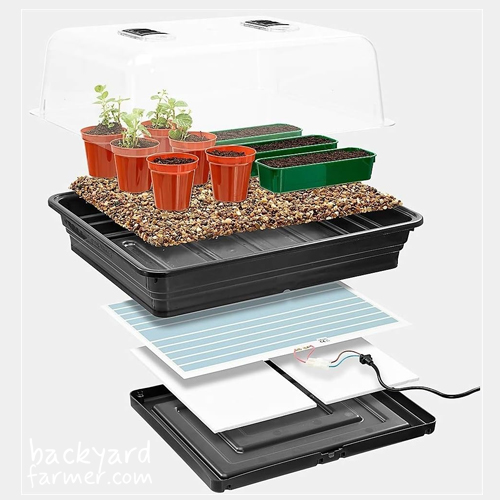
Its fixed thermostat is designed to maintain compost temperatures around 18–23°C under suitable conditions. The compact tray, ventilated lid and supplied starter accessories make it practical for indoor seed starting during late winter and spring.
At the prices checked, it costs around £16 more than the Stewart Essentials. That extra money buys automatic heating regulation rather than additional growing space.
The limitation is that you cannot adjust the thermostat for crops that prefer warmer germination conditions.
| Specification | Detail |
|---|---|
| Power | 8W |
| Dimensions | 38 × 24.5 × 19.5cm |
| Temperature control | Fixed thermostat |
| Advertised compost temperature | Approximately 18–23°C |
| Ventilation | Adjustable lid vent |
| Accessories | Seed tray, six pots and growing guide |
Best For
- Small indoor growing setups.
- Regular spring seed sowing.
- Gardeners wanting straightforward temperature control.
Pros
- Fixed thermostat included.
- Compact and easy to use.
- Starter accessories supplied.
- Good value for controlled heating.
Cons
- Temperature isn’t adjustable.
- Limited growing capacity.
- Less suitable for seeds requiring higher temperatures.
Our Verdict: The best balance of price, simplicity and temperature control for everyday UK seed starting. The modest extra cost over the Essentials makes it a worthwhile upgrade for regular use.
Best Budget Heated Propagator — Stewart Essentials 38cm
The Stewart Essentials 38cm offers an inexpensive way to start seeds with bottom heat.
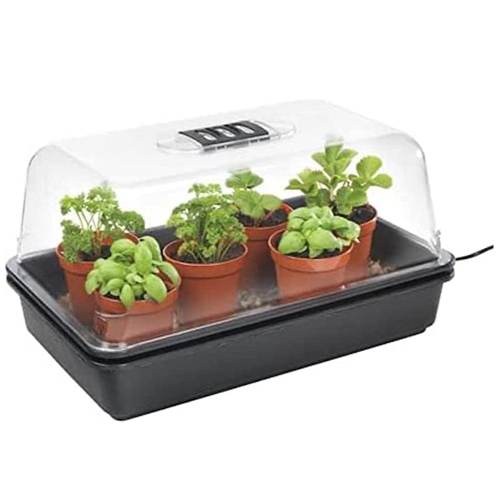
It combines an 8W heated base with a clear ventilated lid, providing a simple setup for gardeners who only sow a few trays each spring.
Unlike the Premium, it has no thermostat. Compost temperature depends on the surrounding conditions, so a separate thermometer is useful for avoiding excessive heat.
At around £22, it’s a practical option for occasional seed starting in a reasonably warm indoor room.
| Specification | Detail |
|---|---|
| Power | 8W |
| Dimensions | 38 × 24.5 × 19.5cm |
| Temperature control | None |
| Ventilation | Adjustable lid vent |
| Operation | Plug-in heating |
| Intended use | Small indoor propagation |
Best For
- Beginners.
- Occasional seed starting.
- Small windowsills or growing shelves.
Pros
- Affordable.
- Simple setup.
- Compact footprint.
- Low rated power consumption.
Cons
- No thermostat.
- Temperature needs monitoring.
- Limited growing space.
Our Verdict: A sensible budget choice for occasional sowing. If you intend to use a propagator regularly, the Stewart Premium offers useful automatic temperature control for around £16 more.
Best Windowsill Heated Propagator — Garland Super 7
The Garland Super 7 is particularly useful for gardeners starting several varieties in small quantities.
Seven individual mini propagators sit on one long, narrow heating base. Each compartment has its own ventilated lid, allowing different crops or sowing dates to be managed separately.
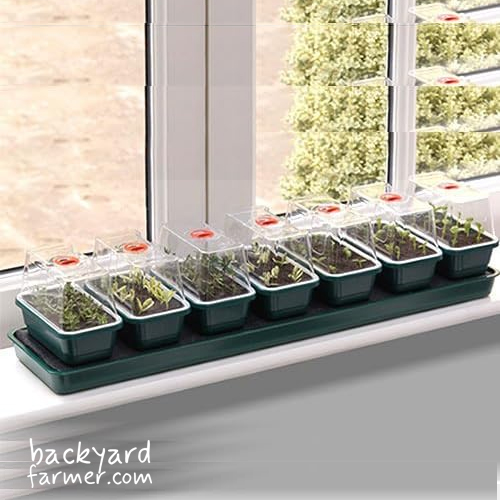
Its 76 × 18.5cm footprint suits a sufficiently long windowsill or propagation shelf. UK gardeners have reported successful use of Garland multi-tray propagators over several growing seasons, although those accounts don’t establish the lifespan of every current unit.
The Super 7 has no thermostat. Garland advertises a compost-temperature increase of approximately 8°C above ambient conditions, but actual results depend on the growing environment.
| Specification | Detail |
|---|---|
| Power | 13W |
| Dimensions | 76 × 18.5 × 15cm |
| Compartments | Seven |
| Temperature control | None |
| Ventilation | Individually vented lids |
| Heating | Carbon-fibre element |
Best For
- Windowsill seed starting.
- Several varieties in small quantities.
- Staggered sowing.
Pros
- Seven separate compartments.
- Individual ventilation.
- Space-efficient narrow design.
- Encouraging owner feedback.
Cons
- No thermostat.
- Small individual trays.
- Requires a long enough windowsill.
Our Verdict: A practical choice for gardeners who prefer several small sowings over one large tray. The separate compartments are its biggest advantage, particularly when starting different crops at different times.
Best Self-Watering Heated Propagator — EarlyGrow Heated 3-Bay
The EarlyGrow Heated 3-Bay combines bottom warmth with a capillary-watering system.
Three separate compartments allow different varieties to grow together, while a 1.4-litre reservoir supplies moisture through capillary matting beneath the trays.
This reduces the need for frequent manual watering, although the reservoir and compost moisture still need checking.
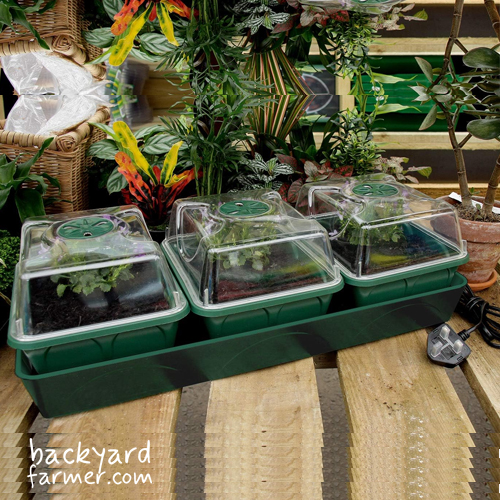
The UK-made unit uses a 12W heating element. No built-in adjustable thermostat is listed, although EarlyGrow sells a separate digital thermostat. Check compatibility before purchasing additional controls.
Owner feedback is encouraging in some cases, although one verified buyer reported disappointing heating performance in particularly cold conditions.
Its main attraction is watering convenience rather than precise temperature control.
| Specification | Detail |
|---|---|
| Power | 12W |
| Dimensions | 54.5 × 21.5 × 16.5cm |
| Compartments | Three |
| Water reservoir | 1.4 litres |
| Watering system | Capillary matting |
| Ventilation | Adjustable lids |
Best For
- Gardeners wanting easier watering.
- Staggered seed sowing.
- Small indoor propagation setups.
Pros
- Capillary self-watering system.
- Three separate compartments.
- Adjustable ventilation.
- UK-made construction.
Cons
- Reservoir still needs monitoring.
- No built-in adjustable thermostat listed.
- Heating performance may be limited in cold conditions.
Our Verdict: A useful choice when watering convenience matters more than temperature precision. The three compartments and capillary system suit gardeners raising several small batches of seedlings indoors.
Best Premium Heated Propagator — Vitopod Small
The Vitopod Small is designed for gardeners who propagate regularly and need more control over growing conditions.
Its digital thermostat allows temperatures to be selected between 5°C and 30°C, while the 60 × 60cm growing area provides considerably more room than compact windowsill models.
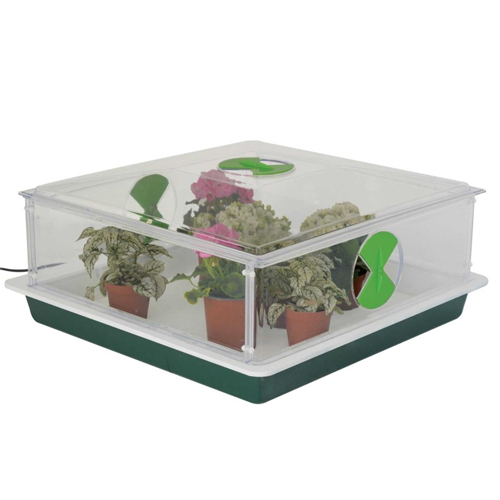
Optional height extensions accommodate taller plants and cuttings, and replacement lids, panels and controllers are available. These features make it easier to maintain and adapt the setup over time.
Long-term owner experiences with older Vitopod models are encouraging, but they don’t prove the durability of the revised version.
At around £150, the Vitopod is a substantial investment. Its extra capacity and flexibility are most worthwhile for gardeners who propagate throughout the growing season.
| Specification | Detail |
|---|---|
| Power | 50W |
| Dimensions | 60 × 60 × 27cm |
| Temperature control | Adjustable digital thermostat |
| Temperature range | 5–30°C |
| Adjustment | 1°C increments |
| Expansion | Optional height extensions |
Best For
- Experienced growers.
- Regular seed and cutting propagation.
- Gardeners needing adjustable temperatures.
- Larger indoor growing setups.
Pros
- Adjustable temperature control.
- Generous growing area.
- Extendable height.
- Replacement parts available.
Cons
- High purchase price.
- Requires more space.
- Extensions and accessories cost extra.
Our Verdict: A strong premium choice for regular propagation. Its adjustable temperature control, growing capacity and replaceable components offer genuine advantages, although occasional growers are unlikely to need this much equipment.
How to Choose the Right Heated Propagator
Choosing the right heated propagator depends on available space, temperature control and how often you start seeds.
For most UK gardeners, usable growing capacity and heating control matter more than wattage alone.
Quick Buying Guide
| Growing Situation | Best Type | Why |
|---|---|---|
| Occasional seed sowing | Basic heated propagator | Affordable and simple |
| Small indoor setup | Fixed-thermostat model | Automatic temperature control |
| Several varieties on a windowsill | Multi-compartment propagator | Separate growing areas |
| Regular propagation | Adjustable-thermostat model | Greater temperature flexibility |
| Less frequent watering | Self-watering propagator | Helps maintain moisture |
| Larger batches | High-capacity propagator | More usable growing space |
Basic Heated Propagators
These provide bottom warmth whenever switched on. They’re affordable and straightforward but require temperature monitoring because heating isn’t automatically regulated.
Fixed-Thermostat Propagators
A fixed thermostat automatically regulates heating around a preset temperature range. This provides greater control without adjustment, although it won’t suit every crop equally.
Adjustable-Thermostat Propagators
These allow gardeners to select a target temperature within the controller’s supported range. They’re more flexible for different crops and conditions, but generally cost more.
Practical Checks Before Buying
Growing capacity: Check tray dimensions, individual compartments and lid clearance. Seedlings may quickly outgrow a propagator once they emerge.
Ventilation: Adjustable vents help manage humidity, but enclosed propagators can still overheat in strong sunshine. Monitor temperatures and avoid unsuitable locations.
Growing location: Small indoor propagators may struggle in cold greenhouses or sheds. Check the manufacturer’s recommended conditions and follow electrical safety instructions.
After germination: Reduce unnecessary bottom heat, adjust or remove covers as appropriate and provide adequate light for healthy seedling growth.
If you already own suitable seed trays and covers, a separate heat mat may offer better value. Our Best Propagation Heat Mats UK guide compares standalone mats and thermostats.
How Much Does a Heated Propagator Cost to Run?
Heated propagators generally use relatively little electricity, although larger systems draw more power while heating.
The table uses an illustrative electricity rate of 25p per kWh, assuming continuous full-power operation over 30 days.
| Propagator Power | 12 Hours Daily | 24 Hours Daily |
|---|---|---|
| 8W | £0.72 | £1.44 |
| 13W | £1.17 | £2.34 |
| 50W | £4.50 | £9.00 |
| 100W | £9.00 | £18.00 |
Figures exclude standing charges and additional accessories. Thermostatically controlled propagators may use less electricity because their heating switches off when the target temperature is reached.
A more expensive propagator shouldn’t be purchased solely on the assumption that lower running costs will recover its purchase price.
Frequently Asked Questions About Heated Propagators
Yes, when your growing conditions are too cool for reliable germination. They’re particularly useful for warmth-loving vegetables started early in the year. If your indoor compost is already warm enough, additional heating may offer little benefit.
Not necessarily. Tomatoes germinate successfully indoors at suitable temperatures without extra equipment. A heated propagator can help when compost temperatures are too low, particularly during early spring.
It depends on the crop. Many warmth-loving vegetables germinate well around 20–25°C, although some prefer warmer or cooler conditions. Follow crop-specific guidance and check the compost temperature.
Generally, yes. Once seedlings emerge, increase ventilation and remove the cover as appropriate to prevent excessive humidity and overheating. Provide adequate light for healthy growth.
Only if the manufacturer permits it. Small indoor propagators may struggle to maintain suitable temperatures in very cold conditions. Keep electrical equipment protected and don’t assume a propagator prevents frost damage.
Not always, but seedlings need sufficient light after germination. Early sowings on dull UK windowsills may benefit from supplementary lighting. Our Best LED Grow Lights UK guide covers suitable options.