

Piennolo tomatoes are traditional Italian storage tomatoes that can be harvested in whole trusses and hung somewhere dry and ventilated, keeping home-grown fruit available well into winter.
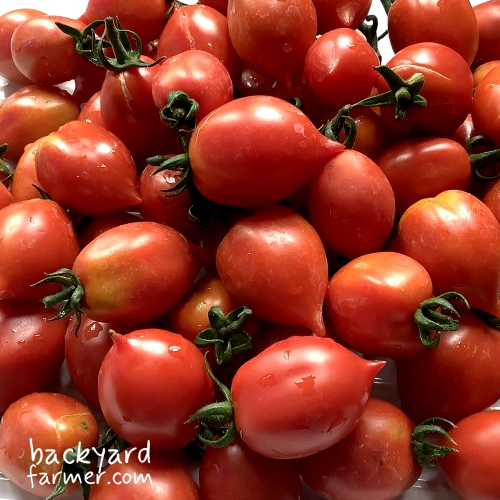
Unlike ordinary cherry tomatoes, they have been selected for firm flesh, thick skins and strong stalk attachment. They originate around Mount Vesuvius, but suitable Piennolo varieties can also be grown successfully in the UK.
This guide covers when to harvest them, how to hang them and what to expect during winter storage.
Quick answer: Piennolo tomatoes are specialist long-storage tomatoes traditionally harvested in whole trusses and hung somewhere dry and ventilated. Genuine storage varieties can remain usable for several months, making them an unusual way to keep home-grown tomatoes into winter.
What Are Piennolo Tomatoes?
Piennolo tomatoes are traditional long-storage tomatoes associated with the area surrounding Mount Vesuvius in Campania, Italy.
The fruits are generally small, red and slightly pointed, growing in large trusses. The name comes from the traditional hanging storage method and is now associated with a group of local tomato types grown around Vesuvius.
Tomatoes grown from Piennolo seed here in Britain can still be described as Piennolo or Piennolo-type tomatoes, but they are not the protected Italian DOP product.
Why Can Piennolo Tomatoes Be Stored for So Long?
The hanging method gets most of the attention, but the tomato itself is just as important.
Piennolo tomatoes have been selected for characteristics that allow them to remain usable for much longer than most ordinary salad or cherry tomatoes.
| Characteristic | Why It Helps |
|---|---|
| Thick skin | Helps reduce moisture loss and physical damage |
| Firm flesh | Slows the softening that normally occurs after harvest |
| Strong stalk attachment | Helps fruit remain attached while hanging |
| High soluble solids | Contributes to the concentrated flavour |
| Dense fruit | Better suited to prolonged storage than very juicy types |
As they hang, the tomatoes gradually lose some moisture and become more concentrated rather than immediately collapsing into soft fruit.
The storage ability comes from the variety as well as the hanging method, so an ordinary cherry tomato should not be expected to perform in the same way.
When to Harvest Piennolo Tomatoes for Storage
Piennolo tomatoes are normally harvested as complete trusses rather than individual fruits.
Traditionally, trusses are harvested once at least around 70% of the fruit has turned red, while the remainder can continue ripening during storage.
You therefore do not need to wait until every tomato is completely ripe and soft.
For storage, look for trusses that are:
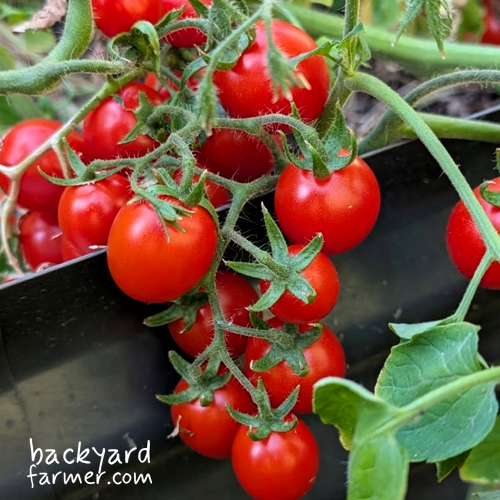
- mostly coloured
- firm
- free from splitting
- free from mould or disease
- undamaged by pests
- still strongly attached to their stalks
Where possible, harvest on a dry day.
Cut the complete truss carefully rather than pulling individual tomatoes away from the plant. Keeping the stalk structure intact makes hanging much easier and helps the fruit remain attached.
For ordinary tomato varieties, see my When to Harvest Tomatoes in the UK guide.
How to Hang Piennolo Tomatoes for Winter
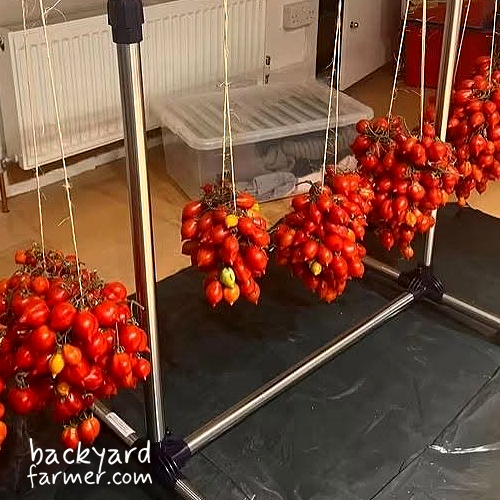
Traditionally, several trusses are tied together to form one large hanging piennolo. For my own crop, I’ve kept things simpler and hung the trusses individually from twine.
This still provides the important benefits of good airflow and keeping the tomatoes away from damp surfaces.
How to Do It
- Harvest complete trusses.
Cut the trusses carefully, keeping as much of the stalk structure intact as possible. - Check every tomato.
Remove fruit that is split, bruised, mouldy or otherwise damaged. - Do not wash them before storage.
Washing adds moisture to the fruit. Store them dry and wash individual tomatoes when you are ready to use them. - Attach the trusses to strong twine.
Support the main stalk rather than tying string tightly around individual tomatoes. - Leave space between the bunches.
Air needs to circulate around the fruit. - Hang them clear of damp surfaces.
Avoid allowing the tomatoes to rest against walls, shelves or one another more than necessary. - Check them regularly.
Remove any tomato that begins to rot before it can affect neighbouring fruit.
It is an extremely simple system, which is part of its appeal.
Where Should You Hang Piennolo Tomatoes?
The aim is not to keep the tomatoes warm.
What they need is a location that is:
- dry
- well ventilated
- protected from rain
- out of direct sunlight
- reasonably stable in temperature
- away from direct heat
- protected from rodents and other pests
The main things to avoid are damp, condensation and direct heat. A cool spare room, pantry, dry utility area or suitable shed can work, provided there is good airflow and the fruit is protected from pests.
How Long Do Piennolo Tomatoes Keep?
Under suitable conditions, genuine Piennolo and other storage tomato varieties can remain usable for several months.
Traditional accounts describe hanging Piennolo tomatoes through winter and, under particularly good conditions, considerably longer.
However, I would not treat claims such as “keeps for eight months” as a guarantee.
Storage life depends on:
- the exact variety
- how ripe the fruit was when harvested
- whether any fruit was damaged
- temperature
- humidity
- airflow
- how quickly spoiled tomatoes are removed
There will usually be some losses along the way.
For UK growers, getting sound tomatoes through Christmas and into the new year would already make the technique worthwhile.
Checking Piennolo Tomatoes During Storage
Hanging the tomatoes does not mean forgetting about them until January.
Check the bunches periodically.
Look particularly for:
- mould
- soft spots
- leaking fruit
- splitting
- unusual discolouration
- fruit beginning to detach from the stalk
Remove any mouldy, leaking or badly softened fruit immediately rather than trying to salvage it.
Some wrinkling is normal.
The tomatoes gradually lose moisture during storage, so they will not necessarily look like freshly harvested fruit several months later.
Slightly wrinkled but otherwise sound tomatoes can still be excellent for cooking.
What Do Piennolo Tomatoes Taste Like After Storage?
This is something I’ll update through winter as I work through the stored crop. I’ll be comparing the flavour, texture and condition of the tomatoes after one month, around Christmas and later in winter.
As the fruit ages and becomes more concentrated, it is particularly well suited to sauces, pizza and other cooked dishes.
Piennolo Tomatoes vs Ordinary Cherry Tomatoes
Although they may look similar at first glance, Piennolo and ordinary cherry tomatoes have been selected for rather different purposes.
| Piennolo / Storage Tomato | Typical Cherry Tomato | |
|---|---|---|
| Skin | Generally thicker | Usually thinner |
| Flesh | Firm and dense | Often softer and juicier |
| Stalk attachment | Strong | Variable |
| Main use | Fresh, cooking and storage | Mainly fresh |
| Storage potential | Potentially several months | Usually much shorter |
| Hanging whole trusses | Traditionally used | Generally unsuitable for long storage |
The variety is therefore just as important as the storage method.
Can You Grow Piennolo Tomatoes in the UK?
Yes. Piennolo tomatoes can be grown in the UK, particularly under glass or in a polytunnel. They are normally cordon or indeterminate plants and can also crop outdoors in a sunny, sheltered position during a good summer.
The main UK challenge is producing mature, healthy trusses before cooler autumn weather and blight become an issue.
For the complete growing method, see How to Grow Tomatoes in the UK.
BYF Pick: English Vesuviano Piennolo
English Vesuviano Piennolo is a heritage cordon tomato grown and seed-saved in Kent, making it a strong choice for hanging and storing through winter.
Frequently Asked Questions
Under suitable conditions, genuine storage varieties can remain usable for several months. The exact storage period depends on variety, fruit condition, temperature, humidity and airflow.
Harvest complete healthy trusses, remove damaged fruit and suspend the stalks from strong string somewhere dry and well ventilated. Leave enough room for air to circulate around the bunches.
Yes. They can be grown much like other cordon tomatoes. A greenhouse or polytunnel gives the most reliable UK conditions, although outdoor growing is possible in a warm, sheltered location.
No. The traditional storage method involves hanging the fruit in dry, ventilated ambient conditions rather than keeping it in a refrigerator.
You may extend the life of some ordinary tomatoes, but they generally do not have the same long-storage characteristics as Piennolo and other specialist storage varieties. Choosing the correct variety is an important part of the method.
Harvest complete healthy trusses once most of the tomatoes have coloured but while the fruit is still firm. Traditionally, a truss can be harvested when around 70% or more of the tomatoes are red.