

If your pumpkin is still green or only partly coloured, don’t panic — in most UK gardens the best approach is to leave it on the vine for as long as conditions allow. A healthy plant is still feeding the fruit and helping it develop.
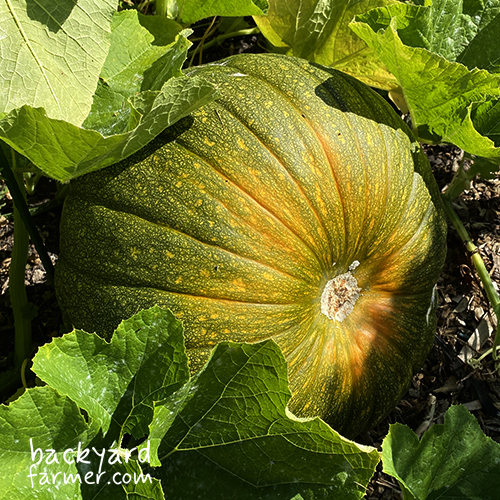
To support ripening:
- Keep the pumpkin dry and off wet soil to prevent rot.
- Remove only a small number of leaves if they are heavily shading the fruit.
- Late in the season, focus the plant’s energy on established pumpkins rather than new flowers or tiny fruit.
- If a damaging frost is forecast and the pumpkin is already well developed, harvesting may be safer than leaving it exposed.
It’s also important to understand that green does not always mean unripe — some varieties naturally mature in shades other than orange.
So before taking action, it’s worth checking what stage your pumpkin is actually at.
What Should I Do With My Pumpkin?
| Situation | What to do |
|---|---|
| Green pumpkin + healthy vine + mild weather | Leave it attached |
| Nearly mature but heavily shaded | Remove only a few shading leaves |
| Pumpkin sitting on damp soil | Raise it onto wood, slate or similar |
| Established pumpkins + very late flowers/tiny fruit | Consider removing the new growth |
| Green but rind and stalk appear mature | Check the variety’s mature colour |
| Nearly mature + damaging frost forecast | Harvest rather than risk serious damage |
| Picked slightly early | Some further colour/skin development may occur |
| Very immature + already picked | Keep expectations limited |
This table gives a quick way to decide what to do without overthinking it. In most cases, the safest option is still to leave the pumpkin growing if the vine is healthy.
Is Your Pumpkin Actually Unripe?
Before trying to “fix” a pumpkin that seems too green, it’s worth checking whether it is actually unripe at all.
Many people assume pumpkins must be orange to be ready, but that isn’t always true. While classic carving pumpkins do turn orange when mature, other varieties naturally finish in different colours — including green, grey, white, blue-grey or striped patterns.
It’s also easy to misjudge size. A large pumpkin can still be immature if it hasn’t fully developed its skin and internal structure, while a smaller pumpkin may already be fully mature and ready to harvest.
Colour alone is only one clue. A better approach is to consider:
- whether the skin is hardening;
- whether the stalk is starting to dry and cork;
- whether the plant is still actively growing;
- and what the expected mature colour of the variety should be.
If you’re unsure whether your pumpkin is ready to pick rather than how to ripen it, it’s worth checking a dedicated guide such as When to Harvest Pumpkins in the UK.
How to Help Pumpkins Ripen on the Vine
If your pumpkin is still developing, the vine is your best tool for helping it reach maturity. The goal is not to force ripening, but to support the plant so it can finish the job naturally.
1. Leave It on the Vine
The most important step is also the simplest: don’t rush to harvest.
A healthy vine continues to supply sugars and nutrients to the fruit. Even if the pumpkin looks slow to change colour, the plant is still working in the background. Removing it too early reduces the fruit’s ability to finish developing.
As long as the vine is green and functioning, it is usually better to let the pumpkin stay attached.
2. Let Some Light Reach the Pumpkin
Light can help with surface colour development, but it is not a cure-all.
- Remove only a leaf or two if they are directly covering the fruit.
- Avoid stripping large sections of foliage.
- Keep most leaves intact so the plant can continue photosynthesis.
Think of this as “tidying” rather than pruning. The plant still needs its leaves to feed the fruit.
3. Keep the Pumpkin Off Wet Ground
In a damp UK autumn, rot is often a bigger threat than slow ripening.
Placing the pumpkin on a piece of wood, slate, tile or even a dry board helps:
- reduce contact with wet soil;
- improve airflow around the fruit;
- lower the risk of soft spots developing.
This doesn’t directly speed up ripening, but it helps the pumpkin stay healthy long enough to finish maturing on the vine.
4. Concentrate the Plant on Established Fruit
As the season progresses, not all fruit on the plant will have time to mature.
- Very late flowers and tiny pumpkins are unlikely to reach full size in time.
- Removing these can help the plant focus energy on existing, more developed fruit.
- This is especially useful in late summer and early autumn.
However, avoid being too aggressive. The aim is gentle redirection, not heavy pruning.
Quick Box: What Not to Do
- Don’t strip most of the leaves from the plant.
- Don’t try to “force” ripening with drought stress.
- Don’t assume fertiliser will suddenly turn a pumpkin orange.
- Don’t keep moving or rotating heavy fruit unnecessarily.
How Late Can Pumpkins Keep Ripening in the UK?
Pumpkins don’t follow a strict calendar, but UK weather strongly influences how long they can continue developing.
August
Usually plenty of time remains. Growth is still active and conditions are generally favourable.
September
This is a key ripening period. Established pumpkins can still make significant progress, but it’s important to start watching night temperatures and rainfall more closely.
October
At this stage, weather becomes the deciding factor more than the plant itself. Consider:
- whether the vine is still green and healthy;
- how developed the pumpkin already is;
- how cold nights are becoming;
- whether heavy rain is persistent;
- and whether frost is likely in your area.
Sheltered gardens in southern parts of the UK may still have useful growing conditions, while exposed or northern sites may see growth slow much earlier.
Frost Is Forecast — Should I Pick My Pumpkin?
If a damaging frost is on the way, timing becomes critical.
A simple way to decide:
- Healthy vine + mild forecast → leave it longer.
- Nearly mature pumpkin + worsening weather → consider harvesting.
- Very immature fruit → extra time may still help, but risk increases quickly.
A damaging frost can affect both the fruit and the vine, so it is usually better to act slightly early than too late.
For more detail on timing, see When to Harvest Pumpkins in the UK.
Will Pumpkins Ripen Off the Vine?
Sometimes — but only partially.
If the Pumpkin Was Nearly Mature
A pumpkin that was already close to full maturity may continue to:
- develop deeper colour;
- harden its skin further;
- and improve its overall finish.
This is why slightly early harvesting can still produce good results.
If the Pumpkin Was Very Immature
If the pumpkin was still far from maturity:
- it will no longer receive nutrients from the plant;
- indoor conditions cannot fully replace vine development;
- and it may only change appearance slightly without truly maturing.
In short, off-vine ripening is limited. It can improve appearance, but it cannot fully recreate vine-grown development.
Should I Put a Green Pumpkin in a Sunny Window?
A warm, bright indoor spot can help a pumpkin continue to change colour slightly after harvest, especially if it was already partly mature.
However:
- warmth and light may improve surface appearance;
- but they do not replace the development that happens on the vine;
- and a completely immature pumpkin will not suddenly become fully mature indoors.
It’s best to think of this as a finishing step, not a transformation method.
My Pumpkin Is Still Green Before Halloween
This is a very common concern in UK gardens.
- If the vine is healthy and conditions are still reasonable, leave it growing.
- If frost or heavy rain is approaching, harvesting may be safer.
- If it has already been picked, allow it time indoors but manage expectations.
- If it’s a naturally green variety, it may already be close to its final colour.
If you’re planning ahead for next year, it may help to choose varieties and timings more carefully for Halloween displays.
→ How to Grow a Pumpkin for Halloween
Quick FAQs
It may still be immature, the weather may be slowing development, or the variety may not naturally turn orange when fully ripe.
Only remove a small number of leaves that are directly blocking the fruit. The plant still needs most of its foliage to feed the pumpkin.
Only partially, and mainly if it was already close to maturity. Very immature pumpkins will not fully ripen off the vine.
Yes, in many cases, but the texture and flavour may be less developed than a fully mature pumpkin.
Final Takeaway
The best approach to ripening pumpkins is usually patience. In most UK conditions, an immature pumpkin will benefit more from staying on a healthy vine than from being harvested early.
Support the plant, protect the fruit from wet soil, avoid removing too much foliage, and let the weather guide your timing. If you do need to harvest early, a nearly mature pumpkin may still improve slightly afterwards — but a very immature one has limited ability to finish ripening off the vine.
If you’re unsure what stage you’re at, or whether to pick now, it’s worth checking: