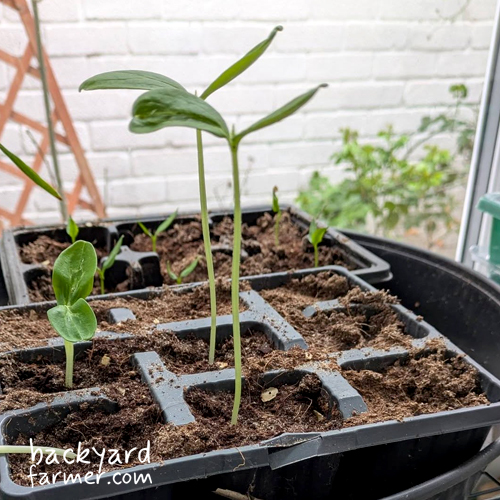
Leggy seedlings are young plants that have grown tall, thin and weak, usually because they aren’t receiving enough light. This commonly happens when vegetable seeds are started indoors during late winter and early spring in the UK.
Many stretched seedlings can still recover, but the best approach depends on the crop and how badly they’ve grown.
Leggy Seedlings at a Glance
| Problem | Leggy or stretched seedlings |
| Type | Environmental growth problem, not a disease |
| Main symptoms | Long, thin stems, leaning and weak growth |
| Primary cause | Insufficient light |
| Contributing factors | Excessive warmth, overcrowding and early sowing |
| Best immediate action | Improve light and adjust growing conditions |
| Can they recover? | Often, if stems remain healthy |
| Deep planting | Suitable for some crops, particularly tomatoes |
| When to resow | Severe weakness, damage or poor recovery prospects |
| Main prevention | Adequate light from emergence and suitable sowing dates |
How to Tell if Seedlings Are Leggy
Leggy seedlings develop unusually long, thin stems between the compost surface and their first leaves.
They may lean towards a window, struggle to remain upright or appear pale and stretched compared with healthy seedlings of the same age.
Common signs include:
- Long, narrow stems with relatively small leaves.
- Seedlings leaning towards a light source.
- Weak growth that struggles to support itself.
- Large gaps between leaves as plants develop.
- Rapid stretching shortly after germination.
A slightly stretched seedling isn’t necessarily unhealthy. The important thing is whether its stem remains firm and intact.
Leggy Seedlings or Damping Off?
A seedling falling over doesn’t automatically have damping off. Severe stretching, physical damage or root problems can also cause seedlings to collapse.
Damping off is caused by disease organisms that damage young seedlings, often around the compost surface.
| Leggy seedlings | Damping off |
|---|---|
| Stem is stretched but generally firm | Stem may become soft, narrowed or discoloured at compost level |
| Growth gradually becomes tall and weak | Seedlings often collapse suddenly |
| Usually linked to poor light and growing conditions | Caused by fungal or fungus-like pathogens |
| Healthy seedlings may recover | Collapsed infected seedlings rarely recover |
Check the stem at compost level for narrowing, softening or decay before assuming the problem is disease.
If you suspect an infection, see our Damping Off: Why Seedlings Collapse guide for identification and prevention.
How to Fix Leggy Seedlings
Healthy leggy seedlings can often be saved by improving light, adjusting temperature and giving them enough room to grow.
However, existing stretched stems won’t become shorter. The aim is to encourage stronger new growth and prevent further stretching.
Should You Rescue or Resow?
| Seedling condition | Recommended action |
|---|---|
| Slightly stretched with a firm stem | Keep and improve light |
| Tall, leaning but otherwise healthy | Improve conditions and consider potting on |
| Leggy tomato with healthy roots | Usually worth rescuing |
| Very thin, tangled or repeatedly falling over | Consider resowing |
| Stem soft or narrowed at compost level | Investigate damping off |
| Collapsed with a soft or decaying stem | Remove affected seedlings and investigate possible damping off |
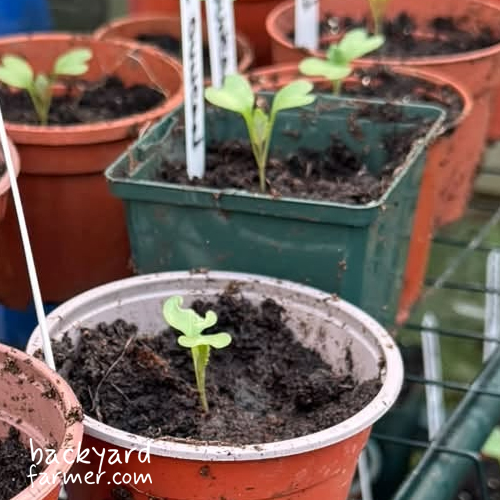
A later sowing under brighter conditions can sometimes establish more strongly than an earlier batch that has struggled indoors.
However, healthy seedlings don’t need discarding simply because they’re taller than expected.
What to Do Now
- Improve the light. Move seedlings into a brighter, suitable growing position or provide supplementary lighting where daylight is insufficient.
- Adjust the temperature. Remove unnecessary propagator heat after germination, while maintaining conditions suitable for the crop.
- Remove propagator covers. Take off lids or covers once seedlings emerge.
- Reduce overcrowding. Thin or prick out seedlings when they’re large enough to handle safely.
- Check compost moisture. Keep the growing medium appropriately moist without allowing it to remain saturated.
- Assess whether to repot. Some crops tolerate deeper planting, while others require greater care.
Correcting the light conditions comes first. Repotting won’t solve the problem if seedlings return to the same warm, poorly lit windowsill.
Extra fertiliser won’t correct stretching caused by insufficient light.
Can Leggy Seedlings Recover?
Yes. Many leggy seedlings can continue growing successfully when their stems remain healthy and growing conditions improve.
New growth may become more compact, although stretched sections won’t shrink.
A mildly leggy seedling can often develop into a productive plant. Severely weakened seedlings may struggle to establish, even after conditions improve.
Whether recovery is worthwhile depends on the crop, stem condition and remaining growing season.
If seedlings are badly damaged or unlikely to establish well, resowing may be the more practical choice.
Can You Plant Leggy Seedlings Deeper?
Planting leggy seedlings deeper can provide additional support, but the technique isn’t suitable for every vegetable.
Some crops tolerate buried stems well, while others are more sensitive to root disturbance, excess moisture or having their growing points covered.
| Crop | Recommended approach |
|---|---|
| Tomatoes | Usually tolerate deeper potting well |
| Cabbage, broccoli and kale | Some stretched seedlings can be carefully potted slightly deeper |
| Cucumbers, courgettes and squash | Sometimes possible, but delicate stems and roots require caution |
| Peppers and chillies | Improve light first; don’t assume tomato-style deep planting |
| Lettuce | Avoid burying the crown or growing point |
| Onions and leeks | Follow normal crop-specific transplanting guidance |
How to Save Leggy Tomato Seedlings
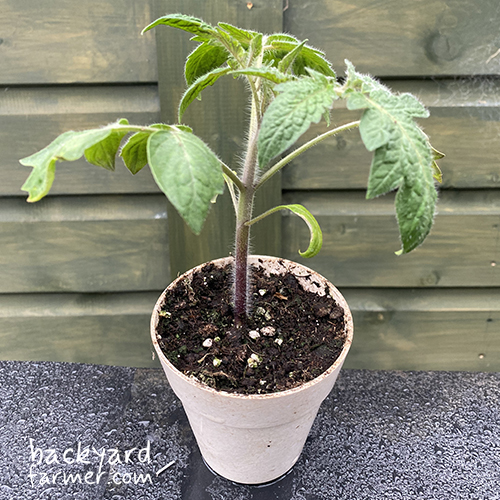
Tomatoes are particularly forgiving because their stems can produce additional roots when buried in suitable compost.
The RHS recommends planting leggy tomato seedlings deeper when pricking them out, leaving their first leaves above the compost.
Once seedlings have developed their first true leaves and are large enough to handle:
- Prepare individual pots with fresh, suitable compost.
- Carefully lift each seedling with a dibber, supporting its rootball and holding it gently by a leaf rather than the stem.
- Position it deeper in the new pot, burying part of the stretched stem.
- Keep the seed leaves or lowest suitable leaves above the compost.
- Water gently and return the plant to adequate light.
Avoid crushing or sharply bending fragile stems.
The buried stem can develop additional roots as the tomato establishes, but continued light deprivation will still produce weak growth.
For broader tomato-growing advice, see our How to Grow Tomatoes Outdoors guide.
Leggy Cabbage, Broccoli and Kale Seedlings
Brassicas commonly become stretched when raised in warm indoor conditions with insufficient light.
Some recover after careful pricking out or potting on, particularly when their stems remain firm.
Healthy but slightly stretched brassica seedlings can sometimes be positioned a little deeper when pricked out, keeping their seed leaves and growing points above the compost.
The aim is to support the stem, not bury a severely weakened plant.
Avoid burying damaged stems or leaving young plants in cold, saturated conditions.
If cabbage, broccoli or kale seedlings are extremely thin, tangled or repeatedly falling over, resowing may produce stronger plants.
Hardy brassicas can often grow on successfully in cooler, brighter protected conditions once temperatures are suitable.
For crop-specific advice, see our How to Grow Cabbage guide.
Leggy Cucumber, Courgette and Squash Seedlings
Cucumbers, courgettes and squash can become leggy when started indoors too early or kept warm without enough light.
Some experienced UK growers successfully pot these seedlings deeper, but this is an option rather than a standard requirement.
Their stems are delicate, and their roots generally dislike unnecessary disturbance.
If attempting deeper potting:
- Handle the seedling carefully without squeezing its stem.
- Disturb the rootball as little as possible.
- Keep the seed leaves and growing point above the compost.
- Avoid cold or saturated growing media.
- Provide suitable light and warmth after transplanting.
This is an optional rescue technique for healthy, stretched seedlings. For ordinary transplanting, follow the crop’s usual planting-depth guidance.
The technique isn’t guaranteed to work.
For severely stretched young cucumbers or courgettes, resowing may be simpler, particularly when spring conditions have improved.
For further growing guidance, see our How to Grow Courgettes guide.
What About Peppers, Lettuce and Other Seedlings?
Not every vegetable responds to deeper planting like a tomato.
Peppers and chillies should first receive better light and suitable growing-on temperatures. Avoid burying long sections of stem without appropriate crop-specific guidance.
Lettuce can sometimes be carefully transplanted, but its crown and growing point should remain above the compost.
Onions and leeks have their own transplanting requirements, so burying stretched foliage isn’t a general remedy.
Where deeper planting isn’t appropriate, improve growing conditions and consider resowing seedlings that are too weak to establish.
What Causes Leggy Seedlings?
The main cause of leggy seedlings is insufficient light.
Young plants respond to low light by extending their stems as they attempt to reach stronger illumination. This is commonly known as etiolation.
Other conditions can make the problem worse:
- Excessive warmth: High temperatures encourage rapid growth when available light is inadequate.
- Overcrowding: Closely spaced seedlings compete for light.
- Early sowing: Seeds may germinate successfully indoors before there is enough daylight to support compact growth.
Why Seedlings Become Leggy on UK Windowsills
A warm kitchen windowsill in February may provide suitable germination conditions but insufficient light for growing seedlings onwards.
Tomatoes intended for outdoor growing often don’t benefit from very early sowing unless suitable lighting is available.
Peppers and chillies may need a longer growing season, making earlier sowing more appropriate when adequate light and warmth can be provided.
Hardy brassicas can often be grown on in cooler, bright protected conditions, while courgettes and cucumbers generally grow quickly and rarely need excessively early sowing.
Turning seed trays can reduce leaning towards one side, but it doesn’t increase the amount of light reaching the plants.
Starting seeds earlier doesn’t automatically produce stronger plants or earlier harvests.
Use our UK Vegetable Planting Calendar to check suitable sowing dates for different crops.
Do You Need Grow Lights for Seedlings?
No. Grow lights can help when natural daylight is insufficient, but they aren’t essential for every UK gardener.
A bright spring windowsill may provide enough light for suitable crops, while an early February sowing may need supplementary lighting.
| Growing situation | Practical approach |
|---|---|
| Bright spring windowsill | May provide adequate natural light |
| Dim winter windowsill | Consider supplementary lighting or later sowing |
| Heated propagator after emergence | Move seedlings into better light and reassess warmth |
| Suitable LED growing setup | Follow the fixture’s guidance for intensity and distance |
| No grow lights available | Adjust sowing dates where practical |
A regular light-and-dark cycle is appropriate. Approximately 14–16 hours of artificial light daily is a common starting point for suitable seedling-lighting setups.
Lamp distance depends on the light’s output, design and heat, so there is no universal mounting height.
Where additional lighting isn’t practical, sowing later may be more effective than struggling to grow seedlings through the darkest part of winter.
How to Prevent Leggy Seedlings
Preventing leggy seedlings begins with planning where they’ll grow after germination, not just where the seeds will sprout.
Before Sowing
- Choose sowing dates suitable for the crop and growing conditions.
- Prepare a bright growing position for emerging seedlings.
- Use appropriate seed trays, modules or pots.
- Avoid unnecessarily dense sowing.
- Plan where seedlings will go after leaving the propagator.
After Germination
- Remove propagator covers promptly after emergence.
- Reduce unnecessary bottom heat.
- Maintain suitable light and temperatures for the crop.
- Keep compost appropriately moist without waterlogging.
- Thin or prick out seedlings when ready.
- Harden off indoor-raised plants gradually before planting outside.
Different crops require different growing-on temperatures.
Don’t move tender tomatoes, peppers or cucumbers into a cold greenhouse simply to prevent stretching.
Even hardy seedlings raised indoors should be acclimatised gradually before prolonged exposure to outdoor wind, sunlight and temperature changes.
The aim is to balance light, warmth and growing space throughout early development.
Frequently Asked Questions About Leggy Seedlings
Yes. Healthy seedlings can develop stronger new growth when conditions improve, although existing stretched stems won’t shorten. Severely weakened plants may be better resown.
Sometimes. Experienced growers do pot cucumbers deeper, but the stems and roots are delicate. Keep the growing point and seed leaves above the compost, avoid cold or saturated conditions and improve the lighting first.
Only when temperatures suit the crop. Indoor-raised seedlings need gradual hardening off before exposure to stronger sunlight, wind and outdoor conditions, even if they are relatively hardy. Tender crops can suffer damage if moved outside too early.
No. Gentle airflow may improve ventilation and encourage some mechanical strengthening, but it cannot compensate for inadequate light. Strong airflow can also dry out or damage delicate seedlings.
Consider resowing if seedlings are severely weak, damaged or unlikely to establish. Healthy seedlings with firm stems are often worth keeping, particularly tomatoes that can be replanted deeper.