
Most UK hedgehogs begin hibernating in October or November and emerge again around March or April. However, these months are only a guide.
Some hedgehogs settle down earlier or remain active later, depending on the weather, food availability, body condition and the individual animal. Hedgehogs also wake naturally during hibernation, so seeing one outside on a mild winter night does not automatically mean something is wrong.
Quick Guide: UK Hedgehog Hibernation Timeline
| Time of Year | What Hedgehogs May Be Doing | What Gardeners Should Know |
|---|---|---|
| September–October | Feeding heavily, building nests and preparing for winter | Some may begin hibernating, although many remain active |
| October–November | Main hibernation period begins | Avoid disturbing established nests and occupied hedgehog houses |
| December–January | Long periods of torpor with occasional waking | Healthy night-time activity can still be normal |
| February | Some begin becoming more active | Others may still be hibernating |
| March–April | Main emergence period | Put out fresh water and suitable food if hedgehogs return |
Individual hedgehogs can follow very different schedules, so dates vary between animals.
Why Do Hedgehog Hibernation Dates Vary?
There is no single temperature or date that triggers every hedgehog to hibernate.
Colder weather and fewer insects and other natural foods make conserving energy increasingly important, but body condition, age, breeding history, local weather and nest conditions also affect when an individual settles down. Late-born juveniles may remain active well into autumn or winter while building reserves.
Recent research from north-west England found considerable variation between individuals, with some tracked hedgehogs beginning hibernation in September and others not until December. The 2025 study also found that males tended to enter and emerge earlier than females, although this should not be treated as a fixed rule across the UK.
Do Hedgehogs Wake Up During Hibernation?
Yes. Hedgehog hibernation is not one continuous period of ordinary sleep.
Hedgehogs spend long periods in torpor, when their body temperature, heart rate, breathing and energy use fall dramatically. They naturally wake at intervals throughout winter. During these arousals, a hedgehog may remain inside its nest, come out to forage or move to another nest. Mild weather can make this activity more noticeable.
Seeing an alert hedgehog outside after dark in December, January or February can therefore be perfectly normal. Tracks, droppings or food disappearing after several quiet weeks may also indicate normal winter activity rather than a hedgehog in trouble.
What to Do If You See a Hedgehog in Winter
The month is less important than when the hedgehog is out, how it is behaving and what condition it appears to be in.
| What You See | What to Do |
|---|---|
| Alert hedgehog outside at night | Usually leave it alone and observe quietly |
| Hedgehog moving between nests at night | Keep the route clear and pets away |
| Hedgehog out during the day in autumn or winter | Contact the British Hedgehog Preservation Society or a wildlife rescue promptly for advice |
| Weak, cold, wobbly, injured or fly-covered hedgehog | Treat as urgent and seek professional help |
| Very small juvenile in autumn or winter | Seek advice based on its condition and circumstances rather than weight alone |
| Cold or motionless hedgehog lying exposed in the open | Seek urgent advice; this is not normal hibernation |
Do not rely on one weight figure to decide whether a juvenile needs rescuing. Behaviour, physical condition, weather and access to food matter too.
For more detailed rescue advice, see What to Do If a Hedgehog Is Out During the Day.
Where Do Hedgehogs Hibernate?
Hedgehogs normally hibernate inside well-insulated nests hidden somewhere quiet and sheltered, such as:
- dense hedges and shrubs
- beneath tree roots
- leaf and log piles
- brushwood
- compost heaps
- old burrows
- beneath sheds or other stable structures
- purpose-built hedgehog houses
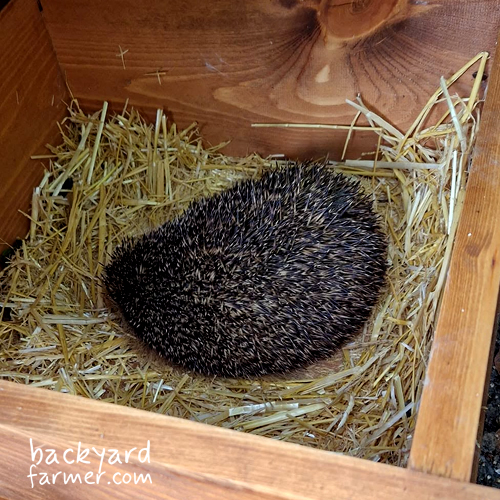
A hibernation nest, sometimes called a hibernaculum, is built from dry leaves, grass and other vegetation packed into a sheltered space. A well-positioned hedgehog house can provide similar shelter, but leave it undisturbed if it may be occupied.
What to Do If You Disturb a Hedgehog Nest
- Stop work immediately and keep pets and people away.
- If the nest is largely intact and the hedgehog appears uninjured, gently replace the original covering material.
- Leave the area quiet and avoid repeatedly checking it.
- If the nest has been destroyed, the hedgehog is exposed to bad weather or injury is possible, contact the British Hedgehog Preservation Society or a wildlife rescue before moving the hedgehog.
- If the hedgehog is weak, cold, wobbly, injured or fly-covered, seek urgent help.
A lightly disturbed nest can often be covered again and left alone. A destroyed or unsafe nest needs specialist advice. Do not move a hibernating hedgehog into another box or hedgehog house without guidance.
Should You Feed Hedgehogs During Winter?
If hedgehogs are still visiting your garden, continue offering suitable supplementary food and fresh water. As activity falls, reduce the amount rather than following a fixed date; if food goes untouched, reduce or pause it, then offer a small amount again if mild weather brings renewed activity.
Fresh water remains useful throughout winter and should be checked during freezing weather. Supplementary feeding can support active hedgehogs, but there is no good evidence that it prevents or delays hibernation.
For suitable foods, see What Do Hedgehogs Eat? If rodents are becoming a problem, see How to Feed Hedgehogs Without Attracting Rats.
How to Prepare Your Garden for Hedgehog Hibernation
- Leave some dry fallen leaves and sheltered vegetation.
- Avoid unnecessarily dismantling established log and leaf piles.
- Check compost heaps carefully before turning them.
- Check bonfires immediately before lighting.
- Inspect long grass and dense edges before using a mower or strimmer.
- Keep hedgehog access gaps between gardens open.
- Place hedgehog houses somewhere quiet, shaded and well drained.
- Avoid opening or inspecting houses during winter.
For broader habitat and access advice, see How to Attract Hedgehogs to Your Garden.
When Do Hedgehogs Come Out of Hibernation?
Hedgehogs commonly begin emerging during March and April, but there is no fixed wake-up date. Some become active earlier in mild weather, while others remain in hibernation for longer. One recent north-west England study found several weeks of variation between individual emergence dates.
Fresh droppings or new night-time camera sightings may show that local hedgehogs are becoming active again. Food disappearing can also be a clue, but does not confirm that a hedgehog is the visitor. Do not assume a hedgehog house is empty simply because spring has arrived
Final Verdict
Most UK hedgehogs hibernate from roughly October or November until March or April, but individual timing varies.
They also wake naturally during winter, so an alert hedgehog outside at night is not automatically in trouble. Use its behaviour, condition and situation to decide whether it needs help.