
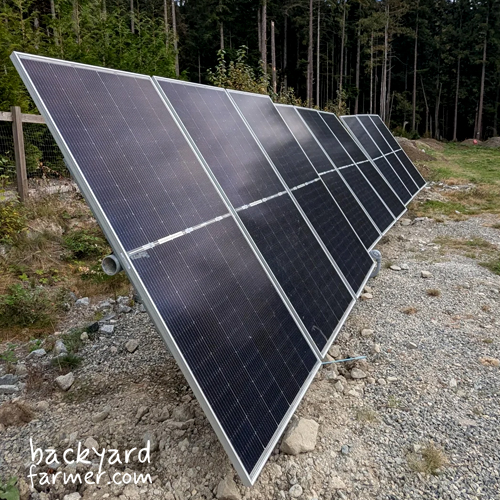
Choosing the right off-grid solar system depends on where and how it will be used. An RV, remote cabin and tiny home all have very different power, battery and installation requirements.
We’ve compared current US options and picked the strongest systems for each use case based on battery capacity, inverter capability, solar input, expandability, support and overall value.
Looking for UK options? See our guide to the Best Off-Grid Solar Kits UK.
Best for RVs — ECO-WORTHY 400W Complete MPPT Off-Grid Kit
Best for Cabins — Anker SOLIX F3800 400W Solar Panels
Best for Tiny Homes — EG4 6000XP Off-Grid Solar Kit
Not sure what size system you need? Use our Solar System Sizing Tool to estimate the panel, battery and inverter capacity required before comparing systems.
Off-Grid Solar System Comparison
These three systems suit very different types of off-grid use. The main differences are solar capacity, battery storage, inverter output and whether the system is mobile, integrated or permanently installed.
| System | Best For | Solar | Battery | Inverter | System Type | Expandable? | Typical US Price |
|---|---|---|---|---|---|---|---|
| ECO-WORTHY 400W Complete MPPT Kit | RVs | 400W | 2.56kWh nominal LiFePO4 | 2,000W pure sine | 12V modular RV system | Some | Check latest price |
| Anker SOLIX F3800 + 400W Solar Panel | Cabins | 400W included | 3.84kWh LFP | 6,000W / 9,000W surge | Integrated 120V / 240V system | Yes | Check latest price |
| EG4 6000XP + Indoor WallMount Kit | Tiny homes | 4.5–5.28kW | 16kWh nominal LiFePO4 | 6,000W continuous | 48V fixed modular system | Yes | Approx. $6,600+ |
Prices and configurations can change, so check the current battery, panel and inverter specification before ordering.
The distinction is simple: ECO-WORTHY suits mobile RV use, Anker offers a convenient high-output cabin system with room to add more solar, while EG4 is designed for permanent off-grid installations such as tiny homes.
Best for RVs — ECO-WORTHY 400W Complete MPPT Off-Grid Kit
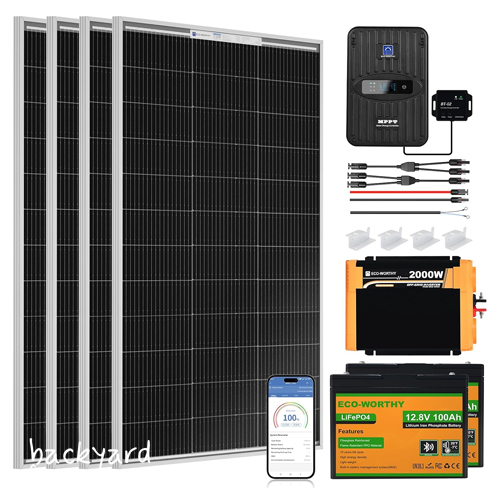
The ECO-WORTHY 400W Complete MPPT Off-Grid Kit is our current pick for RVs because it combines the main parts of a usable mobile solar system in one package.
It includes 400W of solar, two 100Ah LiFePO4 batteries, a 40A MPPT charge controller and a 2,000W pure sine wave inverter, giving it enough storage and inverter capacity for regular RV use rather than basic charging alone.
| Spec | Detail |
|---|---|
| Solar capacity | 400W |
| Solar panels | 4 × 100W |
| Battery | 2 × 12V 100Ah LiFePO4 |
| Battery capacity | Approx. 2.56kWh nominal |
| Inverter | 2,000W pure sine wave |
| Charge controller | 40A MPPT |
| System voltage | 12V |
| Monitoring | Bluetooth |
Best For
- RVs
- Campervans
- Travel trailers
- Boondocking
- Refrigeration
- Lighting
- Laptops and electronics
- Moderate appliance loads
Pros
- Complete solar, battery and inverter kit
- 2 × LiFePO4 batteries
- 40A MPPT controller
- 2,000W pure sine inverter
- Bluetooth monitoring
Cons
- High current under heavier 12V loads
- Usable storage is below nominal capacity
- More involved installation than a power station
- Check exact Amazon configuration
The main limitation is the 12V architecture. At higher inverter loads, current on the battery side becomes substantial, so correct cable sizing, fusing and installation matter.
For RV owners who want more than a basic charging kit, the ECO-WORTHY 400W offers a strong balance of solar generation, lithium storage and usable AC power.
Best for Cabins — Anker SOLIX F3800 + 400W Solar Panel
The Anker SOLIX F3800 + 400W Solar Panel is our pick for cabins because it combines substantial battery storage and unusually strong inverter output in a relatively simple integrated system.
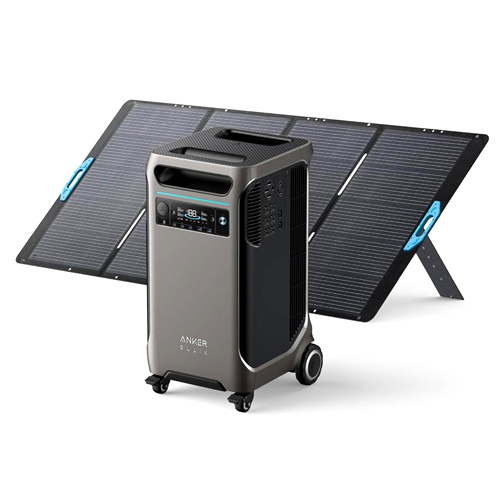
You get 3.84kWh of LFP storage, 6,000W of continuous AC output and 120V / 240V support, while the included 400W panel provides a starting point for solar charging. The F3800 can accept up to 2,400W of solar input, so fixed or additional panels can be added for a more capable cabin setup.
| Spec | Detail |
|---|---|
| Solar capacity included | 400W |
| Battery | 3.84kWh LFP |
| Inverter | 6,000W continuous |
| Surge output | 9,000W |
| AC output | 120V / 240V |
| Maximum solar input | Up to 2,400W |
| Battery expansion | Up to 26.88kWh per F3800 |
| Monitoring | Wi-Fi / Bluetooth app support |
Best For
- Remote cabins
- Weekend cabins
- Hunting cabins
- Refrigeration
- Lighting
- Routers and electronics
- Pumps
- Small appliances
Pros
- 6,000W continuous output
- 120V / 240V support
- Expandable battery storage
- Up to 2,400W solar input
- Simple integrated system
Cons
- Heavy at around 132lb
- Only 400W solar included
- 3.84kWh base storage may be limiting
- Less modular than a fixed off-grid system
The main limitation is that the F3800 is still an integrated power station rather than a permanently wired off-grid system. For a seasonal or regularly used cabin, that simplicity can be an advantage, but a full-time property may eventually benefit from a more modular setup.
For cabins that need serious inverter capacity without the complexity of a full permanent installation, the Anker SOLIX F3800 is a strong fit.
Best for Tiny Homes — EG4 6000XP + Indoor WallMount Off-Grid Solar Kit
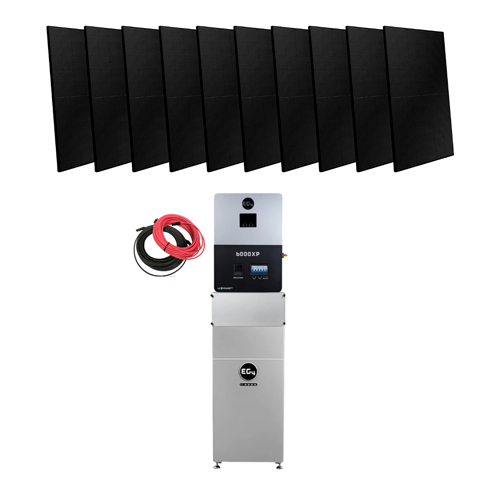
For a permanent tiny home or larger fixed off-grid setup, the EG4 6000XP + Indoor WallMount battery system is the strongest option in this shortlist.
Unlike the BougeRV and Anker systems, this is built much more like a proper fixed electrical system. It combines a 48V inverter/charger, large LiFePO4 battery storage and a substantial solar array, making it better suited to daily residential-style use where reliability and expandability matter more than portability.
| Spec | Detail |
|---|---|
| Solar capacity included | Approx. 4.5–5.28kW, depending on configuration |
| Battery | Approx. 16kWh nominal LiFePO4 |
| Inverter | 6,000W continuous |
| AC output | 120V / 240V split phase |
| System voltage | 48V |
| Solar input | Around 8kW supported |
| Charge controller | Dual MPPT |
| Generator input | Supported |
| Monitoring | EG4 remote monitoring |
| Battery expansion | Yes |
Best For
- Tiny homes
- Larger fixed off-grid installations
- Regular year-round use
- Multiple household appliances
- Refrigeration
- Pumps
- Workshop equipment
Pros
- Proper 48V architecture
- 6,000W continuous output
- 120V / 240V split phase
- Large LiFePO4 battery
- Strong expansion potential
Cons
- High upfront cost
- Requires proper system design
- Extra installation components may be needed
- Professional electrical input advisable
The main trade-off is complexity. This is not a portable solar generator that can simply be unpacked and plugged in; it is a fixed off-grid power system that needs appropriate electrical protection, cable sizing, battery installation and commissioning.
For a tiny home that needs a serious long-term system rather than temporary backup, though, the EG4 setup is the most appropriate of the three because it combines high-capacity storage, split-phase AC output and room to expand.
How to Choose the Right Off-Grid Solar System
The best off-grid solar system depends less on headline wattage and more on how the system will actually be used.
An RV, seasonal cabin and permanent tiny home all have very different requirements, so compare the battery, inverter, solar input and installation type as a complete system.
| What to Check | Why It Matters |
|---|---|
| Battery capacity | Determines how much stored energy is available when the panels are not producing |
| Inverter output | Determines how much equipment can run at the same time |
| Solar capacity | Determines how quickly the battery can be replenished |
| System type | Portable systems suit mobile/seasonal use; modular systems suit permanent installations |
| Expandability | Makes it easier to add storage or solar capacity as demand grows |
Battery Capacity
Compare usable battery capacity where available, rather than relying only on the headline figure.
A weekend RV may need relatively little storage, while a cabin or tiny home running refrigeration, pumps and appliances needs considerably more reserve for overnight use and poor weather.
Inverter Output
Use the inverter’s continuous output rating when deciding what the system can run normally.
Also check surge capacity for equipment such as:
- Refrigerators
- Freezers
- Pumps
- Motors
- Power tools
Peak output is intended for short startup demands, not continuous operation.
Solar Capacity
More battery storage is only useful if the system can recharge it.
Check both the solar panels included with the package and the system’s maximum supported solar input. This is especially important with expandable cabin and tiny-home systems where you may want to add more panels later.
If you’re new to solar generation, our guide to How Solar Panels Work explains how panels, batteries and inverters work together.
Portable or Fixed System?
For an RV, a compact 12V modular system makes sense because mobility and vehicle installation matter.
A cabin can benefit from an integrated system such as the Anker F3800, particularly where simplicity is important.
For a permanent tiny home, a 48V fixed modular system is generally the more appropriate foundation because it offers greater expansion potential and is designed around permanent electrical loads.
Leave Room to Expand
If your energy demand may grow, check whether the system supports:
- Additional batteries
- More solar panels
- Higher charging capacity
- Generator integration
- Monitoring and system management
Planning for expansion at the start is usually easier than replacing major components later.
Before You Buy an Off-Grid Solar System
Before ordering, check the complete system rather than comparing battery or solar wattage alone.
Off-grid solar checklist
- Confirm what is included — panels, battery, inverter, controller, cabling and mounting hardware can vary between packages.
- Check usable battery capacity where the manufacturer provides it.
- Use continuous inverter output for normal appliance loads rather than relying on the peak rating.
- Check maximum solar input if you expect to add more panels later.
- Confirm expansion options for additional batteries or system components.
- Check charging options such as AC, alternator or generator input where relevant.
- Allow for cold-weather use if batteries will be installed in an unheated RV, cabin or outbuilding.
- Check warranty and US support before committing to a higher-value system.
- Plan the installation first — larger fixed systems may require additional protection equipment, cabling and professional electrical work.
A lower purchase price does not necessarily mean a cheaper finished system if important components need to be added separately.
For RVs, cabins and tiny homes alike, the strongest choice is the system that matches your actual energy demand and installation type, not simply the one with the biggest battery or highest solar wattage.