
Plug-in solar panels are now legal in Great Britain under a new route introduced on 27 August 2026, allowing compliant small systems to feed electricity into a suitable household socket. Rules still apply around equipment, electrics, mounting and registration, so this guide covers what you can install, where it can go, what it may save and whether plug-in solar suits your home.
Plug-In Solar UK at a Glance
| Question | Current position |
|---|---|
| Legal in Great Britain? | Yes, from 27 August 2026 |
| Northern Ireland? | Not under the same current route |
| Maximum AC output | 800VA / approximately 3.5A |
| Maximum connected PV | 2,000W DC |
| Current number per household | One |
| Batteries included? | No |
| Electrician always required? | No, but the existing installation must be suitable |
| Registration required? | Yes |
| Extension lead allowed? | No |
| Works in a power cut? | No |
| Typical favourable generation | Around 690–700kWh/year in official modelling |
| Typical modelled saving | Roughly £70–£110/year, depending on use and installation |
What Are Plug-In Solar Panels?
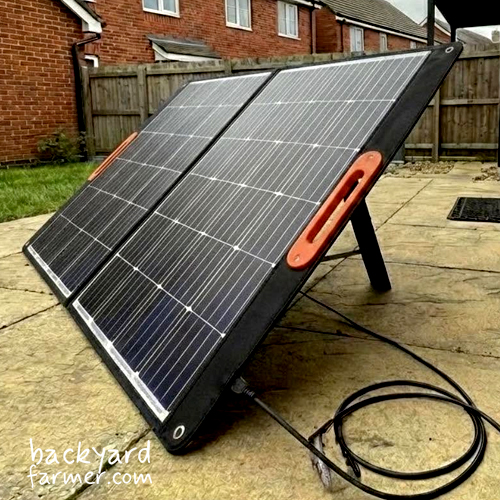
Plug-in solar panels are small grid-connected solar systems designed to feed solar electricity into a home through a suitable household socket, rather than a dedicated solar circuit. A typical system works like this:
Solar panels → compliant inverter → manufacturer-supplied cable and plug → suitable household socket
The panels produce DC electricity, which the inverter converts into grid-compatible AC. Your home uses that solar electricity while it is available; if demand is higher, the grid supplies the difference. If generation exceeds demand, surplus electricity may flow back to the network.
You may also see these systems described as plug-and-play solar, balcony solar, mini-PV or plug-in solar kits. “Balcony solar” usually describes the installation location rather than a different technology.
If you’re new to the technology, see how solar panels work first.
Can You Really Plug Solar Panels Into a UK Socket?
Yes — but only with a compliant plug-in solar system designed for that purpose. An ordinary solar panel cannot be connected directly to a household socket.
A compliant system needs the correct:
- grid-following inverter
- manufacturer-supplied cable and plug
- protection and anti-islanding controls
- installation and operating instructions
- product approval for the relevant network route
The inverter must also shut down if the grid fails, preventing the system from continuing to energise the network during a power cut.
What You Cannot Do
Do not:
- connect an ordinary solar panel directly to a mains plug
- mix random panels, inverters, cables or plugs into a DIY system
- use extension leads, multi-way adaptors, travel adaptors or plug-in RCD adaptors
- modify the supplied cable or plug unless the manufacturer specifically permits it
A product labelled “800W”, “UK plug” or “G98 compatible” is not automatically suitable. Check the exact model and its documentation before buying.
What Changed in August 2026?
From 27 August 2026, a new legal route became available in Great Britain for compliant plug-in solar systems. It allows eligible systems to connect through a suitable household socket instead of requiring the conventional installer-led process normally associated with rooftop solar.
The change only applies where the system:
- meets the relevant technical requirements
- stays within the permitted output limits
- uses eligible equipment
- connects through a suitable household socket
- is installed and operated according to the manufacturer’s instructions
- is registered with the electricity network
It does not remove the need to consider electrical safety, mounting, property permissions, planning rules or network requirements.
Does This Apply Across the Whole UK?
No. The current plug-in route applies to:
- England
- Scotland
- Wales
Northern Ireland has a separate electricity network and regulatory framework, so do not assume that a product or installation route approved for Great Britain can be used there without checking the relevant local requirements.
Best For
- Useful daytime electricity use
- Sunny, suitable panel location
- Homes wanting a simple solar setup
- People looking to reduce grid use
Pros
- Lower upfront cost
- Simple compliant plug-in route
- Reduces daytime grid electricity use
- Useful where full rooftop solar is impractical
Cons
- 800VA AC output limit
- No battery storage under the current route
- No power during outages
- Savings depend on sunlight and daytime use
- Surplus export may be unpaid
How Much Solar Can You Connect?
The key distinction is between the inverter’s AC output and the panels’ DC capacity.
The 800VA Output Limit
The current plug-in route limits the inverter to a maximum apparent power output of 800VA, equivalent to approximately 3.5A at a typical UK supply voltage.
This is the maximum amount the plug-in inverter can feed into the home’s electrical installation at one time.
800VA Does Not Mean Only 800W of Panels
The connected panels can have a combined capacity of up to 2,000W DC, subject to the product and installation requirements.
A larger panel array can help the inverter reach its permitted output more often during:
- cloudy weather
- early mornings
- late afternoons
- winter
- less-than-perfect orientations
- low-light conditions
The inverter still limits the electricity supplied to the household to 800VA.
800VA AC limit does not mean an 800W maximum solar array.
What Happens Above 960W of Panels?
A system with more than 960W of connected panels may still be permitted, provided it meets the relevant requirements. However, the manufacturer must advise that a professional electrical assessment should be considered.
The 960W figure is not a second inverter-output limit. Follow the manufacturer’s assessment guidance and arrange an electrical assessment if recommended.
How Many Plug-In Solar Systems Can You Have?
As of September 2026, the practical network position is one plug-in solar device per household.
The technical specification may refer to one device per final circuit, but the current network position restricts the arrangement to one plug-in device per household. This helps prevent multiple systems being added without considering total generation at the property.
One device may include several panels connected to one inverter, provided the complete system remains within the permitted limits.
If you already have solar, battery storage or another generator, check with your DNO or existing installer before adding a plug-in system.
Do You Need to Notify the DNO?
Yes. Plug-in solar must be registered with the electricity network.
The distribution network operator, or DNO, manages the local electricity network serving your property. Even a small plug-in system can export electricity, so the network needs to know that it is connected.
Under the current consumer route:
- Check the exact make and model on the appropriate ENA register or product list.
- Confirm that the complete system is eligible for the plug-in route.
- Use the national plug-in solar registration process.
- Provide the requested property and product information.
- Complete registration before first use, following the current instructions.
This is simpler than a conventional installer-led G98 or G99 application, but the network requirement still applies.
Check the Exact Product, Not Just the Brand
Check:
- exact model number
- inverter model
- maximum AC output
- panel capacity
- product certification or register entry
- supplied cable and plug arrangement
- installation restrictions
- whether the product is intended for Great Britain
A listing that says “UK plug”, “800W” or “G98 compatible” is not enough on its own.
What If You Already Have Solar or Battery Storage?
Network rules consider the total generation connected at the property. Existing equipment may include:
- rooftop solar
- a solar battery inverter
- a wind turbine
- a micro-CHP system
- another generator
- an existing plug-in solar device
Adding another 800VA of generation could take the property beyond the conditions for a simplified connection. The inverter capacity of a battery system may also count even if the battery is not exporting at the time.
If you already have solar, storage or another generator, contact your DNO or existing installer before buying. They can confirm whether the proposed addition can use the plug-in route or needs a different application.
Do not try to design a G98 or G99 arrangement yourself.
Can Plug-In Solar Use a Battery?
Not under the current Great Britain plug-in solar route. Plug-in batteries and plug-in solar systems integrated with battery storage are excluded from the present arrangement.
If battery storage is central to what you want from solar, a conventional or hybrid solar-and-battery system is likely to be more suitable. That route uses different equipment, connection requirements and installation checks.
If storage and greater independence are the goal, compare the wider solar and off-grid options available.
Electrical Installation and Socket Requirements
An electrician is not automatically required, but the existing electrical installation must be suitable. A compliant plug-in solar system is designed to connect through an appropriate fixed household socket, provided the circuit and socket are in good condition and capable of safely carrying the additional load.
Before connecting a system, check that:
- the socket is secure and undamaged
- the circuit is suitable and not overloaded
- the required protective devices are in place
- the supplied cable and plug can be used without modification
- the cable route is safe and protected from water or mechanical damage where necessary
- the system is installed and used exactly as the manufacturer specifies
Arrange a professional electrical assessment if the installation is old, in poor condition, uses rewireable fuses, has a loose or damaged socket, already carries heavy loads, or you are simply unsure whether it is suitable.
Can You Use an Extension Lead?
No – Do not use:
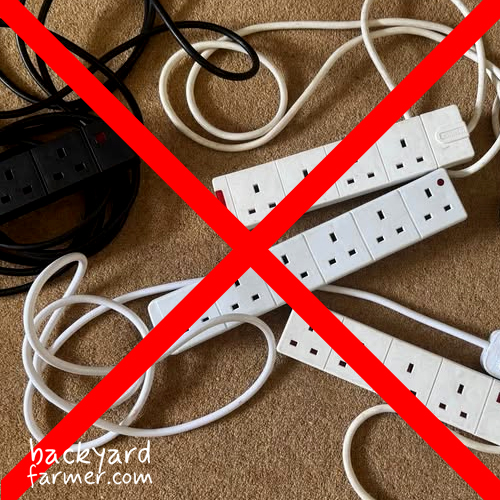
- extension leads
- multi-way adaptors
- travel adaptors
- plug converters
- plug-in RCD adaptors
- improvised cable extensions
If the supplied cable does not reach a suitable socket, the answer is not an extension lead. The installation needs a different solution.
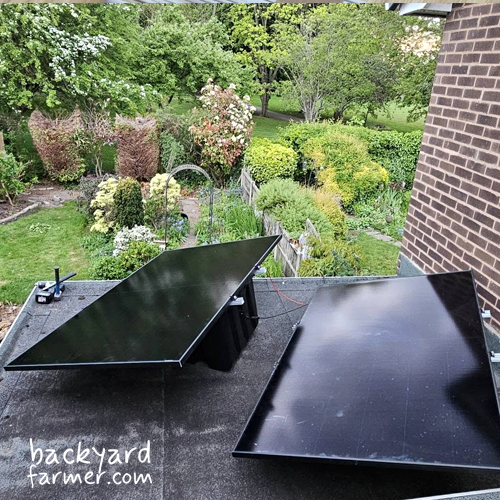
Can You Put Plug-In Solar on a Balcony?
Sometimes. Balcony solar is possible in Great Britain, but not every balcony or building is suitable.
You need to consider:
- the balcony’s construction
- the mounting system
- wind loading
- fire safety
- access and escape routes
- building-owner permission
- lease or tenancy restrictions
- planning requirements
- the condition of the façade or balustrade
Balconies and Cladding That May Not Be Suitable
The current Interim Product Specification prohibits installation on:
- timber balconies
- timber cladding
- aluminium composite material (ACM)
- metal composite material (MCM)
- high-pressure laminate (HPL)
These restrictions relate to fire behaviour, structural safety and the interaction between panels, brackets and the building.
Use a manufacturer-approved mounting arrangement that accounts for:
- wind pressure and uplift
- snow loading
- panel weight
- fixing strength
- corrosion
- balcony movement
- drainage and weatherproofing
- maintenance access
Panels must be secured so they cannot fall, swing into neighbouring property or create a hazard below. They must not obstruct escape routes, rescue access, doors or windows.
If you live in a block of flats, the balcony may be part of the building’s structure or common property even if you have exclusive use. Ask the freeholder, managing agent or building owner before installing anything.
A Garden or Patio May Be Easier
A properly mounted small array in a sunny garden or patio may be simpler than attaching panels to a balcony or façade.
A ground-mounted arrangement still needs to be secure and safe. It should not create a trip hazard, obstruct access or be vulnerable to theft or wind damage.
Compare orientation, shading and mounting complexity before choosing a balcony installation. See Best Orientation for Solar Panels.
Renters, Leaseholders and Planning Permission
Renters and leaseholders may be able to use plug-in solar, but electrical compliance does not override property rights or planning rules.
You may need permission from:
- your landlord
- a freeholder
- a managing agent
- a housing association
- a building owner
- a residents’ management company
Ask for permission in writing and keep the product information, mounting details and insurance requirements available. A system can be electrically legal but still prohibited by a tenancy agreement, lease or building-management rule.
Planning rules are separate and devolved, so England, Scotland and Wales do not have identical requirements. Relevant considerations may include:
- whether the panels are on a house, flat or outbuilding
- whether they are roof-mounted, wall-mounted or ground-mounted
- whether the property is listed
- whether it is in a conservation area or another designated area
- whether the installation projects beyond the building
- whether it affects the appearance of a block
- whether it is visible from a public area
England changed relevant permitted-development rules in August 2026, but you should not assume the same position applies everywhere in Great Britain.
Planning permission is also separate from:
- landlord permission
- freeholder consent
- lease restrictions
- building-management rules
- structural approval
For unusual or visible installations, check with the relevant local planning authority before buying. You can also review the relevant planning guidance on GOV.UK.
How Much Do Plug-In Solar Panels Cost?
Plug-in solar systems that meet the new UK requirements currently start at around £450, according to the Energy Saving Trust. A basic system may include the panels, microinverter, mounting equipment and connection cables.
The market is very new, so prices and product availability may change quickly. Check the exact model against the current ENA register rather than choosing a system on price alone.
How Much Electricity Can Plug-In Solar Generate?
Generation depends on the installation.
Official modelling provides useful reference points:
- An 800W-class system facing south at around a 30-degree angle may generate approximately 690–700kWh per year.
- A vertically mounted east- or west-facing system may generate approximately 378kWh per year in a comparable reference scenario.
These are not guarantees. Actual output depends on:
- location in the UK
- orientation
- panel angle
- shading
- panel capacity
- inverter limits
- weather
- dirt and obstructions
- system availability
- cable and equipment losses
A south-facing installation is not automatically best if it is heavily shaded. A clear east- or west-facing location may produce more useful electricity than a shaded south-facing one.
The inverter may limit output during bright conditions. A larger DC array can help the system reach its 800VA AC limit more often, but it cannot increase the permitted maximum output.
What Does That Mean for a Typical Home?
In one favourable official scenario:
- annual generation was around 690kWh
- modelled household consumption was approximately 3,323kWh
- generation was therefore equivalent to roughly one-fifth of annual demand
- only around 428kWh was self-consumed
This distinction matters:
Annual generation share is not the same as grid independence.
A system may generate electricity equivalent to around 20% of annual household use while reducing grid imports by substantially less. Solar generation is concentrated during daylight hours, while household demand continues in the evenings, overnight and during darker winter periods.
Daytime occupancy and flexible electricity use can therefore have a significant effect on the financial result.
How Much Could Plug-In Solar Save?
Published illustrative scenarios suggest savings of roughly £70–£110 per year, depending on the installation and how much electricity the household uses while the panels are generating.
The exact figure depends on:
- annual generation
- electricity unit rate
- daytime electricity demand
- shading and orientation
- how much electricity is exported
- whether export payments are available
- system cost
- maintenance and replacement costs
Electricity used in the home while the panels are generating directly reduces grid imports. Electricity generated when the home is using very little may flow to the grid instead and may be worth less than electricity bought from the grid, or may not qualify for payment.
Useful daytime loads can include:
- fridge and freezer
- broadband router
- home-office equipment
- ventilation systems
- dehumidifiers
- aquarium equipment
- scheduled washing machine use
- scheduled dishwasher use
Shift flexible loads where convenient and safe, but do not waste electricity simply to increase self-consumption.
Could Plug-In Solar Work for Your Home?
Answer a few quick questions about your home, where the panels could go and how you use electricity during the day. We’ll show whether plug-in solar looks like a good fit, along with a rough estimate of annual generation and potential savings.
Your goal
What do you want plug-in solar to do?
Choose the answer that best matches your main goal.
Panel location
Where could the panels go?
Choose the most realistic location you have available.
Balcony check
What is the balcony mainly made from?
This is a simple suitability screen, not a structural assessment.
Daytime use
What is usually happening at home during daylight?
This helps estimate how much solar electricity you could use directly.
Solar access
How sunny is the location?
You do not need exact solar data — just choose the closest match.
Panel position
Which description best matches the panel position?
Choose the closest match to keep the estimate transparent.
Electrical check
How would you describe the electrical installation?
If you are unsure, the tool will recommend checking before buying.
Existing generation
Do you already have solar panels, battery storage or another generator?
Existing equipment can change the network connection route.
Property permission
Do you have permission to use the proposed location?
Think about landlord, freeholder, managing-agent and planning requirements where relevant.
Your result
Your rough plug-in solar estimate
How this estimate works
The base cases are anchored to DESNZ modelling for an 800W system: about 690kWh generation / 428kWh self-used for a south-facing 30° installation, and 378kWh / 272kWh for a vertical east-or-west-facing installation.
BYF uses simple assumptions for shading, daytime use and illustrative system size. This is a screening estimate rather than a system design. Export income is assumed to be £0.
For a separate shed, workshop or garden office, size a standalone solar system instead.
Checklist Before You Buy
Before buying a plug-in solar system, check:
- The exact model is approved for the current GB plug-in route
- Your socket and electrics are suitable
- The panel location gets enough sun
- The mounting location is permitted and structurally suitable
- You understand the 800VA output and current one-device limit
- You register the system with the electricity network before use
Frequently Asked Questions
They are legal under the current route in Great Britain from 27 August 2026, provided the system and installation meet the relevant requirements. Northern Ireland has a separate network and regulatory framework.
You can connect a compliant plug-in solar system to a suitable household socket. You cannot connect an ordinary solar panel directly to a mains socket.
The current practical network position is one plug-in solar device per household. That device may contain more than one panel, provided the complete system remains within the permitted limits.
The inverter output is limited to 800VA, approximately 3.5A. The connected panels can have a higher combined DC capacity, up to 2,000W under the current route, subject to the product and installation requirements.
Yes. The system must be registered with the electricity network using the current plug-in solar registration process. Check the exact product model before buying.
Not automatically. A suitable compliant system can connect to an appropriate existing socket, but the electrical installation must be safe and suitable. An assessment is advisable where the wiring, consumer unit or socket condition is uncertain.
Potentially. The balcony, mounting system, building materials, fire safety, structural loading and property permissions all need to be considered. Timber balconies and certain cladding materials may be excluded or unsuitable.
Potentially, with the necessary permission from the landlord, freeholder, managing agent or building owner. Electrical rules do not override tenancy agreements or lease restrictions.
Not under the current Great Britain plug-in solar route. Plug-in batteries and solar systems integrated with battery storage are excluded from the current arrangement.
No. The standard grid-following inverter shuts down when the grid fails. Plug-in solar is not a backup-power system.
For systems built around storage and independent power, see the UK off-grid solar guide.
Possibly, but do not assume eligibility. Supplier requirements, certification, metering and evidence rules may apply. Base your financial calculation on self-consumption unless your supplier confirms otherwise. See the Ofgem Smart Export Guarantee guidance.
Official illustrative scenarios suggest roughly £70–£110 per year, depending on the installation, electricity prices and household usage. Actual savings may be lower or higher.
Final Verdict

Plug-in solar is a useful new option for reducing daytime grid electricity use without installing a full rooftop solar system. For the right home, a small compliant setup can be simple, relatively affordable and genuinely useful.
It is not a replacement for conventional solar, battery storage or blackout backup. But if your aim is simply to use more of your own electricity and rely a little less on the grid, plug-in solar can make good practical sense.