
For most UK solar installations, an unshaded south-facing position is the best starting point if you want to maximise annual electricity generation. But panels do not need to face perfectly south to work well.
South-east and south-west are both strong options, while east- and west-facing panels can still produce useful amounts of electricity throughout the year. The angle matters too, but there is no single “perfect” solar panel angle for the whole UK.
In practice, the best position depends on direction, roof pitch, shading and where you live. Here’s what actually matters.
Best Orientation for Solar Panels UK — Quick Answer
| Orientation | Typical UK Suitability | Main Consideration |
|---|---|---|
| South | Excellent | Best general direction for maximum annual generation |
| South-east / South-west | Very good | Usually only a modest compromise from due south |
| East / West | Good | Lower annual output, but useful morning or afternoon generation |
| North-east / North-west | Site-dependent | Roof pitch and location become increasingly important |
| North | Usually poor | Site-specific modelling is recommended |
For most installations, the practical order is simple:
Minimise shading → favour a broadly southerly position where possible → use a sensible roof pitch → worry about exact degrees last.
Which Direction Should Solar Panels Face in the UK?
South-facing panels are the benchmark for fixed solar systems because they receive strong exposure as the sun moves across the southern part of the sky.
South-east and south-west-facing roofs are also very good options. They shift more generation towards the morning or afternoon respectively, but usually involve only a modest compromise from due south.
East- and west-facing roofs can still be worthwhile, particularly when their generation profile matches household demand. North-facing roofs are generally the least favourable and should be assessed using site-specific modelling.
Are East- or West-Facing Solar Panels Worth It?
For many UK properties, yes.
As a general guide, an east- or west-facing system tends to produce around 15–20% less electricity over the year than an equivalent system facing directly south. That does not necessarily make it a poor choice.
East-facing panels generate more electricity in the morning, while west-facing panels produce relatively more in the afternoon and early evening. This can be useful if you:
- use more electricity early in the morning
- use more electricity in the late afternoon
- want generation spread across a wider part of the day
Shading also matters. An unshaded east- or west-facing roof can be more useful than a south-facing roof that is heavily shaded by trees, chimneys or nearby buildings.
Can You Use North-Facing Solar Panels?
Solar panels can generate electricity on a north-facing roof, but in the UK it is usually the least favourable direction because the panels spend more of the day facing away from the strongest solar exposure.
A shallow north-facing roof is generally less disadvantaged than a steeply pitched one. As the roof becomes steeper, the panels point more directly away from the southern sky.
The actual result depends on:

- roof pitch
- exact orientation
- location within the UK
- surrounding shading
- panel layout
If north-facing space is your only realistic option, model the actual roof before ruling it in or out.
What Is the Best Angle for Solar Panels in the UK?
There is no single perfect solar panel angle for the whole UK.
A common shortcut is to assume the best angle should match the latitude, leading to claims that UK panels should sit at around 55°. For a real fixed installation, it is not that simple.
The best angle varies with:
- your location
- the direction the panels face
- local solar conditions
- whether you want maximum annual output
- whether summer or winter generation matters more
- the practical pitch of the roof or mounting system
Modern solar calculations therefore use the actual location, orientation and panel tilt rather than applying one UK-wide angle.
What About Normal UK Roof Pitches?
Most conventional UK pitched roofs sit somewhere around 30–45°, which is already a sensible range for fixed rooftop solar.
If you already have a suitable, unshaded and well-oriented pitched roof, there is often little reason to introduce a complicated raised mounting system simply to chase a few degrees of theoretical improvement.
For most homeowners, shade and orientation deserve attention before tiny differences in panel angle.
Summer vs Winter Solar Panel Angle
The sun travels higher across the sky in summer and remains lower in winter. This creates a useful general rule:
- Shallower panel angles favour the higher summer sun
- Steeper panel angles favour the lower winter sun
A fixed rooftop system normally has to compromise between the two.
For a grid-connected home, maximising total annual generation is usually the main objective. An off-grid system may place greater value on winter output, when solar production is lower and energy demand can be higher.
That can make a steeper fixed array or adjustable ground-mounted system useful in some off-grid installations. The appropriate angle still depends on the site and how the system will be used.
If you’re planning an independent setup, see our Off-Grid Solar Systems UK guide for the wider system-planning side.
Shading Can Matter More Than the Perfect Angle
One of the easiest mistakes is focusing on whether panels should face 180°, 170° or 160° while overlooking an obstruction that shades the array.
Common causes of solar-panel shading include:
- trees and hedges
- chimneys
- nearby buildings
- roof features and dormers
- other rows of solar panels
- structures around ground-mounted arrays
Partial shading can reduce generation, and its effect changes throughout the year. A tree that causes little trouble when the summer sun is high may create much longer shadows in winter.
A good solar survey therefore looks beyond compass direction. A slightly imperfect orientation with clear exposure can outperform a theoretically ideal orientation with significant shading.
If you’re ready to get quotes, see our guide to the best solar companies in the UK to compare installers, accreditation, aftercare and system design.
Pitched Roofs, Flat Roofs and Ground-Mounted Panels
| Installation | Practical approach |
|---|---|
| Pitched roof | Usually follow the existing roof pitch and direction |
| Flat roof | Use tilted mounting, while allowing for spacing, ballast, fixing and wind-loading requirements |
| Ground mount | Choose orientation and tilt more freely, with seasonal adjustment possible in some systems |
On a pitched roof, raised frames may add unnecessary complexity if the existing pitch is already suitable. The roof and mounting system must also safely handle panel weight, wind loading and weather exposure.
Flat roofs provide more control over direction and tilt, but steeper mounting can increase wind loading, ballast or fixing requirements, and the spacing needed between rows. There is no single flat-roof tilt that is automatically best for every UK installation.
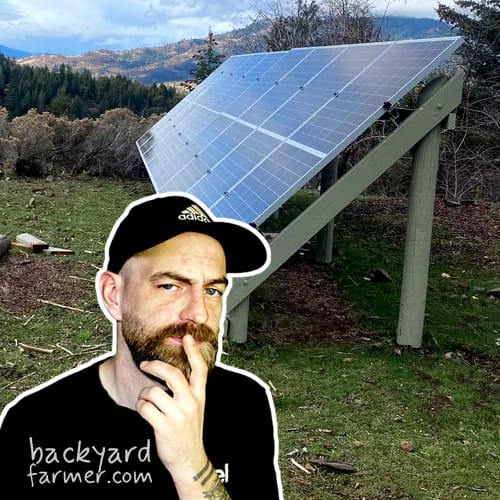
Ground-mounted arrays offer the greatest freedom and can be useful for off-grid properties, cabins, rural buildings, homes without a suitable roof and larger land-based installations.
If you’re positioning a small socket-connected array, see the current plug-in solar rules.
What About Solar Trackers?
Solar trackers move panels to follow the sun. They can increase exposure, but they also add moving parts, structural complexity and installation requirements.
They are not normally used for everyday UK rooftop systems. For most small installations, a well-positioned fixed array is the simpler solution.
Check Your Own Roof With PVGIS
If you want to compare different angles or directions for your location, PVGIS is one of the most useful free tools available.
You can enter:
- your location
- solar array size
- panel technology
- expected system losses
- panel angle/slope
- orientation/azimuth
PVGIS can then estimate monthly and annual electricity generation. It is useful for comparing south with south-east or south-west, different roof pitches, east against west, unusual roof orientations and possible ground-mounted positions.
Not Sure What Size Solar System You Need?
Once you know where the panels can go, the next question is how much solar capacity you need.
Our free Solar System Sizing Tool lets you add the appliances you want to power and estimate the panel capacity, battery storage and inverter size your setup requires.
Bottom Line: The Best Solar Panel Position in the UK
For most UK installations, you do not need to chase a mathematically perfect angle.
The practical priorities are:
- Minimise shading wherever possible
- Choose a south-facing or broadly southerly position if available
- Do not dismiss south-east, south-west, east or west-facing roofs
- Use the existing roof pitch where it already provides a sensible installation
- Treat north-facing and unusual setups as site-specific
- Use PVGIS to compare the actual orientation and angle when the answer is not obvious
An unshaded south-facing array remains the best general starting point for maximum annual generation, but the best real-world solar installation is the one that works with the site you actually have.