

An on-grid solar system, also called grid-connected or grid-tied solar, generates electricity for your home while remaining connected to the electricity network. Your home uses solar energy when it is available, the grid supplies any shortfall, and surplus electricity can be exported or stored in a battery. You do not need a battery to install on-grid solar, and installing solar panels does not mean going off-grid.
On-Grid Solar at a Glance
| Question | Answer |
|---|---|
| Connected to electricity grid? | Yes |
| Battery required? | No |
| Can you still import electricity? | Yes |
| Can surplus solar be exported? | Yes |
| Works during a power cut? | Normally no |
| DNO registration required? | Yes |
| Typical household setup | Panels + inverter + household connection |
| Current EST example | Around 4.5kWp / 12 panels |
UK note: The G98, G99, G100 and Smart Export Guarantee information in this guide applies to Great Britain (England, Scotland and Wales). Northern Ireland uses separate NIE Networks connection and export arrangements.
What Is an On-Grid Solar System?
An on-grid solar system is a solar photovoltaic system connected to both your home and the public electricity grid. It generates electricity during daylight hours and works alongside the grid rather than replacing it.
You may also see the same arrangement described as:
- on-grid solar
- grid-connected solar
- grid-tied solar
- grid-connected photovoltaic system
In most household contexts, these terms refer to the same type of installation.
The basic flow is:
Solar panels → inverter → home ↔ electricity grid
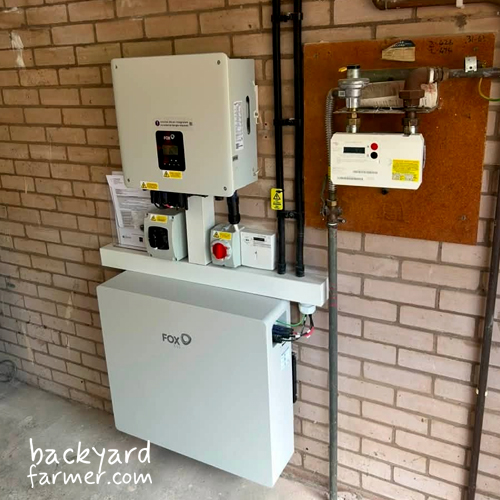
The panels generate direct current (DC) electricity from sunlight. The inverter converts it into alternating current (AC), which is compatible with your home’s electrical system and the wider electricity network. Solar can supply household demand when available, while the grid covers shortfalls and receives surplus generation.
How Do Solar Panels Connect to the Grid?
The normal route for connecting solar panels to the grid is:
Panels → inverter → household electrical installation → meter → grid
This describes the system architecture rather than a DIY wiring method. The electrical connection must be designed, installed, tested and documented by a suitably qualified installer.
1. Solar panels generate DC electricity
Solar panels produce DC electricity when light reaches their photovoltaic cells. Generation varies throughout the day and across the year, with output usually highest around the middle of a clear day and lowest at night or during heavy shading.
2. The inverter converts the electricity
Household appliances and the electricity grid use AC electricity, so the DC electricity from the panels must pass through an inverter.
The inverter:
- converts DC electricity into AC electricity
- synchronises with the grid’s voltage and frequency
- monitors system operation and safety conditions
- shuts down if the grid supply fails
The inverter controls the interface between the panels, your home and the network.
3. Solar electricity supplies household demand
Once converted into AC electricity, solar generation becomes available to the property’s electrical system, reducing the amount of electricity that needs to be imported while the panels are generating.
4. Surplus electricity can be stored or exported
If solar generation is higher than household demand, the excess may:
- charge a battery
- power an immersion heater or other controllable load
- be exported to the electricity grid
A suitable import/export meter records electricity flowing into and out of the property. This allows your supplier to calculate imports and, where applicable, exports.
5. The grid supplies any shortfall
Solar generation is variable, while household demand continues throughout the day and night. When your home needs more electricity than the panels are producing, the grid automatically supplies the difference.
There is no need to manually switch between solar and grid electricity.
When Solar Produces More Than Your Home Is Using
Imagine that:
- Home demand is 500W
- Solar production is 1,500W
Around 500W can be used by appliances operating in the home. The remaining 1,000W is surplus.
If you have a battery, some or all of that surplus may be stored for later. If the battery is full, or if you do not have one, the remaining electricity may be exported to the grid.
When Your Home Needs More Than Solar Is Producing
Now imagine that:
- Home demand is 2,000W
- Solar production is 800W
The solar system can contribute around 800W. The grid supplies the remaining 1,200W.
This can happen when you use several appliances at once, when solar output is reduced by cloud or shading, or when generation is falling in the evening.
What Happens at Night?
Solar panels do not normally generate electricity at night. Without a battery, your home imports electricity from the grid in the usual way.
With a battery, stored electricity may supply some household demand after sunset. Once the battery is empty, the grid supplies the remaining demand.
The key takeaway is simple:
The grid simply fills in the gaps.
Does Your House Really Use Solar First?
Saying that a home “uses solar first” is useful shorthand. There is no physical switch choosing between solar and grid electricity: both operate together, with solar reducing your property’s net demand from the grid. If generation exceeds demand, the surplus can be stored or exported.
Does On-Grid Solar Make You Grid Independent?
No. An on-grid solar system can reduce your reliance on the grid, but it does not normally make your home grid independent.
Several different measurements are often confused:
- Annual solar generation: the total electricity produced by the panels over a year
- Solar self-consumption: the proportion of generated solar electricity used directly in the home
- Grid imports: electricity bought from the grid
- Exports: surplus electricity sent to the grid
- Grid electricity independence / self-sufficiency: the proportion of household electricity demand supplied without importing electricity from the grid
A home might generate as much electricity over a year as it consumes, but still import electricity at night and during winter. It may export surplus electricity during sunny summer days and then buy electricity from the grid when solar output is low.
Generating as much electricity as your home uses over a year does not mean you are grid independent.
The timing of generation and demand matters as much as the annual total. A battery, smart controls or flexible electricity use can increase the amount of solar energy consumed on-site, but a standard on-grid system remains connected to the network.
Want to know how much of your actual household electricity solar could cover? → Can Solar Panels Power My House UK.
What Does an On-Grid Solar System Include?
| Component | What it does |
|---|---|
| Solar panels | Generate DC electricity |
| Mounting system | Secures the panels to the roof or ground structure |
| Inverter | Converts DC into grid-compatible AC |
| Household connection | Feeds solar into the home’s electrical system |
| Import/export meter | Records electricity flowing to and from the grid |
| Monitoring | Tracks system production and performance |
| Battery | Optional — stores surplus electricity |
| EPS/backup equipment | Optional — needed for designed outage backup |
Exact equipment varies by system design, and modern installations may use string inverters, microinverters or additional monitoring and control equipment.
Do You Need a Battery With On-Grid Solar?
No. A battery is optional for a standard on-grid solar system.
Without a battery, the basic energy flow is:
Solar → home → surplus export
With a battery, the flow may be:
Solar → home → battery → later household use → remaining export
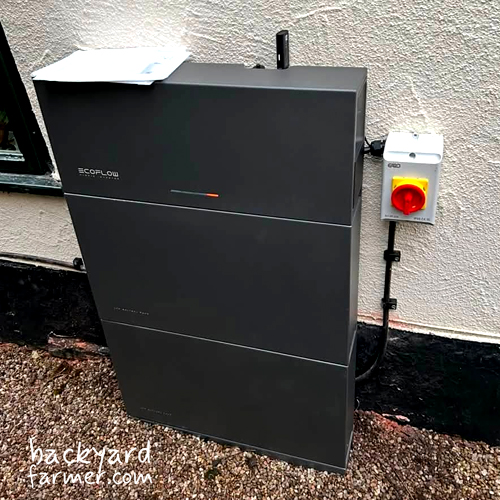
A battery can increase self-consumption by storing some daytime solar for use in the evening or overnight. This may reduce grid imports, particularly if your household uses most of its electricity outside daylight hours.
However, a battery:
- adds significant cost
- introduces charging and discharging losses
- has a finite operating life
- does not automatically provide blackout backup
For more detail, see Solar Battery Storage UK.
What Happens to Excess Solar Electricity?
Once current household demand and any available battery charging are satisfied, surplus electricity can flow through the meter and onto the grid. Other controllable loads, such as an immersion heater, may also use the surplus if the system supports them.
Can You Get Paid for Exported Solar?
Potentially. The Smart Export Guarantee (SEG) is the main framework through which eligible small-scale generators can receive payments for electricity exported to the grid.
Payment is not automatic simply because you have solar panels. You generally need:
- an eligible installation
- appropriate metering
- relevant certification or documentation
- an export tariff with a participating supplier
Tariff rates and terms vary between suppliers. The company that supplies your imported electricity does not necessarily have to be the same company that pays you for exports.
Does On-Grid Solar Work During a Power Cut?
Normally no.
A standard grid-connected inverter shuts down when the network fails to prevent the installation from energising a network that should be dead. This safety feature is known as anti-islanding.
This means:
- panels alone do not provide backup power
- a battery does not automatically provide blackout protection
- backup operation requires compatible EPS or backup equipment
- the system must be designed to isolate the property safely from the grid
See Solar During a Power Cut UK for more information.
Do You Need to Notify Your DNO About Solar Panels?
Your Distribution Network Operator (DNO) runs the local electricity network your home connects to. Grid-connected solar must follow the appropriate DNO connection process, which may involve notification or approval depending on the system.
The relevant process depends mainly on the system’s AC output, connection arrangement and whether export is limited.
| Route | Broad use |
|---|---|
| G98 | Up to 16A registered AC generation per phase |
| G99 | Larger or non-G98 generation connections |
| G100 | Export limitation where agreed with the DNO |
The Important 3.68kW Point
The commonly quoted 3.68kW G98 figure refers to roughly 16A of AC generation on a single phase — not necessarily the total DC wattage of the solar panels.
This distinction matters because a solar array’s panel capacity is normally described in DC kilowatt-peak, or kWp, while the DNO connection threshold relates to the inverter’s AC output.
A PV array can therefore have a different DC kWp rating from the inverter’s maximum AC output.
In broad terms:
- G98 is commonly a connect-and-notify route for qualifying systems
- G99 generally applies to larger or more complex generation connections
- G100 relates to agreed export limitation arrangements
- the installer normally handles the DNO notification or application
- export limiting does not automatically turn a larger system into a G98 installation
The correct route depends on the complete installation and local network, so your installer should confirm it before work begins.
Do You Need an MCS Installer?
MCS is not a universal legal requirement for every privately funded solar installation.
However, an MCS-certified installer is the mainstream professional route for household solar in the UK. MCS can provide:
- recognised installation standards
- consumer protection and documentation
- structured performance calculations
- a clearer route to eligibility for some export arrangements
If you want an export tariff, check its certification requirements before choosing an installer.
Conventional household solar involves mains and network-connected electrical work, so installation should be handled by appropriately competent professionals.
On-Grid vs Plug-In vs Hybrid vs Off-Grid Solar
These terms describe different system arrangements and should not be treated as interchangeable.
| System | Connected to grid? | Battery required? | Export? | Blackout operation? | Best suited to |
|---|---|---|---|---|---|
| On-grid | Yes | No | Yes | Normally no | Normal household rooftop solar |
| Plug-in solar | Yes | No under current GB route | Possible | No | Small daytime offset |
| Hybrid solar | Yes | No, but commonly fitted | Yes | Only if designed for it | Greater self-consumption and flexibility |
| Off-grid | No | Usually | No public-grid export | Yes, by design | Independent or remote systems |
For smaller socket-connected systems, see Plug-In Solar Panels UK. For independent systems, see the Off-Grid Solar guide. Hybrid systems get their own guide in this cluster.
What Does a Typical UK On-Grid Solar System Look Like?
For a current reference example, the Energy Saving Trust describes a system of around:
- 4.5kWp
- roughly 12 panels
- approximately 20–30m² of roof area
- an indicative installed cost of around £7,600, as of July 2026
This is a reference example rather than a recommendation. The right system depends on roof space, orientation, shading, electricity use, budget and plans for future loads such as an EV or heat pump.
See How Many Solar Panels Do I Need UK?
How Much Electricity Will It Generate?
The amount of electricity an on-grid solar system generates depends mainly on:
- location
- orientation and pitch
- shading
- installed capacity
- system losses
East- or west-facing arrays can still perform well, although their generation profile may differ from a south-facing system.
A site-specific estimate using recognised modelling is more useful than a generic national rule of thumb. Installers may use MCS methodology, PVGIS or other recognised modelling tools to estimate annual and monthly generation.
See how much of your electricity solar could realistically supply → Home Solar Calculator
Frequently Asked Questions
Yes, broadly. “On-grid”, “grid-connected” and “grid-tied” generally describe a solar system that remains connected to the public electricity network.
Yes. The grid automatically supplies any demand that solar generation cannot meet, including electricity used at night or during periods of low solar output.
No. A standard on-grid system can operate with solar panels, an inverter and the appropriate household and grid connection. A battery is optional.
It may be used by household appliances, stored in a battery if one is installed, directed to another controllable load or exported to the grid.
Normally not. A standard grid-connected inverter shuts down during a power cut for safety reasons. Backup operation requires a system with suitable isolation and EPS or backup equipment.
No. The commonly quoted 3.68kW figure is associated with the approximate 16A single-phase AC generation threshold used for G98 connections. It is not a universal maximum for the total DC capacity of a solar panel array.
Yes. The appropriate DNO notification, application or approval process applies to grid-connected generation. Your installer will normally manage this as part of the installation.
Potentially. Eligible systems may receive payments through an export tariff such as the Smart Export Guarantee. You need to meet the supplier’s requirements and arrange an appropriate tariff.
Final Verdict
An on-grid solar system does not replace the electricity grid — it works alongside it. Solar supplies your home when available, the grid covers shortfalls, and surplus electricity can be exported or stored in a battery.
For most UK homes considering conventional rooftop solar, this is the standard starting point for reducing grid imports without going fully off-grid.
See How Much of Your Electricity Solar Could Supply
→ Can Solar Panels Power My House UK