
Quick answer: Gardening by the Moon means using lunar rhythms as an additional guide for deciding when to sow, plant, tend or harvest crops.
Different systems use the Moon in different ways. Simple moon gardening often focuses on waxing and waning phases, while biodynamic calendars also use the Moon’s position in relation to the zodiac to divide days into Root, Leaf, Flower and Fruit periods.
Already know the basics? Use our free Biodynamic Planting Calendar to see today’s day type and which crops are actually in season.
For many gardeners, lunar timing is an optional extra layer of planning alongside soil temperature, frost risk, crop rotation, seed-sowing instructions and the weather forecast. That matters in the UK, where suitable planting dates vary considerably between Cornwall, the Midlands, Scotland and coastal areas. A lunar calendar may suggest a useful day type, but it cannot replace checking whether the ground is workable or conditions are warm enough for a particular crop.
What Does Gardening by the Moon Mean?
Gardening by the Moon is the practice of using the Moon’s cycle as a guide for planning garden activities. Depending on the tradition, this might mean sowing during a waxing or waning Moon, planting particular crops on certain lunar days, or timing harvesting and other jobs according to a lunar calendar.
There is no single universally agreed version of moon gardening. Some systems use the visible phases of the Moon, while others use its position against the zodiac, ascending and descending periods, or a combination of astronomical cycles.
For a home gardener, the idea is usually straightforward: choose a suitable gardening date, then use the Moon as one more factor in deciding which task to do. You might choose a Root day for sowing carrots, a Leaf day for planting lettuce, or a Fruit day for tending tomatoes.
Moon gardening is an additional timing system, not a replacement for normal horticultural judgement. It should not override practical information about frost, soil condition, crop readiness, daylight, watering or pest control.
Why Gardeners Use Lunar Calendars
People follow lunar calendars to:
- choose possible sowing, planting or harvesting dates
- create a repeatable rhythm through the growing season
- connect with traditional gardening practices
- compare different planting dates in their own garden
Some gardeners use a lunar calendar for every crop, while others consult one occasionally. It can be a planning prompt, a gardening experiment or simply an interesting way to organise seasonal work.
These reasons describe how gardeners use lunar calendars; they do not, by themselves, demonstrate that lunar timing improves germination, yield or crop quality.
Moon Gardening vs Biodynamic Gardening
Moon gardening and biodynamic gardening overlap, but they are not interchangeable terms.
| Moon gardening | Biodynamic gardening |
|---|---|
| Broad term for gardening according to lunar rhythms | A wider agricultural/gardening system |
| Often focuses on waxing and waning Moon phases | Uses a broader range of astronomical rhythms |
| Can be followed independently | Includes soil fertility, composting, preparations and whole-garden thinking |
| Does not necessarily use Root/Leaf/Flower/Fruit days | Biodynamic calendars commonly use these crop-day categories |
In some phase-based moon-gardening systems, above-ground crops are associated with a waxing Moon and root crops with a waning Moon. These rules vary between traditions and do not necessarily involve a particular philosophy of soil management.
Biodynamic gardening is broader. It treats the garden or farm as an interconnected living system and may include composting methods, soil-building practices, biodiversity, crop rotations and biodynamic preparations, as well as an astronomical calendar.
Using a biodynamic calendar does not automatically mean someone is practising biodynamic gardening in full. A gardener may use the Root, Leaf, Flower and Fruit categories simply as an optional planting guide.
How a Biodynamic Planting Calendar Works
The BYF Biodynamic Planting Calendar uses the traditional Root, Leaf, Flower and Fruit classification system, as described by the Biodynamic Association.
The Moon moves through the zodiac during its sidereal cycle. In biodynamic tradition, different parts of the zodiac are associated with four elements, which are then linked with different parts of the plant:
- Earth → Root
- Water → Leaf
- Air/Light → Flower
- Fire/Warmth → Fruit
The Moon’s position in the zodiac determines the traditional day type. BYF then combines that classification with ordinary seasonal crop timing so the calendar only suggests jobs that are realistic for the selected date and region.
A Fruit day, for example, does not automatically make it sensible to plant tender courgettes outdoors in February. A Root day does not make frozen or waterlogged soil suitable for sowing carrots.
The practical question is therefore not simply “What day is it?” but “What is the day type, and which of my seasonally suitable garden jobs could fit it?”
See today’s Root, Leaf, Flower or Fruit day in the Biodynamic Planting Calendar.
Root, Leaf, Flower and Fruit Days Explained
| Day | Traditional association | Typical examples |
|---|---|---|
| Root | Earth | Carrots, beetroot, radish, potatoes and other crops valued mainly for roots or underground parts |
| Leaf | Water | Lettuce, spinach, cabbage and other leafy crops |
| Flower | Air/Light | Broccoli, flowering herbs and plants grown for blooms |
| Fruit | Fire/Warmth | Tomatoes, beans, peas, cucumbers, courgettes and other fruiting crops |
These categories describe the part of the plant that the gardener is mainly trying to develop or harvest. They are not strict botanical classifications, so some crops may appear in a group that is not immediately obvious.
Root Days
Root days are traditionally associated with underground plant parts. Typical examples include carrots, beetroot, radishes, onions, garlic and potatoes.
A gardener following this system might choose a Root day for sowing, planting or harvesting root crops. The category is based on the part of the plant that matters most for the harvest, not on every task carried out that day.
Leaf Days
Leaf days are associated with plants grown mainly for their leaves or leafy growth, including lettuce, spinach, chard, kale, cabbage, rocket and many herbs.
A gardener might use a Leaf day for sowing salad leaves, planting out brassica seedlings or harvesting leafy crops. Seasonal conditions still come first: a Leaf day is not a reason to plant tender seedlings into cold or waterlogged ground.
Flower Days
Flower days are traditionally linked with plants grown for their flowers or flowering parts. This includes ornamental flowers, flowering herbs and vegetables harvested for immature flower heads.
Broccoli is a common example. Although it is usually thought of as a vegetable, the part harvested is a flower head, so it is placed in the Flower category in biodynamic calendars.
Flower days may therefore be used for sowing or planting flowers, tending flowering herbs or working with crops such as broccoli. The category is about the plant part being developed, rather than whether the crop is edible or ornamental.
Fruit Days
Fruit days are associated with crops grown for their fruits, pods or seeds. Common UK examples include tomatoes, beans, peas, cucumbers, courgettes, pumpkins, squashes and sweetcorn.
A gardener might choose a Fruit day for sowing beans, planting out tomatoes, tying in cucumber plants or harvesting ripe courgettes. The calendar cannot replace frost protection or the need to wait until tender plants are ready to go outside.
Is Planting by the Moon Just About Waxing and Waning?
No — not in a biodynamic planting calendar.
“Planting by the Moon” can describe several systems. The most familiar is based on the visible phases of the Moon, while the biodynamic Root, Leaf, Flower and Fruit system is based primarily on the Moon’s movement through the zodiac.
The Synodic Cycle
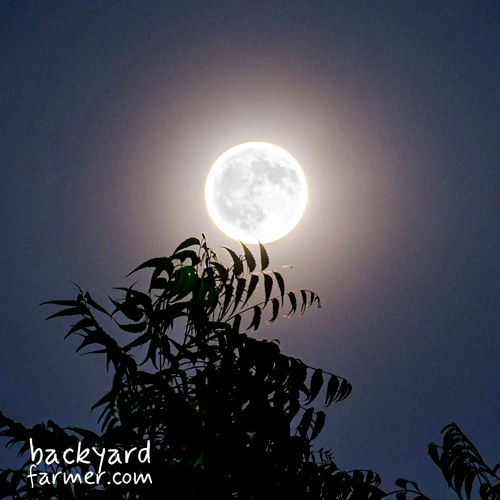
The synodic cycle is the familiar cycle of visible Moon phases:
- New Moon
- waxing Moon
- Full Moon
- waning Moon
This cycle takes roughly 29.5 days. In simple moon-gardening traditions, the waxing Moon is sometimes associated with crops that grow above ground, while the waning Moon is associated with root crops, pruning or harvesting. The Biodynamic Association and standard astronomy references distinguish this synodic cycle from the Moon’s sidereal cycle.
These rules vary between sources. Some calendars place sowing around the New Moon, others around the Full Moon, and some use the phases mainly as a general rhythm.
The Sidereal Cycle
The sidereal cycle describes the Moon’s movement through the zodiac constellations. It takes approximately 27.3 days and is central to the Root, Leaf, Flower and Fruit system.
In a biodynamic calendar, the Moon’s position in the zodiac identifies the day type. The visible phase may be waxing or waning at the same time, but it does not determine whether the day is classified as Root, Leaf, Flower or Fruit.
Two days with a similar visible Moon phase can therefore have different biodynamic day types. Conversely, a Root day can occur during either a waxing or waning phase.
Detailed biodynamic calendars may also consider ascending and descending Moon periods, lunar nodes and other astronomical events. These are separate from the day-type information currently exposed by the BYF tool.
Is a Planting Calendar the Same as Biodynamic Gardening?
No.
A planting calendar is a timing tool. Biodynamic gardening is a wider approach to managing soil, plants, compost, wildlife and the garden as a connected system.
Where Biodynamic Gardening Came From
Modern biodynamics began with Rudolf Steiner’s agricultural lectures in 1924. These provided the starting point for an approach that considered astronomical rhythms, soil fertility, preparations and the farm as an integrated organism. The Biodynamic Association’s historical resources provide further background on Steiner’s agricultural course.
The familiar Root, Leaf, Flower and Fruit planting-calendar system developed later, particularly through the work of Maria Thun and other biodynamic growers. It is therefore more accurate to describe the modern planting calendar as part of the later development of biodynamic practice rather than something Steiner personally invented in its current form.
Biodynamics Beyond Lunar Timing
Biodynamic gardening may include:
- building and maintaining soil fertility
- making and using compost
- encouraging biodiversity
- planning the farm or garden as an interconnected organism
- using crop rotations and mixed habitats
- applying biodynamic preparations
- observing seasonal and astronomical rhythms
The astronomical calendar is one part of this wider system, not the entire practice. Someone can use a biodynamic planting calendar without making biodynamic preparations, and someone can follow biodynamic soil and composting principles without using every calendar recommendation.
Does Gardening by the Moon Actually Work?
There is a long tradition of growers using lunar calendars, but scientific evidence specifically showing that sowing crops on Root, Leaf, Flower or Fruit days improves their performance is limited and contested.
Personal experience, tradition and controlled scientific evidence should therefore be kept distinct.
What Biodynamic Growers Report
Biodynamic growers have used astronomical calendars for many decades. Maria Thun and other practitioners conducted planting trials within the biodynamic tradition and reported differences between crops sown on different types of days.
These reports form an important part of the history of biodynamic gardening and help explain why the Root, Leaf, Flower and Fruit system remains popular.
However, reported experience and tradition are not the same as settled independent proof. Results can be affected by weather, soil, seed quality, sowing depth, watering, pest pressure and many other variables.
What Controlled Research Says
Reviews examining agricultural claims based on lunar phases have generally found insufficient reliable evidence to establish a consistent agricultural benefit. See, for example, this review of lunar influences on plant growth and agricultural practice.
Research on simple lunar phases should not be automatically extended to the Root, Leaf, Flower and Fruit system, which uses a different classification method. Studies may not test the exact calendar used by a particular gardener.
The most accurate conclusion is cautious: there is a long-standing tradition and a substantial body of practical claims, but no clear scientific consensus that following these planting dates reliably improves crop performance.
Plants Can Respond to Moonlight — But That Is a Different Question
Plants can respond to extremely low levels of light, and researchers continue to study how moonlight and other environmental signals may affect plant behaviour. A recent 2026 review in Plant Science examines plant responses to moonlight and related light signals.
That does not demonstrate that a Root day improves carrots or a Fruit day improves tomatoes. A plant’s ability to detect or respond to moonlight is a different question from whether a particular lunar calendar produces better germination, growth or yield.
Evidence that plants can respond to moonlight is not evidence that the Root, Leaf, Flower and Fruit timing system improves crop performance.
What About Research on Biodynamic Farming?
Some research reports benefits from whole biodynamic farming systems, including possible effects on soil characteristics, biodiversity and farm ecology. See the peer-reviewed review of biodynamic agriculture for an overview of this research.
Those findings cannot automatically be attributed to lunar planting. Biodynamic farms may also differ from conventional farms in soil management, organic inputs, crop rotations, biodiversity, tillage, composting and biodynamic preparations.
If a whole farm system produces different results, it is difficult to identify which individual element caused the difference. Lunar timing may be one part of the system, but it should not automatically be treated as the sole explanation.
How to Try Gardening by the Moon Yourself
The simplest way to explore lunar gardening is to treat it as a small comparison rather than reorganising your entire plot.
Start Small
Choose one or two crops that you already grow successfully. Fast-germinating crops such as radishes, salad leaves or beans can make differences easier to observe, although any suitable seasonal crop can be used.
Do not change every part of your gardening routine at once. A small trial is easier to manage and less likely to be confused by differences in soil, watering or variety.
Compare Like With Like
For a simple comparison, use:
- the same seed variety
- similar soil or compost
- the same sowing depth
- similar watering, light and spacing
- two or more suitable sowing dates
- one date aligned with the calendar and one ordinary suitable date
Keep the dates reasonably close together. If one batch is sown in early spring and another in midsummer, temperature and daylight will make the comparison difficult to interpret.
Record What Happens
Track:
- germination rate and speed
- early vigour
- pest or disease issues
- transplanting success
- harvest date
- total yield
- crop quality
A notebook or spreadsheet is enough. Include the weather and unusual events such as a late frost, heavy rain or drought.
One season may produce an interesting result, but it is not enough to establish a reliable pattern. Repeat the comparison across more than one season before drawing firm conclusions.
Check the Biodynamic Planting Calendar and choose a date to test.
What Should Take Priority Over the Moon?
For UK gardeners, normal growing conditions should come first.
A practical priority order is:
- Frost and temperature
- Soil condition
- Crop and seedling readiness
- Weather
- Available time
- Lunar timing
This order is especially important for tender crops. Tomatoes, courgettes, cucumbers, pumpkins and beans can be damaged or killed by cold conditions, regardless of the lunar day.
Examples:
- Don’t sow carrots into frozen soil because it happens to be a Root day.
- Don’t plant tender courgettes outside ahead of frost because the calendar says Fruit day.
- Don’t work waterlogged soil to hit an ideal lunar date.
- Don’t leave seedlings overcrowded or pot-bound while waiting several weeks for a preferred day.
- If conditions are poor, wait for another suitable opportunity.
A calendar can help you choose between several sensible dates. It should not turn an unsuitable date into a suitable one.
Use the Moon as an extra timing layer, not as a replacement for good gardening judgement.
This is why the BYF calendar combines biodynamic classification with normal seasonal crop data. The day type can suggest which jobs to consider, while the crop information helps show whether those jobs are appropriate for the time of year.
Using the Biodynamic Calendar With the Allotment Planner
The tools answer different planning questions:
- Biodynamic Calendar → helps decide when
- Allotment Planner → helps decide what fits and where it goes
- Grow guides → explain how to grow the crop
For example, you might use the Allotment Planner to find space for a row of carrots, check the crop’s seasonal window in a grow guide, and then use the Biodynamic Calendar to identify a suitable Root day within that window.
This keeps lunar timing in its proper place: as one useful planning layer within a wider gardening process.
Frequently Asked Questions
Moon gardening is the practice of using lunar rhythms to help plan sowing, planting, harvesting or other garden work. Different systems use visible Moon phases, zodiac positions or named day types.
It is not one single calendar system.
Planting by the Moon means timing planting or other gardening work around lunar cycles. Some traditions use waxing and waning phases, while others use zodiac positions or Root, Leaf, Flower and Fruit days.
No. Lunar timing can form part of biodynamic practice, but biodynamics is a wider approach that may include soil fertility, composting, biodiversity, preparations and whole-garden thinking.
They are four traditional biodynamic day types linked with different parts of the plant:
– Root days: underground crops such as carrots and beetroot
– Leaf days: leafy crops such as lettuce and spinach
– Flower days: flowers and crops such as broccoli
– Fruit days: fruiting and seed-bearing crops such as tomatoes and beans
You can see the current classification in the Biodynamic Planting Calendar.
That depends on the system you are following. Some traditions use waxing and waning rules, while biodynamic calendars rely more heavily on the Moon’s sidereal movement through the zodiac.
A biodynamic Root, Leaf, Flower or Fruit day is not determined simply by whether the Moon is waxing or waning.
No clear scientific consensus establishes that following lunar planting dates improves crop performance.
Research into plant responses to moonlight and whole biodynamic farming systems does not automatically prove that sowing a crop on a particular Root, Leaf, Flower or Fruit day produces better results.
Yes. Frost, temperature, soil condition, weather and crop readiness should take priority.
A suitable lunar day cannot make frozen, waterlogged or excessively dry soil suitable for planting.
No. Treat the calendar as an optional additional timing guide. You can use it for selected crops, compare it with your usual planting dates or ignore it when practical conditions are more important.
You can see today’s Root, Leaf, Flower or Fruit classification in the Biodynamic Planting Calendar.