

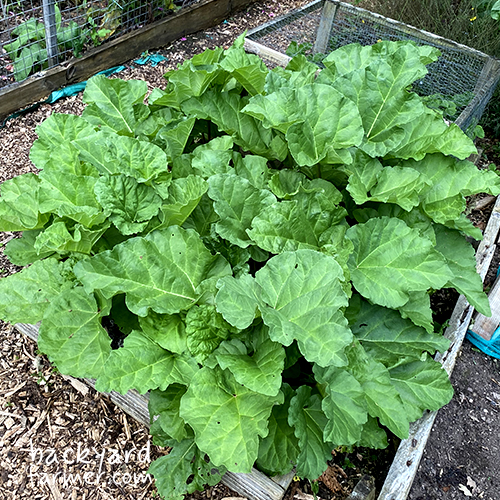
Rhubarb (Rheum × hybridum) is a hardy perennial that can remain productive for ten years or longer. The easiest way to grow it is from a dormant crown planted between November and March.
Choose its position carefully, as rhubarb dislikes being moved unnecessarily. Give each crown fertile, moisture-retentive but well-drained soil, around 90 cm of space and its first growing season without harvesting.
Rhubarb growing at a glance
| Question | Quick answer |
|---|---|
| Best way to start | Dormant crown |
| Plant bare-root crowns | November–March |
| Best position | Full sun or light shade |
| Soil | Fertile, moisture-retentive but well drained |
| Spacing | Approximately 90 cm |
| First harvest | A few stalks in year two; normally from year three |
| Main harvest season | April–June |
| Productive life | At least ten years, often longer |
What is the best way to start rhubarb?
A dormant crown is the best choice for most gardeners. It is economical, straightforward to plant and should establish more reliably than seed.
| Starting method | Best for | What to know |
|---|---|---|
| Dormant crown | Most gardeners | The simplest and recommended route |
| Potted plant | More flexible planting | Can be planted more widely through the year |
| Division | Propagating an established plant | Produces a copy of the parent plant |
| Seed | Raising several plants cheaply | Slower and the resulting plants may vary |
Seed-grown rhubarb does not always reproduce the exact characteristics of a named cultivar. If you want predictable stalk colour, vigour or forcing performance, buy a crown or divide a healthy established plant.
Rhubarb varieties worth considering
- ‘Victoria’ is reliable and productive, with greenish stalks flushed red.
- ‘Timperley Early’ produces early, thick red stalks and is particularly suitable for forcing.
- ‘Early Champagne’ has lighter-coloured stalks and a relatively long season.
- ‘Glaskin’s Perpetual’ is vigorous and may crop later than many standard varieties.
Stalk colour is mainly a characteristic of the variety. A redder stalk is not necessarily riper or sweeter.
When should you plant rhubarb in the UK?
Plant bare-root rhubarb crowns from November to March, while they are dormant. Plant them promptly after delivery unless the soil is frozen or waterlogged.
Potted rhubarb can be planted throughout the year in suitable conditions, although spring and autumn are generally best. Avoid planting during very hot or dry weather unless you can water it consistently.
Existing crowns can be divided and replanted from around October to March. Seed can be sown indoors in February or outside from March to May.
Treat these months as a guide rather than a fixed deadline. Cold or exposed gardens may start later than sheltered plots in southern Britain.
Where should you grow rhubarb?
Rhubarb performs best in an open, sunny position, although it will tolerate light shade. Deep shade usually produces weaker growth and smaller crops.
Choose a permanent position with:
- Fertile, humus-rich soil
- Good moisture retention
- Free drainage
- Approximately 90 cm between crowns
- Enough room for large leaves to spread
Waterlogging is one of the main causes of crown and root rot. Improve poorly drained ground before planting or use a raised bed where necessary.
Remove perennial weeds carefully before the crown goes in. Weeding around a large established clump is much harder, while deep cultivation can damage its crown and roots.
Planning your allotment? One rhubarb crown occupies approximately a 3 × 3 ft area in our free UK allotment planner.
How to plant a rhubarb crown
Prepare the planting area by incorporating roughly two bucketfuls of well-rotted compost or manure per square metre.
- Remove perennial weeds from the planting area.
- Dig a hole slightly wider than the crown’s roots.
- Spread the roots naturally in the hole.
- Cover the roots with soil.
- Leave the crown tip or growing point just above soil level.
- Firm the soil gently around the roots.
- Water thoroughly.
- Leave approximately 90 cm before planting another crown.
Do not bury the crown. Cover the roots, but keep the growing point just above the surface. A deeply buried crown is more vulnerable to rotting.
How to care for rhubarb
Once established, rhubarb needs relatively little attention. Consistent moisture, an annual mulch and enough remaining foliage to replenish the crown are more important than regular feeding.
Watering
Water newly planted crowns during dry spells throughout their first growing season.
Established plants usually need additional water only during prolonged drought. Growth may slow or stop in very hot, dry weather, so reduce or suspend harvesting if the plant looks stressed.
Container-grown rhubarb needs more frequent watering, but the compost must never remain waterlogged.
Mulching and feeding
Apply approximately 7 cm of well-rotted organic matter around the plant each spring. Keep the mulch clear of the crown itself.
A good annual mulch will normally supply enough nutrients while conserving moisture and suppressing weeds. If growth remains weak in poor soil, an organic high-nitrogen feed can be applied during spring or summer.
Avoid overfeeding, as excessive nitrogen may encourage flowering.
Removing flower stalks
Remove flower stems at their base as soon as they appear. Flowering diverts energy away from the crown and can reduce its vigour.
Some varieties flower more readily than others. Flowering can also become more common in old, congested plants or during periods of stress.
Autumn and winter care
Allow the leaves to die back naturally in autumn before removing the dead foliage.
The dormant crown is hardy, but young emerging shoots can be damaged by late frost. Cover new growth temporarily with straw or biodegradable fleece when a sharp frost is forecast.
Can you grow rhubarb in a container?
Rhubarb can be grown in a pot, although open ground is usually easier for such a large, permanent plant.
Use a container that is at least 50 cm wide and 50 cm deep, with effective drainage holes. Fill it with a soil-based, peat-free compost and choose a compact cultivar where possible.
Plant the crown with its growing point just above the compost. Water regularly during warm weather, but do not allow the container to stand in water.
Restricted root space means container plants need closer attention and may not remain as vigorous as crowns planted in the ground.
How to grow rhubarb from seed
Rhubarb can be grown from seed, but it takes longer and the resulting plants may vary.
Sow seeds approximately 25 mm deep:
- Indoors in modules during February
- Outdoors in a prepared seedbed from March to May
Germination normally takes around 14–21 days. Thin outdoor seedlings initially to approximately 15 cm, then move the strongest plants to their final positions at 75–90 cm apart.
Harden off indoor seedlings before planting them outside in late spring or autumn.
Do not harvest seed-grown rhubarb until its third season. If you want an exact copy of a named variety, grow it from a crown or division instead.
When and how to divide rhubarb
Divide an established crown approximately every five years, or when it becomes congested and produces noticeably weaker growth.
Carry out the work while the plant is dormant, usually between October and March.
- Lift the whole crown carefully.
- Cut it into sections containing healthy rhizome.
- Make sure each section has at least one sound growing point.
- Keep the strongest outer pieces.
- Discard soft, weak or decayed central material.
- Replant each division promptly.
- Keep the growing point just above soil level.
- Water well and allow the plant to re-establish.
Do not divide or share crowns showing serious distortion, unexplained discolouration or decay.
How to force rhubarb for an earlier crop
Forcing excludes light from an established crown, producing earlier, paler and more tender stalks.
Only force a strong, healthy plant that has been established for at least three years.
- Cover the entire crown in January before strong growth begins.
- Use a forcing jar, tall bucket, bin or deep pot.
- Make sure the cover excludes all light.
- Secure lightweight containers against the wind.
- Check the plant occasionally.
- Expect stalks after approximately four to eight weeks.
- Remove the cover after harvesting the forced flush.
- Mulch the crown and allow it to recover.
Do not take any more stalks from that crown during the same year. As a conservative rule, rest it for at least three years before forcing it again.
Lifted indoor forcing
Rhubarb can also be lifted in November, exposed to cold outside for up to two weeks and then potted indoors.
Keep the crown slightly moist in complete darkness at approximately 7–16°C. Stalks may be ready in around five weeks, but this process severely weakens the crown and it is usually discarded afterwards.
Common rhubarb problems
| Symptom | Likely cause | What to do |
|---|---|---|
| Crown becomes soft or collapses | Waterlogging or crown rot | Improve drainage and discard badly decayed crowns |
| Thin or weak stalks | Young plant, drought, congestion or poor conditions | Allow it to establish, correct watering problems or divide an old crown |
| Flower stalk develops | Natural flowering, age or stress | Remove it promptly at the base |
| Holes and ragged damage on young shoots | Slugs or snails | Protect vulnerable new growth |
| Blackened leaves or soft, mushy stalks after frost | Late-frost damage | Discard visibly damaged growth |
| Growth is distorted or discoloured | Possible virus or disease | Do not divide or share the affected crown |
Undamaged stalks and healthy new growth can still be used normally after a frost. There is no need to discard the entire crown if only the exposed growth has been damaged.
Are rhubarb leaves poisonous?
Rhubarb leaves are not edible. Eat only sound leaf stalks and never eat the leaves, raw or cooked. Healthy removed leaves can be added to the compost heap.
Keep discarded leaves away from small children and pets. Follow current NHS poisoning guidance after suspected human ingestion and seek veterinary advice if a pet may have eaten them.
When can you start harvesting rhubarb?
Do not harvest rhubarb during its first growing season. Take only a few stalks in year two and begin normal harvesting from year three.
The main UK harvest season runs from April to June. Stop routine picking by late June or early July so the remaining leaves can replenish the crown for the following year.
Learn how to recognise ready stalks, pick them without weakening the plant and know when to stop in our guide to when and how to harvest rhubarb.