
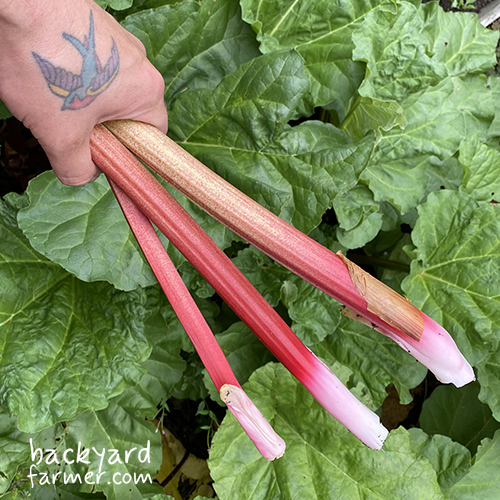
Most rhubarb in the UK is ready to harvest from April to June. Look for young, firm stalks around 30 cm long, with leaves that have recently opened. Harvest by pulling and gently twisting each stalk from the base rather than cutting it.
Do not harvest a newly planted rhubarb crown during its first growing season. In the second year, take only a few stalks if the plant is growing strongly. From the third year onwards, an established crown can usually be harvested normally, provided you do not remove too much at once.
Is your rhubarb ready to harvest?
Use the following checks before picking:
| Check | Ready to harvest? |
|---|---|
| Plant age | Not in year one; only lightly in year two |
| Season | Normally April–June |
| Stalk | Young, firm and approximately 30 cm long |
| Leaf | Just fully opened |
| Plant condition | Strong and healthy |
| Stalk colour | Not a reliable readiness test |
Do not wait for every stalk to turn red. Colour varies by cultivar and does not reliably indicate readiness for harvesting.
A healthy plant should have several firm stalks and plenty of undamaged leaves. If the crown is small, recently planted, drought-stressed or generally weak, leave it to grow rather than taking a substantial crop.
When is rhubarb ready to harvest in the UK?
Main harvest season
Most rhubarb cultivars begin cropping in April or May. Early varieties and plants growing in mild, sheltered gardens may produce harvestable stalks sooner, while crowns in colder or exposed plots may start later.
The calendar is useful, but the plant’s development is a better guide. Harvest when the stalks are firm and well developed, the leaves have opened and the crown is producing plenty of healthy growth. Around 30 cm is a practical guide, although some cultivars naturally produce shorter or longer stems.
Routine harvesting should normally finish by late June or early July. Stopping at this point allows the remaining leaves to continue feeding the crown and building reserves for the following season.
When to harvest a newly planted crown
Do not harvest rhubarb during its first growing season. A new crown needs time to establish roots and produce a strong framework of leaves.
During the second year, you may take a few stalks if the plant is vigorous, but avoid removing a large proportion of the crop. Begin normal harvesting from the third year, when the crown should be better established.
Seed-grown plants should also be left until their third season before they are harvested fully. For advice on establishing a new plant, see How to Grow Rhubarb in the UK.
How to tell when a stalk is ready
Choose stalks that are:
- Young and firm
- Approximately 30 cm long
- Attached to a leaf that has just fully opened
- Free from soft patches, bruising or frost damage
- Growing on a strong plant with plenty of healthy foliage
Stalk length is only a practical guide. Some varieties produce naturally shorter stems, while others grow much taller. Firmness, plant health and the stage of leaf development are more useful than length alone.
Avoid taking very thin, weak or damaged stalks. These are less worthwhile as a crop and may indicate that the plant needs to retain its growth.
How to harvest rhubarb correctly
Harvesting rhubarb is straightforward, but the method matters:
- Select a young, firm stalk that has reached the readiness stage.
- Grip the stalk as low down as possible, close to the crown.
- Pull upwards while gently twisting the stalk.
- Remove the whole stalk cleanly from the crown.
- Take off the leaf immediately after picking.
- Leave the remaining healthy stalks and leaves undisturbed.
Pull rhubarb rather than cutting it. A cut stump left at the crown can be more vulnerable to rotting and may leave damaged tissue behind.
Do not yank the stalk sharply or use excessive force. If it does not release easily, try a slightly lower grip and a gentle twisting movement. Avoid damaging neighbouring shoots as you harvest.
Remove the leaf straight away because it is not edible. The stalks can then be trimmed and used or stored.
What should you do with rhubarb leaves?
Never eat rhubarb leaves, raw or cooked. Only sound leaf stalks are used for food.
Remove the leaf as soon as the stalk is picked. Healthy leaves can be added to a compost heap, but keep removed leaves away from children and pets.
If a person is suspected of eating rhubarb leaves, follow the current NHS poisoning guidance. If a pet may have eaten the leaves, seek veterinary advice rather than attempting to treat the problem at home.
How much rhubarb can you harvest?
As a general rule, take no more than approximately one third of the plant’s stalks at one time. This leaves enough foliage for the crown to continue producing energy and preparing for the following year.
Pick again as suitable stalks develop rather than stripping the plant in a single session. A strong, established crown may produce several harvests during the main season, but the amount depends on the cultivar, weather, soil moisture and overall plant health.
Harvest less, or nothing, from a plant that is:
- Newly planted
- Recently divided
- Recently forced
- Drought-stressed
- Showing sparse or weak growth
- Recovering from frost or other damage
Do not use a fixed picking interval. Inspect the plant regularly and harvest only suitable stalks while leaving plenty of healthy leaves in place.
When should you stop harvesting rhubarb?
Stop routine harvesting by late June or early July in most UK gardens. The remaining leaves need time to rebuild the crown’s reserves after the main cropping period.
Continued heavy picking can weaken the plant and reduce the following year’s growth. Sound summer stalks do not suddenly become poisonous because the calendar has reached July, but repeated late-season harvesting is discouraged because it removes growth the plant needs for recovery.
Can you harvest rhubarb in July, August or September?
An occasional later stalk from a strong, established plant is not automatically unsafe. However, do not extend the general harvest season simply because stalks remain.
Repeated harvesting during July, August or September can reduce the plant’s ability to replenish its reserves. It is better to leave the remaining stalks and leaves in place and allow the crown to prepare for winter.
Some cultivars naturally have a longer cropping period, but these are exceptions rather than the default rule. If you do take a late stalk, choose one that is firm and healthy, and avoid removing several stalks from the same plant.
How to harvest forced rhubarb
Forced rhubarb is usually harvested earlier than outdoor-grown rhubarb. The stalks are often pale or pink, tender and approximately 30 cm long. They are commonly ready four to eight weeks after forcing begins, although growth rates vary.
To harvest forced rhubarb:
- Pull and gently twist each stalk from the base.
- Remove the leaf immediately.
- Take the stalks when they are well developed and easy to release.
- Avoid damaging the crown or nearby shoots.
After harvesting the forced flush, uncover the crown so it can grow normally again. Take no further stalks from that plant during the same year. A forced crown needs time to recover, so rest it for at least three years before forcing it again.
See our guide to growing rhubarb in the UK for the complete forcing method.
Can you harvest frost-damaged rhubarb?
Inspect the plant carefully after frost. Discard blackened or shrivelled leaves, along with stalks that are soft, mushy or visibly damaged.
Healthy new growth and undamaged stalks can still be harvested normally. Frost damage does not automatically make every sound stalk unsafe, so assess each stalk by its condition rather than discarding the entire plant.
If the crown has suffered extensive damage, leave it to recover and avoid taking a heavy harvest. Removing damaged growth while allowing healthy leaves to remain gives the plant the best chance of producing new growth.
How to store freshly harvested rhubarb
Remove the leaves immediately after harvesting. Use the stalks fresh where possible for the best texture and flavour.
Sound stalks can be refrigerated for up to approximately two weeks. For longer storage, freeze them. Always discard stalks that become soft, slimy or visibly spoiled rather than trying to use damaged sections.