
Introduction
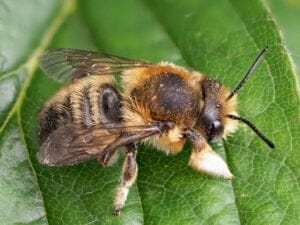
If you have spotted a small gingery bee around blossom, old brickwork, hollow stems or a bee hotel in spring, there is a good chance you have found a Red Mason Bee.
The Red Mason Bee (Osmia bicornis) is one of the most familiar solitary bees in the UK, and it is often one of the first bees people start trying to identify properly. It turns up at exactly the time of year when gardens are just waking up, which is why it gets noticed so often around fruit trees, spring flowers and sheltered walls.
This guide is focused on identification only. So, the aim here is simple:
- Help you work out if the bee you have seen is a Red Mason Bee
- Show you the main ID features
- Explain the difference between male and female Red Mason Bees
- Compare it with other bees that people commonly confuse it with
How to Identify the Red Mason Bee
At first glance, a Red Mason Bee can look a bit like a small honey bee or a slightly scruffier spring bumblebee. That is where people get thrown off. However, the best way to identify one is not by colour alone. You need to look at the full picture:
- Size
- Shape
- Season
- Behaviour
That last one is often the giveaway.
What to look for
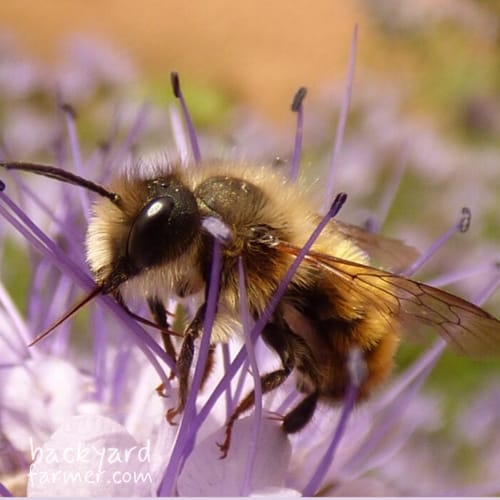
In simple terms, a Red Mason Bee is usually:
- A small, compact bee rather than a bulky bumblebee
- Covered in gingery or orange-brown hairs
- Active in spring, often around blossom time
- Interested in holes, tubes, bee hotels, old walls and hollow stems
- In the case of females, carrying pollen on the underside of the abdomen
If you keep seeing the same little bee checking tubes, slipping into a wall hole, or returning with mud or pollen, that is a very good clue. In the garden, that sort of behaviour often tells you more than colour ever will.
Quick identification checklist
| Feature | What to look for |
|---|---|
| Common name | Red Mason Bee |
| Scientific name | Osmia bicornis, formerly often listed as Osmia rufa |
| Size | Around 6–11 mm; females are usually larger than males |
| Colour | Gingery or orange-brown hairs, often with a darker head |
| Body shape | Compact, chunky, mason-bee shape rather than a slim honey bee look |
| Key behaviour | Investigates holes, tubes, bee hotels, old walls, stems and cavities |
| Best nest clue | Uses cavities above ground |
| Flight season | Mainly late March or April to June, sometimes a little later |
The easiest clue: look at what it is doing
This is the part I would pay most attention to.
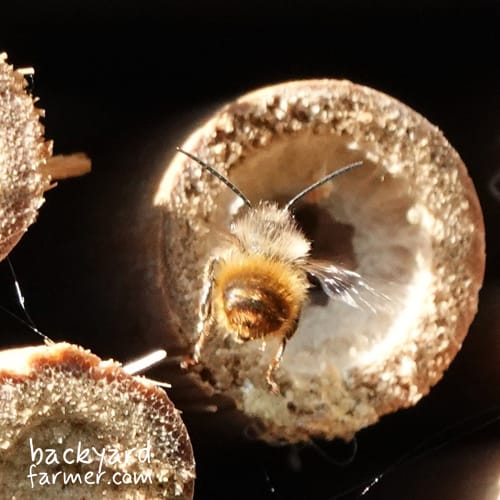
If the bee is:
- Using a bee hotel
- Entering an air brick
- Disappearing into an old wall hole
- Exploring a hollow stem
- Returning to the same cavity repeatedly
Then you are much more likely to be looking at a Red Mason Bee or another cavity-nesting solitary bee than a mining bee.
That is why so many people first notice them around sheds, patios, old brickwork and homemade bee hotels. They are busy little bees, and once you clock that nesting habit, they become much easier to recognise.
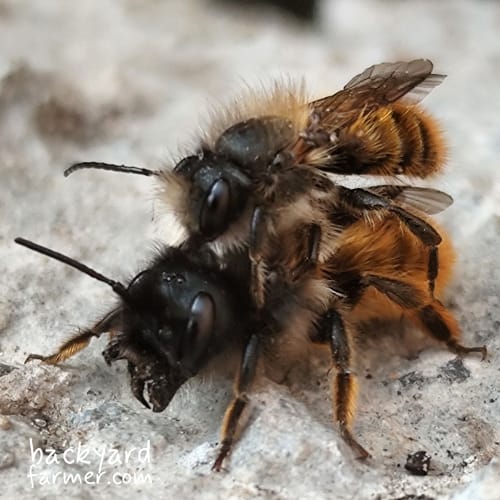
Female Red Mason Bee
Females are usually the most useful to describe because they are the ones people tend to notice going in and out of bee hotel tubes or wall holes.
A female Red Mason Bee typically has:
- A light brown or gingery thorax
- Dense orange-red hairs on the abdomen
- A darker, almost blackish head
- Two small facial “horns” used when working mud into place
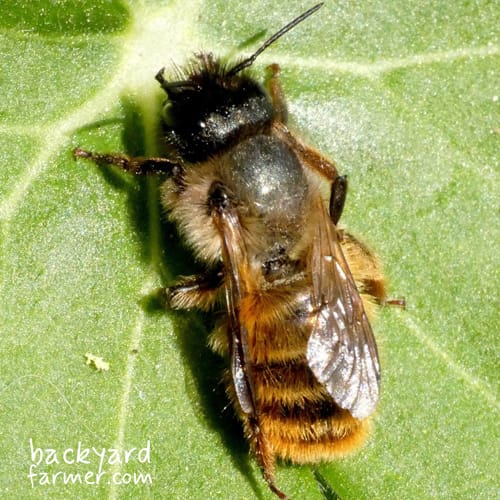
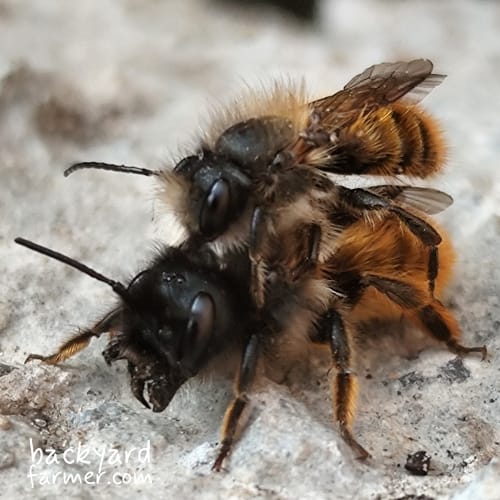
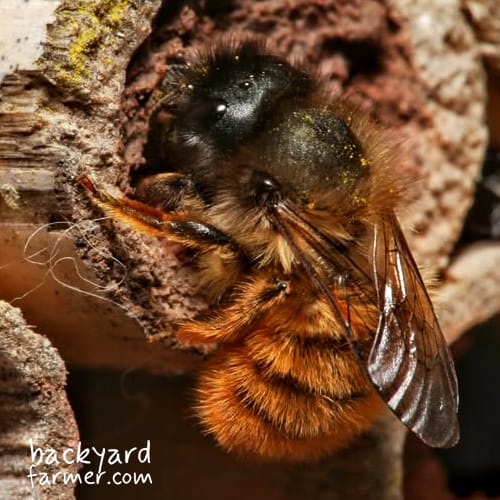
She also carries pollen on the underside of the abdomen, not in obvious pollen baskets on the hind legs.
Best female ID clues
| Feature | Female Red Mason Bee |
|---|---|
| Size | Larger and chunkier than the male |
| Face | Dark face with two small “horns” |
| Thorax | Light brown or gingery |
| Abdomen | Orange-red hairs, often fuller-looking than the male |
| Pollen | Carried underneath the abdomen |
| Behaviour | Enters tubes, stems, wall holes, bee hotels and cavities |
Male Red Mason Bee
Males are smaller, slimmer and usually emerge before the females. They also tend to look a bit softer in the face, with long antennae and a noticeable pale or whitish tuft around the mouthparts.
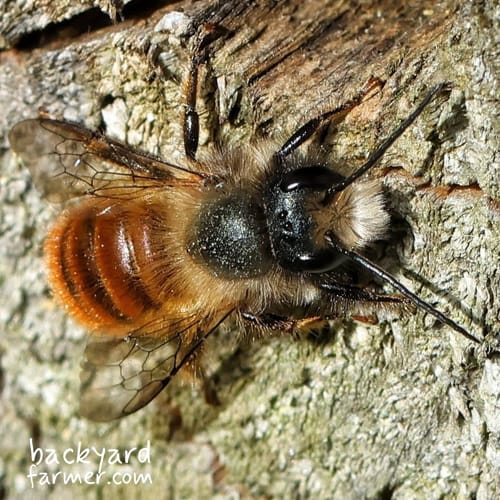
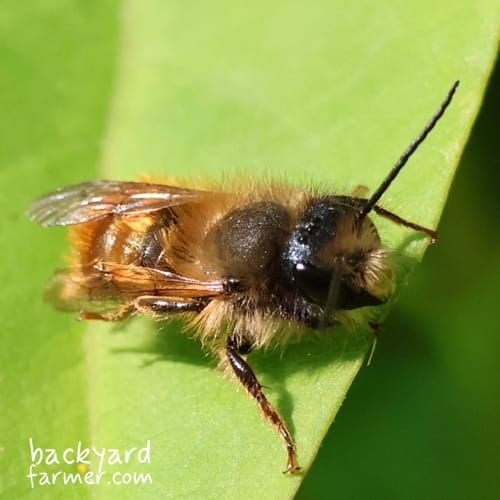
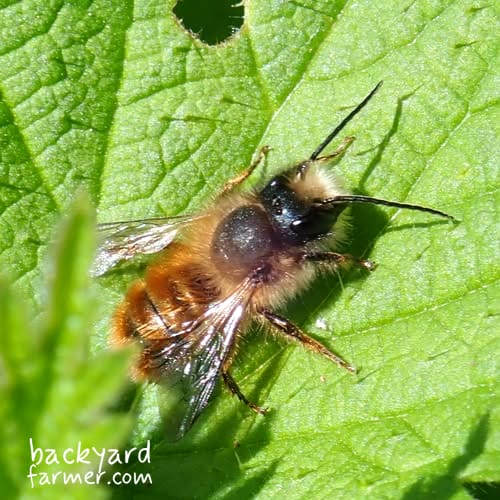
They do not have the female’s facial horns.
Best male ID clues
| Feature | Male Red Mason Bee |
|---|---|
| Size | Smaller than the female |
| Face | Pale or white facial hair tuft |
| Antennae | Long and often easier to notice in close photos |
| Horns | No female-style facial horns |
| Behaviour | Patrols around nesting sites waiting for females |
Red Mason Bee Identification and Key Facts
If you want the short version, a Red Mason Bee is a small spring-flying solitary bee with a warm gingery look, a darker head, and a strong habit of using holes above ground.
That combination is what matters most.
In practical terms, you are usually looking for a bee that is:
- Active in spring
- Orange-brown or gingery rather than boldly striped
- Using bee hotels, hollow stems, wall holes or other small cavities
- Often seen returning to the same hole repeatedly
If you have seen a compact orange-brown bee disappearing into a hole above ground, you are very much in Red Mason Bee territory.
Key facts at a glance
| Key fact | What it means |
|---|---|
| Bee type | A solitary mason bee, not a honey bee hive species |
| Scientific name | Osmia bicornis |
| Old scientific name | Sometimes still listed as Osmia rufa |
| Typical size | Around 6–11 mm |
| Main season | Usually spring into early summer |
| Nesting style | Uses pre-existing cavities above ground |
| Common nest sites | Bee hotels, hollow stems, old wall holes, air bricks, drilled wood and similar gaps |
| Pollen carrying | Females carry pollen on the underside of the abdomen |
| Male clue | Pale face and longer antennae |
| Female clue | Darker head and small facial “horns” |
The most useful clues to remember
If you are trying to identify one quickly, these are the clues worth keeping in your head:
- Spring timing rather than a high-summer flush of bee activity
- Gingery or orange-brown colouring
- A compact solitary bee shape rather than a classic bumblebee bulk
- A clear interest in holes, tubes and cavities above ground
- Females carrying pollen underneath the abdomen
- Males showing a paler face
Simple takeaway
If a reader only remembers one thing from this section, it should be this:
A Red Mason Bee is a small spring solitary bee that favours holes above ground and is often easiest to recognise by its nesting behaviour.
When and Where You Are Most Likely to See It
Red Mason Bees are mainly seen in spring, usually from late March or April into June. That timing helps with identification, because it places them firmly in that early part of the bee season when blossom, willow and hedgerow flowers are getting going.
You are most likely to notice them in places such as:
- Gardens
- Allotments
- Orchards
- Patios and courtyards
- Old walls and sheds
- Areas with blossom, bee hotels or hollow stems
That does not prove the ID on its own, but it does help narrow things down. A small gingery bee in spring around blossom and cavities above ground is a much better Red Mason Bee fit than the same guess made in the middle of summer with no nesting clue at all.
Red Mason Bee vs Tawny Mining Bee
This is one of the most useful comparisons in the whole guide, because the two bees can overlap in:
- Season
- Size
- General orange-brown colouring
To a casual eye, both can look like small warm-coloured bees in spring. That is why people mix them up all the time.
However, the biggest difference is not really colour. It is where they nest.
The simplest difference
A Red Mason Bee is a cavity nester. It uses places like:
- Bee hotels
- Hollow stems
- Old wall holes
- Air bricks
- Other small spaces above ground
A Tawny Mining Bee is a ground nester. It digs into:
- Bare soil
- Short turf
- Banks
- Lawn edges
and often leaves behind little spoil heaps or tiny volcano-like mounds.
If you remember that one contrast, you are already most of the way there.
| Feature | Red Mason Bee | Tawny Mining Bee |
|---|---|---|
| Nest type | Cavity nesting | Ground nesting |
| Main garden clue | Bee hotel tubes, wall holes, air bricks, hollow stems | Tiny soil mounds or little burrows in lawns, paths or bare ground |
| Where you see it | Around walls, nesting holes, bee hotels and blossom | Low over the ground, especially around nesting patches |
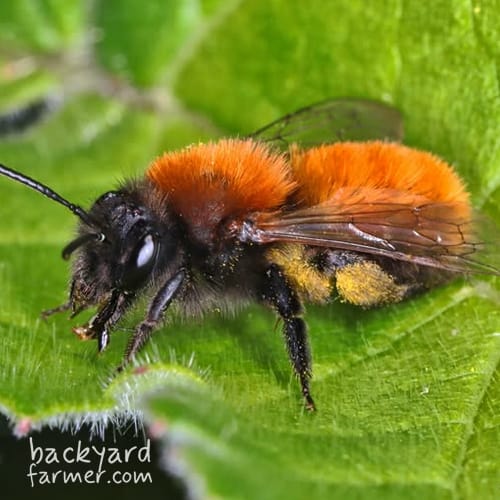
| Colour | Gingery or orange-brown, often with a darker head | Female often brighter fox-orange on top with a darker underside |
| Pollen carrying | Under the abdomen | On the hind legs |
| Best quick clue | Holes above ground | Holes in the ground |
Simple comparison takeaway
If a reader only remembers one thing from this section, it should be this:
Red Mason Bees use holes above ground. Tawny Mining Bees use holes in the ground.
Similar Species to Watch For
Even once you know the basics, Red Mason Bees can still be confused with a few other spring bees. That is normal. A lot of bees look warmer-toned in spring light, and if one zips past your face and vanishes into a flower bed, you do not get long to study it.
The good news is that you do not need to identify every bee to species level to make sense of what you are seeing. In most cases, it is enough to work through a few practical clues.
Start with these questions
Ask yourself:
- Is it using a hole above ground or a nest in the soil?
- Does it look slim, chunky or very fluffy?
- Is it carrying pollen under the abdomen or on the hind legs?
- Does it behave like a solitary cavity nester, a ground nester, or a more obviously social bee?
That is usually enough to separate a Red Mason Bee from the species people most often mix it up with.
| Similar species | How to tell it from a Red Mason Bee |
|---|---|
| Honey Bee | Usually slimmer, more neatly striped, and less strongly tied to bee hotel tubes or wall holes |
| Small bumblebees | Bulkier, fluffier and more obviously bumblebee-shaped |
| Tawny Mining Bee | Nests in the ground, often with little spoil heaps or tiny volcano-like mounds |
| Leafcutter Bees | Also cavity nesters, but often linked with neat cut leaf pieces rather than mud work |
| Other mason bees | Can look similar, but season, behaviour and facial detail help narrow it down |
Red Mason Bee vs honey bee
This is one of the most common mix-ups because a Red Mason Bee can be roughly honey-bee sized.
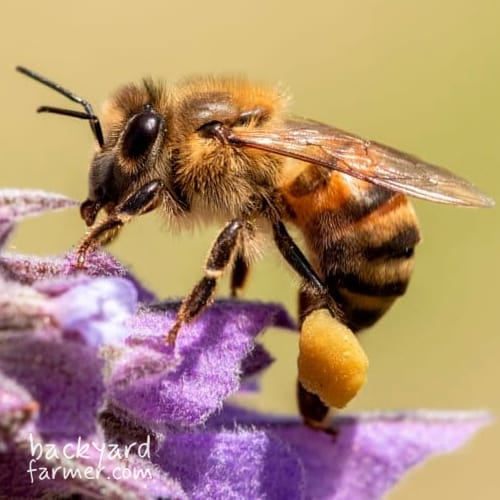
Honey bees are usually:
- Slimmer and tidier-looking
- More clearly banded or striped
- More often seen foraging in groups around flowers rather than repeatedly using one small cavity
- Carrying pollen on the hind legs, not underneath the abdomen
Red Mason Bees, by contrast, look more compact and a bit scruffier, and they are much more likely to be linked with:
- Bee hotels
- Hollow stems
- Air bricks
- Wall holes
Red Mason Bee vs bumblebee
A Red Mason Bee can sometimes be mistaken for a very small bumblebee, especially on a quick glance.
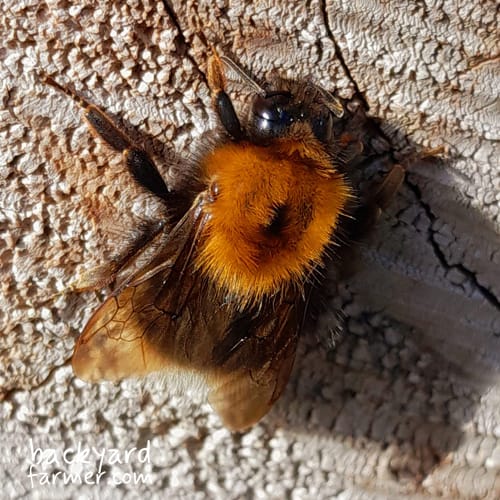
Bumblebees usually look:
- Bulkier and rounder
- More heavily furred all over
- More obviously patterned in the classic bumblebee style
A Red Mason Bee is smaller, neater in shape, and much more likely to show that telltale behaviour of checking or entering holes above ground.
Red Mason Bee vs leafcutter bee

This is a useful comparison because both are solitary cavity nesters, so both may turn up in bee hotels.
The simplest clue is the nest material:
- A hole worked with mud points towards Red Mason Bee first
- A nest lined or sealed with leaf pieces points towards leafcutter bee first
The adults can still be tricky to separate on sight, but the nesting material often tells the story more clearly than colour does.
Simple similar-species takeaway
If a reader only remembers one thing from this section, it should be this:
The quickest way to narrow down a Red Mason Bee is to combine appearance with nesting behaviour.
Red Mason Bee FAQ
A Red Mason Bee is usually a small, compact spring bee with gingery or orange-brown hairs. Females tend to look chunkier and darker-headed, while males are smaller with a paler face and longer antennae.
Most Red Mason Bees are around 6–11 mm long, with females usually a bit larger than males.
They are mainly active in spring, usually from late March or April into June, sometimes a little later depending on weather and location.
You often see them around bee hotels, hollow stems, old wall holes, blossom, sheds, patios and other sheltered garden spaces.
Red Mason Bees are usually more compact and scruffier-looking, while honey bees are slimmer and more neatly striped. Red Mason Bees are also much more strongly linked with cavities above ground.
The quickest difference is the nesting site. Red Mason Bees use holes above ground, while Tawny Mining Bees nest in the ground.
A female Red Mason Bee is usually larger, with a darker head, orange-red abdominal hairs and two small facial “horns”. She carries pollen underneath the abdomen.
A male Red Mason Bee is smaller and slimmer, with a paler face and noticeably long antennae.
No. Both are cavity-nesting solitary bees, but Red Mason Bees are more strongly linked with mud, while leafcutter bees are known for using cut leaf pieces.
Final Thoughts
The Red Mason Bee is one of the easiest solitary bees to recognise once you know the main clues.
If you remember just a few things, make them these:
- It is a small spring bee
- It usually looks gingery or orange-brown
- It is strongly linked with holes above ground
- Females are darker-headed and chunkier
- Males are smaller with a paler face
Once you start watching for those details, Red Mason Bees become much easier to separate from honey bees, mining bees and other spring species.