Introduction
If you’ve looked into crop rotation on an allotment before, you’ve probably seen the diagrams, charts, and strict 3–4 year plans. On paper, they look great. In reality, on a damp UK plot in mid-season, they can feel a bit… optimistic.
Most guides overcomplicate it — so let’s strip it back to what actually matters when you’re working a real allotment.
Because the truth is, most growers aren’t following perfect systems. Beds are tight, crops get squeezed in where there’s space, and plans change halfway through the season (usually when something bolts or gets eaten).
Even so, people still grow plenty of good food.
That’s because allotment crop rotation isn’t about sticking to a rigid plan — it’s about avoiding a few problems before they build up and bite you later.
From what I’ve seen on allotments (and from chatting over the fence), rotation really only matters for a handful of crops — mainly potatoes, brassicas, and onions. These are the ones that tend to bring pests and disease back with them if you keep putting them in the same spot.
Everything else? You’ve usually got more wiggle room than most guides make out.
What You’ll Learn in This Guide
In this guide, I’ll show you:
- When crop rotation actually matters (and when it doesn’t)
- What crops you really need to rotate on an allotment
- A simple, flexible crop rotation plan you can actually stick to
- How to make crop rotation work in small gardens, raised beds, and real allotments
The aim isn’t to get everything perfect — it’s to give you a simple crop rotation plan for UK allotments that actually works once you’re out there, not just on paper.
Do You Really Need Crop Rotation on an Allotment?
Short answer: yes — but not in the way most guides make out.
Most traditional advice treats crop rotation on an allotment like a strict rule: follow a neat 3–4 year cycle or you’ll ruin your soil. In reality, that’s not how it goes. Space is tight, plans change, and you usually end up planting where you can — not where the chart says.
What Crop Rotation Is Actually For
At its core, crop rotation is about reducing problems, not chasing perfection.
In practice, it helps with:
- Soil-borne diseases building up in one spot
- Pests coming back to the same crops year after year
- Heavy feeders draining the same patch repeatedly
However, here’s the bit most guides don’t really say out loud:
For most home growers, pests and disease matter more than nutrients.
If you’re regularly adding compost, manure, or mulch (which most allotment growers do anyway), the soil side of things usually looks after itself.
When Crop Rotation Really Matters
There are a few situations where allotment crop rotation actually makes a noticeable difference:
- Potatoes → blight and scab show up more if they stay put
- Brassicas (cabbage, broccoli, kale) → prone to clubroot and repeat pests
- Onions & garlic → white rot can hang around in the soil for years
These are the crops where repeating the same spot tends to catch up with you.
If you’ve had a bad run with brassicas or onions, this is usually why.
When It Matters Less (or Not at All)
For plenty of other crops, crop rotation in a small garden or allotment is much more relaxed.
Things like:
- Lettuce
- Herbs
- Carrots
- Quick salad crops
…can often go back into roughly the same area without causing much trouble — especially if your soil’s in decent shape.
Because of that, most experienced growers don’t stick rigidly to rotation plans. They focus on the crops that cause problems and stay flexible with everything else.
The Reality on UK Allotments
Allotments come with their own quirks that most guides don’t really account for:
- Plots are close together → pests and disease move between them easily
- Weather is often damp → fungal issues (like blight) don’t respect your rotation plan
- Space is limited → full rotation just isn’t always practical
Even if you rotate perfectly, you’re not working in isolation.
So in practice, most growers take a more relaxed approach:
- Rotate crops where it makes sense
- Prioritise the ones that cause issues
- Don’t stress the rest too much
So… Do You Need to Rotate Crops?
Yes — but keep it simple.
A realistic crop rotation plan for an allotment looks more like this:
- Avoid growing the same crop in the same spot two years running
- Move potatoes, brassicas, and onions if you can
- Keep feeding the soil as you go
Think of crop rotation as a way to avoid problems building up — not a rule you have to follow perfectly.
Once you look at it that way, it becomes much easier to work into day-to-day gardening.
What Crops Need Rotating on an Allotment (and What You Can Ignore)
One of the biggest misconceptions with allotment crop rotation is that everything needs to be rotated perfectly.
In reality, that’s not how most people garden — especially on a UK allotment where space is tight and beds get a bit mixed.
From what I’ve seen (and from chatting to a few neighbours), most experienced growers boil it down to one idea:
Rotate the crops that cause problems — and don’t overthink the rest.
Look at it that way, and it suddenly feels a lot more manageable.
High Priority Crops (Always Rotate These)
These are the crops where crop rotation on an allotment actually matters — and where you’ll notice it if you don’t move them.
Potatoes
- More likely to pick up blight and scab if they stay put
- Heavy feeders that take a fair bit out of the soil
👉 Best practice: move them each year if you can — even a rough shift is better than nothing
Brassicas (Cabbage, Broccoli, Kale, Sprouts)
- Prone to clubroot, which can hang around in the soil
- Tend to bring back the same pests year after year
👉 Best practice: avoid putting them back in the same spot if you can help it
Onions, Garlic & Leeks (Alliums)
- Vulnerable to white rot, which once it’s there, tends to stick around
👉 Best practice: rotate carefully — and if white rot shows up, be cautious with that patch long-term
Medium Priority Crops (Rotate If You Can)
These benefit from rotation, but they’re not usually the ones that cause headaches:
They’re still heavy feeders, so moving them helps. That said, if you’re adding compost regularly, you’ve got a bit of breathing room here.
Low Priority Crops (Don’t Stress)
These are the easy ones in any crop rotation plan — generally low-risk and pretty forgiving:
They:
- Grow quickly
- Don’t take much out of the soil
- Rarely cause long-term issues
👉 In most cases, just tuck these in wherever you’ve got space
A More Realistic Way to Think About It
Instead of trying to rotate everything perfectly, it helps to think in terms of risk:
- High-risk crops → make the effort to rotate
- Medium-risk crops → rotate when it fits
- Low-risk crops → slot them in wherever works
That’s how most allotment growers actually handle crop rotation in practice — and it’s more than good enough.
The Simple Rule to Remember
If you take one thing from this section, let it be this:
Don’t grow the same high-risk crop in the same spot two years running.
That one habit does most of the heavy lifting without turning it into a chore.
Linking This to Your Planning
This is where things tend to fall apart.
If you’re not keeping track of what went where last year, your crop rotation plan quickly turns into guesswork — and it’s easy to repeat crops without realising.
A quick sketch, a few notes, or a simple planner is usually enough. After a couple of seasons, it starts to feel second nature.
The “Real-World” Crop Rotation System
If you’ve looked at crop rotation charts before, they usually show a tidy 3–4 year cycle with everything lined up nicely. Looks great on paper. In reality, on an allotment, it rarely ends up like that.
Beds fill up quicker than you expect, crops get moved last minute, and there’s always something that doesn’t quite fit where you planned it. So most growers end up using a looser, more flexible version of allotment crop rotation rather than sticking to a rigid system.
Loose Rotation vs Strict Systems
Strict systems tend to:
- Follow fixed crop groups (roots → legumes → brassicas → fruits)
- Need a fair bit of space and planning ahead
- Fall apart once the season gets busy
Loose (real-world) rotation looks more like:
- Moving crops when it makes sense
- Avoiding obvious repeats
- Working around what’s already in the ground
Most allotment growers aren’t following a perfect plan — they’re just making sure they don’t keep putting the same thing in the same place.
The Core Rule That Actually Matters
Instead of trying to follow a full chart, most people fall back on one simple rule:
Don’t grow the same high-risk crop in the same spot two years running.
That alone does most of the job.
Priority-Based Rotation (How People Actually Do It)
Rather than rotating everything, people tend to focus on the crops that actually cause trouble:
- Potatoes → usually get moved every year
- Brassicas → moved if there’s room
- Onions & garlic → handled a bit more carefully
Everything else just gets fitted in around them.
It’s not perfect, but it works — especially on smaller or slightly chaotic plots.
Why Perfect Rotation Breaks Down
There are a few reasons strict systems don’t hold up once you’re actually gardening:
- Limited space → there just isn’t room to rotate everything properly
- Mixed planting → crops end up sharing beds
- Seasonal changes → plans shift as you go
- Permanent beds → things like brassica cages or strawberries don’t move
The more “real” your setup is, the less likely a perfect plan will survive the season.
What Most Growers End Up Doing
Walk around an allotment and you’ll see the same patterns:
- Rotating the key crops
- Shifting things roughly each year
- Avoiding obvious repeats
- Accepting that some beds stay put
So in practice:
It’s less about perfect rotation, and more about not repeating the same mistake.
A Simple System You Can Actually Stick To
If you want something workable, keep it simple:
- Move potatoes, brassicas, and onions if you can
- Avoid putting the same crop in the same spot two years running
- Shift things around when there’s space
- Don’t worry about getting it perfect
That’s usually enough for a solid crop rotation plan.
Why This Works
This approach works because it:
- Focuses on the crops that actually cause issues
- Helps limit pest and disease build-up
- Fits how allotments are really laid out
- Is simple enough to repeat every year
And that last point is the big one.
A simple system you actually stick to will always beat a perfect one you drop halfway through the season.
Where This Fits Into the Bigger Picture
Crop rotation is just one part of it.
Alongside:
- Adding compost
- Keeping the soil in decent shape
- Growing what actually works on your plot
…it helps keep things ticking over year after year.
From there, it’s just about keeping it going — without overthinking it.
Simple Crop Rotation Plan for Allotments (3-Year & 4-Year)
If you’ve made it this far, you’ve probably already clocked the main thing:
You don’t need a perfect system — you just need something simple you’ll actually use.
A bit of structure does help though, especially once you’ve got a few beds on the go and everything starts overlapping.
This is where a simple crop rotation plan for allotments (3–4 year) comes in handy — not as something to follow religiously, just something to give you a bit of direction.
The Basic Crop Groups
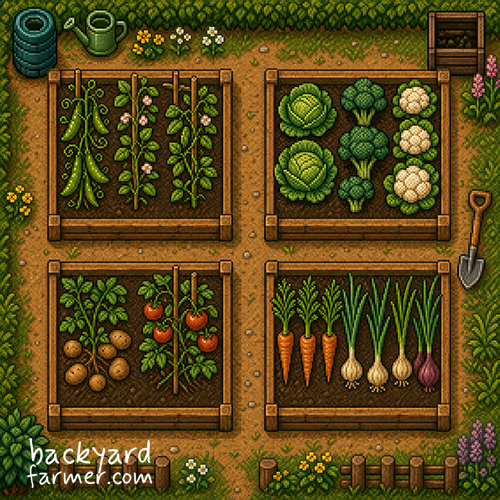
Most crop rotation plans are built around four main crop groups:
- Legumes (peas, beans) → help put nitrogen back into the soil
- Brassicas (cabbage, broccoli, kale) → heavy feeders
- Roots (carrots, beetroot, parsnips) → lighter feeders
- Fruiting crops (tomatoes, courgettes, peppers) → high demand
On paper, these get rotated neatly to balance things out.
In reality, it’s more of a rough guide — especially once your plot starts doing its own thing.
A Simple 4-Year Crop Rotation Plan
This is the version you’ll see most often — and it’s a decent starting point for allotment crop rotation:
| Year | Bed 1 | Bed 2 | Bed 3 | Bed 4 |
|---|---|---|---|---|
| 1 | Legumes | Brassicas | Roots | Fruits |
| 2 | Brassicas | Roots | Fruits | Legumes |
| 3 | Roots | Fruits | Legumes | Brassicas |
| 4 | Fruits | Legumes | Brassicas | Roots |
Each year, everything shifts along one bed.
👉 Why it works: it stops the same crops sitting in the same soil year after year — which is where problems usually start.
A Simpler 3-Year Rotation (More Realistic for Most Gardens)
If you haven’t got four decent beds, don’t force it.
A 3-year crop rotation plan is usually easier to live with:
- Year 1 → Legumes
- Year 2 → Brassicas
- Year 3 → Roots + Fruits combined
It’s not perfect, but it works — and that’s what matters.
How to Adapt This in Real Life
This is the bit most guides skip.
In reality:
- Beds aren’t all the same size
- Crops end up mixed together
- Some things just stay where they are (like permanent beds)
So instead of trying to force a perfect crop rotation system:
- Treat it as a guide, not a rule
- Move things when it makes sense
- Focus on the crops that actually need rotating
A rough plan you stick to is far more useful than a perfect one you give up on.
When It’s OK to Break the Plan
There’ll be times where rotation just doesn’t fit:
- You’ve run out of space
- You want more of one crop
- Beds are already spoken for
When that happens:
- Avoid repeating the problem crops if you can
- Feed the soil well
- Accept that some years won’t line up neatly
That’s normal — every allotment ends up like this at some point.
The Key Takeaway
A crop rotation plan for your allotment should help you think things through — not get in the way.
Keep it simple, and you’re far more likely to stick with it.
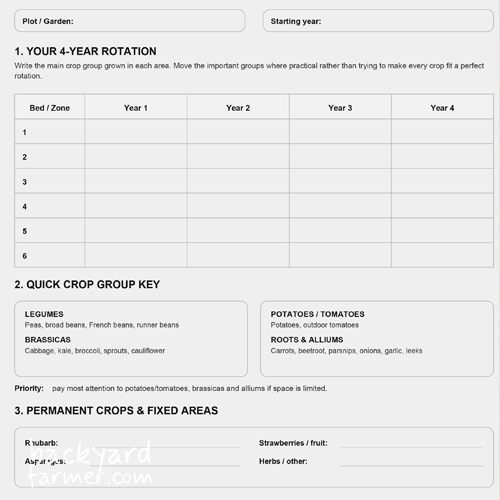
Next Step: Visualising Your Rotation
Once you’ve got a rough idea, the next step is seeing how it fits your plot.
That’s where a quick sketch — or a planner — makes crop rotation much easier to keep track of over time.
Example Allotment Crop Rotation Layout (With Diagram)
A crop rotation plan always looks tidy on paper — then you get to the plot and it… doesn’t.
Beds aren’t equal, crops wander, and half the time you’re working around whatever you planted on a whim last month. So rather than chasing a perfect layout, aim for something you can actually follow next year without scratching your head.
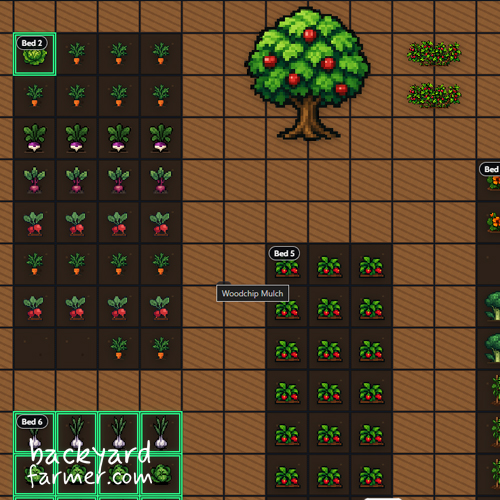
A Simple 4-Bed Allotment Crop Rotation Layout
Here’s a straightforward way to set up a 4-bed crop rotation plan for an allotment:
- Bed 1 → Legumes (peas, beans)
- Bed 2 → Brassicas (cabbage, broccoli, kale)
- Bed 3 → Roots (carrots, beetroot, parsnips)
- Bed 4 → Fruits (courgettes, tomatoes, squash)
Each year, just shift everything along one bed.
For example (Year 2):
- Legumes move into Bed 2
- Brassicas move into Bed 3
- Roots move into Bed 4
- Fruits move into Bed 1
That simple loop is what most allotment crop rotation systems boil down to.
What This Looks Like in Practice
On a real plot, your allotment layout will look a bit rougher:
- Beds aren’t the same size
- Crops spill into the next space
- Lettuce and radish get shoved in wherever there’s a gap
That’s normal.
The layout is there to steer you a bit — not trap you.
Working Around Fixed Beds
Most allotments end up with areas that don’t move, like:
- Brassica cages
- Strawberry beds
- Asparagus patches
At that point, full crop rotation on an allotment isn’t really on the cards.
So just:
- Leave those where they are
- Rotate everything else around them
- Keep those spots well fed with compost
It’s a compromise, but it does the job.
Smaller Plots and Raised Beds
If you’ve only got a couple of beds, don’t try to force a big system.
3-Bed Allotment Layout Example
- Bed 1 → Legumes
- Bed 2 → Brassicas
- Bed 3 → Roots + Fruits combined
Then rotate each year as best you can.
It’s not neat, but it works — which is what you want.
The Key to Making This Work
The tricky bit with crop rotation planning isn’t the layout — it’s remembering what went where.
Rely on memory and you’ll end up:
- Repeating crops without realising
- Losing track after a season or two
A quick sketch saves a lot of guesswork later.
Recreate This Layout in the Allotment Planner
If you want to keep it simple, map your beds out in a planner and track your crop rotation over time.
- Lay out your beds
- Move crops each season
- Check last year before you plant
👉 It turns it into a 2-minute job instead of trying to remember everything.
Final Thought
Your layout doesn’t need to be perfect — it just needs to be clear enough that next year you know what you did.
Get that right, and the rest tends to fall into place.
How to Apply Crop Rotation in Real Life (Small Gardens & Allotments)
This is the bit where most crop rotation guides start to fall over.
On paper it’s all neat rows and tidy plans. On the plot, you’ve got tight space, mixed beds, and the odd curveball from the weather. Things move. Plans change.
So instead of forcing a perfect system, it’s easier to fit crop rotation around your space — not the other way round.
Small Gardens vs Allotments
If you’re working with a small garden or raised beds, full crop rotation can be a stretch.
- Beds are too small to split into neat groups
- Crops get mixed together
- You plant where there’s room, not where the chart says
So keep it simple:
- Try not to repeat high-risk crops in the same spot
- Nudge things along where you can, even if it’s only a bit
Even a small shift is better than putting the same thing back in the same place again.
Raised Beds & Square Foot Gardening
With square foot or intensive growing, strict crop rotation plans don’t really hold up.
Instead:
- Rotate at a bed level if you can
- Or just avoid using the exact same square for the same crop
Most people doing this rely more on:
- Compost
- Decent soil
- Mixing crops naturally
…rather than sticking to a rotation chart.
Mixed Planting (What Most Plots Actually Look Like)
Most allotments aren’t laid out in tidy blocks — even if the plan says they should be.
You’ll usually see:
- Onions tucked between carrots
- Lettuce filling odd gaps
- Beans climbing wherever there’s space
In that setup:
- Keep track of the main crop in each area
- Don’t stress about the little filler crops
It’s the main crops that matter for rotation — not every leaf you’ve squeezed in.
What If You Don’t Know What Was Planted Last Year?
Happens all the time — especially if you’ve just taken on a plot.
If you’re not sure, don’t overthink it.
A simple reset for your crop rotation:
- Don’t put potatoes, brassicas, or onions straight back in the same spots
- Start a basic rotation from where you are now
- Feed the soil well
After a season or two, it usually settles into a rhythm.
Dealing With Limited Space
If space is tight, prioritise your allotment crop rotation.
Focus on:
- Moving potatoes each year
- Avoiding repeat brassicas
- Keeping onions and garlic away from old allium spots
Everything else can move around that.
This is how most people make rotation work when space isn’t on their side.
Keeping Track (The Bit Everyone Forgets)
The hardest part of crop rotation planning isn’t the plan — it’s remembering what you did last year.
Rely on memory and you’ll end up:
- Repeating crops without realising
- Losing track after a season or two
A simple fix does the job:
- Sketch your beds
- Jot a few notes
- Or use a planner
The Real Goal
You don’t need perfect crop rotation.
You just need to:
- Avoid obvious repeats
- Move key crops when you can
- Keep your soil in decent shape
Do that, and you’ll get most of the benefit of crop rotation on an allotment without turning it into a chore.
What Comes Next
Once you’ve got this dialled in, the next step is spotting the usual mistakes — and avoiding them before they catch you out.
Common Crop Rotation Mistakes (Real Examples)
Crop rotation sounds simple enough — until you actually try to stick to it for a full season.
Most of the time, it’s not that people can’t be bothered. It’s just that real plots don’t behave like neat plans.
These are the mistakes I see (and have definitely made myself).
1. Rotating Crops… But Not Crop Families
This one catches a lot of people out.
For example:
- Cabbage one year
- Broccoli in the same spot the next
Feels like rotation, but both are brassicas — so you’re still inviting the same pests and problems back in.
It’s not about swapping veg — it’s about moving the whole crop family.
2. Trying to Follow a Perfect System
Plenty of people start with a full 4-year crop rotation plan…
…and then quietly abandon it halfway through the season.
Usually because:
- Something outgrows its space
- You change your mind about what to plant
- Beds just don’t line up the way you hoped
A rough plan you actually stick to beats a perfect one you drop by July.
3. Not Thinking a Season Ahead
Rotation only really works if you look one step ahead.
A common mistake is just planting what fits now, without thinking where it’ll go next year.
Then you end up with:
- Nowhere sensible to move things
- Repeating crops because you’re boxed in
You don’t need a full plan — just a rough idea of what comes next helps a lot.
4. Relying on Memory
Everyone thinks they’ll remember.
Then a year later:
- “What was in this bed again?”
And that’s usually where rotation starts slipping.
- Crops get repeated without realising
- Beds get mixed up
A quick scribble on paper saves a lot of guessing later.
5. Expecting Rotation to Fix Everything
Crop rotation on an allotment helps — but it’s not a cure-all.
Some problems:
- Drift in from other plots
- Blow in on the wind (blight’s a classic)
- Hang around in the soil for years
It lowers the chances of problems — it doesn’t stop them completely.
6. Forgetting About the Soil
It’s easy to get wrapped up in rotation and forget the basics.
But honestly:
- Good soil will carry you through a lot of rotation mistakes
- Poor soil will cause issues even if your rotation is spot on
Nothing fancy needed:
- Add compost
- Keep it loose and workable
- Don’t let beds get tired
7. Making It Too Complicated
This is where most people give up.
Trying to:
- Track every crop perfectly
- Follow charts to the letter
- Rotate everything evenly
…just becomes a headache.
The simpler it is, the more likely you are to actually keep doing it.
The Key Takeaway
Most crop rotation mistakes come down to one thing:
Trying to get it perfect instead of just keeping it going.
Keep it simple, focus on the crops that matter, and you’ll avoid most of the usual problems.
What Comes Next
Now you’ve seen where it tends to go wrong, the next step is looking at the shortcuts people use to make allotment crop rotation a bit easier to live with.
Workarounds That Actually Work
If you’ve read this far, you’ve probably noticed a pattern with allotment crop rotation:
Most people aren’t following a perfect plan — they’re just making it work.
And that’s about right.
The stuff that works tends to be simple enough to repeat, otherwise it gets dropped halfway through the season.
Here are the workarounds I see (and use) on real plots.
1. Rotate Only the Crops That Matter
Don’t try to rotate everything. Focus on the ones that actually cause grief in a crop rotation plan:
- Potatoes
- Brassicas
- Onions & garlic
Everything else can shuffle around them.
Do this and most of the pressure disappears straight away.
2. Let Compost Do the Heavy Lifting
A lot of growers lean on soil health more than strict rotation — for good reason.
Add:
- Compost
- Well-rotted manure
- Mulch
…and the soil keeps ticking over, even if your crop rotation on an allotment isn’t spot on.
Healthy soil covers a lot of sins.
3. Accept “Good Enough”
You don’t need a perfect 4-year loop.
What you’ll actually see on plots:
- A basic 2-bed swap
- A loose 3-bed rotation
- Or just moving the main crops when there’s space
It’s not neat, but it works — especially on small allotments.
4. Use Sacrificial Beds (When Needed)
Sometimes you just bend the rules.
For example:
- Potatoes going back into a similar spot
- Brassicas staying in a fixed cage
If that happens:
- Accept it
- Feed that patch a bit more
- Keep an eye on problems
Better to manage it than force a layout that doesn’t fit your plot.
5. Keep Some Areas Fixed
Most allotments end up with bits that don’t move:
- Fruit beds
- Brassica cages
- Perennials
Leave them be, and rotate everything else around them.
You still get most of the benefit of crop rotation for allotments where it counts.
6. Avoid the Obvious Mistakes
Instead of chasing perfection, just dodge the big ones:
- Don’t repeat high-risk crops in the same spot
- Don’t ignore the soil
- Don’t rely on memory
Get those right and you’re ahead of most crop rotation plans anyway.
7. Keep It Simple Enough to Stick With
This is the bit that matters.
If it’s a faff, you won’t keep doing it.
The best crop rotation setup is the one you don’t have to think too hard about.
So if that means simplifying things, moving stuff last minute, or breaking the odd rule — that’s just normal.
The Big Picture
All of this really comes down to one thing:
Crop rotation is flexible.
You shape it around your plot, not the other way round.
What Comes Next
Next up, we’ll pull this together into something you can actually follow without it turning into a chore.
Using Crop Rotation With Your Planner
By this point, you’ve got a rough handle on how crop rotation on an allotment works — or at least enough to get by.
The bit that usually trips people up isn’t the plan… it’s this:
Remembering what you planted last year.
That’s where even a decent crop rotation plan starts to fall apart.
Why Tracking Matters
Crop rotation only really works if you can remember what you did.
Without that, it’s very easy to:
- Stick the same crop back in without realising
- Lose track after a season or two
- Undo your rotation by accident
Most rotation problems aren’t bad planning — they’re just forgetting.
The Simple Way to Track Your Rotation
You don’t need anything fancy.
Honestly, most people just use:
- A rough sketch of the beds
- A few notes in a notebook
- Or photos on their phone
The important bit is having something to glance at before you start planting again.
Using the Allotment Planner
If you want to make it easier (and a bit less guesswork), an allotment planner does help.
Instead of trying to remember, you can:
- See your beds clearly
- Drop crops into place
- Shuffle things around when plans change
- Keep track of your crop rotation over time
Which means you’re less likely to:
- Repeat crops without noticing
- Get halfway through planting and realise you’ve boxed yourself in
Turning Rotation Into Something You’ll Actually Use
Once you’ve got a visual of your plot, it gets a lot simpler.
- Lay out your beds
- Decide where the main crops go
- Move them next season
- Have a quick check of last year before planting
That’s it. No need to overthink it.
Why This Helps
Seeing it laid out takes a lot of the mental load off.
- No guessing
- No “I’m sure this was onions last year…”
- No accidental repeats
You’re just moving things on with a quick look, not trying to remember everything.
The Bigger Benefit
Once you’re tracking your allotment plan, a few other things fall into place as well:
- You plan a bit smarter
- Crops get spread out better
- The plot starts to feel more organised (even if it still looks a bit scruffy)
Final Thought
Crop rotation doesn’t need to be clever — it just needs to be something you keep doing.
A rough record is usually enough.
Get into that habit, and the rest sort of takes care of itself.
FAQs
Not really, at least not in a strict way.
In a small garden or raised beds, a full 3–4 year crop rotation plan is hard to stick to. So keep it simple:
– Don’t put potatoes, brassicas, or onions back in the same spot two years running
– Shuffle things along a bit where you can
– Keep feeding the soil with compost
That kind of “loose” crop rotation in a small garden is usually plenty.
Quite a few, to be honest.
Low-risk, quick growers are pretty forgiving in most crop rotation plans:
– Lettuce
– Herbs
– Radishes
– Spinach
– Most salad crops
They don’t hang around long or cause much trouble, so just stick them where they fit.
No — but it’s not a magic fix either.
On a UK allotment, plots sit close together, so pests and disease move about. Even perfect allotment crop rotation won’t stop everything.
That said, it still helps, especially with:
– Potatoes
– Brassicas
– Onions and garlic
Think of it as tipping things in your favour, not solving it completely.
It usually creeps up on you.
You might see:
– More pests on the same crops
– More disease in the soil
– Plants just not doing as well as they used to
Repeating something once won’t ruin anything. It’s doing it year after year that causes issues in crop rotation systems.
Rotation can help a bit, but it won’t fix everything.
For example:
– Onion white rot can sit there for years
– Clubroot in brassicas is stubborn once it’s in
At that point:
– Avoid those crops in that spot
– Keep the soil in good shape
– Try resistant varieties if you can
Sometimes it’s more about working around it than getting rid of it.
Not very.
A simple crop rotation approach is enough for most people:
– Move key crops when you can
– Don’t repeat obvious problem crops
– Keep the soil healthy
Doing it roughly every year beats trying to do it perfectly once.
Sometimes, yes.
– High-risk crops (potatoes, brassicas, onions) → better moved
– Low-risk crops (salads, herbs) → usually fine to repeat
If you do keep things in the same spot:
– Add compost
– Keep an eye out for problems building up
Only if you’ve got the space for it.
A 4-year crop rotation plan for an allotment works well on paper. In reality, most people end up using:
– A 3-year rotation
– A simple bed swap
– Or just moving things as best they can each year
Avoiding repeat problems matters more than sticking to a strict system.
Conclusion
Crop rotation gets made out to be this big, complicated thing.
On an actual allotment, it’s not. It’s just one of those small habits that helps you avoid problems building up over time.
You don’t need a full 4-year crop rotation plan, colour-coded charts, or everything mapped out perfectly. Most of the time, it’s just about keeping an eye on what went where and not repeating the obvious mistakes.
Keep It Simple (The Core Rules)
If you take one thing from all this, it’s this:
- Don’t put the same problem crops back in the same spot two years running
- Keep an eye on potatoes, brassicas, and onions first
- Feed the soil regularly
- Make some sort of note of what you’ve planted
Do that, and you’re covering most of what allotment crop rotation is meant to do anyway.
The Bigger Picture
Crop rotation only really works because it sits alongside everything else.
- Decent soil
- Adding compost
- Growing what actually works on your plot
All of that matters just as much as any crop rotation system.
It’s not about getting it right on paper — it’s about keeping things ticking over year after year.
Start Simple
If you’re new to crop rotation, don’t try to do too much at once.
Pick a basic setup, move the main crops next year, and see how it goes. After a couple of seasons, it starts to click.
Put It Into Practice
The bit that really makes it stick is keeping track.
Even something basic helps:
- A quick sketch of your beds
- A few notes
Just enough so you’re not guessing next spring.
👉 If you want it a bit clearer, an allotment planner does make life easier for tracking your crop rotation plan over time.
Final Thought
Crop rotation doesn’t need to be clever.
It just needs to be something you actually keep doing.
Get into that habit, and most of the rest sorts itself out.