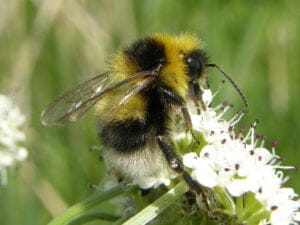

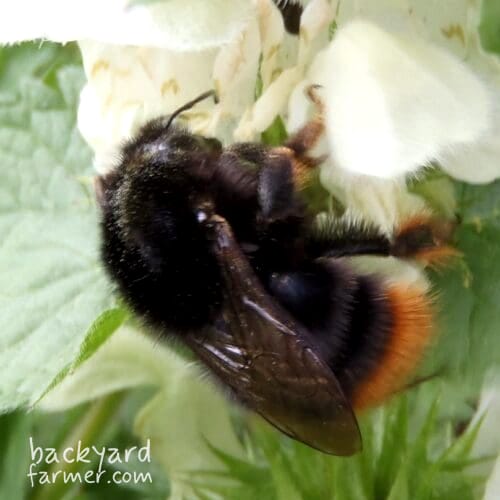
Look for a mostly black or very dark brown bumblebee with an orange-red tail. Compared with the common Red-tailed Bumblebee, it generally appears smaller, rounder and fluffier, with a noticeably longer face.
On females, check the hind legs. Red-shanked Carder queens and workers have orange-red hairs around the edge of the pollen basket. Red-tailed Bumblebee females have black hairs in the same position.
Tail colour can help, but it is not conclusive. The Red-shanked Carder’s tail is usually more orange-red than the deeper crimson tail of a fresh Red-tailed Bumblebee. Both species can fade as they age, sometimes becoming yellowish or cream at the tail.
Queen Red-shanked Carder Bumblebee
Queens average around 17mm long. They have a black or very dark brown body, an orange-red tail, clear wings and relatively fluffy hair. Compared with a Red-tailed Bumblebee queen, they are normally smaller and rounder, with a longer face.
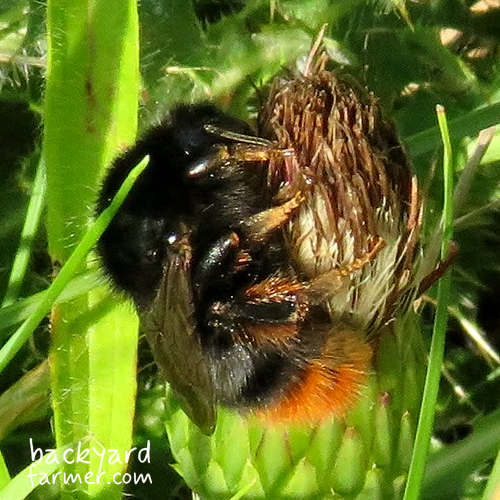
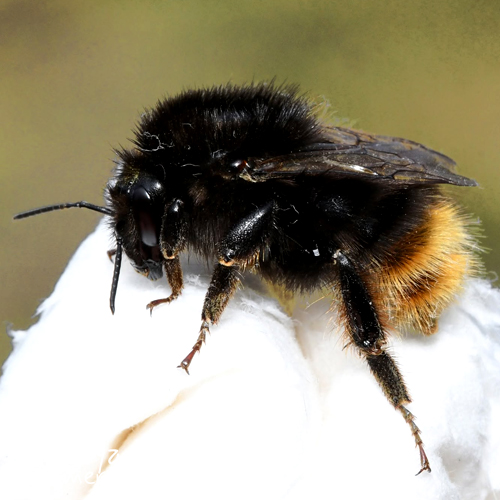
Look for the orange-red hairs fringing the hind-leg pollen basket. This is much more dependable than judging the bee by size or tail shade.
Female Worker Red-shanked Carder Bumblebee
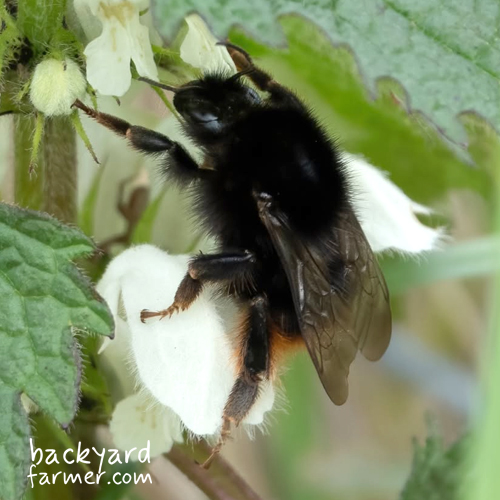
Workers average around 15mm and resemble smaller queens. They have the same black body, orange-red tail and reddish pollen-basket fringe.
Their size and fluffiness can overlap with Red-tailed Bumblebee workers, while age and sunlight can alter the apparent tail colour. If the leg fringe cannot be seen, it is usually better to leave the identification uncertain.
Male Red-shanked Carder Bumblebee
Males average around 13mm and have longer antennae, black facial hair and hairy hind legs without a pollen basket. Most show a faint greyish-yellow collar and weak pale band across the front of the abdomen, but these markings can be stronger or almost absent.
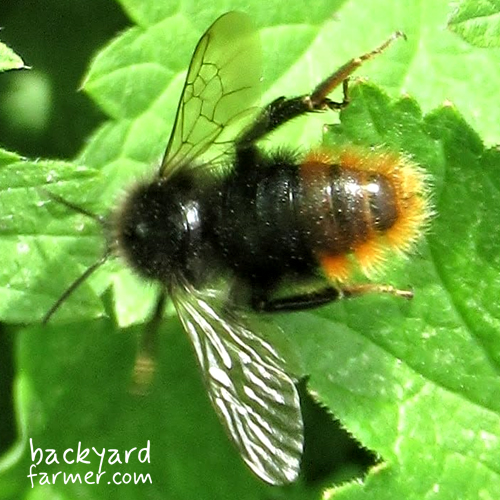
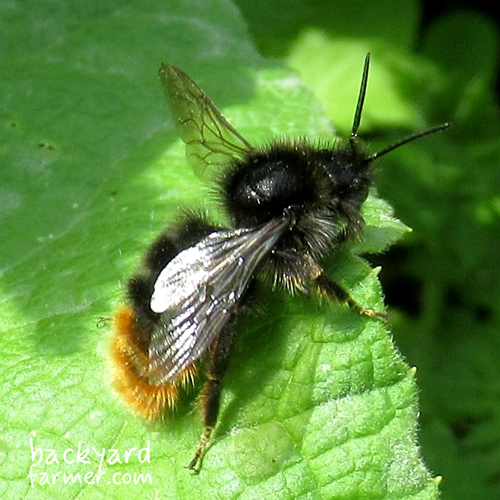
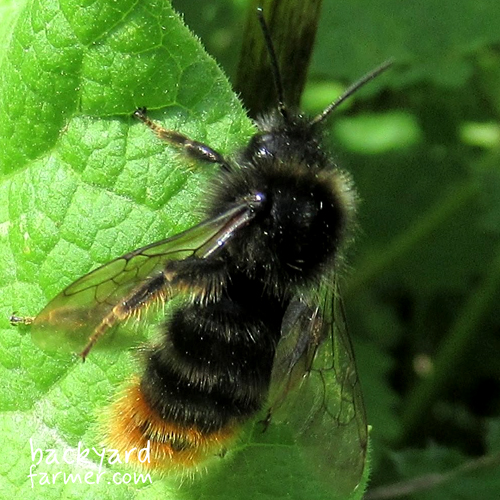
Reddish hair on the hind legs is not diagnostic because male Red-tailed Bumblebees can show it too. Some males also require expert examination to separate from Red-tailed Cuckoo Bumblebees.
Identification and Key Facts
| Attribute | Details |
|---|---|
| Common name | Red-shanked Carder Bumblebee |
| Scientific name | Bombus ruderarius |
| Approximate size | Queens 17mm, workers 15mm, males 13mm |
| UK status | Scarce, strongly declined and a Section 41 priority species in England |
| Active period | Usually April to August, occasionally into early September |
| British distribution | Localised in southern England and Wales; isolated populations on Coll and Tiree |
| Habitat | Flower-rich grassland, meadows, old quarries, coastal grassland and dunes |
| Nesting behaviour | On or slightly below the ground among long vegetation |
| Colony size | Usually around 20-100 workers |
| Key identification feature | Black body, orange-red tail and reddish pollen-basket fringe on females |
| Useful flowers | Ground ivy, dead-nettles, red clover, vetches, bird’s-foot trefoil, knapweed, bramble and thistles |
Exact body length varies and should not be used as a deciding feature.
Similar Species
The Red-shanked Carder Bumblebee is most likely to be confused with other black-bodied, red-tailed bumblebees.
Red-tailed Bumblebee (Bombus lapidarius)
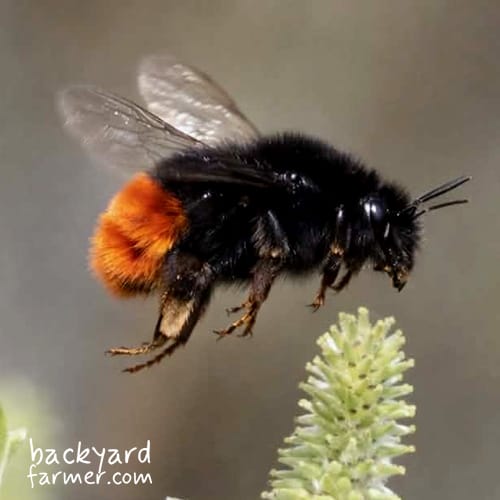
This is the main lookalike and is much more common and widespread. Queens are usually larger and more rectangular, with dense velvety-black hair and a deeper crimson tail.
Female Red-tailed Bumblebees have black hairs around the pollen basket, rather than the orange-red fringe found on Red-shanked Carders. Males usually have conspicuous yellow facial hair, while Red-shanked Carder males have black faces.
Red-tailed Cuckoo Bumblebee (Bombus rupestris)
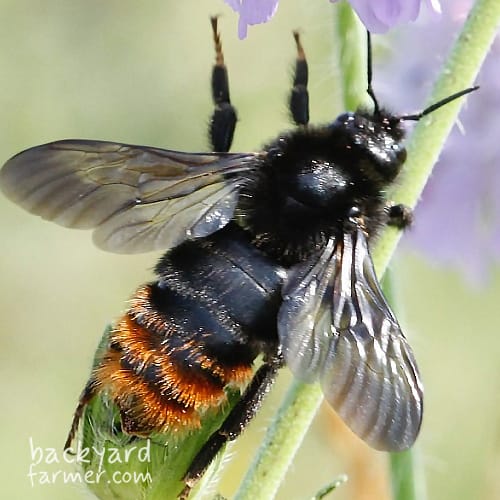
Females are generally larger and slimmer, with dark wings and sparser hair that allows the shiny body surface to show through. As a cuckoo bumblebee, the female has no pollen basket and does not collect pollen.
Males can be very difficult to distinguish from Red-shanked Carder males. A photograph may not show enough detail for a safe identification.
Early Bumblebee (Bombus pratorum)
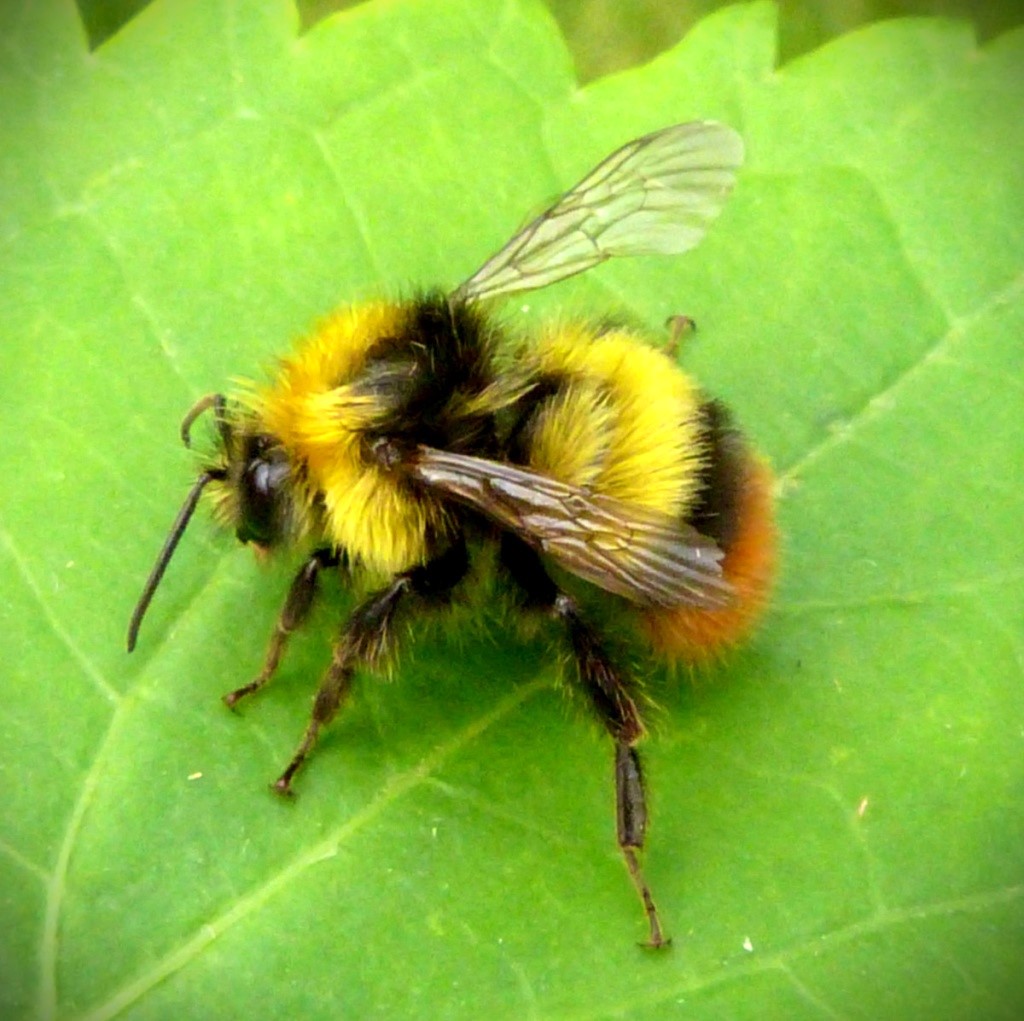
The Early Bumblebee is also small and has an orange-red tail, but it normally has clear yellow bands on the thorax. Males usually show yellow facial hair and additional yellow on the body.
Bilberry Bumblebee (Bombus monticola)
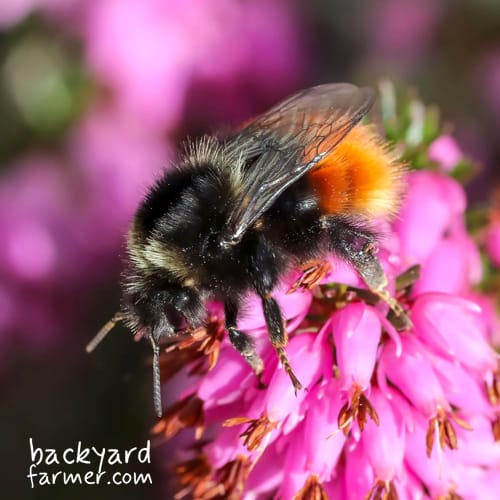
The Bilberry Bumblebee has yellow thoracic bands and much more extensive red hair across the abdomen. It is mainly associated with upland heath and moorland where bilberry and related plants grow.
For more help separating UK species, see our complete Bee Identification Guide.
Where Is the Red-shanked Carder Bumblebee Found?
This was once a much more widespread species, but its British range has contracted substantially. Current populations are concentrated in parts of southern England and Wales, with separate Scottish populations on Coll and Tiree. It is considered regionally extinct in Northern Ireland.
The species is most closely associated with large, connected areas of flower-rich grassland. Suitable locations include traditional meadows, lightly managed coastal grassland, dunes, old quarries, brownfield sites and other open ground with plentiful flowers.
Queens may turn up away from an established colony while searching for food or a nest site. Repeated worker sightings are stronger evidence that the species is nesting nearby.
Lifecycle, Nesting and Flowers
Mated queens emerge from hibernation from April, with occasional earlier records in mild weather. Workers normally appear around six weeks after a queen establishes her nest.
Nests are usually built on the surface or just below ground among long grass. The queen cards together moss, dry grass and other soft plant material, sometimes using an old mouse nest as a foundation.
Colonies generally contain 20-100 workers. Males and new queens are produced in late July and August, after which the colony breaks down and newly mated queens find somewhere to hibernate.
The species has a medium-length tongue and visits:
- Spring: ground ivy, white dead-nettle, red dead-nettle and sallows
- Early summer: red clover, vetches, kidney vetch and bird’s-foot trefoil
- Later summer: knapweed, bramble, scabious and thistles
A nesting colony needs suitable flowers from spring until new queens and males are produced in late summer.
Why the Red-shanked Carder Bumblebee Matters
The Red-shanked Carder Bumblebee has undergone a major decline as flower-rich grassland has been lost, degraded or divided into isolated fragments. Remaining populations can depend on relatively small areas of suitable habitat, making insensitive mowing, development or changes in land management particularly damaging.
It is listed as a species of principal importance under Section 41 of the Natural Environment and Rural Communities Act in England. Protecting it also benefits many other pollinators that require varied flowers and undisturbed grassland.
How You Can Help
If you live within its current range, the most useful actions are those that provide flowers and undisturbed nesting habitat throughout the season:
- Grow red clover, vetches, bird’s-foot trefoil, knapweed and other pollen-rich flowers
- Leave areas of long grass, tussocks, moss and dry plant material undisturbed
- Avoid cutting all meadow or grassland vegetation at the same time
- Remove grass cuttings after an autumn meadow cut to prevent the soil becoming too fertile
- Avoid insecticides and herbicides where possible
- Do not mow or disturb an active nest; wait until activity has naturally finished
A single garden cannot replace a connected grassland landscape, but gardens, allotments, road verges and field margins can all provide useful stepping stones between larger habitats.
Think You Have Found One?
Take several photographs without handling the bee. Try to capture:
- The complete colour pattern from above
- A side view showing the hind leg and pollen basket
- The face and antennae
- The tail and wings
Record the date, location and flower being visited. Suspected sightings can be submitted to iRecord, where supporting photographs allow an expert to assess the identification.
Do not be discouraged if a worker or male cannot be confirmed from photographs. These are genuinely difficult bees to identify, and leaving an uncertain record unassigned is better than forcing it into the wrong species.