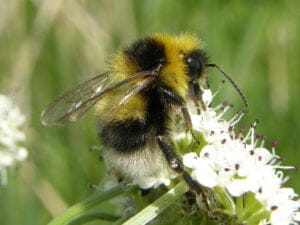

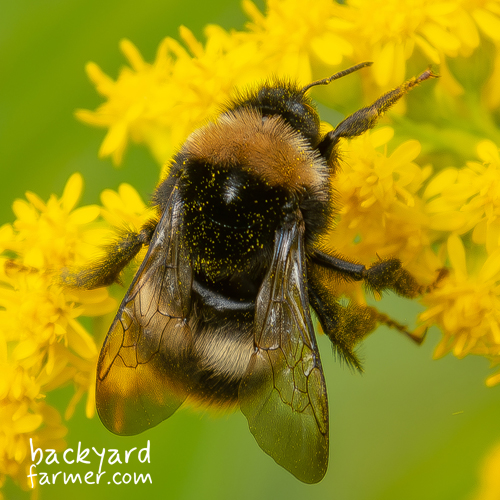
The Broken-belted Bumblebee (Bombus soroeensis) is a scarce British species, found mainly in north and west Scotland, with scattered populations in parts of England and Wales. It is a relatively small bumblebee with the familiar black, yellow and white pattern shared by several common species, making it easy to misidentify.
It is most often confused with the White-tailed Bumblebee (Bombus lucorum). Despite its name, the “broken belt” is not a reliable identification feature on its own. Here’s how to identify it.
If you have confirmed photos of female, male and queen Broken Belted Bumblebees (in the UK) and are open to me using them for this guide, please email me at admin at backyard-farmer dot com.
How to Identify a Broken-belted Bumblebee in the UK
This is a small, neat bumblebee with a black body, yellow collar on the thorax, yellow abdominal band, and a white tail. Some individuals also show soft peach or orange hairs just before the tail, which can support identification.
The abdominal band is variable: it may appear slightly curved at the sides and sometimes interrupted, but this is inconsistent and not diagnostic.
Overall, it is a smaller, more delicate-looking species than many common garden bumblebees.
Because several UK species share this pattern, identification should always rely on a combination of features rather than any single mark.
Queen Broken-belted Bumblebee
The queen is the largest caste, though still relatively small compared with many other bumblebee queens. She has a black body, yellow collar, yellow abdominal band, and a white tail. Some individuals show faint peach or orange hairs just above the tail.
Queens emerge from hibernation from around mid-May, depending on conditions.
Worker Broken-belted Bumblebee
Workers are smaller versions of the queen with the same basic pattern. Markings are often less distinct, and the abdominal band may appear more uneven or broken.
Some workers show subtle beige or peach tones near the tail, but this is variable.
Workers are particularly difficult to separate from White-tailed Bumblebees, and many cannot be identified with certainty.
Male Broken-belted Bumblebee
Males are slimmer and often fluffier in appearance. They typically show a broader yellow collar, sometimes extending down the thorax to form a “mane-like” effect.
The head is often yellow-haired, and the abdomen ends in a white tail, sometimes with more obvious orange or peach tones just before the tail.
They appear mainly from mid to late summer.
Identification & Key Facts
| Attribute | Details |
|---|---|
| Common name | Broken-belted Bumblebee |
| Scientific name | Bombus soroeensis |
| Best field clues | Yellow collar, variable yellow abdominal band, white tail, small size |
| Important warning | “Broken belt” alone is unreliable |
| Size | Relatively small |
| Female markings | Yellow collar, yellow band, white tail; occasional peach/orange near tail |
| Male markings | Broad yellow collar, yellow head hairs, white tail |
| Tongue | Short |
| Season | Mid-May to September |
| Habitat | Moorland, heathland, chalk/calcareous grassland |
| Nesting | Underground in old rodent burrows |
| Colony size | ~80–150 workers |
| UK status | Scarce |
| Distribution | Mainly north and west Scotland; scattered England and Wales |
Why the “Broken Belt” Can Be Misleading
The name refers to the yellow abdominal band, which can appear interrupted by black hairs. In Bombus soroeensis, this variation is real but inconsistent: some individuals show a clear band, others a broken or crescent-like one.
This variation means the feature is not reliable for identification on its own.
Other bumblebees can also appear to have a broken band when yellow hairs are worn or missing.
For this reason, the band must always be assessed alongside tail colour, size, habitat, and location.
Broken-belted Bumblebee Nesting Behaviour
This species nests underground, usually in abandoned small mammal burrows such as those of mice or voles. The colony is annual, with all individuals dying off at the end of the season.
Colonies are relatively small, typically around 80–150 workers, though estimates vary.
What Flowers Do Broken-belted Bumblebees Visit?
A short-tongued species, this bumblebee feeds on a wide range of open, accessible flowers, including:
- scabious
- knapweed
- clovers
- bird’s-foot trefoil
- bramble
- heathers
Late-season flowers are especially important in upland habitats. Devil’s-bit scabious can be a key resource where present.
Similar Species
Several common UK bumblebees share a similar black, yellow and white pattern.
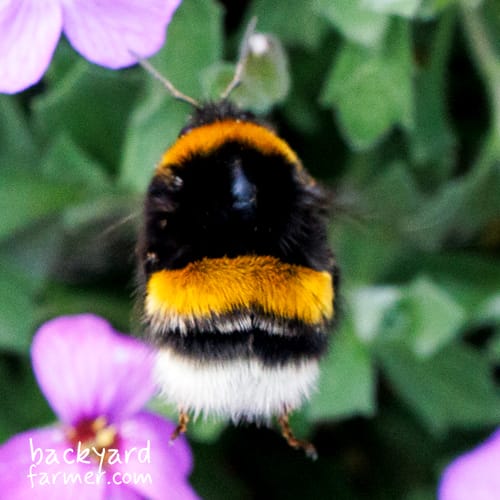
White-tailed Bumblebee (Bombus lucorum): The most important confusion species. It shares almost the same pattern but is often bulkier.
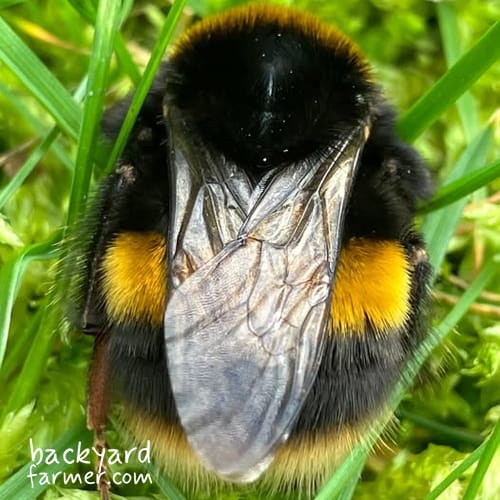
Buff-tailed Bumblebee (Bombus terrestris): Larger and more robust. Queens usually show a clear buff-coloured tail, and the abdominal band is typically more straight and block-like.
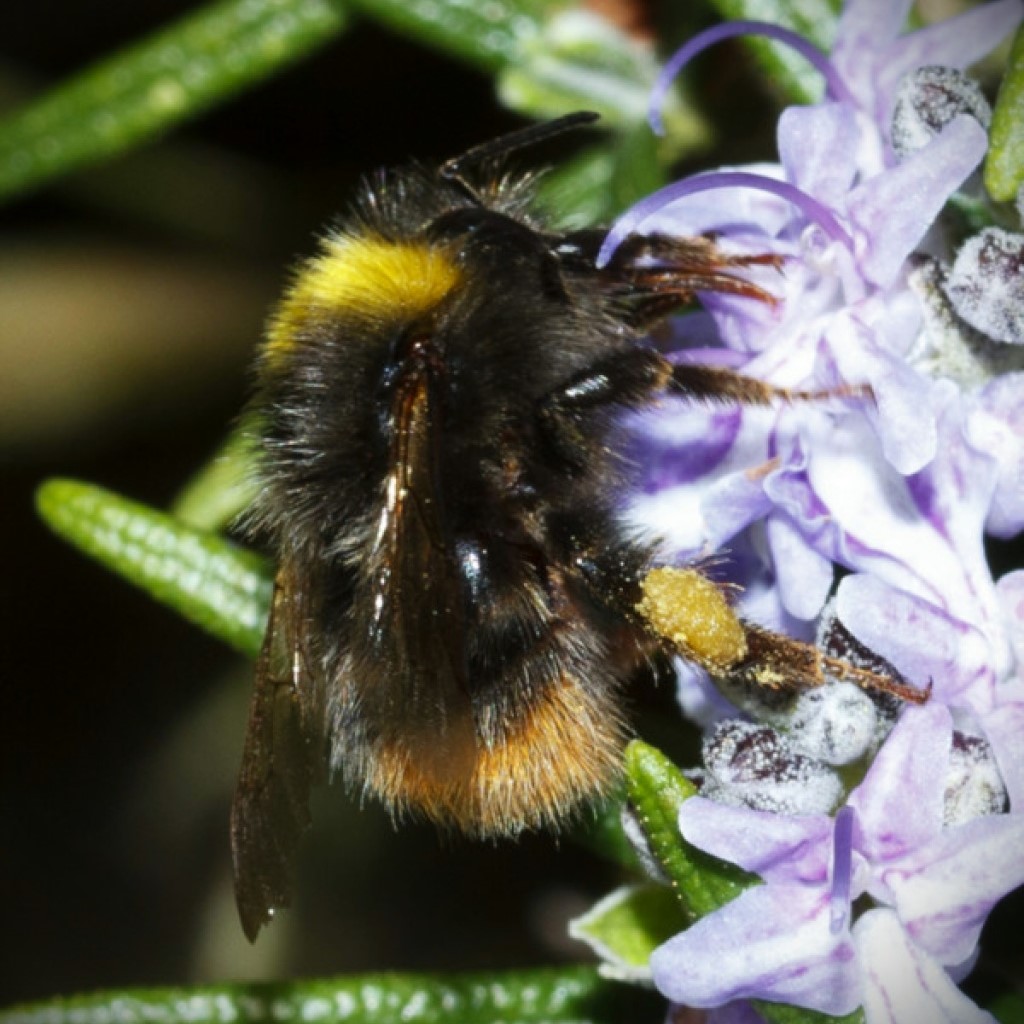
Early Bumblebee (Bombus pratorum): Smaller species with similar yellow markings but easily separated by its distinct orange-red tail.
Where Are Broken-belted Bumblebees Found in the UK?
This is a scarce species, with its main stronghold in north and west Scotland. Outside this area it occurs only in scattered populations across parts of England and Wales.
It is most often associated with:
- moorland
- heathland
- chalk and calcareous grassland
- flower-rich upland habitats
It is not a typical garden species and is generally associated with rural and upland landscapes rather than urban areas.
How You Can Help Broken-belted Bumblebees
The Broken-belted Bumblebee is scarce in Britain, so protecting flower-rich habitat within its range is important.
Useful actions include:
- retaining scabious, knapweed, clovers, bird’s-foot trefoil, bramble and heathers
- protecting species-rich grassland and heath
- avoiding unnecessary cutting while forage plants are flowering
- leaving some undisturbed ground
- reducing pesticide use
Frequently Asked Questions
A small black, yellow and white bumblebee with a yellow collar, yellow abdominal band and white tail. Some show a curved band and faint peach tones near the tail.
No. It is variable and can occur in other species due to worn or missing hairs.
Look for smaller size, possible curved band, peach tones near the tail, and habitat/location—but many individuals cannot be separated confidently.
It is considered scarce in the UK.
Mainly north and west Scotland, with scattered populations in England and Wales.
Typically mid-May to September.
Scabious, knapweed, clovers, bird’s-foot trefoil, bramble and heathers.